FW
India plans to be a technical textile hub
India has the capability to become a hub of technical textiles, geo textiles and manmade fiber.
The country can grow in silk textile export also. For the first time the textile and agriculture ministries have come together to streamline the entire value chain starting from cotton to garment. Branding of Indian textiles is also a focus area, so the global market can acknowledge its capability. The industry is diversifying and focusing on emerging markets.
Currently, 50 per cent of India’s exports are to developed countries. The National Technical Textile Mission is focusing on the emerging sector. At present, the Indian industry is more focused on cotton-based textiles, but manmade fiber and technical textiles also have vast opportunities. The Indian industry will have to scale up its capacity to tap the opportunity created as most global brands are looking for a China Plus One sourcing base.
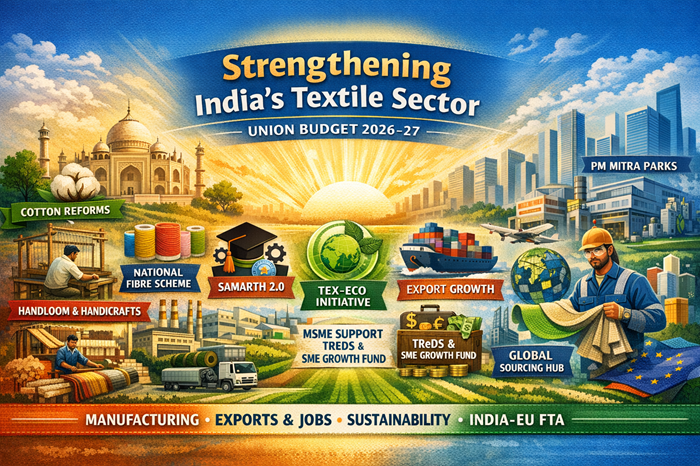
In the post-Covid world, India is the only country that can substitute China for supplies to global brands but has to invest and build up large-scale capacity for grabbing the opportunity. The PM Mitra and PLI schemes are expected to give a big push to scale up production capacity. The PM Mitra scheme plans to build a textile park of at least 1000 acres.
Hemp grows at 33 per cent annually
The hemp market is growing at 33 per cent a year.
Hemp is a fiber. Due to its sustainable aspects, hemp (it has the shortest cultivation cycle and entails minimum water to grow) is attracting companies and its use is increasing. This is driven by hemp’s nutritional and cosmetic qualities. Hemp is seen as a sustainable, organic and regenerative agricultural crop.
Almost everything that can be made with cotton or soy or corn can be made with hemp – with less impact on the earth. Hemp is a weed, so it grows prolifically with little water and no pesticides. It takes up relatively little space, produces more pulp per acre than trees and is biodegradable. Hemp crops even give back by returning nutrients to the soil and sequestering carbon dioxide.Hemp is cultivated for a medley of biodegradable materials including plastic polymers, building products, fabrics, wood, biofuel, paper and even car components.
Every part of the plant can be used. The stalk’s outer bast fiber can make textiles, canvas and rope while its woody core – hurd – is used for paper, construction and animal bedding. The seeds are high in protein, fiber, omega-3 fats and other nutrients. The oil can be used for paints, adhesives, cooking and plastics.
Counterfeiting turns brands from Vietnam to the Philippines
The Philippines hopes to take advantage of the anticipated flight of foreign orders of garments and other apparel from Vietnam due to counterfeiting issues. Buyers from the United States have approached garment producers in the Philippines asking them if they can meet the demand that is normally filled by Vietnamese producers.
Foreign buyers are turned off by the rampant counterfeiting of apparel and other wearables in Vietnam. A raid on a popular shopping district in Vietnam that is a hot spot for copycat goods seized thousands of counterfeit luxury fashion items. Thousands of items were confiscated including, among others, clothes, bags, purses, wallets, eyewear, watches and other fashion accessories. These fake branded products bear the names of popular foreign brands ranging from high-end one such as Hermes, Chanel, Gucci and Louis Vuitton to more affordable household names like Nike and Adidas.
In contrast counterfeiting is not a major problem in the Philippines, where piracy and counterfeiting complaints and reports have declined year on year by 40 percent from January 2022 to November 2022. Prominent e-commerce platforms in the Philippines have signed a memorandum of understanding with several big brand names to combat the sale of fake products online.
Better Cotton event in June’ 23
A Better Cotton conference will be held in the Netherlands, June 21 to 22, 2023.
The conference will help drive Better Cotton’s mission and strategic direction onward while highlighting the work and perspectives of others working on the same issues. Attendees will have the chance to build network with experts and leaders in the industry, and discuss the most important problems in sustainable cotton production, such as livelihoods, regenerative agriculture, traceability, and climate change adaptation and mitigation.
Better Cotton focuses primarily on supporting farmers on the ground. Continuous improvement is a core principle for Better Cotton. Its focus is on helping cotton communities to survive and thrive, while protecting and restoring the environment. It collaborates with businesses and civil society organisations from across the cotton sector, to advance sustainability and encourage demand for Better Cotton among suppliers, manufacturers, retailers and brands.
Working with close to 70 different field-level partners, Better Cotton continues to reach more and more of the world’s cotton-farming communities. Nearly all of them – farmers and farm workers – work on smallholdings less than 20 hectares in size. The initiative helps them enjoy better yields, improved working conditions and greater financial security. Over 2.4 million farmers now have a license to sell their cotton as Better Cotton. In total, Better Cotton has reached almost four million people whose working lives are connected to cotton production.
Demand for secondhand luxury goods grows
The secondhand luxury goods market is growing at nine per cent a year. Secondhand luxury goods represent premium personal products that are purchased by a second or later end-user.
They generally include antique furniture, footwear, apparel, artwork, jewelry, and fashion accessories such as bags and watches. Several luxury goods are usually durable with an extended warranty period, which makes them suitable for the resale market. In line with this, the re-selling of these items instead of discarding them also offers economic benefits to the seller.
As such, secondhand luxury goods assist in minimizing the dependence on high-quality raw materials for manufacturing new products and reducing waste production levels. Furthermore, they are commonly sold at bazaar-style fundraisers, privately-owned consignment shops, auctions, charity events, etc. The escalating demand for high-end fashion accessories at lower prices is primarily augmenting the secondhand luxury goods market. Additionally, the increasing consumer living standards and the inflating disposable income levels are further positively influencing the global market.
Besides this, the easy availability of secondhand luxury goods on online retail channels that are extremely beneficial for the sellers, as they allow firsthand buyers to invest the resale money in buying new full-priced premium products, is acting as another significant growth-inducing factor.
Textile machinery to be certified
Italy has introduced a digital ready certification for textile machinery manufacturers.
The certification is designed to simplify the production process, making use of a standard language and unique data reading system that allows different types of machinery to dialogue with production systems. The certification aims to build customer loyalty while establishing a link between textile machinery manufacturers and their customers. It provides standardisation of machine management and production data and simplifies use.
The international certification body Rina is authorised to issue the certification to associated member companies. A company intending to obtain digital ready certification for its machinery is required to abide by a framework that includes identification of the machine and collection of data, an analysis of all documents and on-the-spot audits and verifications by Rina.
The digital ready itinerary implemented for a manufacturer’s specific machine will lead to certification valid for all machinery of the same production type, for which there will be no need to replicate the procedure. The certification has a duration of five years.
The value of Italian textile machinery sales in 2022 is estimated to be up about ten per cent from 2021. Exports account for more than 85 per cent of this value.
Paramount joins ITMF
Paramount Textiles has joined ITMF as corporate member.
Based in Bangladesh, Paramount Textiles, established in 2006, manufactures a diversified range of dyed yarns and dyed, finished, and printed woven fabrics. In 2021, the company exported more than 60 million dollars worth of merchandise worldwide.
Founded in 1904, ITMF (International Textile Manufacturers Federation) is the international forum of the global textile value chain for producers of fiber to finished products. Its members are from textile and apparel-producing countries representing approximately 90 per cent of global production.In addition, ITMF offers its members information that helps better understand the dynamics of the industry.
Companies from the entire textile value chain see value in being part of a neutral international platform that provides relevant information as well as a unique international network.Meeting old and new friends and colleagues in a relaxed atmosphere outside the regular business environment is helping people better understand the ongoing dynamics in the global textile industry. Meeting persons from the entire textile value chain, from fiber producers to brands/retailers as well as affiliated industries like textile machinery producers, textile chemical producers, etc., provides a wider spectrum of perspectives.
The ITMF Annual Conference 2022 in Switzerland highlighted the importance of discussing emerging trends with experts and colleagues face to face.
Layoffs in Indonesia expected to continue
The wave of layoffs in Indonesia’s textile and footwear industries is expected to continue in 2023.
This is because the demand for export-oriented products is still weak due to the world recession. Since the beginning of the second semester of 2022 there has been a decline in the demand for textile and footwear products in global markets, especially for developed countries.
This condition has forced companies in the sector to significantly reduce production leading to reduced working hours and layoffs. There have been layoffs of 87,236 workers from just 163 companies. In other words, the world economic situation continues to show a negative trend. The projected layoffs remaining until the end of 2022 are very likely to exceed 2021 layoffs due to the global economic crisis that has occurred at the end of 2022.
Indonesia’s textile exports have dropped dramatically after the Russia-Ukraine war. The loss of this export market has made textile companies in Indonesia overstock. Because, on the other hand, the domestic market is not available since it is flooded with imported products. So this condition causes domestic textile products to go nowhere and the impact of which has been that textile companies in Indonesia are experiencing overstock.
Sitip thinks green
Sitip’s sustainability strategy stems from the need to rethink any business field from a green perspective.
The development model is based on innovative technologies that allow the company to obtain benefits in terms of economic, social and environmental sustainability, in order to achieve ever more efficient goals. Sitip has developed a range of sustainable textile fabrics obtained from GRS-certified recycled yarns produced with chemicals with a low environmental impact and with a lower consumption of natural resources.Continuous innovation goes hand in hand with a far-sighted corporate strategy since Sitip makes use of the most recent technologies and the most advanced machinery to allow continuous production and quality updating.
Sitip is a reliable partner within a responsible supply chain. Sitip has voluntarily published its first sustainability report with the aim of giving concreteness and transparency to the commitment supported by the company in the field of sustainability, thanks to constant innovation and cutting-edge technology.
Based in Italy, Sitip has over 60 years of experience, specializing in the production of synthetic warp-knitted fabrics, intended for the technical industrial world, and stretch and circular fabrics, intended for clothing. Sitip’s fabric collections for sportswear, urbanwear and athleisure ensure exceptional performance, impeccable style and attention to sustainability.
India gets going on technical textiles
The Production Linked Incentive (PLI) scheme for textiles will promote the production of manmade fiber apparel, fabrics and products of technical textiles.
An outlay of Rs 1480 crores for the National Technical Textiles Mission has been allocated to promote and develop the technical textile sector in India. India’s share in technical textiles is about six per cent of the world’s market size.
The penetration level of technical textiles is low in India but the annual average growth of the segment is 12 per cent as compared to the four per cent world average growth.With adequate support, Indian exports of technical textiles can grow and achieve their true potential. So says the Synthetic and Rayon Textiles Export Promotion Council. Inclusion of technical textile products under the Interest Equalization Scheme and creating awareness about the capacity of the Indian technical textile sector to supply high quality technical textile products in the world market has also been recommended by the SRTEPC.
The council wants the government to provide enhanced RoDTEP rates for technical textile export promotion for a period of three years. Fixation of SION for technical textile products on a priority basis has also been called for. SRTEPC says inclusion of certain HSN codes of technical textile products under the PLI 2 scheme would go a long way in promoting technical textiles in the country.