FW
Lee and Wrangler combo store in Germany
Lee and Wrangler have opened a dual-concept joint denim store in Germany. The dual-branded retail concept has been created to provide customers with the ultimate denim experience through a carefully curated retail space that brings to life the unique features of each brand.
The store, which is over 1,600 square feet in size, has individual windows and frontages for each company and will always display each brand’s most recent advertising campaigns. Lee Jeans has a luxury archive-driven aesthetic, which also includes a capsule section for its exclusive Lee 101 line. A bold, youthful aesthetic has been employed to capture the essence of Wrangler, the visuals being a combination of brilliant red and indigo blue.
In the store’s main area, customers will be able to find jeans from both companies merchandised by gender and fit categories, along with a variety of clothing options that pair well with the jeans.The store also has fitting rooms aligning with the company’s brand image and a dedicated denim room that displays a larger selection of denim on a seven-shelf stack.
Europe continues to be a key market for expansion for the Lee and Wrangler brands. The plan is to have more such Lee plus Wrangler stores in key retail destinations across Europe in the coming months.
Sorting for Circularity, a new research by fashion for Good on post consumer textiles
A total of 4,94,000 tons of low-value, post-consumer textiles is readily available for fiber-to-fiber recycling in six European countries.
So says a study ‘The Sorting for Circularity undertaken by Fashion for Good. The European countries are Belgium, Germany, Netherlands, Poland, Spain, and United Kingdom. The study was undertaken to explore post-consumer textiles in depth, provide meaningful information on which to base investment decisions, policy developments and next steps towards circularity.
Fashion for Good aims at increasing harmonisation between the sorting and recycling industry, stimulating a recycling market for unwanted textiles that can generate new revenue streams for sorters and unlocking demand for recyclers and brands.Using innovative near infrared technology to determine garment composition, traditionally a task performed manually, the project analysed a total of 21 tons of post-consumer garments.
The findings provide the most comprehensive and representative snapshot of textile waste composition in Europe to date. The results point to promising opportunities for recapturing value while diverting textiles from downcycling and incineration. The results also inform brands of the best circular design practises to adopt, as well as textile collection agencies and organisations to build the necessary infrastructure and better educate and engage consumers on proper sorting and disposal practices. Currently only two per cent of post consumer textiles are diverted to fiber-to-fiber recycling.
EcoVadis awards Lenzing platinum
Lenzing has been awarded platinum status by EcoVadis.
This comprehensive assessment covers the four key practices of corporate social responsibility: the environment, fair working conditions and human rights, ethics and sustainable procurement.
Lenzing has set ambitious targets in each of its core strategic areas, aimed at bolstering its capacity to move from a linear to a circular model. Lenzing reports the corresponding implementation measures and the progress it has made in its annual sustainability report. This high level of accountability and transparency was particularly praised by EcoVadis. The rating provider also highlighted Lenzing’s comprehensive measures to reduce air pollution, wastewater and greenhouse gases, in addition to its provision of skills development training and health care programs for staff members.
Lenzing provides sustainably produced specialty fibersand is a partner of global textile and nonwoven manufacturers and drives many new technological developments. Lenzing’s high-quality fibers form the basis for a variety of textile applications ranging from elegant clothing to versatile denims and high-performance sports clothing. EcoVadis founded in 2007 has become the world’s largest and most trusted provider of sustainability ratings for businesses and has created a global network of more than 90,000 rated companies in over 175 countries around the world. The organization also offers information and tools to enhance transparency in global supply chains.
Reliance Retail poised to challenge international fast fashion giants

Internally nicknamed Regalia, the fast fashion label from Reliance Retail is gearing up to take on international fast fashion brands like Zara and H&M.
In India, fast fashion is the fastest growing segment in the apparel and lifestyle sector, the proof being the enormous success Zara, H&M and other international brands have profited from. Devangshu Dutta, founder of retail consulting firm Third Eyesight said, "International brands have the advantage of a certain cachet, which has allowed them to gain disproportionate visibility, both in terms of share of mind and share of space in prime locations in the larger cities, which has allowed them to grow rapidly. However, the market can certainly accommodate more fashion brands. Reliance will need to not only create a viable product-retail mix but connect with the aspirational aspects in the consumer's mind to compete with the international brands."
Biggest retailer hunts for suitable space, positioning for the new model
Taking on this challenge, Reliance Retail is confident of making its presence felt. It is currently the largest fashion and lifestyle retailer in the country with a network of nearly 4,000 stores across segments from ethnic and value fashion to luxury brands. It also runs Marks & Spencer stores in India and recently partnered with Gap. Additionally, talks are underway with LVMH for its beauty chain Sephora.
The label hasn’t been officially named yet as its brick-and-mortar presence is being finalized. Finishing touches are on at the selected outlets in Mumbai and Gurugram in High Street Phoenix and Airia Mall respectively. Delhi, Hyderabad and Bengaluru are also a part of the initial launch with 20,000 to 30,000 square feet planned for the debut. It has been acknowledged by Reliance Retail that it is finding the availability of large retail spaces at shopping destinations a bit challenging with malls running on full capacity.
The new brand is expected to have mid-premium pricing and will bank on young consumers’ segment. Zudio, the partnership between Tata and Zara has already been launched and will be the direct local competitor. Perhaps Zudio’s success was the inspiration Reliance Retail was looking for. Since the announcement that Reliance Retail was entering the tough FMCG market earlier this year, it is not a surprise that the retail giant would enter the fast fashion market. And why not as the market value of textile and apparel across India in the financial year 2021 was USD 80 billion and this value was estimated to reach USD 190 billion by 2026.
Gold Collar defines India’s new high income group
In the world of fast fashion, India is increasingly a focal point for the industry. A rapidly growing middle class and an increasingly powerful manufacturing sector are two key elements that combined together with strong economic fundamentals and growing tech savvy, make India too important for international brands to ignore. According to Sanjay Kapoor, founder of Genesis Luxury, an Indian luxury retail conglomerate, higher incomes are likely to create a whole new class of consumer: “We are moving on toward the ‘gold collar’ worker. It’s a term that defines the well-paid, highly paid professionals, who are happy to look good, happy to feel good, and are expanding the consumption of today.”
VTG hosts more than 200 companies
Vietnam Textile and Garment (VTG) exhibition was held September 21 to 24, 2022.
The four-day exhibition attracted the participation of more than 200 domestic and overseas businesses from 15 countries and territories worldwide.
It showcased a wide range of products in textile machinery, apparel, fibers, filaments, yarn fabrics, footwear machinery, and materials at 800 booths. It provided an ideal opportunity for Vietnamese textile and garment manufacturers to gain access to advanced technologies and the latest market information, and connect with leading enterprises globally.
A series of seminars were held within the framework of the exhibition, during which speakers shared their expertise.
Since 2001, VTG has been deeply involved in Vietnam’s textile and garment industry, bringing groundbreaking technologies and leading machinery to the local market.VTG is also a bridge between local and international industry players in the post-pandemic period.
Vietnam plays an increasingly large role in the world’s textile and garment value chain, with garment products exported to over 180 countries and territories. Major garment makers are continuing to explore expansion and production opportunities in the country. For the first six months of 2022, Vietnam’s exports of textile and garment products increased by 17 per cent compared to the same period last year.
South Africa wants less of Chinese imports
South African clothing retailers are moving away from imports from China.
The South African flag is increasingly decorating labels on garments at major retail chains across the country. It’s an effort to bolster the country’s clothing and textile sector. As of now more than half of the textiles sold by South African retailers are imported from abroad, and nearly 60 per cent of those imports come from China.
But now domestic production is seen as a way of actually responding to what the customer needs and more efficiently. The shift is now gaining momentum on the heels of global trade disruptions due to the coronavirus pandemic as well as record unemployment. Domestic production will mean more jobs. South Africa has a target of 1,21,000 new textile jobs by 2030 and 60 per cent of all textile goods sourced locally in the next five years.
But this will require investment in skills training and support for entrepreneurs.Regular power cuts and decaying railways are impeding local manufacturers from producing and transporting goods. And there are other practical barriers to closing the trade imbalance between China and South Africa. China has economies of scale and South Africa as compared to China is a relatively small country.
Ganni gets B Corp status
Ganni, a ready-to-wear fashion brand, has achieved B Corp status. The Danish women’s wear label scored 90.6 points while B Corp certification requires a B Impact assessment score of over 80 points.
Ganni successfully answered over 300 questions pertaining to its governance, workers, customers, environment and community. Thanks to its efforts towards using certified organic, lower-impact and recycled fibers, the women’swear brand received 90.6 points.
The NGO B Corp was founded in 2006. There are over 4000 certified B Corporations in more than 77 countries today. All of them are united by the same goal to reconcile profit maximization with a social mission on their journey towards a responsible, environmentally sustainable and socially fair future for business. They aim at meeting the highest standards of social and environmental performance, public transparency and accountability in order to balance profit with purpose.They operate at the very top of their class, excel in creating a positive impact for their stakeholders, including their workers, communities, customers and the environment.B Corp offers a tangible and transparent framework for keeping businesses accountable and setting industry benchmarks.
Founded in 2000, Ganni has 27 stores across Europe and the US, and is available via 400 wholesalers worldwide.
Indonesia to join RCEP
Indonesia is set to join the Regional Comprehensive Economic Partnership (RCEP).
This is the world’s largest free trade agreement.While Indonesian exports will benefit from the reduction in tariffs between RCEP members, the country’s downstream industries are also well poised to receive greater investments. Supported by an abundance of natural resources, Indonesia is actively seeking to climb up the global value chain – transitioning from an exporter of raw commodities to a producer of high-value products.
The RCEP presents an opportunity for Indonesia to better integrate into regional value chains and attract investments into its industries, especially manufacturing, which accounts for 20 percent of GDP. Indonesia aims at becoming a manufacturing hub. Indonesia’s main areas of production are textiles and garments, electronics, automotive, footwear, food and beverages, and chemicals. The country’s trade-to-GDP ratio is 40 percent, lower than the global average of 55 to 60 percent, highlighting that Indonesia is poorly integrated with global supply and value chains.
However, with RCEP set to eliminate 92 percent of tariffs on goods traded among its 15 members, Indonesia fears that this could trigger an influx of imported goods and thus impact the competitiveness of local businesses, particularly micro and small medium enterprises.
Brioni offers women’s wear
Men’s wear brand Brioni is set to venture into women’s wear. The brand’s aim is to offer a range of models in the same couture style of Brioni’s menswear, but in women’s sizes and fits, in a spirit of timeless beauty, sophisticated simplicity, unparalleled freedom and lightness, combined with top-notch fabrics and details. So for instance Brioni offers a white suit, a turtleneck sweater under a cashmere coat, a shirt and satin evening trousers, matched with a dinner jacket.
Founded in 1945, this Italian luxury house specialises in sartorial ready-to-wear, leather goods, shoes, eyewear and fragrance, and provides a tailor-made service.
All products are made in Italy and meticulously handcrafted by expert artisans. The house is revered for its personalised bespoke approach. Its product range comprises all categories of men’s apparel and accessories, including shoes, leather goods, jewelry, eyewear and fragrances.
Brioni has the potential to redefine its position as a unique luxury brand. The house’s philosophy is based on a pioneering approach to menswear. Suits of this high-end Italian brand retail in the thousands of euros. The brand has a distinct identity, and is known for its sartorial values and pioneering heritage. Brioni is a part of the French luxury group Kering.
Bangladesh eyes technical textiles to meet 100bn export target
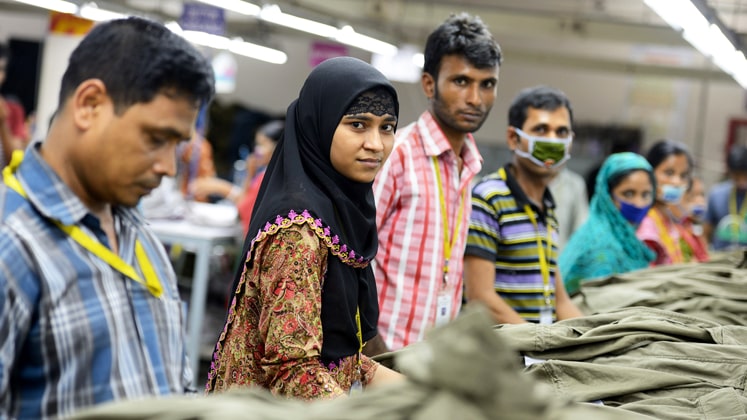
Second only to China, Bangladesh carved out an awe-inspiring success story in the global RMG supply. Exports worth USD 42 billion last year contributed to an 83% of its total export volume. Whilst the RMG sector in Bangladesh continues its growth, the two-year long pandemic and the drop in demand for RMG imports from the West thereafter created an economic crisis for the nation. The Bangladesh Garment Manufacturers and Exporters Association (BGMEA) have targeted the USD 100 billion mark of export by 2030. After the hit it took in the last two years, Bangladesh is keen to diversify its RMG portfolio.
This is where technical textiles present an opportunity. Futuristic technical textiles used in planes, cars, and firefighters’ uniforms and protective clothes are not what comes to mind in the RMG sector but this category represents a huge potential for Bangladesh’s diversification plan. Textile technology has become increasingly commercially viable and is experiencing rapid increase in demand. Garments made of technical textiles can offer many qualities which traditional garments cannot; they can be antibacterial, insect repellent, flame retardant, odorless and much more, allowing the wearer to reduce risks and bodily harm.
Manufacturers of technical textiles use both natural and manmade raw materials. Manmade materials, which currently account for 40% of total fiber consumption across the entire textile industry, include items like polyester, nylon, acrylic and polypropylene. The global market for technical textile is projected to reach $208.5 billion by 2024 from $178.92 billion in 2020. Its market is assumed to reach $298.1 billion by 2030. Europe represents the largest regional market for technical textiles, accounting for an estimated 28.8% share of the global total.
The Asia Pacific dominated the technical textile market with a share of 45.9% in 2019. China is the largest exporter of technical textile products with a share of 24%. This is followed by USA, Germany and Republic of Korea with a share of 10%, 9%, and 4% respectively. Within the Asia Pacific region, China and India are two leading countries in the technical textile sector. India is the world second largest polyester producer and its market size is USD 19 billion. India has set up a scheme within an average growth rate of 15-20% to increase their domestic market size of technical textiles to USD 40-50 billion at 2024; through market development, technological development, international technical collaborations, marketing and investment promotion.
Bangladesh has a lot of work cut out for it as they venture into the technical textile segment. In 2010, the Bangladeshi technical textiles consumption market value was USD 281.1 million and production value was USD 252.2 million. Whilst the pandemic may have been doom and gloom for Bangladesh’s RMG sector, the silver lining came in the form of technical textiles as demand for gloves, mask, PPE kits, etc. grew. During this production process, Bangladesh realised it lacks the infrastructure, research facilities and skilled labour to compete significantly in the global market. The government of Bangladesh has launched various conduct schemes and policies for technical textile manufacturers to make them globally competitive.