


FW
Sustainability, awareness drive-up demand for secondhand luxury fashion
 Luxury fashion labels have always been reluctant about the resale market. However, the perception is changing now with growing popularity for secondhand luxe goods and focus on sustainable goods. In fact, many luxury brands are partnering resale platforms to increase sales.
Committed to responsible fashion
As per a Refinery29 write up, brands now consider resale integral to maintaining value. They view it as a strong motivator for shoppers to buy luxury goods, says Allison Summer, The RealReale.
ThredUP’s 2020 Resale Report expects the secondhand luxury goods market to grow from $28 billion in 2019 to $64 billion by 2024. Of late, there have been several notable partnerships between companies and designers. For example, designer Victor Glemaud launched its first shoe collection, created in collaboration with Nigerian accessories brand Shekudo, on the The RealReal platform. The luxury resale platform was also home to conceptual fashion label Imitation of Christ’s Spring ‘21 collection. Similarly, designer Christian Siriano altered two dresses from his collection from ThredUp and relaunched them on the runway.
Embracing their own secondhand clothes has become a way for brands to show their commitment to responsible fashion. Most recently, social shopping app partnership app, Depo partnered designer Kenneth Nicholson to launch Division 332-a new collection made from discarded fabrics.
Adopting circularity in fashion
Brands are also embracing secondhand fashion to rid themselves of excess inventory. Sustainable fashion brand Mara Hoffman organized an archive sale in July to release unsold inventory. She has been a strong supporter of secondhand clothing and believes real platform give another life to discarded garments besides extending their lifespan. The designer recently launched an in-house resale platform know as Full Circle Marketplace to buy her own brand’s garments.
The RealReal’s partnership with sustainability trailblazer Stella McCartney in 2018 has encouraged more brands to embrace resale. In October, the resale platform launched an online shop with Gucci to sell a curated selection of secondhand goods from consignors. Like in February, Vestaire launched a buy-back program with Alexander McQueen to enable customers to sell their second luxury items in exchange for store credit. Thus, resale is fast becoming a way to adopt circular fashion, says Steve Dool Head-Brand Partnerships, Depop. As the 2020 Vestiaire Collective X BCG survey reveals, around 62 per cent consumers are more willing to purchase from fashion brands partnering resale platforms.
This popularity is being driven by younger consumers' growing interest in sustainability. In future, more such partnerships are likely to be formed as designers are keen to expand the lifespan of their collections by making clothes that can be resold.
Vietnam’s textile and garment exports to Eurasian Economic Union exceed quota
Last year, Vietnam exported more textile and garment items than those entitled to preferential tariffs in the Eurasian Economic Union under a bilateral free trade agreement.
The Ministry of Industry and Trade recently received a diplomatic note from the Eurasian Economic Commission saying that while the quota for jerseys, pullovers, cardigans, and waistcoats was 1,520 tonne a year, exporters had shipped over 1,640 tonne. Exports of knitted women’s suits also exceeded the quota of 382.7 tonne, with 414.9 tonne being shipped.
According to the safeguard measures incorporated in the agreement, Vietnamese textile-garment exporters will therefore not be entitled to preferential tariffs for a period of six to nine months and instead will have to pay Most Favored Nation import duties.
However, Pham Xuan Hong, Chairman, Chi Minh City Textile and Garment Association, said, its members had not received any warnings from their partners in the EAEU market. Nguyen Ly Truong An, Deputy CEO, Sea Air Global, said some textile companies with factories in Vietnam import products from China and pass them off as made in Vietnam, thus causing export volumes to surge. He urged authorities to take strong action against this.
The Trade Remedies Authority of Vietnam announced a list of 13 other products also likely to face trade origin fraud or illegal transshipment investigations, including plywood made from hardwood, foam cushions and wooden cabinets exported to the U.S., and car tire exports to the US and the EU.
PIM solutions to help retailers become more agile and customer-friendly
 A Forrestor report released in April 2020, predicted global retail industry to have gone through a fundamental shift with sales declining by 9.6 per cent or $3.1 trillion due to the pandemic.
The world also witnessed a sharp drop in consumer spending on fashion, and beauty during the year. Instead of visiting stores, consumers scrolled through social media channels to improve their engagement with apparel and fashion brands. However, brands found it challenging to convert this to actual sales as consumers restrained from discretionary spending.
As per experts, these shifts in consumer spending are likely to persist in a post-pandemic future as consumers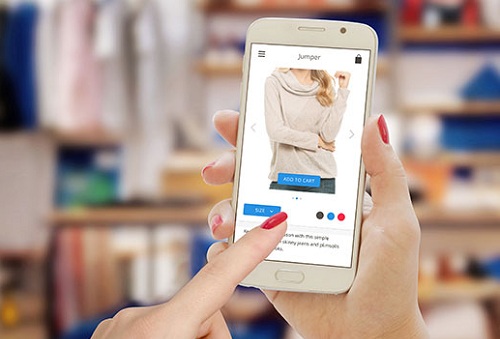 become accustomed to online shopping.
For organized, enriched and channel-neutral information
In 2021, retailers are likely to become more agile as they embrace the omnichannel route for sales. They are likely to adopt the robust product information management (PIM) solution which will provide them with organized, enriched and channel-neutral product information. This will help them extend product delivery across the web, mobile, social media, in-stores, and other third-party channels and engage customers with a seamless omnichannel experience.
By centralizing all product information, a PIM solution will help retailers manage inventory, both for offline and online distribution channels, with ease and accuracy. It will also enable them locate the right products for processing orders, update stock regularly to match sales and return figures, and answer customers’ questions on product availability.
Appealing to shoppers’ preferences through new solutions
Retailers are also likely to incorporate immersive solutions to connect the real and the virtual worlds. They will useinnovative technologies like augmented reality (AR) and virtual reality (VR) to establish an emotional connection with consumers and appeal to their shopping preferences. Implementation of AR/VR in the fashion retail space helps these retailers prioritize customer safety while powering D-to-C channels for highly optimized and immersive buying experiences through in-store navigation, smart mirrors, contactless virtual try-on, and prolific personalization of products.
The PIM solution offers helps retailers to bring content, commerce, and community together to push consistent, high-quality data to various output channel, It helps them align next-generation digital capabilities with the critical security, production prowess, and business agility.
To cater to changing consumer expectations and allay their fears, fashion and retailers plan to offer a contactless or touch-free retail experience. PIM helps them achieve this goal by introducing new omnichannel strategies
Yarn Expo Spring’21 brings innovative yarns, smart recycling technologies
Held from March 17-19, 2021 at the National Exhibition and Convention Center in Shanghai, the 2021 Yarn Expo Spring focused on smart recycling technologies and customization. The meticulously planned expo managed to meet the multi-functional demands of its consumers. Yarn producers attending the expo, deliberated on the current downward spiral of yarn prices.
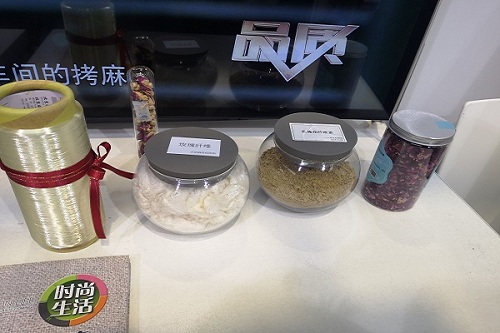
As recycled chemical fiber plants do not have a large inventory currently, they continue to execute previous orders. These plants are waiting for the downstream demand to improve, and prices to stabilize. However, plants manufacturing recycled polyester filament yarn and colored recycled staple fiber, opined,prices of high-end re-PSF are unlikely to improve as they have limited added value.
Participants at the expo expected the market for 3A-grade white flakes to improve as international brands have strengthened their presence in the market. Big polyester plants have also entered the recycled market to fulfill their procurement needs.
Launch of new products
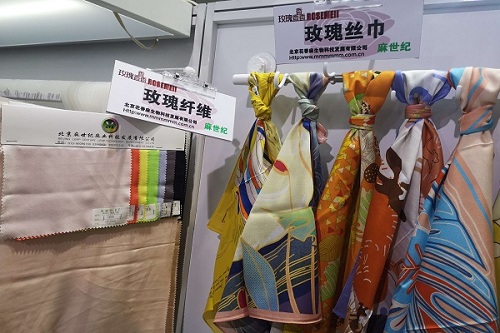
Participants also focused on new products like rose fiber which is made from rose scent and known to be anti-oxidant. The fragrance of this fabric lasts for 5-10 years. The fabric costs over RMB10,000 per piece and its shoulders are cold-proof. The filling content of the double quilt made from this fabric is different for men and women.
Another product launched at this expo included imported goose down which costs more than RMB 800,000 per tonne. A single winter quilt made from this fiber weighs 1,200 grams and costs more than RMB 300,000.
Focus on recycled nylon
In addition to recycled polyester, this year, Yarn Expo also focused on recycled nylon. Currently produced only on orders, high-end recycled nylon fiber is 50 per cent more expensive than the ordinary fibers. The overall output of recycled nylon fibers is less than 20,000-30,000 tons.
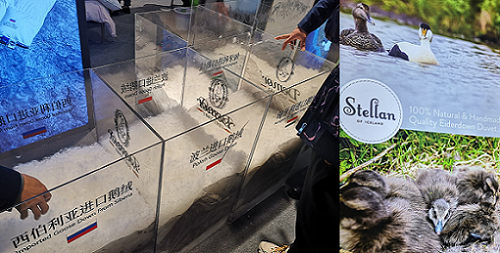
Manufacturers of zippers and webbing in accessories focused on environmental protection concepts. Sustainable products such as recycled fabric, organic cotton, and Tencel fabric were also introduced at the expo.
Future trends
The expo also deliberated on the 14th Five-Year Plan which focuses on six types of consumption; information consumption, digital consumption, green consumption, customized consumption, experiential consumption and fashion consumption. In addition, it also pointed out to the rise of high-end Chinese brands in the fields of cosmetics, garments, home textiles and electronic products.
Nike’s Q3 revenues fall short of expectations
Third quarter revenues of Nike Inc fell short of Wall Street estimates as the brand grappled with supply chain problems in North America and a slump in sales at brick-and-mortar stores shut due to the COVID-19 pandemic.
As per data from Refinite, revenues of the world's largest sportswear maker rose to $10.36 billion from $10.1 billion during the year while analysts had expected them to rise to $11.02 billion.
The brand’s net income climbed to $1.45 billion or 90 cents per share from $847 million, or 53 cents per share, a year earlier. Analysts had expected income to rise to 76 cents per share.
The brand’s revenues in North America fell by 11 per cent on a currency-neutral basis where container shortages and U.S. port congestion held up inventory by more than three weeks and delayed shipments to retailers.
In Europe, the Middle East and the Africa region, 45 per cent of Nike-owned stores were closed for parts of the last two months of the quarter. Currently, 65 percent of stores in EMEA are open or operating on reduced hours,
Govt to increase production of MMF and technical textile products
The government plans to increase production of its 50 man-made fiber and technical textile product categories.
Through the Rs 10,683-crore production-linked incentive (PLI) scheme, India intends to grab a share in this pie. According to the draft PLI program, known as the “Focus Product Incentive Scheme”, India accounted for 4.3 per cent (or $35.5 billion) of global exports of textiles and apparel in 2019 but its share in the man-made fiber segment was much lower at 2.8 per cent ($9.3 billion). In fact, products based on man-made fibers made up for only 26 per cent of India’s exports, compared with almost 5 per cent% in China and 49% in Vietnam.
In fact, India’s exports of products in the 40 apparel categories, which are targeted under the PLI scheme, stood at just $1.1 billion in 2019, against $140 billion globally. Importantly, Bangladesh’s exports of these products were as much as $7.3 billion and Vietnam’s $14.8 billion.
As reported by FE, the PLI scheme for textiles marks a paradigm shift in the government’s decision-making on two counts. First, it earmarks big bucks for big companies, shedding its long and costly bias towards small businesses. Second, it seeks to correct India’s historical policy preference for a cotton-dominated value chain, which is contrary to the global trend. The idea is to reclaim India’s export markets after ceding substantial ground to Bangladesh and Vietnam in recent years.
US’ kidswear imports decline by 9.67% in Jan’21: OTEXA
As per figures revealed by OTEXA, kidswear imports by the US fell by 9.67 per cent in January ’21.
The country imported $ 214.22 million worth of kidswear in the first month of 2021 as compared to $ 237.14 million imported during January ’20, reports Sourcing Journal.
Weight-wise, US’ imports declined by 5.28 per cent on Y-o-Y basis to 11.04 million kg. And, the per kg price of the shipment valued $19.40 in January ’21 as compared to $20.55 in January ’20.
As far as major destinations are concerned, China plunged in value-wise shipment to USA in kidswear segment, while it noted growth in weight-wise exports.
Imports from Bangladesh declined both in values and weight of the kidswear shipment on Y-o-Y basis.
India saw a miniscule decline in value-wise shipment to the US in while weight of its exports also declined marginally by just under 2 per cent.
On the other hand, imports from Vietnamincreased both in values and weight.
Adidas launches first collection in partnership with Preston
Adidas has launched its first collection in partnership with fitness brand Peloton As per Fashion Network, the Adidas x Peloton SS21 collection includes tanks, tights, shorts, hoodies, tees, crewnecks, sports bras, and joggers, available from $30-$85 via the Adidas and Peloton websites and in select Peloton showrooms.
The collection has been created in collaboration with Peloton instructors Ally Love, Robin Arzón and Cody Rigsby. The three instructors were involved in the design process to help develop a co-creation model. Together, the teams worked to produce styles and fits rooted in inclusivity and crafted with quality performance technology for high energy workouts, plus comfort for relaxed recovery days”.
Reflecting the’90s attitude, the collection features bold, neon hues such as ‘Screaming Pink’, and inspirational text graphics”. It is also size-inclusive with a range of sizing from XS-2X and designs spanning men’s, women’s, and unisex.
The marketing campaign for the collection includes a series of on-demand classes, available on the Peloton Bike, Bike+ and the Peloton App starting March 18. A live class celebrating the collection drop will take place on March 25.
Delhi High Court restrains Future Retail’s sale to Reliance Retail
The Delhi High Court has upheld the Singapore's Emergency Arbitrator's (EA) order restraining Future Retail (FRL) from going ahead with its Rs 24,713 crore deal with Reliance Retail to sell its business.
As per Economic Times, Justice J R Midha directed Future Retail to stall the deal and deposit Rs 20 lakh in Prime Minister's Relief Fund for providing COVID-19 vaccines to senior citizens of Below Poverty Line (BPL) category.
The court directed the presence of Biyani and others before it on April 28 besides attaching their properties.
The high court's order came on Amazon's plea seeking direction to order enforcement of the award by Singapore's EA on October 25, 2020, restraining FRL from going ahead with its Rs 24,713 crore deal with Reliance Retail.
Amazon, in its interim plea, has sought to restrain FRL from taking any steps to complete the transaction with entities that are a part of the MukeshDhirubhaiAmbani (MDA) Group.
DTC focus, digital transformation helps Levi Strauss face COVID-19 challenges
Despite facing extraordinary challenges in fiscal year 2020, Levi Strauss & Co kept its focus on operating with a direct-to-consumer first mindset, diversifying its portfolio by driving outsized growth in under-penetrated areas and digitally transforming our business.
Since its inception 168 years ago, Levi Strauss & Co weathered many storms including wars, economic recessions, natural disasters, and the second major global pandemic. From the start of the pandemic, its teams acted quickly to protect its employees, consumers and business, all while positioning ourselves to meet the accelerated changes that will shape the next decade.
Levi Strauss & Co. is an American clothing company known worldwide for its Levi's brand of denim jeans. It was founded in May 1853 when German immigrant Levi Strauss moved from Buttenheim, Bavaria, to San Francisco, California to open a west coast branch of his brothers' New York dry goods business. Although the corporation is registered in Delaware, the company's corporate headquarters is located in Levi's Plaza in San Francisco.











