


FW
India, EU to sign interim trade agreement during May summit
India and the European Union plan to sign an interim trade agreement during the India-EU summit scheduled for May 8 in Portugal. The two sides also plan to sign an investment pact, which would help India attract more interest from investors in the region. Commerce Minister Piyush Goyal and Executive Vice-President and Commissioner for Trade for the EU, Vladis Dombrovskis had urged experts to consider the feasibility of resuming work on trade and investment agreements; new areas of cooperation (regulatory aspects and resilient value chains); as well as enhancing collaboration on WTO reform”.
The two sides had open and constructive exchanges on a broad range of issues with the aim of enhancing EU-India trade and investment relations. Their discussion will help in the preparation of the upcoming EU-India Leaders’ Meeting.’ The decision to hold this meeting was taken during the 15th EU-India Summit held on July 15, 2020. Both sides confirmed their interest in resuming negotiations for ambitious, comprehensive and mutually beneficial trade and investment agreements once their respective approaches and positions are close enough.
The meeting also focused on the various key policy developments and market access issues. The EU side provided an update on the ongoing review of the Generalized Scheme of Preferences, which expires at end of 2023, and on the work towards EU Carbon Border Adjustment Mechanism under the European Green Deal.
US’ denim apparel imports decline 25 per cent in 2020
As per Office of Textiles and Apparels stats, US import of denim apparels declined nearly 25 per cent to $2.8 billion in 2020 compared to $3.73 billion the previous year, as the pandemic severely curbed demand. Suppliers who showed resilienc despite COVID and benefitted from the general flight from China included Bangladesh, whose shipments to the US declined by 3.98 percent to $561.3 million and a 20 percent market share. The same was true of Vietnam, whose imports to the US declined 1.08 per cent to $368.19 million. Imports from Pakistan declined 2.8 percent o $251.41 million. Only Cambodia’s imports increased 13.41 per cent to $143 million.
The only other Top 10 supplier that showed strength was Lesotho, with its shipments dipping 1.79 percent to $56.39 million. Other African countries that continued to demonstrate potential as a denim sourcing alternative were Madagascar, with imports increasing by 10.99 percent to $34.4 million; Ethiopia, gaining 21.37 percent to $22.99 million, and Tanzania, with a 5.48 percent increase to $13.85 million.
EEB urges European Commission to look at business model of RMG, textiles sector
The European Environmental Bureau (EEB) has urged the European Commission to ensure the forthcoming Textile Strategy recognizes pressures and impact linked to clothing, footwear and household textiles in Europe is the result of a business model based on the sale of ever-more new products made from finite virgin resources.
EEB has urged the commission to maintain economic growth in the global textile and clothing industry through the extraction and exploitation of resources, from raw materials to labour. It should also address the textile industry’s growth in material use to protect the life-sustaining earth functions people rely on and to remain within a safe operating space for humanity. Additionally, policymakers should set the textile sector on a path to a fair and sustainable transition.
The EEB states, the Textile Strategy is an opportunity to set an overarching framework that ties together the various new and existing legal instruments affecting a textile product, from production to end-of-life.
These instruments should be based on the principles of absolute resource-use reduction, achieving a toxic-free environment, absolute reduction in climate and environmental impact, and the respect of fundamental human rights, it said.
New recycling technologies, zero fossil fuels to help fashion curtail polyester use
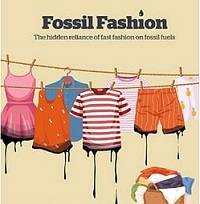 Global fashion industry’s addiction to synthetic fibers has doubled the use of polyester in the last 20 years. As per a Changing Markets Foundation report, polyester will account for 85 per cent of global use of synthetic fibers by 2030. Titled ‘Fossil Fashion: The Hidden Reliance of Fashion on Fossil Fuels’, the report was released in collaboration with the Plastic Soup Foundation, the Clean Clothes Campaign, Zero Waste Alliance Ukraine, No Plastic in my Sea and WeMove.EU. The report attributes the rise in polyester use to anexplosion of cheap, low-quality clothing across the globe. As brands launch almost 20 collections per year and apparel purchases have increased by 60 per cent in the last 15 years, global fashion production is likely to leap to 102 million tons in 2030.
Fast fashion addiction causes 87% loss of clothes
Another reason for the huge rise in fashion production is the addiction to synthetic fashion and its consumption of cheap clothes, which leads to 87 per cent clothes being dumped in landfills.
Dumped clothes often release tiny microfibers that are invisible to the human eye. Non-biodegradable, these microfibers are found everywhere, from the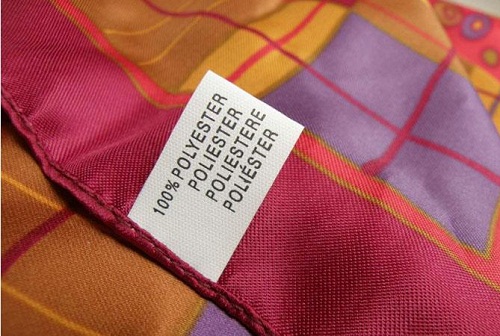 Arctic Ocean to food chains. They are also present in 80 per cent of tap water and are found in the placentas of unborn babies. They are not only harmful for sea creatures but also disrupt human lung development.
A detailed plan to reduce fashion consumption
The fashion industry has failed to reverse the negative effects of microfibers despite launching many green labels and initiatives. Hence, the new textile strategy, to be launched later this year by the European Commission, needs to include a detailed plan to slow down this consumption rate, urges Changing Markets Foundation.
Changing Markets Foundation states, the fashion industry can achieve this by distancing itself from the use of fossil fuels, increasing the quality of materials and being more responsible for the end-of-life of their products. It can also invest in viable fiber to fiber recycling technologies and separate collected, reused, and repaired materials.
To expose irresponsible corporate practices and create a more sustainable economy, Changing Markets Foundation has partnered with non-governmental organizations (NGOs) like the Plastic Soup Foundation, an Amsterdam-based NGO focused on stopping plastic pollution at the source and Zero Waste Alliance Ukraine, a public association that unites Ukrainian zero waste initiatives. An independent and values-based organization, WeMove.EU also aims to transform Europe in the name of community, future generations and the planet while another NGO No Plastic in my Sea aims to tackle plastic pollution in the marine world.
Common shared goals can boost circularity in European fashion industry
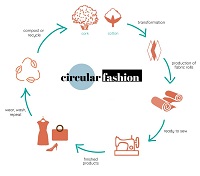 Though experts believe that a circular European apparel industry has the capacity to lessen the impact of textile waste it produces, the idea has not been adopted by mainstream producers. As per a GreenBiz report, the European fashion industry fails to invest in circular projects. According to Conor Hartman, COO and Vice President-Business Development, Circ, very few brands invest in sustainability and technological solutions for a circular economy and support laws for them.
Some fashion companies are slowly incorporating sustainability into their operation, says Lauren Phipps, Senior Analyst, GreenBiz. Prominent amongst them is Levi’s which launched its first resale offering known as SecondHand and H&M launched its first in-store garment-to-garment recycling system known as Loop.
Collaboration between supply chain players
According to Karla Magruder, Founder, Accelerating Ciruclarity, though people across the textile supply chain are individually involved in recycling, they do not necessarily work towards the same goal. If they are made to work together, they can help the industry tackle some of its sustainability challenges.
One of these includes ensuring newly launched recyclable products are actually recycled at their end-of-life and easily made into a new product. Home textiles company Coyuchi ensures this by confirming each of its supply chain links understands their role in the industry.
Boosting circular fashion principals across products
Fashion Technology Company Circ aims to recycle 10 billion garments by 2030. The company produces 100 billion clothing items each year, notes Hartman. Its recent $8million Series A funding round was led by Patagonia and joined by Marubeni America, Card Sound Capital and Alante Capital. The company’s technology can give textile waste made from cotton or polyester or poly-cotton blends, a new life. In 2021, it aims to produce garments across the world using this technology.
France recently banned textile landfilling of unsold inventory by retailers and brands. Hartman believes, if these retailers can be made to work together, they can bring about a great change in the industry. In November last year, the Massachusetts Department of Environmental Protection proposed to ban textiles from disposal in the sale. The European Union also plans to launch a new textile strategy to introduce durable, reusable, repairable, recyclable and energy-efficient products. This will boost fashion companies’ adoption of circular fashion principals across their products.
Global Fashion Agenda launches Circular Fashion Partnership
Global Fashion Agenda has launched the cross-sectorial project Circular Fashion Partnership including the global brands Bershka, Bestseller, C&A, Gina Tricot, Grey State, H&M Group, Kmart Australia, Marks & Spencer, OVS, Pull & Bear, Peak Performance and Target Australia.
The project also includes partners like Reverse Resources, The Bangladesh Garment Manufacturers and Exporters Association (BGMEA) and P4G. It facilitates circular commercial collaborations between major fashion brands, textile and garment manufacturers, and recyclers to develop and implement new systems to capture and direct post-production fashion waste back into the production of new fashion products.
In addition, the partnership seeks to find solutions for the COVID-19 related pile-up of deadstock and to engage regulators and investors around the current barriers and economic opportunities in the country.
Through collaboration among the participants, the partnership aims to build a successful business model for adopting more circular processes. It plans to facilitate a decrease in textile waste and increase the use of recycled fibres, distributing value throughout the fashion value cycle and generating economic benefits in Bangladesh by accelerating the fiber recycling market.
The Woolmark Company launches new digital platform
Taking its Wool Lab online, the Woolmark Company has launched a new platform called the Wool Lab Digital. The new platform for fabric and yarn is dedicated to the innovative essence of the curated sourcing guide, reinventing its offering to meet the needs of the global industry
While the structure and functionality of the digital platform have been adapted, the core of The Wool Lab remains the same. It is freely accessible to everyone in a dedicated area of www.woolmark.com. To access this platform, users need to register and will then be able to go through the guide and choose a selection of wool fabrics and yarns in which they’re interested. They will immediately receive an email with the details of their chosen swatches along with the contact information of the applicable manufacturers that the user can contact to request samples.
The Wool Lab Digital will present four macro-trends and will suggest fabric innovations that are most suitable. Two of the macro-trends will be released on the platform in February, with the other two coming in May. The first two are In Motion, which is dedicated to clothing for people who are always on the move, whether for work or leisure; and Hybrid, dedicated to hybridization in all its facets.
India’s wool exports reach $181.23 million in 2019-20
In 2019-20, export of woollen yarn, fabrics, made ups etc. reached $181.23 million. As per India Brand Equity Foundation report, export of woollen yarn, fabrics, made ups etc. export between April 2020 to October 2020 was $ 56.51 and for the month of October 2020 it was $9.83 million. The export of raw wool valued accounted for 2020 US$ 80,000 from April to October 2020.
US and EU are key export destinations for Indian wool and wool-blended products. Indian exporters are geographically diversifying their exports to other regions such as the Middle East, Latin America, South East Asia, and East Asia to increase their footprint globally.
Major importers of woollen yarn, fabrics and made-ups in FY19 were China, Italy, Japan Korea, UK and US.
India is the ninth-largest producer of wool in the world with a global production share of nearly 2 per cent. India’s wool consumption is expected to reach 260 million kgs by 2019-20. The wool industry is concentrated in Punjab, Haryana, Rajasthan, Uttar Pradesh, Maharashtra and Gujarat. Punjab accounts for about 35 percent of the wool production units in India, followed by Maharashtra and Rajasthan.
COVID-19 driving the growth of value apparel market: GlobalData
A new report from GlobalData says the economic uncertainty risen in the wake of the pandemic is driving consumers to seek value for money with Asia emerging as the new epicenter of the value apparel market by 2024. As per Business of Fashion, the APAC region will account for nearly 50 per cent of worldwide value apparel sales within the next years. Against this, Europe will account for 26 per cent, the Americas’ 22 per cent and the Middle East and Africa’s 3 per cent. Between 2019 and 2024, value apparel sales are set to grow worldwide by $42.2 billion.
While China will continue to be the largest apparel market in terms of sales by 2024 India will become the third largest and fastest growing value apparel market surpassing UK. In 2019, China was the largest value apparel market in terms of sales followed by the US and the UK.
COVID-19 leads to sharp decline in apparel imports by the US: OTEXA
As per an OTEXA report, the global pandemic led to a 23.46 per cent decline in US’ apparel imports in 2020. The largest apparel supplier to the US, China noted a 39.16 per cent decline in its apparel shipments during the year. China’s market share declined to 23.65 per cent from 29.68 percent a year earlier and 33 per cent in 2018.
Shipments by other suppliers, Cambodia, Pakistan and Vietnam showed considerable growth during the past year and are likely to continue, along with Bangladesh, India and Indonesia, said Julia Hughes, President, United States Fashion Industry Association in a Sourcing Journal report.
Among the other top tier countries, Vietnam countered tariff threats by the Trump administration as did Cambodia whose apparel imports increased during the pandemic. While Vietnam’s shipments fell by 7.25 percent to $12.57 billion its market share rose to 19.62 from 16.18 percent in 2019. Imports from Bangladesh declined 11.73 per cent to $5.23 billion last year.
Cambodia was the only supplier whose shipments increased by 5.45 percent to $2.82 billion. Imports from Indonesia fell by 20.09 percent to $3.52 billion for the year, while India’s shipments declined by 25.58 percent to $3.02 billion and Pakistan’s dipped by 4.17 percent to $1.4 billion.











