FW
Hugo Boss restricts Q1sales decline to 10 per cent
Hugo Boss managed to restrict sales decline to 10 per cent in the first quarter of the current financial year. The group also recorded positive EBIT of €1 million during the quarter. It was helped by the ongoing strong dynamic in mainland China which also led to its online business surging by 72 per cent. However, retail sales declined 14 per cent in Q1, although wholesale rose 1 per cent (both currency-adjusted). The wholesale channel benefited from a “robust” order intake for the SS21 collections of Boss and Hugo. While Boss and Hugo posted currency-adjusted sales declines of 8 per cent and 6 percent, respectively, their casualwear sales returned to mid-single digit growth.
Currency-adjusted sales in Europe decreased 17 per cent to €299 million. The company closed almost half of its shops during the first three months of the year. Weakness in several key markets, including the UK, France and Germany, added to its weak performance.
Sequential improvements in important US business, as well as a robust performance in wholesale, boosted sales during the quarter. American currency-adjusted sales declined by only 11 per cent at €80 million as consumer sentiment rebounded. The robust demand for its product in China helped drive sales in Asia-Pacific by 39 per cent to €101 million.
India’s cotton yarn exports increase by 2.32 per cent in February’21
After 10 per cent fall during January ’21, India’s cotton yarn exports increased by 2.32 per cent on Y-o-Y basis in February ’21, says Ministry of Commerce and Industry stats. In February ’21, India exported cotton yarn worth $266.70 million as against $260.60 million exported in February ’20. As per Apparel Resources, most of this yarn was exported to China and Bangladesh.
China increased yarn sourcing from India during February’21 while Bangladesh noted a steep decline in its imports. Bangladesh’s imports declined by 18.80 per cent on yearly basis to $59.94 million while China’s imports increased by 92.07 per cent to $81.28 million.
As per SIMA, India’s cotton yarn exports peaked in 2013-14 with 1,313.43 million kg. During 2019-20, exports fell to 959 million kg, primarily because of absence of incentives, which were given to the sector earlier.
Euratex urges for more consistency in EU policies
Welcoming the revised EU industry Strategy, Dirk Vantyghem, Director General, Euratex urged for more consistency by the EU across different policies. There is a need to establish global rules to ensure fair competition, and ensure these rules are properly implemented and controlled, Vantyghem said. He also welcomed the proposal to address distortions caused by foreign subsidies in the Single Market. The industry has an opportunity to build a new business model based on innovation, quality, sustainability and fairness, he added.
Euratex works towards creating a favorable environment within the European Union for design, development, manufacture and marketing of textile and clothing products. It focuses on developing an ambitious industrial policy, effective research, innovation and skills development, free and fair trade and sustainable supply chains along with with EU institutions and other European and international stakeholders.
Debenhams to permanently shut all stores by May 15
Pushed over the edge by COVID-19 lockdowns, British department store Debenhams plans to permanently close remaining stores by May 15. The retailer has already closed 52 store closures by May 8. May 15 closures will include stores in Belfast, Birmingham, Bristol, Manchester, Liverpool, Newcastle and Swansea Since entering liquidation process in December, Debenhams has been holding closing down sales, offering up to 80 per cent discount on fashion and homeware.
Though it will shut physical stores in the UK, its online operations will continue under the administration of online fashion retailer Boohoo. Debenhams was founded in 1778 as a single store in London and grew to 178 locations across those countries, also owning the Danish department store chain Magasin du Nord. In its final years, its headquarters were within the premises of its flagship store in Oxford Street, London. The range of goods sold includes clothing, household items, and furniture.
Adidas to auction Reebok to prevent political backlash
Sportswear maker Adidas plans to auction its Reebok to prevent it from being affected by a political row over possible forced labor in China's western Xinjiang region. As per Fashion Network, Adidas bought the US fitness label in 2016 to compete with arch-rival Nike. However, its sluggish performance is compelling Adidas to sell the brand for around €1 billion ($1.2 billion). Adidas expects China’s Anta Sports and Li Ning to bid for the brand in the first round. It also hopes to attract financial investors including TPG, Sycamore, Cerberus and Apollo.
However, Chinese buyers may not be interested in this proposal due to consumer’s boycott of Western fashion brands in the country over comments they did not use cotton sourced from Xinjiang. In April, Shanghai Half Marathon scrapped plans to provide runners with Adidas-branded T-shirts.
Adidas is marketing Reebok off 2025 earnings before interest, tax, depreciation and amortization (EBITDA) of more than €200 million with expected annual revenue growth of 10 per cent. The brand’s recent collaborations with celebrities like Cardi B and a refreshed focus on women's apparel have put the brand in a better place.
Cambodia’s Q1 garment exports decline
Cambodia exports of garments, footwear and travel goods declined 6.48 per cent to $2.410 billion during the first quarter of this year, shows data from the General Department of Customs and Excise of Cambodia. Garment exports 6.43 per cent to $1.775 billion while footwear slumped 7.33 per cent to $316 million, and travel goods – including suitcases, backpacks, handbags and wallets – declined by 5.89 per cent to $319 million.
As per Ly Khunthay, President, Cambodia Footwear Association, the ongoing global COVID-19 epidemic has shut down the tourism sector of each country, resulting in plummeting demand for footwear. He hoped vaccination campaigns around the world, coupled with gradual reopening of tourism in major countries would lead to increased orders of Cambodian-made footwear in the second half of 2021.
Sin Chanthy, President, Cambodia Logistics Association (CLA) says, a shortage of empty shipping containers has increased the costs of transporting goods abroad from Cambodia since the second quarter of 2020. This is affecting all orders, especially to distant destinations such as the US and Europe, he added. In 2020, Cambodia exports increased by 16.72 per cent to $17.21537 from $14.74874 billion in 2019, said the Ministry of Commerce in its 2020 annual performance report.
Garment exports declined by 10.24 per cent to $7.42028 billion while footwear exports declined by 11.69 per cent to $1.11673 billion and travel goods exports declined by 10.58 per cent to $964.7 million.
Highlighting achievements will help remove stigma around Bangladesh apparel industry
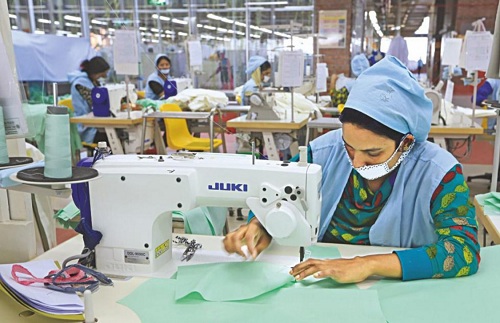
Bangladesh is regularly criticized for poor working conditions in its apparel factories, rising pollution, water wastage, etc. However, for several years, Bangladesh has supported apparel factories through the Accord and Alliance for Bangladesh Worker Safety agreement. The country has also carried out major remediation works costing tens of millions of US dollars, and also rolled out key safety features across the industry, reports Daily Star. It has been ranked second in the recent ‘Ethical Manufacturing Survey’ by QIMA and Just Style. Bangladesh scored 7.7 points in this survey while winner Taiwan scored 8.0. Vietnam ranked third followed by Thailand, Pakistan, Turkey, China, India and Brazil, respectively.
Labor issues in apparel factories
Bangladesh is also perpetually in the eye of storm due to labor issues in its garment factories. However, most of these issues are blown out of proportion and the industry has made significant improvements over the past few years. Bangladesh successfully eliminated child labor from apparel industry with ILO’s help. It increased workers’ wages and ensured their rights protection. However, mis-portrayal in the social media demeans the concerted efforts made by the manufacturers, buyers and the government to transform it.
Media’s responsibility
The Daily Star report states, media needs to refrain from making sweeping comments and publishing fake news that defame the country. On the contrary, it needs to highlight the country’s achievements in promoting safety and sustainability in its apparel sector. This will help it attract more investors in future.
Slow apparel, textile recovery calls for patience from industry leaders
 The first quarter of this year is proving to be a boom for China’s textile and apparel industry with exports increasing 43.8 per cent to reach $65.1 billion, reveals China Customs Statistics Express statistics. As per China Textile, though China reduced its export projection for the year due to the pandemic, apparel exports have registered strong growth owning to robust demand in markets such as the United States.
Apparel exports grow 42.1 per cent
Compared to March 2020, China’s apparel exports grew by 42.1 per cent to reach $9.25 billion in March 2021. However, compared to March 2019, this growth was restricted to 6.8 per cent. In the first two months of this year, China’s apparel exports to the US surged 35.3 per cent. Its market share rose nearly 7 percentage points year-on-year to 29.8 percent. Similarly, China’s apparel exports to Japan also increased by 22.3 per cent.
Textile export growth rate declines
Since March last year, China’s textile exports too have increased significantly; though the growth rate is lower than apparel exports. Textile exports have increased by 40.3 per cent year-on-year, however, their growth rate has declined to 8.4 per cent due to a decrease in international demand. These exports are expected to register larger year-on-year decline in the second quarter of this year. Apparel and textile capacities of developing countries are slowly being restored, though full recovery may take some time. The industry needs to be patient and explore new opportunities being presented to it.
Vietnam’s clothing imports rise by 18.2%
Vietnam’s clothing imports rose by 18,2 per cent year-on-year in the first four months of this year to over $4.2 billion, according to the country's General Statistics Office.
Between January and April, Vietnam’s clothing imports increased by 6.5 per cent to over 571,000 tonne of cotton. Their value increased by 11.7 per cent to $984 million.
Over the period, the country also imported 414,000 tonne of yarn worth $ 880 million, an increase of 23.9 percent volume wise and 19.8 percent according to value.
Last year, Vietnam imported clothing items worth $11.8 billion and exported garments and textiles worth $29.5 billion. China was Vietnam's largest supplier of cloth, followed by South Korea and Japan.
Kelheim Fibers collaborates with ZDHC on its Roadmap to Zero program
Bavarian viscose specialty fiber manufacturer Kelheim Fibers has joined ZDHC’s ‘Roadmap to Zero’ program
The non-profit organization, with more than 160 contributors worldwide, aims to eliminate harmful substances from the textile value chain. The ZDHC guidelines will provide the MMF producer uniform criteria for measuring indicators such as wastewater, air emissions and other process-related parameters. The measured data is independently monitored and published.
The collaboration gives Kelheim Fibers an access to range of best practices in chemical management and an opportunity to network and learn from each other. The company claims to be the world’s first EMAS-validated viscose fiber producer. The company sees its ZDHC contributorship as another building block on the road to even more sustainable fiber production.