FW
Performance Days Munich is cancelled
Performance Days Munich which was to have been held in Germany, December 1 to 2, 2021, has been cancelled due to the sharp rise of Covid cases. The event organizers of Performance Days were in the final stages of preparations for the fair and the goal of being able to realize a fully booked fair with a portfolio like in pre-pandemic times seemed to be within reach. But the digital fair on December 1 to 2, 2021, will go on.
As a part of The Loop, there is the opportunity as of now to view online the fabric innovations and news for the winter season ’23/’24, this year’s focus topic, The Sustainable Future of Nylon, and the latest color trends. In the Marketplace, visitors will be able to view the numerous exhibitor products, including the Performance Forum’s curated sustainable fabric highlights.
Throughout the digital fair, exhibitors and fair visitors can look forward to extensive networking opportunities. For example, as part of the digital supporting program on December 1, with various expert talks, there will be discussion rounds and speakers via livestream and Q&A live from the studio. On December 2, the sustain and innovate conference on this year’s focus topic will kick off with discussions and panels.
KPR Mill adds garment manufacturing capacity
KPR Mill has increased its total garment manufacturing capacity to 157 million garments a year. The company is one of the largest vertically integrated apparel manufacturing companies in India. Net profit jumped 115.23 per cent in the quarter ended September 2021 as against the previous quarter ended September 2020. Sales rose 27.39 per cent in the quarter ended September 2021 as against the corresponding quarter last year.
KPR Mill is an integrated textile manufacturing company from India. KPR Mill has opened a garment unit in Ethiopia. The complete set-up of the garment unit took about two months. Extensive training of the workforce took place in both Ethiopia and India. At full capacity, the company will employ 1,500 machine workers who will produce 50,000 garment pieces a day for the world market. So far, employment has been created for 700 people and export shipments have commenced to Europe and the United States.
For the six month period total income was Rs 2166.30 crores as against Rs 1498.74 crores in the previous year. Net profit was at Rs 410.29 crores compared to Rs 172.84 crores in the previous year.
GHCL invests across segments in Tamil Nadu
GHCL will invest Rs 500 crores in Tamil Nadu. The chemical and textile company will set up 40,000 ring spindles in Tiruchirappalli district to produce synthetic and synthetic blended yarn to cater to the knitting and weaving segments. GHCL also plans to develop an extra high tension power transmission facility to ensure uninterrupted power supply. It will install another 40,000 ring spindles with 24 knitting machines in Madurai district to produce 100 per cent cotton yarn and knitted fabrics.
In order to fulfil its commitment towards sustainable business practices and reduce its carbon footprint, GHCL proposes to set up a 20 MW solar power park. At the moment, 52 per cent of the energy requirements of GHCL’s yarn business is fulfilled from renewable resources. Once the project is completed, almost 70 per cent of GHCL’s energy requirement for the spinning business will be from renewables. Going forward, GHCL will further enhance its energy portfolio to fulfill almost 90 per cent of its energy requirements from renewable sources.
GHCL is an Indian group with a footprint in chemicals, textiles and consumer products. It has commenced the new fiscal year on an encouraging note with substantial gains across all its business segments.
Jordan gets Italian, UNIDO support to enhance textile value chain
Italy’s Design and Training Services Centre (GSC) and the United Nations Industrial Development Organisation (UNIDO) have launched Creative Jordan, a project to support and encourage the textile value chain in Jordan. The aim is to create employment and economic opportunities in Jordan. It will directly target textile manufacturers. Besides the provision of technical training to actors of the value chain, one of the objectives of this project is to create new successful brands and collections under two fashion brands, JO! By Creative Jordan and Khayt, which are the storytelling umbrella of the fashion sector and be further promoted in the international markets.
Through capacity building and effective linkages, the project will play a key role in enhancing economic opportunities and job creation in Jordan’s textile and fashion value chains. The prospective outcome of the project is streamlined to be in line with Jordanian law and with targets set in Jordan’s economic growth plan.
The project will enhance income-generation opportunities and job creation in the textile and fashion value chains through capacity building and effective connections in the local market. It will target women and improve their capacities so as to lead an increase in their economic participation, and effectively foster local women empowerment and gender equality. Women will represent at least 40 per cent of the project’s direct beneficiaries.
CMAI launches Arbitration Cell for members
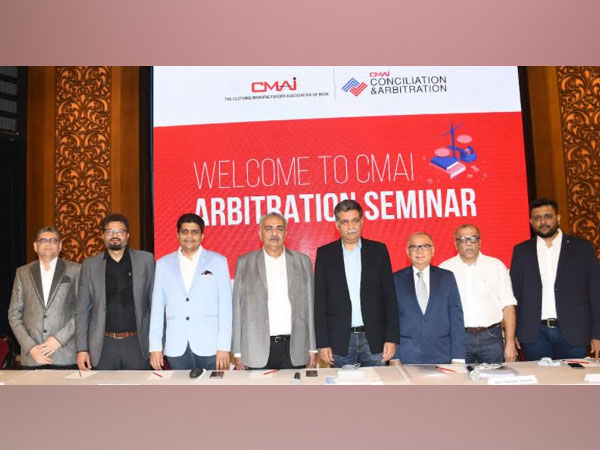
Clothing Manufacturers Association of India (CMAI) has launched the CMAI Arbitration Cell. The Arbitration Award will offer legal strength to the recipient. The cell will provide support to the members, consisting largely of MSME manufacturers. CMAI has designed its Arbitration Rules and Regulations keeping in mind the industry practices and while time ensuring fairness and equity to all stakeholders.
CMAI’s Research on Indian Domestic Market estimates the market size is around Rs 6.5 lakh crores. Even a minuscule if 1 per cent disputed, delayed or denied payments, the amount be around Rs 6,500 crores. This clearly underlines the need for a quick, efficient, and economical mechanism for resolving such disputes and complaints.
Speaking at the launch Shaunak Thakker, Lawyer and Fellow of the UK Arbitrators, underlined the usefulness of the arbitration process, and complimented CMAI for introducing this concept in their activities. Rajesh Masand, President, CMAI, informed the Panel of Arbitrators of CMAI will include leading members of the industry with impeccable credentials, legal luminaries, as well as individuals of high repute. The Panel will also include members from other trade associations from all over the country.
A book on CMAI Arbitration Rules and Regulations was also released by former President Ashok Rajani and other dignitaries. CMAI also launched the CMAI membership card which offers members a variety of benefits and discounts from close to 25 topbnrands and retailers of the country.
India’s cotton yarn prices soar
Cotton yarn prices have increased over 20 per cent in the past three months in India. Prices of superior quality yarns 40 CWC and 60 CWC have increased to Rs 405 a kg from Rs 330 and Rs 500 from Rs 415, respectively, in the past three months. Yarn prices normally keep pace with the raw material i.e. cotton. Yarn prices move in tandem with cotton and demand in the apparel sector. The demand for garments has seen a northward trend after the opening up of Covid related restrictions Cotton prices have sky rocketed and have not come down even with the onset of the new cotton season. Domestic prices have galloped in line with the global trend due to lower production and supplies. For instance 30 counts CCH yarn, used by hosiery units, is currently quoted at Rs 340 to Rs 345 a kg. When the Covid pandemic broke out in the country in March last year, the yarn was quoted at Rs 165 to Rs 170 a kg.
While Shankar-6 cotton prices have increased 80 per cent since October last year, 40s count hosiery yarn rates have gone up only by 58 per cent during the period. However the policy is to let cotton growers enjoy the current good prices they are getting.
Guess Q3 net revenue up four per cent
Guess’ net revenue for the third quarter increased 4.4 per cent. Compared to prior year quarter, net revenue was up 13 per cent. Net earnings for the third quarter increased 140.5 per cent. Compared to fiscal 2021, third quarter earnings were up 13.3 per cent. Diluted earnings per share (EPS) increased 150 per cent in fiscal 2020.
Earnings from operations rose 190 per cent in the third quarter of fiscal 2020. Compared to the 2021 quarter, earnings from operations increased 47.7 per cent. Operating margin in the period increased 6.5 per cent to 10.2 per cent from 3.7 per cent in the third quarter of fiscal 2020, driven primarily by lower markdowns, higher initial markups, overall leveraging of expenses and lower occupancy costs, partially offset by higher performance-based compensation. Operating margin was up 2.4 per cent to 10.2 per cent from 7.8 per cent in the same prior-year quarter, driven primarily by lower non-cash impairment charges, lower markdowns, higher initial markups and overall leveraging of expenses, partially offset by higher performance-based compensation.
All in all, Guess delivered a 10 per cent operating margin in the period, driven by strong gross margin expansion, as a result of lower promotional activity and improved IMUs in spite of increased freight costs related to the supply chain disruptions experienced in the market.
Fiber Trace launches circularity program in Benin
Arise Integrated Industrial Platform and Fiber Trace has started a new pilot program in Benin. The partnership aims at enabling vertically integrated mills in the Republic of Benin to trace, verify and audit the lifecycle of their garments from spinning mills to stores, sharing the journey of Benin premium cotton with end consumers. The aim of this agreement is also to improve Benin’s position in terms of textile innovation and technology, improving visibility, resilience, securing economic competitiveness and creating a thriving value chain for African agriculture as the country is expected to reach a 98,000 ton cotton processing capacity a year by the end of 2023.
Arise Integrated Industrial Platform is a pan-African developer and operator of industrial parks committed to help Africa thrive. Fiber Trace embeds luminescent pigments on the fiber at the spinning mill. The pigments, indestructible throughout the entire textile processing cycle, can be read and tracked at every stage of the supply chain, and each audit is recorded on the blockchain making the information secure, accessible and irrefutable. Fiber Trace will provide transparency and true custody of supply chain solutions for brands and suppliers across the globe working with African manufacturers and supporting the growth of best practices in agriculture on the continent.
Polyester stocks mount in China
Stocks of polyester fabric are mounting in Chinese mills. As per a CCF Group report, the operating rate of downstream fabric mills in Haining, Changshu, Xiaoshan and Shaoxing is falling, disfavoring a rigid demand for polyester fiber. Falling feedstock prices have discouraged sales of polyester fiber too. Downstream buyers would rather cut the run rate than hoard stocks. The processing fee of the whole industrial chain is shrinking. Players' mindset will not recover until feedstock prices stabilize. Even if buy-the-dip appears, it is simply a transfer of polyester inventory. Polyester companies are still expected to face a big pressure to cut production during the Lunar Chinese New Year holiday.
The rapid ups and downs of raw materials have disrupted market sentiments. Fabric traders and end-users who make finished goods were hurt the most with volatile raw material prices. Prices of raw materials surged when the regulation of energy consumption was strict in late September and October, while buyers needed to prepare feedstock for the coming online shopping spree in November. As a result, many downstream players placed orders and even hoarded up a large quantity of fabrics. However, feedstock prices dropped rapidly later. Most fabric traders, especially those who purchased for speculation, faced serious losses. Some even canceled their orders with fabric mills.
Fashion for Good launches ‘Sorting for Circularity Project’ in India to map textile waste
 Fashion for Good, the global platform for fashion and textile innovation for a better tomorrow, launched the ‘Sorting for Circularity Project’ in India to understand the pre-consumer and post-consumer textiles waste streams. This consortium project to pilot sorting and mapping solutions in India, aims to build an infrastructure towards greater circularity for future.
With the Sorting for Circularity India Project, Fashion for Good calls on stakeholders within the textile waste sector in India to collaborate to map the Indian textile waste landscape. Data and resources volunteered are crucial to obtaining real world estimates beneficial to mapping the landscape and successfully testing technologies that are best placed to address the challenges.
Working for a better Tomorrow
The project is a joint initiative of Fashion for Good with partners, adidas, Levi Strauss & Co., PVH Corp,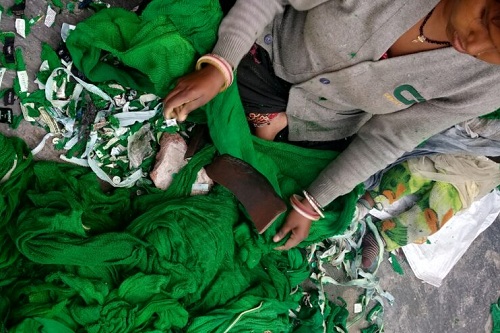 Arvind Limited, Birla Cellulose and Welspun India. A key technology partner for the project is Fashion for Good innovator Reverse Resources who provides the analysis of pre-consumer textile waste streams in addition to designing and running the pre-consumer pilot. The project is supported through catalytic funding provided by Laudes Foundation.
Mapping India’s textile waste landscape
As a strong textiles manufacturing and consuming country, India offers a large streams of pre-consumer as well as domestic post-consumer waste. In fact, pre-consumer waste is only partially recycled, with the remaining portion mostly downcycled to products of inferior quality. And domestic post-consumer waste is tough to trace, with limited data to understand waste, quantities, composition, and other factors key to recycling. As Katrin Ley, Managing Director, Fashion for Good says, “India is a critical hub, not only for textile production and consumption, but also as a global post-consumer textile waste destination. This project is pivotal to understanding the size of this considerable market and providing the incentive, tools and means for the industry to benefit from the wealth of this untapped resource.”
In fact, India is also one of the largest recipients of global post-consumer textile waste, with millions of tonnes, worth over €100m, of discarded textile being brough into the country and then manually sorted at various hubs. What’s more, there is very little information on this imported waste.
Moreover, there are no technologies that organize, categorise and sort materials to ensure quality textile waste is accessible for recyclers, who require sorted feedstocks in large volumes. Other challenges for recyclers include significant barriers to the growth of chemical recycling technologies in India.
The Sorting for Circularity India project will address all these challenges and build an accessible infrastructure for manufacturers, sorters, collectors, waste handlers and recyclers in India. Over 15 months, the project will demonstrate a new textile value chain across three phases. Firstly, by obtaining an overall understanding of the textile waste supply chain of pre- and post-consumer textile waste in India. Secondly, by identifying and piloting technologies that enable the traceability of textile waste and its accessibility to existing recyclers. Thirdly, it will be providing recyclers access to textile waste feedstocks that meet the quality parameters of advanced recycling technologies, giving these technologies an incentive to scale in India.
Partner Support
Many Indian textile manufacturers have collaborated on this project. As Abhishek Bansal, Head Sustainability, Arvind explains. “Recycling technologies are going to be the future of the industry and to get there we need access to traceable, high-quality textile waste for all waste streams. We will be looking at efficiently recycling traceable textile waste and help along in building a new textile waste value chain in India. This project is a great opportunity to help organise the India textile waste market, making it traceable and accessible to recyclers, manufacturers, and brands.”
Birla Cellulose is also partnering this project as H K Agarwal, Business Director Designate, Birla Cellulose opines “A collaborative approach to building a reliable and robust supply chain of pre- and post-consumer waste is crucial for scaling the circular business model for the fashion industry and for Birla Cellulose to reach our ambitious goal of scaling circular fibres such as Liva Reviva to 100,000 tonnes per year by 2024. This project can have a huge social impact by creating more value from waste by collection, segregation and upscaling of textile waste and create a win-win situation for all stakeholders while making fashion more sustainable. Birla Cellulose is excited to be part of this partnership.”