


FW
3PLs helping manufacturers, retailers keep pace with changing trends
"Comprising freight forwarders, courier companies, and other companies integrating and offering subcontracted logistics and transportation services, third party logistics (3PL) companies, help textile manufacturers and fashion retailers to grow their businesses and boost profits. These companies typically provide warehousing and transportation services that can be scaled and customised as per customer requirements."
 Comprising freight forwarders, courier companies, and other companies integrating and offering subcontracted logistics and transportation services, third party logistics (3PL) companies, help textile manufacturers and fashion retailers to grow their businesses and boost profits. These companies typically provide warehousing and transportation services that can be scaled and customised as per customer requirements.
A third party logistic provider helps manufacturers meet customer’s request for a particular kind of fabrics for garments. They also reduce delays and iron out logistical details by streamlining the movement of textiles between destinations. European fabric manufacturers hope to withstand growing competitive pressures by focusing on sustainable fabrics, including those with traceable origins. A 3PL can enable these companies to respond to global customer preferences instead of falling behind the curve.
Helping manufacturers provide season-specific garments
Besides catering to changing demands of customers, the fashion industry must provide shoppers with season- specific garments. To accurately predict their demands, many manufacturers utilise artificial intelligence (AI) to detect fabric defects or predict customer demand during a given period.
At times, smaller manufacturers find it difficult to maintain flexibility in their operations; especially when they need to ramp up their processes in a relative short. By providing services that would otherwise be out of reach of these manufacturers, 3PL companies fulfill their need for three primary services of transportation, warehousing and information technology.
Enabling market expansion
At times, textiles originate from countries located far away from those that sell apparels made with these fabrics. A 3PL provider can bolster the chances of success of manufacturers and retailers by moving into new, international markets. A 3PL provider can help manufacturers and retailers source materials faster or at cheaper rates. 3PL can also help a retailer meet latest demand by launching operations in a new marketplace and serving customers there.
Changing apparel procurement for store shelves
Many customers have faced the disappointment of wanting to purchase a particular garment and discovering it out of stock. To avoid this scenario, fashion retailers work with 3PLs to procure goods faster. They also plan to outsource most of their e-commerce order fulfillment to 3PL businesses who can ship their products directly to the consumers who order them, reducing delays and meeting expectations.
Though fashion customers are happy with what their purchases, whether in stores or through a website, factors like fit, feel and durability can ruin their happiness. To address these requirements, 3PL organisation can smoothen the process of returns.
The fashion industry moves at a lightning speed. In order to remain profitable, textile manufacturers and garment retailers need to match this rapid pace. Specialised resources provided by 3PL companies can help these manufacturers and retailers to accomplish this.
Tirupur manufacturers adopt clean processes
Tirupur garment exporters are investing in sustainability. For example, Tirupur-based Sulochana Cotton Spinning Mills makes garments made out of recycled PET bottles. Twelve recycled PET bottles are used to make a single T-shirt. The waste PET bottles are processed into fiber, which at the end is converted to yarn that is used for garmenting and knitting. The company is in the process of adopting a technology that gives an assurance to its overseas buyers about the yarn, whether it is recycled or not. It also lets them trace the raw materials and process involved in manufacturing. A process will help in tracing the entire supply chain, right from collecting bottles to recycled fabric yarn, through blockchain. Syndicate Impex has launched knitwear collections made from fiber using recycled PET bottles and textile fabrics. Syndicate plans to buy back the garments it has sold and recycle them and so ensure the T-shirts do not go to the landfills.
Apart from individual companies that are taking greener initiatives, Tirupur as a cluster has invested in 1,600 MW of wind and solar energy, recycling waste water in processing units, and has zero liquid discharge systems.
As shoppers around the world demand sustainable product ranges, suppliers are seeking out possible ways to meet the demands of buyers.
Spanish groups divert from China for sourcing
Spanish fashion companies are facing the impact of the Coronavirus (COVID 19). Companies are losing money because of the outbreak. Retailers are worried that new collections may be delayed by months. Spanish brands that have suppliers and factories in China have started to implement contingency plans aimed to prevent damage to their production. In particular, orders from China are beginning to shift to countries such as Myanmar and Thailand. With this, companies hope to save their new garments for the time being. The spring/summer collection is already in stores. There is no risk of shortage, at least for now, as their fears are centered on the autumn and winter collections, for which raw materials – buttons, zippers or threads – should already be in the process of being manufactured.
Fashion group Tendam has more than 100 suppliers in China alone; around 30 per cent of the garments bought by the group’s brands are produced in Asian countries. Having a production network in more than 30 countries, Tendam has begun to divert manufacturing away from China and may shift from sea to air transport if the accumulated delays are large and lengthy. Inditex has seven stores in the Wuhan region and part of its production in China.
Ludhiana apparel industry investing on high tech solutions
Ludhiana’s apparel manufacturing industry is tilting toward technology and investing in automation, be it knitting or stitching. Manufacturers are aiming to increase productivity, efficiency and reduce labour dependency. Flat knitting (multi-gauge) machines that start from five or six gauges and go up to 14 gauges have the option of jointless knitting. This helps users save money and produce more value-added products. Fleece jacquard machines help in this regard. Brother’s DigiFlex series of machines has received a very good response in Ludhiana. These help monitor workers’ efficiency, factory efficiency, no matter where they are. Sewing machine leader Jack is also getting a good response in Ludhiana for its new and different machines. The technology leader recently launched its automatic placket-making machine for tees which can make 1,200 pieces a day in eight hours and help reduce dependence on labor. The company has also introduced automatic button feeders and pattern sewing machines.
Ludhiana accounts for over 90 per cent of the total winter wear production in the country. Knitwear constitutes around 50 per cent of the domestic apparel market in India. There are around 12,000 units in Ludhiana, a majority of them in the micro, small and medium category who are engaged in the production of winter wear. The winter wear category comprises sweaters, hoodies, sweat shirts, jackets, shawls, cardigans and trousers.
Lee tests sustainable production methods for denim
Lee is testing sustainable production methods together with a series of new technologies and materials, mainly circling around denim production.
Indigood Denim is a foam dyeing technique that does not use water and features 89 per cent less chemicals and 65 per cent less energy than traditional dyeing. At Lee, Indigood is featured in the spring preview ’20 range on two different washes on the slim tapered Luke fit men’s jean. Back to Nature features pieces that are meant to be completely biodegradable. They are made using entirely compostable linen-cotton yarns, and no rivets, so that when the garment is no longer needed, the buttons can be unscrewed for re-use and the rest is just thrown into the compost, where it will biodegrade. Sustainable Selvage is an ongoing collaboration with Italian denim mill Candiani. The result is a series of jeans created using less energy, water and chemicals. Sustainable production and finishing processes include the use of Kitotex dyeing, derived from the food waste industry. Sustainable laundry treatments include lasering that does not use chemicals and E-Flow which uses less chemicals and water. PP spray (used for creating worn effects) has been replaced with an eco-friendly bleaching additive.
Lee is benchmarking its sustainability initiatives’ impacts on environmental and social issues since this will help the brand set targets over time.
Invista builds ADN plant in China
Invista is building a plant in China which will produce up to 4,00,000 tons of adiponitrile (ADN) annually. The plant will integrate with Invista’s existing polymer facilities to directly supply domestic customers with the key building ingredients to produce nylon 6.6 and other high-value products in China and throughout the Asia Pacific region. The plant will incorporate Invista’s latest ADN technology that improves product yields, reduces energy consumption, lowers greenhouse gas emissions, enhances process stability and slashes capital intensity compared to existing technologies. This plant is expected to help the company meet the growing demand for nylon 6.6 chemical intermediates in China and the Asia Pacific region. Invista plans to begin construction on the project this year, eyeing a production start date in 2022.
China is expected to be the world’s largest consumer of nylon 6.6 in the next few years. Invista, based in the United States, is one of the world’s largest integrated producers of polymers, fibers, fabrics, resins, chemical intermediates, and specialty chemicals for commercial, residential, automotive, and industrial customers. The company offers premium fibers and fabrics for apparel, swimwear, active wear, denim, sweaters, and leg wear; carpet fiber for commercial carpet, as well as carpet and rugs for home; automotive flooring, airbags, and upholstery products; and products for applications, such as daypacks, outdoor gear, luggage, and outdoor wear.
ITA Singapore show cancelled due to Coronavirus
Innovate Textile and Apparel (ITA) in Singapore scheduled for May 2020 has been called due to the Coronavirus. A virtual conference will be held instead. Delegates will have access to the scheduled presentations through internet-connected devices, allowing them to experience some of the show’s educational resources remotely. About 23 presentations will be recorded in advance and linked to presentation slides. There will also be an opportunity to pose questions to presenters during virtual networking events. The online event will give attendees the opportunity to access all presentations in one go. They can watch presentations at their own pace with no extra cost of travel or accommodation; the virtual format aims to provide all the functionality of the in-person event including the networking. The event’s programming will focus on emerging manufacturing technologies, material innovations and business models that are set to deliver the next wave of opportunity for the global textile and apparel manufacturing community.
Registrants will be able to stream presentations on topics including blockchain, supply chain efficiency, the digitally connected circular economy, 3D design and development and digital inspections. Those who are interested in the materials offerings can partake in presentations covering the future of smart textiles, e-textiles, product development processes for smart garments and more.
Global denim jeans grows four per cent
The denim jeans market worldwide is growing by 4.3 per cent. Within Europe, Germany will add to the region’s size and clout in the next five or six years. In Japan, denim jeans have a significant market size. As the world’s second largest economy, and the new game changer in global markets, China exhibits the potential to grow at 6.8 per cent over the next couple of years.
The US market is growing 3.4 per cent. Denim brands in the US are figuring out how to appeal to Gen Z. These are consumers born since 1996. They account for 40 per cent of all US consumers. Shapeless T-shirts, sweatshirts, dresses and other low-key staples like denim appeal to Gen Z because they’re effortless and without pretense, which is exactly what they aspire to be. Most of consumers prefer their denim jeans be made of 100 per cent cotton or cotton blends. Vintage vibes delivered in lighter weights is just what the younger set prefers. Even though these young consumers spend the least on their denim, Gen Z shoppers say price isn’t the most important factor when they buy new jeans. Rather, they put a higher value on fit, comfort and quality.
NCTO releases statement on coronavirus
National Council of Textile Organizations (NCTO) is a Washington, DC, USA based trade association that represents domestic textile manufacturers, including artificial and synthetic filament and fiber producers.
NCTO President and CEO, Kim Glas issued the following statement on the industry’s response to the coronavirus crisis.
The coronavirus has impacted Asian textile and apparel manufacturing productivity and output, and our concerns lie with the affected companies and workers during this terrible crisis.
The U.S. textile industry continues to be ready, able, and willing to help in any way possible. Our industries have been in touch with U.S. government officials to help identify key U.S. textile suppliers to provide surgical masks and other items to help contain the spread of the coronavirus. In addition, several companies have donated much-needed medical textile supplies and other sanitary items to help address this outbreak.
Given the uncertainty in the market as a result of the coronavirus, many textile and apparel sourcing executives are seeking alternatives outside of Asia. We stand ready to assist brands and retailers looking to shift sourcing during this uncertain time. The western hemisphere production platform established under our free trade agreements and trade preference programs provides a sound alternative as companies look to diversify their sourcing. The region has immediate capacity to meet worldwide demands with duty-free access through well-established supply chains.
Whether this terrible crisis lasts days, months, or longer – our member companies are ready and willing to help.
Moda brings the AW20 fashion community to life
 As the doors close on a successful AW20 season at Moda, the heart of UK fashion and the National Footwear Show, its organisers Hyve Group plc have committed to the show’s long-term future at the NEC Birmingham securing future dates which are aligned with all of its key sector buying calendars.
Adam Gough, Event Director at Moda said; “Following this season’s date clash with Micam and change of dates, we felt the industry needed a clear commitment from Moda to a long-term future that works effectively for the majority. Moda is one of the UK’s longest standing fashion trade shows, with a massive 59% of visitors attending the show for over 20 years, so we’re really pleased to return to our traditional date line from SS21. Despite local and global turbulence in the market, Moda plans to stand strong acting as a bridge between the UK, the EU, and the rest of the world. All of the team will continue to strive to provide the best possible platform for our exhibitors and experience for our visitors.”
Designed to bring the entire fashion community together, the new look Moda layout saw the show’s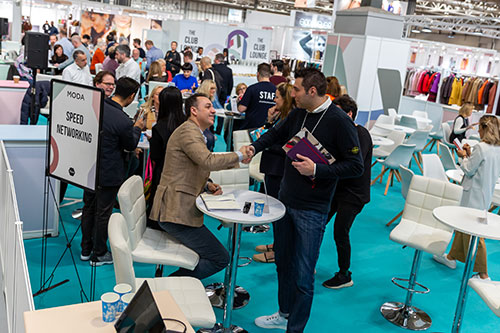 Neighbourhoods brought to life. Moda Woman showcased the best of womenswear including occasionwear, ready-to-wear, and young fashion. Moda Accessories will be refreshed for SS21 with an exciting line-up of leading accessories, jewellery and lifestyle brands. Moda Boutique, the new premium edit was a big hit amongst buyers and will return for SS21. Moda Footwear saw the UK’s largest gathering of footwear brands with a comprehensive edit of contemporary, classic, sport, and fashion footwear. Little Soles launched this season and was a hit with children’s footwear buyers. For SS21, Moda Made will align the entire footwear supply chain bringing suppliers and manufacturers together with brands and buyers.
Dedicated Speed Networking sessions over the three days saw over 2000 meetings and introductions between brands and buyers facilitating new relationships. An exciting new buyer initiative for the AW20 season included The Club which brought relevant buyers with strong buying power to the show.
Moda SS21 will take place on the 2nd – 4th August at the NEC Birmingham, offering the industry the ultimate environment for buying, networking, trends, and inspiration.











