


FW
Egypt to host Stitch and Tex garment fair
Stitch and Tex in Egypt will consist of two trade fairs, February 27 to March 1, 2020, and March 5 to 8, 2020.
The first trade fair is dedicated to garment processing technologies including sewing, embroidery, fabrics and accessories. The second is dedicated to textile processing technologies including weaving, spinning, knitting and dyeing machinery, technologies and spare parts.
Stitch and Tex is Africa’s most important trade fair and platform for textile technologies. Global players, innovative newcomers and providers of niche technology will all represented here. Brands will demonstrate textile technologies that will be revealed for the first time in African markets. Visitors can explore unprecedented profit-making business hot spots. For the first time in the history of textile technologies trade fairs in Africa, the event will feature the presence of buyers and factory owners from Ethiopia, Kenya, Lesotho, Mauritius, South Africa, Madagascar, Tanzania, Algeria, Morocco and Tunisia. They can have open channels of communication directly with the exhibitors within a well set bilateral business meetings program. Flow of 40,000 visitors from 16 countries will be welcomed into the trade fair. Over two-thirds of these visitors work in upper and middle management in their companies and as such have a direct influence on on-site procurement decisions.
EU-Bangladesh organise event to discuss current trade status
European Parliament of the European People’s Party (MEP) in cooperation with the Bangladesh Embassy in Brussels held a multi-stakeholder event titled ‘EU-Bangladesh Apparel Trade: A Time for a Reality Check’ create a platform to discuss the current state of the European Union-Bangladesh garment trade. At the event, former BGMEA President and Advisory Committee member of the Commerce Minister of Bangladesh Shafiul Islam Mohiuddin addressed some of the issues raised later on subcontracting, the fire safety standard and the Rana Plaza tragedy.
State Minister Shahriar Alam said that the sea change in Bangladesh’s RMG industry over the past seven years, especially as a result of the concerted efforts of many dedicated actors and Prime Minister Sheikh Hasina envisioned a Bangladesh where prosperity and social justice coexist in a prosperous economy and our social partners work together to manage industrial relations in harmony. He called on Brussels stakeholders to help set a positive agenda for EU-Bangladesh trade relations beyond ‘disseminating relentless misinformation by some malls’.
Bangladesh Power Development Board (BPDB) has proposed to raise the bulk tariff of electricity by 23.28 per cent from this year and the minimum wage increased 51 percent by now. In this current situation, Bangladesh RMG must highlight the fair price of products to sustain the RMG industry.
British retailers facing stock shortages over Coronavirus outbreak
Several British retailers are likely to face stock shortages over the Coronavirus outbreak. Factories of brands like Halfords, B&M, DFS, Asos and Primark are likely to shut operations leaving gaps on their store shelves. Britain's biggest car manufacturer Jaguar Land Rover, which has been flying components from China in suitcases, has curbed production at 11 domestic plants while Chinese suppliers facing the ongoing coronavirus crisis 'struggle' to ship parts.
European seaports have been warned that shutting down of plants across China could result in the suppression of the country's trade with the continent by a fifth. Ultimate Products, who are behind Russell Hobbs kitchen products, has been warned of possible delays, as have Kleenze mops and Dreamtime duvets. Fashion retailer Joules, which imports 90 per cent of its product range from China, is planning to shift its manufacturing to Turkey and Bangladesh.
Brexit may harm Pakistan exports to the UK
Brexit can potentially have a major negative impact on Pakistan’s exports to the UK. Pakistan’s exports to the UK are governed by the GSP Plus scheme. Meanwhile addressing the Pakistan Textile Exporters Association (PTEA) British Ambassador Gillian Rogers has said that UK is establishing its own GSP Plus scheme or a similar arrangement to maintain the current level of merchandise exports from Pakistan to UK. Increase in bilateral trade is more interest to the both government
The UK is a major trade partner of Pakistan. Much of Pakistan’s exports to the UK consist of made-up textile articles, articles of apparel, cotton and articles of leather. All these products currently enjoy duty-free access to the UK under the GSP Plus. The UK is one of the vocal and reliable supporter of Pakistan and has taken extreme measures to support its economy. The UK is establishing its own GSP Plus scheme or a similar arrangement to maintain the current level of merchandise exports by Pakistan to the UK.
The UK is currently focusing on green energy and energy efficiency in Pakistan including consultancy for individual enterprises on energy conservation in their production processes. It is working in different sectors of the economy to enhance the productivity and the working conditions to further improve the quality and quantity of exportable surplus from Pakistan. By taking advantage of Brexit, the UK hopes to take economic ties with Pakistan to the next level. The textile industry in Pakistan is the eighth largest exporter of textile products in Asia.
New appointees to the Management Board of the Lenzing Group
The Supervisory Board of Lenzing AG, the world’s leading producer of botanic cellulose fibers, has appointed two new members to the company’s management Board. Stephan Sielaff will serve as the new Chief Technology Officer effective March 1, 2020, succeeding Heiko Arnold, who left the Lenzing Group in November 2019. At the same time, Lenzing’s highest management body led by Chairman Stefan Doboczky will be expanded to include a newly created Management Board position for “Pulp and Wood Raw Materials” and will thus consist of five members instead of four. Christian Skilich will assume the position of member of the management board for pulp and wood raw materials as at June 1, 2020. “In the coming years our focus will be on achieving the strategic target of strongly increasing our own supply of pulp in line with our corporate strategy sCore TEN. By creating this new division, the composition of the management board now also reflects this focus”, says Peter Edelmann, Chairman of the Supervisory Board of Lenzing AG.
Coronavirus affects India’s textile trade, both exports and imports
Coronavirus (Covid 19) is affecting the Indian textile and apparel industry. The prevailing situation in China is posing a major threat for Indian manufacturers dependent on the supply of raw materials from China. India imports $ 460 million worth of synthetic yarn and $ 360 million worth of synthetic fabric from China annually. It also imports accessories like buttons, zippers, hangers and needles. India does not have the domestic supply base to cater to such a huge demand of these raw materials.
Traders in India also anticipate curtailed demand from China. There may be a decline in China’s imports of cotton yarn from India. This will divert India’s surplus cotton yarn to the domestic market, further reducing the price of cotton yarn. With the epidemic, Chinese textile factories have stopped operations. If this continues, Indian garment manufacturers will need to look at other alternatives, including local sourcing, which in turn may increase the finished goods’ cost by three percent to five percent. In addition to this, identifying vendors in such a short time can take a toll on lead times, quality and cost.
However, there can be a positive impact on India as well. During the month of January, buyers from Europe and the US generally travel to China to negotiate with garment exporters for the next season. However, due to the Coronavirus scare, most of the buyers are looking at alternatives and India could emerge strong.
98th edition of Lineapelle goes beyond all expectations
 Lineapelle closes the 98th edition, going beyond the current global forecasts and emergencies, concretely strengthening its international leadership.
Held at Fieramilano Rho from 19 to 21 February 2020, Lineapelle confirms its importance for the global supply chain in the fashion and luxury goods sector by welcoming almost 20,000 visitors, an increase of 2% compared to the 2019 edition. A growth evidenced by both Italian and foreign operators despite the absence of Chinese and Far Eastern exhibitors and buyers due to the coronavirus epidemic.
In addition to the positive attendance, the exhibitors at Lineapelle also reported the excellent level of quality of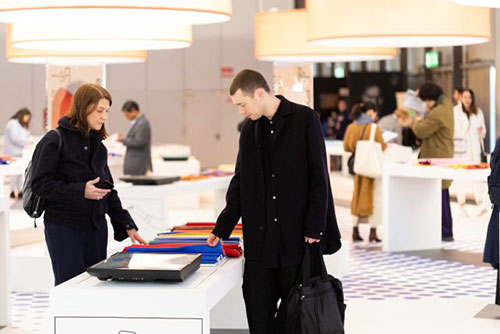 the visitors, the result of the synergy with footwear, Micam, and leather goods, Mipel, with whom Lineapelle shared a day of exhibition, Wednesday, February 19. While Lineapelle is archiving the edition dedicated to the summer season 2021, the exhibition Questione di Pelle organized by Lineapelle and curated by journalist Mariella Milani, under the artistic direction of Simone Guidarelli, will be open until Saturday 29th February at Spazio Lineapelle in Palazzo Gorani in Milan.
Questione di Pelle is an exhibition project that celebrates leather and describes its beauty and versatility through some creations by Gianfranco Ferré (provided by the Gianfranco Ferré Foundation) and garments by designers Bozart, Cecilio Castrillo, Alessandro Dell'Acqua, Mario Dice, Diego Dolcini, Ely.B, Massimiliano Giornetti, Simone Guidarelli, Mani del Sud, Antonio Marras, Italo Marseglia, Simone Marulli, Sermoneta, Ventaglidautore, Vivetta, Alessandra Zanaria.
The next edition of Lineapelle will take place at Fieramilano Rho from 23 to 25 September 2020 and will be dedicated to the autumn/winter 2021/2022 season.
Make a Statement with Wrangler’s Monochrome Collection
 This season, Wrangler introduces their fresh outlook on tees and shirts featuring asymmetrical designs, HD prints, reflective prints and accentuated blurred print styles. The men’s denim range stars reflective elements and pocket detailing. The Monochrome collection plays with blacks, greys and whites and it adds an edge to your wardrobe. This range is exclusively designed to make a statement in the day or light up the night.
The all new Monochrome collection from Wrangler brings forth the hi-style, uber cool range inspired by the futuristic design elements.
The heritage of Wrangler goes back 70 years, when the brand was launched in the U.S.A. Wrangler was the first modern five-pocket jeans to be test-fitted and endorsed by real-life cowboys. Since then, Wrangler continues to inspire freedom, independence and adventure in its wearers.
In India, the brand has evolved to meet the needs of the ‘urban cowboy’ with a range of fashion apparel that is contemporary and fashionable yet rugged.
Wrangler has found a loyal consumer base in the Indian youth that swear by this unique fashion brand. This stylish denim brand is available at exclusive Wrangler stores, major department stores, leading apparel stores and popular e-commerce websites.
Pakistan raw cotton imports up 42 per cent
Pakistan’s raw cotton imports increased 42 per cent in fiscal July to January as compared to the same period last year. In January 2020, Pakistan’s raw cotton imports surged 51.2 per cent as compared to January 2019. The country’s trade deficit shrank by 28.4 per cent in the first seven months of fiscal ’20. Total textile imports including raw cotton, synthetic fiber, synthetic and artificial silk yarn, worn clothing and other textile items rose 32 per cent in January 2020 as compared to January 2019.
Pakistan is trying to increase its textile exports. Presently, its share is 1.6 per cent in the world textile trade. Efforts are on to increase this to three per cent by 2025. The potential of home-grown cotton will be fully utilized augmented by manmade fiber/filament to boost value-added exports and become a major player in the global textile supply chain. Among the objectives are restoring the profitability of cotton farmers by increasing cotton yields, improving the quality of cotton and decreasing the cost of production for farmers, strengthening the manmade fiber/filament sector to make this chain internationally competitive and export oriented, long-term financing facility for the entire textile value chain, revival of impaired textile capacity and establishment of textile clusters and export processing zones with plug and play facilities.
Decathlon revenue up nine per cent in 2019
Decathlon ended 2019 with a revenue growth of nine per cent. Decathlon’s revenues in France, its main market, rose three per cent. The French sporting goods retailer is present in 69 countries around the world, nine more than a year ago, after sealing its entry into markets such as the United States, Algeria, Vietnam, Malta, Japan, South Korea and Ukraine. The number of employees has grown from 87,000 to 93,000 workers. Decathlon has invested in store openings and corporate operations.
The target for the sportswear and goods retailer is to reduce carbon dioxide emissions per product sold by 40 per cent between 2016 and 2026 for all its sports categories. Decathlon wants to achieve these targets by a number of sustainable strategies, including using 100 per cent renewable electricity by 2026 in its stores – including its 45 in the UK – and warehouses. In addition, 100 per cent of Decathlon’s new products will be eco-designed by 2021 and the retailer will also investigate into developing the sale of secondhand products throughout the store. Decathlon is also striving towards using just one per cent air freight for its transportation needs and reducing the impact of other means of transport, such as through maritime or road.











