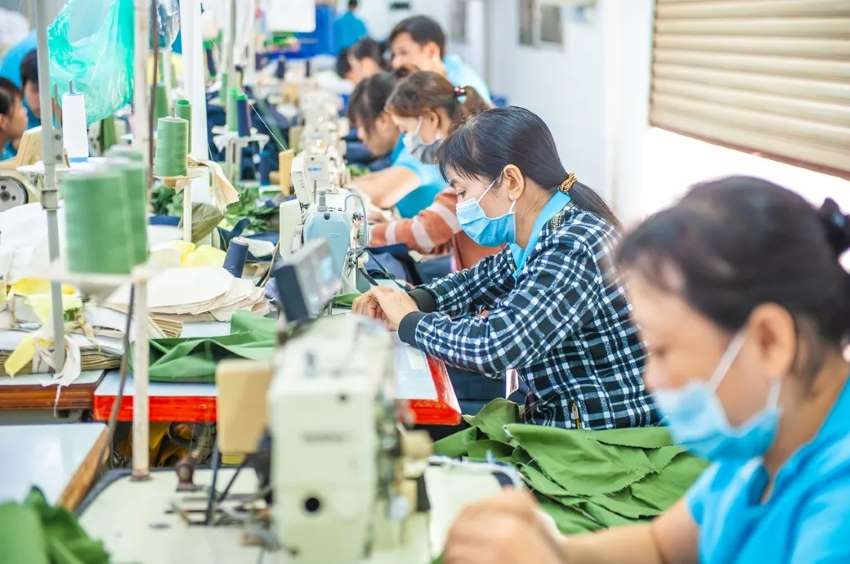
Japan’s apparel industry is turning to state-of-the-art technology in a bold bid to cut labour costs and secure its future, from ready-to-wear knits manufactured instantly to customized dresses produced on inkjet printers. At Shima Seiki’s factory in Western Japan, garments materialise in minutes, thanks to digitally-programmed automated machines that can turn out a sample seam-free pullover in half an hour with a push of a button.
Patented by the Japanese manufacturer, the WholeGarment system and sold to knitwear companies like Italian luxury brand Max Mara includes a digital design system that allows users to choose patterns, colors and cuts. Known for glove-making machinery, Shima Seiki took a technological leap in the 1990s in an effort to revive the flagging fortunes of Japanese apparel manufacturers.
The WholeGarment system allows one worker to operate ten machines - thereby lowering labor costs - and uses limited raw material to create seam-free garments that generate no waste, since they require no cutting. The initiative is part of a push by Japan’s knitwear industry to capitalize on its technical know-how to create garments that cannot be replicated elsewhere at a lower cost.
The focus on technique and technology has already paid off, with Japan’s knitwear sector registering a 40 percent increase in exports over a 10-year period beginning in 2006, a rare bright spot in an otherwise dismal picture for textile and apparel exports from the country.
- 1
- 2
- 3
- 4
- 5
- 6
- 7
- 8
- 9
- 10
The £7 Billion Question: Who pays for fashion’s ‘free rental’ habit?
The global fashion industry is facing an uncomfortable paradox: its most valuable customers may also be its most destructive. A... Read more
India, China Bangladesh face fresh headwinds as global apparel markets rebalance
Global apparel trade is entering a more uneven recovery phase, with demand growth persisting but losing uniform momentum across major... Read more
Global cotton enters a deficit year in 2026 as supply drop meets logistics risk
The global cotton economy has entered a fragile and sensitive phase. Early projections for the 2026-27 season suggest that world... Read more
India’s textile trade gets a Pacific push as New Zealand FTA removes tariff barr…
India and New Zealand have inked a ‘once-in-a-generation’ Free Trade Agreement (FTA), one that will have a profound impact on... Read more
Lululemon’s world-first nylon circularity push signals a new apparel arms race
The global apparel industry’s circularity narrative is entering a more technically demanding phase. Polyester recycling once the flagship of sustainable... Read more
Beyond the DTC Rush: Levi’s hybrid channel strategy sets a new retail benchmark
The global apparel sector is entering a phase where channel strategy is no longer a tactical lever but a core... Read more
The New Rules of Resale: EPR turning secondhand into fashion’s strategic growth …
The global fashion industry is facing a decisive regulatory and commercial reset. What began as a sustainability narrative around reuse... Read more
The 2027 Mandate: Why denim’s future hinges on verifiable data
For decades, the global denim industry has relied on a narrative of durability, heritage, and authenticity. That narrative is now... Read more
Europe’s textile core unravels as costs, imports and policy pressure bite
Europe’s textile and apparel sector, long seen as a benchmark for craftsmanship and industrial depth, is slipping into a prolonged... Read more
Automation, innovation, regulation are the forces shaping textiles in 2026
The global textile sector has entered a new era. Early 2026 saw the industry breach a $1.06 trillion valuation, reflecting... Read more