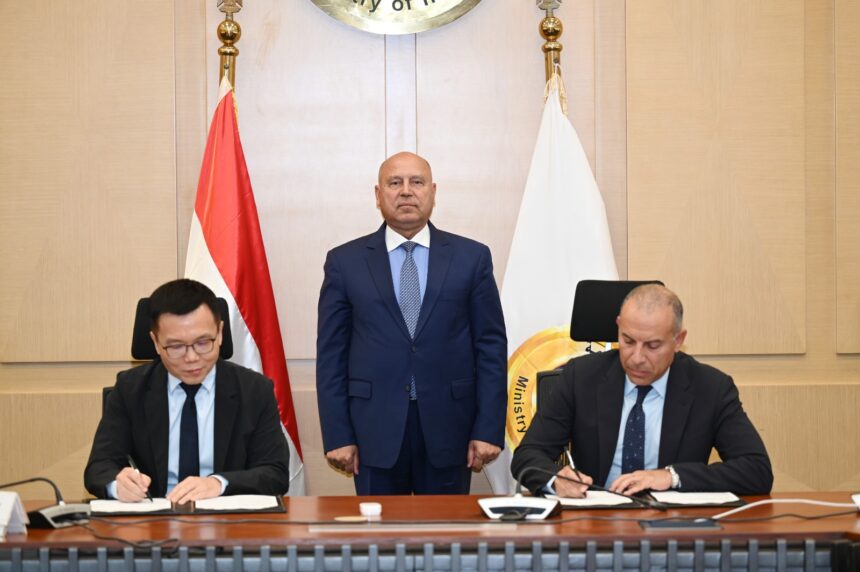
Egypt is making a decisive play to become one of the world's most important apparel manufacturing destinations after securing a landmark $2 billion investment from Chinese industrial developer Cloud Chain. The project will establish the Middle East and North Africa region’s first fully integrated carbon-neutral textile industrial city in Port Said, reinforcing Egypt’s ambitions to emerge as a strategic sourcing hub for European and international fashion brands.
Spanning 4.5 million sq mt, the mega-project reflects a broader transformation underway in global textile sourcing. As brands face mounting pressure to reduce emissions, diversify production networks, and shorten delivery timelines, countries positioned close to major consumer markets are becoming increasingly attractive alternatives to traditional manufacturing centers. The Port Said development is designed to capitalize on these structural shifts while strengthening Egypt’s position within global apparel supply chains.
Nearshoring gains momentum
The investment arrives at a time when international sourcing strategies are realigning. For decades, apparel manufacturing was concentrated in low-cost Asian markets. However, rising production expenses, geopolitical disruptions, and environmental regulations are forcing brands to reassess long-established supply chain models. Manufacturers and retailers have faced persistent challenges ranging from escalating labor costs in China and Turkey to political uncertainty in Bangladesh. At the same time, disruptions to shipping routes through the Red Sea have highlighted the vulnerabilities of heavily extended global supply chains.
These pressures have increased demand for nearshoring solutions that place production closer to end markets. Egypt's geographic proximity to Europe gives it a unique advantage, allowing brands to reduce transportation times while limiting exposure to global logistics disruptions. Experts believe this trend could substantially reshape textile trade flows over the next decade, particularly as European regulators introduce stricter carbon accounting requirements across supply chains.
Building an integrated ecosystem
The Port Said project is structured around a 48-month development schedule divided into two phases. The first phase will cover approximately 2 million sq. mt. and focus on establishing environmentally sustainable manufacturing facilities. Between 30 and 50 textile and ready-made garment companies are expected to operate within the zone during this initial stage.
Unlike conventional industrial parks that host isolated production facilities, the Port Said development is being designed as a complete industrial ecosystem. Manufacturing plants will be connected to logistics infrastructure, commercial services, and specialized workforce training institutions. The inclusion of vocational and technical academies addresses one of the most common constraints facing rapidly expanding manufacturing regions: labor availability and skills development. By integrating training directly into the industrial zone Egypt aims to ensure a steady pipeline of qualified workers capable of meeting the quality standards demanded by international buyers. The project is also expected to generate significant economic benefits, creating between 50,000 and 80,000 direct jobs and an additional 60,000 indirect employment opportunities across related sectors.
Vertical integration advantage
The second phase of development will focus on creating a fully integrated textile value chain. An additional 2.5 mn sq. mt. will be allocated to upstream operations, including spinning, weaving, raw material processing, and related activities. These facilities will operate alongside downstream garment production and logistics services.
This model contrasts sharply with many conventional textile clusters, where manufacturers remain dependent on imported fabrics and intermediate materials. Such fragmented systems often create delays, increase transportation costs, and expose production schedules to external disruptions. The Port Said hub seeks to eliminate these inefficiencies by consolidating every stage of production within a single location.
Table: Comparison with global industrial clusters
|
Objective |
Port Said Cloud Chain hub |
Standard non-integrated clusters |
|
Projected Capital Outlay |
$1.5 bn to $2 bn |
$50 mn to $100 mn avg. |
|
Total Physical Footprint |
4.5 mn sq mt |
Under 500,000 sq. mt. |
|
Projected Employment (Direct) |
50,000 to 80,000 Positions |
5,000 to 10,000 Positions |
|
Value-Chain Scope |
Fully Integrated (Upstream to Logistics) |
Fragmented (Cut-and-Sew Only) |
|
Environmental Compliance |
Certified Carbon-Neutral Ecosystem |
Standard Grid-Dependent Operations |
The scale of the project also sets it apart from traditional industrial developments. While many textile parks globally involve investments of between $50 million and $100 million and occupy less than 500,000 sq. mt., the Cloud Chain development represents a significantly larger undertaking. Its fully integrated structure, combined with carbon-neutral operations, positions it among the most ambitious textile manufacturing projects currently being developed worldwide.
Sustainability becomes a competitive tool
Environmental compliance is emerging as a key factor in sourcing decisions for major fashion brands. Increasingly, retailers must demonstrate transparency across supply chains and provide measurable evidence of emissions reductions. Carbon-border adjustment mechanisms and sustainability reporting requirements in Western markets are raising the cost of operating within high-emission manufacturing networks.
Egypt's decision to build a carbon-neutral textile city directly addresses these evolving market expectations. Rather than treating sustainability as a regulatory obligation, the project positions environmental performance as a competitive advantage. The integrated design is expected to reduce transportation-related emissions while providing brands with clearer visibility into production processes. For global apparel companies seeking to align sourcing strategies with climate commitments, such capabilities could become increasingly valuable.
Trade access strengthens Egypt’s case
The investment also supports Egypt’s broader industrial development strategy. The government has established a goal of increasing textile and ready-made garment exports to $12 billion by 2031. Achieving that target will require continued foreign direct investment and the expansion of export-oriented manufacturing capacity.
Egypt’s extensive network of trade agreements strengthens its appeal to international manufacturers. Duty-free access to numerous export markets provides a hedge against tariff volatility and helps improve competitiveness relative to other sourcing destinations.
Officials have also introduced targeted incentives aimed at attracting industrial investors and accelerating project implementation. According to Egypt’s Ministry of Investment and Foreign Trade, the country's combination of infrastructure, strategic location, and trade connectivity creates a strong foundation for developing high-value industrial ecosystems capable of serving global markets.
The Cloud Chain agreement is not an isolated development. A growing number of Chinese textile and apparel manufacturers are relocating or expanding operations in Egypt as part of broader diversification strategies. Recent investments include a $350 million commitment by Hong Kong-based Crystal International to develop an integrated apparel complex. Additional Chinese manufacturers have announced investments in new production facilities in Qantara West, while Egypt's investment authorities continue to manage relocation plans involving several other major textile producers.
This influx of capital suggests that Egypt is becoming a preferred destination for companies seeking alternatives to traditional Asian manufacturing centers. As global apparel brands continue to prioritize resilience, sustainability, and faster market access, Egypt's combination of geographic proximity, integrated manufacturing capacity, and environmental compliance could position the country as one of the Mediterranean region's most influential textile production hubs.
The Port Said textile city is more than a single industrial project. It reflects a broader shift in how the fashion industry is organizing production for a future defined by sustainability requirements, geopolitical uncertainty, and the growing importance of regionalized supply chains.