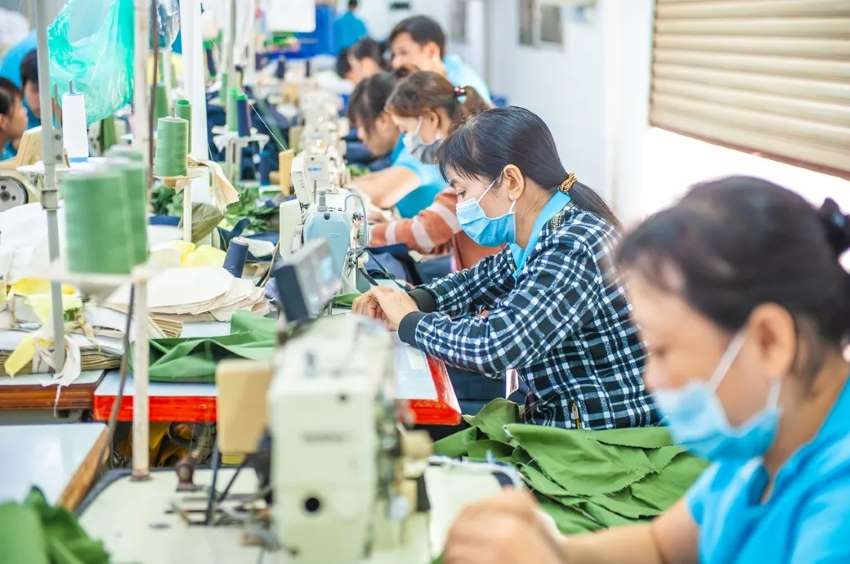
Syria's textile industry, once one of the country's bright spots, with its products coveted throughout the region and beyond is in shambles today. The sector has been devastated by the war that erupted in March 2011, with factories destroyed, workers displaced and sanctions hampering trade. The migrant crisis and outflow to Europe have also depleted its workforce.
Before Syria's conflict began, textiles represented some 63 per cent of the industrial sector's total production. According to the Syrian Economic Forum think-tank, the sector was worth 12 per cent of GDP, employed a fifth of the workforce and exports netted around $3.3 billion a year.But by 2014, private sector textile exports had fallen by half, with the industry particularly affected by fighting in Aleppo city, the country's former commercial hub and home to many textile factories.
Nearly 70 per cent of factories were closed or destroyed by the war. In addition, many businesses lost machines and employees. When the war arrived in Aleppo in mid-2012, eventually dividing the city between government control in the west and rebel control in the east, some businesses relocated to small workshops in the city's safer areas.
For all its challenges, Syria's textile industry continues to enjoy a reputation of quality in the region, and the recently concluded Beirut Fair attracted some 500 buyers, mostly from the Middle East.
The rising costs of production, difficult trading environment and shrinking workforce, all mean competitors from Turkey and China are increasingly able to pinch clients from Syria's textile industry. Manufacturers blame shrinking exports in part on sanctions slapped on Syria after the government began its crackdown on dissent following anti-government protests five years ago.
- 1
- 2
- 3
- 4
- 5
- 6
- 7
- 8
- 9
- 10
Bharat Tex 2026: Redefining the global textile value chain
Union Minister of Textiles, Giriraj Singh, has officially unveiled Bharat Tex 2026, signaling a significant leap in India’s influence over... Read more
Intertextile Shanghai Spring 2026: A hub for global textile innovation
The textile industry’s pulse is quickening as Intertextile Shanghai Apparel Fabrics – Spring Edition prepares to open its doors from... Read more
Moscow Fashion Week 2026: Blending sustainable innovation with timeless glamour
Scheduled to run from March 14-19, 2026 in Moscow, Russia, the Moscow Fashion Week (MFW) is cementing its status as... Read more
The Store as Stage: How fashion is crafting immersive consumer worlds
The North American fashion retail sector in 2026 is shedding its product-first identity and shifting towards a model that values... Read more
Turning the supply chain upside down, on-demand production reshapes apparel
The global fashion industry, long celebrated for its creativity and scale, is facing a structural reckoning. For decades, retailers and... Read more
Intertex Milano 2026 - A global nexus for textile innovation
Intertex Milano is set to return this summer, confirming its status as a premier international destination for the textile and... Read more
Primark at crossroads as AB Foods weighs spin-off amid digital and Lefties press…
The long-standing supremacy of Europe’s budget fashion champion, Primark, is facing a test. As of February 2026, Associated British Foods... Read more
Vietnam, Bangladesh, Cambodia drive US apparel imports in 2025
The 2025 year-end data for the US apparel sector reveals an industry in structural flux. Despite aggressive tariff measures and... Read more
The New Dress Code: Sportswear’s takeover of modern wardrobes
For much of the last decade, fashion retail has been defined by volatility. Trends have shortened, discount cycles have intensified... Read more
Hemp finds its moment in India’s $500 billion American trade calculus
In the grand arithmetic of India’s expanding trade engagement with the US, the headlines usually gravitate toward oil cargoes, aircraft... Read more