‘Better Work’ program is helping in improving working conditions in garment factories of Bangladesh. The program is helping shift the mindset of garment employers in from seeing compliance as an obligation to being a business necessity that makes them more competitive. The challenge is to bring more factories under the program and convince individual factory owners. Another challenge is to ensure global brands and retailers implement compliance in their supplier factories across the country.
Currently it works with 120 factories, which employ over 2, 41,000 workers and cooperates with 34 international brands and retailers. Better Work, launched in 2014, is a joint initiative between ILO and IFC. It helps ensure compliance on issues like welfare funds, vacation and maternity leave in factories. It has introduced a new concept of supporting readymade garment factories to boost their compliance while enhancing productivity. It hopes to make a contribution to the working conditions and competitiveness of individual factories and help take the industry to the next level.
Bangladesh’s $28 -dollar-a-year garment export industry includes 4,500 factories, employing some four million workers. The country is the second-largest apparel and textile exporter in the world, only after China. Bangladesh aims to be a middle-income country with a $50 billion export sector by 2021.
- 1
- 2
- 3
- 4
- 5
- 6
- 7
- 8
- 9
- 10
The 2027 Mandate: Why denim’s future hinges on verifiable data
For decades, the global denim industry has relied on a narrative of durability, heritage, and authenticity. That narrative is now... Read more
Europe’s textile core unravels as costs, imports and policy pressure bite
Europe’s textile and apparel sector, long seen as a benchmark for craftsmanship and industrial depth, is slipping into a prolonged... Read more
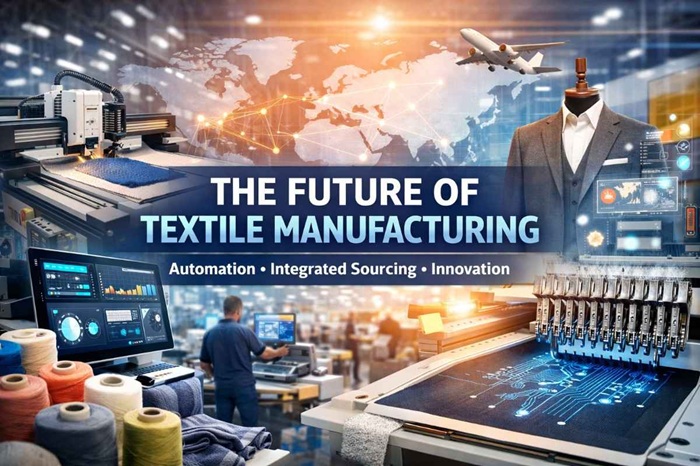
Automation, innovation, regulation are the forces shaping textiles in 2026
The global textile sector has entered a new era. Early 2026 saw the industry breach a $1.06 trillion valuation, reflecting... Read more
The new Brussels rulebook, every EU apparel order is now a balance-sheet risk
The humble export order sheet is undergoing a transformation. What was once a straightforward commercial instrument: SKU, volume, FOB price,... Read more
Why 2026-27 could be a defining cotton year for India’s farm-to-fashion economy
The global cotton economy is entering a more constrained phase, and for India, the implications run far beyond the farm... Read more
Luxury resale’s next big battle is no longer digital, it is about who controls s…
For nearly a decade, the luxury resale story was written in the language of platforms. Market leadership was measured by... Read more
Digital Arms Race: Indian apparel giants deploy AI to neutralize tariff crisis
The Indian textile and apparel sector is in a digital survival phase in 2026, shifting from traditional labor-intensive models to... Read more
Europe’s Textile Endgame: Why Project FAE is becoming fashion’s most critical in…
Europe’s apparel majors are no longer treating circularity as a branding layer. With Project FAE or Feedstock Activation Europe, the... Read more
Engineering color at source, dye-free production is cutting cost, water, and tim…
For over a century, coloring has been anchored in wet processing, an energy-intensive, chemically saturated stage that happen post spinning.... Read more
The €11 bn deadlock, can Europe’s textile recycling catch up?
Europe is at a tipping point. Fast fashion consumption, led by rising incomes and a growing global middle class, has... Read more