As India enters the FY26-27, the textile and apparel sector faces a critical juncture characterized by an inverted duty structure. Industry leaders, including the Southern India Mills Association (SIMA) and the Confederation of Indian Textile Industry (CITI), have intensified pressure on the government to permanently abolish the 11 per cent import duty on raw cotton. Comprising a 5 per cent Basic Customs Duty and a 5 per cent Agriculture Infrastructure and Development Cess, this levy has rendered domestic cotton prices 10 per cent to 12 per cent higher than international benchmarks. Consequently, Indian manufacturers are struggling to fulfill high-value export orders for the US and EU, as regional competitors like Vietnam and Bangladesh leverage zero-duty regimes to secure market share.
Strategic shift towards value-added segments
Despite these operational headwinds, the industry demonstrates remarkable resilience. Official data for FY 2025-26 reveals a 2.1 per cent growth in total textile exports, reaching Rs 3.16 lakh crore. The Ready-Made Garment (RMG) segment remains the primary engine of this growth, contributing Rs 1.39 lakh crore, a 2.9 per cent Y-o-Y increase. However, the stagnation in cotton yarn and fabric exports - which grew by a mere 0.4 per cent - highlights the urgent need for raw material neutrality. To mitigate the volatility of cotton, many large-scale spinning units are diversifying into man-made fibers (MMF), which saw a more robust growth of 3.6 per cent, signaling a structural shift toward technical textiles and synthetic blends.
Bridging the quality gap for global logistics
The demand for duty-free access is primarily driven by a deficit in Extra-Long Staple (ELS) cotton, essential for premium garment production. Analysts suggest, removing the 11 per cent duty is vital for achieving the Ministry of Textiles' $100 billion export target by 2030. While the recent reduction in U.S. tariffs to 18 per cent offers a competitive edge over neighbors, high domestic input costs threaten to erode these gains. A permanent waiver would stabilize internal yarn pricing and allow Indian mills to function as global manufacturing hubs, integrating more effectively with newly signed Free Trade Agreements with the UK and the EU.
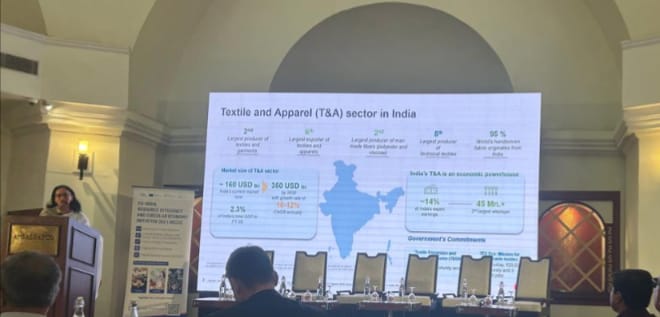
The Indian textile industry is a dominant global player in cotton spinning and ready-made garments, serving major retailers across North America and Europe. Currently, the sector is transitioning toward high-growth technical textiles and sustainable MMF blends. With a 2.1 per cent export growth in FY26, the industry aims for $100 billion in annual exports by 2030 through infrastructure modernization and trade liberalization.