FW
UK fashion industry calls for greater clarity on trade with EU
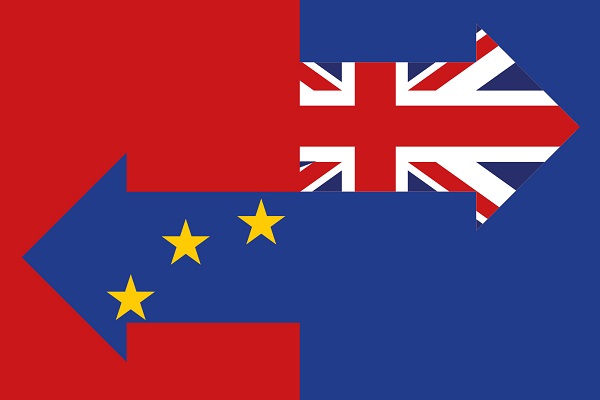
Even after 18 months of UK officially leaving the European Union, the country has failed to resolve bilateral trade issues. As Mark Neale, CEO, Mountain Warehouse opines, supplying materials to retail stores in Europe has become more complicated and tiresome post Brexit. Increased costs and bureaucracy have made trading more challenging in the region with sales of smaller brands and businesses declining.
Customs duties hitting fashion exports
Goods not manufactured in the UK and EU are being subjected to customs duty while crossing the UK-EU border. As a Drapers Online report reveals this is creating profound issues that have become even more complex in the past 18 months. Suppliers are splitting their shipments before dispatching them. They are shipping directly to a warehouse in the EU and separately to a warehouse in the UK, leading to a significant costs escalation.
And as Simon Berwin, Owner, Simon Berwin Advisory and Former Managing Director, Berwin & Berwin explains, his fashion clients are losing customers as they have been unable to supply products into Europe due to an increase in duties. The duties paid by UK businesses and consumers on goods imported into the country have surged by 62 per cent to £4.7 billion. Fashion exports have also been hit hard because of higher duty and customs charges.
UK textile and leather exports to the EU have declined 45 per cent compared to the rest of the world, indicates a Resolution Foundation and the London School of Economic report. The report ‘The Economy 2030 Enquiry: The Big Brexit’, assesses the scale of change caused by Brexit. It attributes the fall in export relationships to the inability of SMEs to afford the costs of non-tariff trade barriers or comply with the rules of origin requirements under the EU-UK Trade and Co-operation Agreement (TCA). And as Guy Mor, Co-founder, 3RD Rock says, many small businesses are dealing with rising shipping, VAT charges and duties. However, businesses can recover import VAT duties through a VAT registration in the EU country of import.
Need for greater clarity on trade issues
In force since January 2021, the Northern Ireland protocol of Brexit withdrawal agreement governs the unique customs and immigration issues at the border in Ireland between the UK and Northern Ireland and the European Union. The remaining of Northern Ireland as a part of the EU for supplies/movements of goods makes certain customs formalities applicable to goods moving between Northern Ireland and Great Britain. This increases the administrative burden of the EU as Northern Ireland requires special border with the Union.
Experts point out, issues are arising because of the requirement of border checks by EU on goods imported from non-EU countries. This is resulting in customs checks at Northern Irish ports, he adds. The UK government is looking to simplify trade between Great Britain and Northern Ireland. But this is threatening its relationship with the EU and creating issues with respect to a united Ireland.
The fashion industry is also calling for greater clarity and a honest dialogue on trade issues with Europe, sums up William Bain, Head - Trade Policy, British Chambers of Commerce.
Cambodian exports up 26 per cent, non-garment products grow higher
Cambodia’s exports from January 2022 to August 2022 were up 26 percent compared to the same period in 2021.
The total value of the country’s international trade rose by 21 percent. Imports increased by 18 percent during the period. Exports increased by 37 per cent.
The US is the biggest market for Cambodia’s products. Vietnam and China are the second and third markets. Garment, footwear, and travel goods have the country’s biggest share of total exports, but the non-garment product exports are on a significant increase.
New factories opening up are viewed as investors’ high confidence. Promulgated investment law and free trade pacts bilaterally and multilaterally are also factors that have opened the markets for Cambodia-made products as well as attracted new foreign direct investments.
But due to the signs of an impending recession in the US and Europe, demand and purchase orders have seen significant drops in the second half of 2022.A quarter of garment manufacturers in Cambodia are looking to partially suspend operations in September or may require their workers to work less hours. Operations in some 100 factories are suspended, affecting around 10,000 workers.The entire sector, consisting over 1,200 garment, travel goods and footwear manufacturers, employs about one million workers.
Bangladesh targets ten per cent global apparel share
Bangladesh expects to get a ten per cent share of the global apparel market by 2030.
This hope is based on the potential of the markets in Europe, the UK and the US amid a declining share of Chinese garments. But in order to reach the ten per cent target the country has to achieve an annual export growth of 11 per cent.
As Chinese apparel export share is declining in western markets due to the rising tension between the west and China, Bangladesh’s exporters are likely to take advantage of the situation to boost their products. China is moving away from low value-added apparel to more sophisticated items, and this can be an advantage for Bangladesh’s apparel exporters.
However Bangladesh has to deal with issues like logistics, port handling capacity and skilled labor, environment and labor rights. Bangladesh must focus on AI-developed equipment, skilled labor and labor wage satisfaction to face the challenges in the coming years.
In fiscal 2021-22 Bangladesh’s export share was up by 36 per cent year-on-year. Earnings from July to August grew by 26 per cent compared to the same period of the last fiscal year. Bangladesh’s apparel exports to the EU grew by 59 per cent in the January to June period of 2022.
Retailers look at lower earnings with inflation squeezing consumer buying
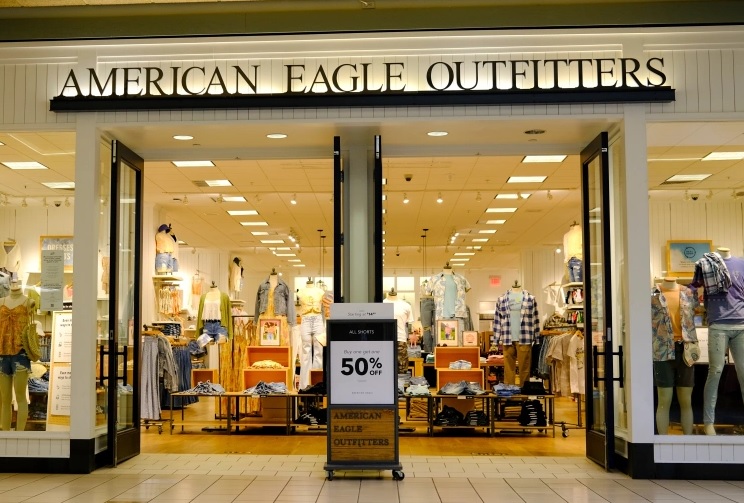
American Eagle is no longer soaring high as it joins the growing list of premium clothing retailers reporting bleak earnings worldwide. The apparel industry is currently trying to figure out what the consumer wants in post-pandemic period with lower demand as inflation squeezes tight budgets of the average middle-class consumer.
Quarterly revenues lower than expectation
American Eagle recently suspended its dividends as in the latest quarter, it fell 6 per cent from a year ago The company echoed other retailers’ issues with excess inventory and joined the bandwagon of retailers like Macy’s and Nordstrom who have resorted to extreme markdowns to clear products off shelves.
Chief Operating Officer Mike Mathias points out, ‘slowdown in demand’ caused by the macroeconomic environment. Jen Foyle, Chief Merchandising Officer at American Eagle, says the brand’s priorities are “adjusting our assortments and rightsizing inventory.” The need for markdowns to move inventory has upset the bottom line of American Eagle, with the company posting earnings of 4 cents per share for the quarter ending July 30, which fell short of the 13 cents per share expected by industry analysts.
American Eagle Outfitters, the parent company to American Eagle, Aerie, Bodd Synder and Unsubscribed brands have all recently posted dismal quarterly results, falling short on both top and bottom lines but still beating analyst expectations for the three months ending August 1, 2022. Except for intimate brand, Aerie which continues to be the retailer’s crown jewel, the company seems to be flying in grey and troubled skies.
Brand revenues of American Eagle declined 26 per cent during the quarter, while Aerie’s sales surged 32 per cent. Meanwhile, revenues in the company’s e-commerce business grew 74 per cent, or 47 per cent at American Eagle and 142 per cent fir Aerie. App downloads also increased during the quarter by 45 per cent. Even then, the company as a whole lost $13.7 million during the quarter, compared with profits of nearly $65 million at the same time last year. That’s on top of the company’s $257 million loss the quarter before that.
Rival Macy’s also slashed its revenue and earnings forecast for the year, with Chief Financial Officer Adrian Mitchell noting it has had to take necessary markdowns necessary to help clear inventory in all segments as “weakening apparel sales over the quarter as the consumer faces higher costs on essential goods, particularly grocery”.
Other retailers including Walmart, Target, Gap, and Kohl’s have also faced similar problems with bloated inventories and are employing various measures to stay afloat in the post-pandemic inflation-wary consumer. Walmart has focussed on aggressive markdowns to move clothing off their shelves which have led to a significant cut in profit expectations. Gap and Kohl’s, meanwhile, are looking to avoid some markdowns with a “pack-and-hold” strategy for certain items, which allows them to reserve excess inventory until demand rises.
While physical stores are currently loss-making, American Eagle Outfitters has been in expansion mode having launched ecommerce businesses across Japan, Hong Kong, Australia, Malaysia, Taiwan, and Singapore, in addition to a shopping site in Mexico.
However, experts feel by 2023, retailers might be able to adjust more quickly to demand as the supply chain normalizes, although for now, they need to struggle to adjust their offerings. The focus will be on expansion in important international markets where there is significant opportunity for growth, even though these may be smaller countries that were not on the map in pre-covid times.
Christmas bells jingling for India with export of festive items on the rise

The Yuletide is a couple of months away and Indian exporters of Christmas offerings have reasons to deck their companies with successes. It has been reported that India now ranks among the top five countries that makes the festive season merry in the US with offerings of festive T-shirts and decorations. According to US Customs, the total value of festival-related goods has jumped roughly three times compared to last year, with a value of $20 million.
Indian exporters gain edge
India edged out fellow competitor Philippines as buyers spread out with their orders, prompted by China’s strict lockdown as Covid-zero regulation came in to force coupled with rising labour costs. As Amit Malhotra of Asian Handicrafts says, orders are up 20 per cent from a year ago and they have increased production capacity accordingly. This year they have shipped over 3.2 million Christmas products, up from 2.5 million last year.
Even though China exports a sizable portion of Christmas items, a lot of first-time customers have just begun approaching Indian exporters. India exported festive items to over 120 countries already and in 2020-21 (April-Nov), such exports were valued at $39.3 million. Indian government stats show, export of festive-season items increased over 54 per cent from the fiscal 2020 levels in the year that ended in March, while exports of handicrafts increased by about 32 per cent over the same period.
United Arab Emirates, US, Mexico, Thailand and Philippines are the top five importers Indian Christmas items together accounting for 43 per cent of exported items. As Siddharth Jain, Partner in Kearney’s operations and performance practice says, China’s continuous decoupling from the global economy and the post-pandemic recovery presents an opportunity for India to accelerate its investment in lengthy competition and prioritize ‘capable of winning’ areas.
Tapping a growing market
The opportunity doesn’t end with Christmas. Over the past three years, India’s export of handmade carpets has grown substantially. India accounts for roughly 40 per cent of global exports of handmade carpet exports worth $1.37 billion in FY20. From April 20 to February 21 India’s the total carpet exports stood $1.33 billion. It seems global markets have acquired a taste for handmade goods from India. The list includes: woolen, embroidered & crocheted goods, hand printed textile & scarves, brocade among others.
Indeed, India has the potential to overtake China in handcrafted items that not only bring merry during the holiday season but also throughout the year. The big companies that are importing from India include: Walt Disney, Target, Harrods in London and Dillard’s Inc.
Inflation shakes up low-cost China markets
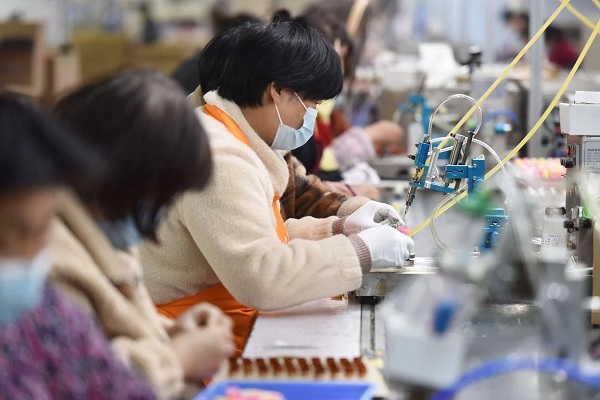
China has always been synonymous with low-cost and mass production. However, the ongoing slow recovery from pandemic has led to rampant inflation in pricing, since the lockdown has changed demand in the goods sector and interrupted supply chains. The new virus has led to a further lockdown and there is no knowledge what the economic future of the country would be.
Headwinds with inflation and supply chain pressures
Although experts feel global inflation should come down soon as the situation improves, it’s still true that the world is on the verge of a global inflation regime after Covid. Supply chain disruptions due to China’s zero-Covid policy have resulted in brands looking at reshoring production. The global market is dependent on China not only in the luxury segment but also for low-cost mass production.
Experts are concerned the deflationary drag may go into reverse in China. Its working-age population is expected to shrink significantly in the next few years, while rapid wage growth means labor is now more expensive. The government’s policy of ‘common prosperity’ for all threatens to drive wages even higher. If common prosperity leads to centrally-mandated increase in wage growth that far exceed productivity, then it could be more troublesome. Rising labor costs have historically tended to cause external competitiveness to deteriorate, resulting in import substitution and the destruction of domestic industry.
Meanwhile, these structural changes are happening against a backdrop of more hawkish trade policies towards China that threaten to break up supply chains. In contrast to other countries such as Mexico, which has seen similar increase in earnings, wage growth in China appears to have been justified in large part by rapid increase in productivity. Most workers in China have been paid more for producing more goods, keeping unit labor costs down and in the process becoming even more competitive.
Although Chinese customers spent on luxury brands in spring 2020, the ensuing revenge spending after Covid has encouraged many brands to open new stores or refurbish others while investing in digitalization efforts. A more significant decline in the number of workers will drive up output prices in the longer term.
Labor market a cause of concern
There is a hidden slack in other parts of China’s labor markets that need to be focussed on. Although construction has been a major source of employment before, post-Covid, there is not much need to sustain rapid house building and this will free-up workers. Also, China has a casual and unprofessional labor market with almost half of all workers operating in the shadow economy. Not all workers are mobile or possess the required skills to enter new industries. Also, absorbing these workers into more productive sectors is a must for the country to thrive.
The clothing and footwear sectors are labor-intensive, so these could be candidates for inflationary pressures to emerge but delving into data shows that a transformation here is already happening. China’s share of global textiles exports has already peaked, at around 40 per cent in 2015.
With many labour-intensive manufacturing apparel brands already having left China, the future of the country looks bleak, But global market experts know that life is like a wheel and will always come back to where it all started.
Vietnam hopes for bigger UK market share
Vietnam’s garment exports to the UK were up 88 per cent in August 2022 as compared to August 2021.
Vietnamese enterprises are taking advantage of the UK-Vietnam Free Trade Agreement to expand their presence in this market.The UK accounts for less than two per cent of Vietnam’s total export value of garments.
However, with the advantage of lower tariffs thanks to the agreement, Vietnam has a big chance to expand its market share. Under the agreement, about 42 per cent of Vietnamese textile and garment exports will be liberalised at entry into force, while some garment products will see tariffs eliminated after six years.
Vietnam is the world’s third largest exporter of garments. But the industry is facing many difficulties including a steep fall in export orders due to soaring inflation in major markets and rising input costs. China’s strict pandemic control, where more than 50 per cent of raw materials for the Vietnamese textile and garments are sourced, has pushed up input costs.
In addition, the EU has introduced new regulations on the textile industry, including replacement rates, green products and switching from fast fashion to sustainable fashion, which makes it harder for Vietnamese apparel products to enter this region.In this context, the UK is emerging as a promising market.
Tirupur India turns to turmeric, bamboo and new fibers
Tirupur garment manufacturers are now finding a wider use of natural products like banana fiber, hemp, bamboo, and coconut fiber.
Hosiery makers in this knitwear town are experimenting with different natural products for fibers, colors, and even printing. Apparel and fashion brands in the international market are promoting sustainability, and since customers of these brands do not mind spending a little more, these brands are looking for suppliers of naturally dyed garments. This trend is encouraging many manufacturers in Tirupur to explore different natural sources for dyes. While cotton is a natural fiber used to make apparels, disposal of garments is a problem because of the dyes and chemicals used. So there is a big demand for natural dyes, even in domestic garment brands.
Apparel producers are not using turmeric or banana fiber directly on the garments. Instead, these natural products are processed and the by-products are used for dyeing. The company also plans to explore natural dyes sourced from suppliers for T-shirts.
US apparel spending drops
For the past five months, spending growth on apparel in the US has been lower than growth in overall spending,
Several spending categories have experienced price decreases. US gasoline prices have been declining since June. The rate of year-over-year increases in US clothing prices has slowed from rates near seven per cent to those below five per cent.
While there has been a deceleration in hiring in August, jobs are still being added at a rate above the long-term average. The US economy added 3,15,000 jobs in August. The unemployment rate increased marginally, from 3.5 per cent to 3.7 per cent. This was primarily due to a substantial month-over-month increase in the labor force. The larger increase in workers relative to the labor force over the past year implies a tightening in the labor market.
In July, overall consumer spending increased 0.2 per cent month-over-month in inflation-adjusted terms. Year-over-year, real spending was 2.2 per cent higher. Spending on garments rose 0.7 per cent month-over-month and was up 2.1 per cent year-over-year.
Import volumes have been strong. Import costs continue to rise. In July, the average import cost per square meter of cotton-dominant apparel was up 23 per cent year-over-year, reaching the highest value since 1990.
India asks for duty relief on cotton imports
The Southern India Mills Association (SIMA) has appealed to the union government not to levy import duty on cotton during the next cotton season, which starts in October.
This, says SIMA, will enable the industry to achieve its potential growth rate and sustain its financial viability apart from protecting the jobs of over 35 million people employed in the cotton textile value chain.Cotton prices even during the beginning of the cotton season (October 2022 to September 2023) when arrivals will be high are anticipated to be more than the minimum support price.
Hence, duty free imports would not affect farmers. If needed, the government can consider levying the duty only during the peak arrivals of the season (December to March) to avoid recurrence of a crisis during the end of the cotton season 2022-2023.
Following the removal of the import duty on cotton in April and the changes brought about in MCX cotton trading, domestic prices have softened. MCX cotton prices have reduced over 25 per cent in the last one week. Domestic cotton arrivals have started early and the cotton prices have reduced. However, Indian cotton prices are still higher by 15 per cent to 20 per cent compared to international prices, especially with countries such as Pakistan and China.