FW
China industrial output up three per cent
China’s value-added industrial output increased 3.1 per cent year on year in September 2021 reveals National Bureau of Statistics data. This was up 10.2 per cent over the same period of 2019. The two-year average growth reached five per cent. It edged up 0.05 per cent from the previous month. In the first three quarters, China’s value-added industrial output grew by 11.8 per cent year on year.
Industrial output, officially called industrial value added, is used to measure the activity of certain large enterprises.
The manufacturing output increased by 2.4 per cent year on year in September and 12.5 per cent in the first three quarters. In September, the textile industry’s value-added output declined by 5.8 per cent while it increased by 3.7 per cent in January to September. By product, in September, the production of 255 out of 612 kinds of products increased year on year. The output of fabric decreased 1.2 per cent in September and increased by 10.1 per cent in January to September, while the output of chemical fibers dropped two per cent in September and rose 13.5 per cent in January to September. In September, the sales-output ratio of industrial enterprises was 98.2 per cent, down 0.4 percentage points from the same period of last year.
HanesBrands Q3 sales up five per cent
For the third quarter HanesBrands’ sales increased 5.8 per cent. HanesBrands is a US-based global marketer of branded everyday basic apparel. International sales improved six per cent. Global Champion brand sales increased 33 per cent over last year’s third quarter, driven by strong consumer demand across channels in the US and continued growth in Europe, and the ramp-up of partners in China.
On the other hand, US innerwear sales went up 12 per cent due to the combination of strong consumer demand across the company’s brand portfolio as well as the impact from pent-up consumer demand fuelling category growth rates above historical levels. Gross profit during the third quarter escalated to $699.6 million while operating profit rose to $234.6 million. Additionally income from operations increased to $176.7 million. By segment, the innerwear business fell 11 per cent whereas active wear sales surged 42 per cent driven by strong double-digit growth in both the Champion and Hanes brands.
The American clothing company anticipates a three per cent sales growth during the fourth quarter. It continues to make progress on its full potential plan as it invests in its iconic brands, builds talent, enhances e-commerce capabilities and modernizes its technology.
Fashion brands renew their pledge to safeguard environment with new charter
The Fashion Industry Charter for Climate Action establishes a framework for stakeholder dialogue and participation in climate action. Under the charter, the fashion industry is raising its collective ambition with updated emission reduction targets. The renewed commitments, announced recently at the COP26 meeting in Glasgow, form a decarbonizing detailed outline with Paris Agreement aspirations to limit worldwide temperature rise to 1.5 degrees Celsius above preindustrial levels. The call for companies to set scientific objectives or divide their emission levels by 2030, with a pledge to achieve net zero emissions by 2050, is core to this. This is an update on the previous target of 30 per cent aggregate greenhouse gas emission reductions by 2030.
This is a significant moment for the fashion charter. Other obligations in the revised charter include procuring 100 per cent of energy from renewable sources by 2030, sourcing environmentally friendly raw resources, and going to phase out coal from the distribution chain by 2030.
Signatories to the fashion charter collectively represent a sizable portion of the fashion industry. The charter is currently has 130 companies on board and 41 supporting organisations, including well-known brands such as Burberry, H&M, VF Corporation, Adidas, Kering, Chanel, Nike, and Puma, as well as suppliers such as Crystal Group, Tal Apparel, and others.
Morocco can seize the opportunity to emerge strong player in T&A sector
Morocco is becoming an attractive destination for global textile companies. Several brands from the European Union, the UK and the US have been sealing deals with Moroccan textile companies. Spanish brand Mango and the group Inditex as well as the French group Camaïeu have already established connections with Morocco’s local producers.
As the world’s leading textile groups are migrating from traditional Asian manufacturers to closer markets offering favorable conditions, and Morocco stands to gain from this. Logistical costs, the downturn caused by the pandemic and the increase of salaries in China have forced Western textile giants to look for more favorable partners explains Mohammed Boubouh President, Moroccan Association of textile and clothing industries (AMITH).
Distributors who used to buy exclusively in Asia are now shopping in Morocco and the country has an opportunity to become a major textile player. But there is a need to provide credit insurance for Moroccan producers to ease the export process. Moroccan textile companies which are largely specialized in packaging need to step up and become producers of finished products. The creation of textile aggregators would help as they constitute the connecting link between subcontracted producers and distributors. These aggregators have a know-how that traditional manufacturers do not have. Moroccan manufacturers lack expertise in several areas including creativity, marketing, logistics, technical development.
Drop in US cotton exports push up prices globally
American cotton exports dropped twofold from September 2021 to October 2021, reveals IndexBox data. Droughts have wiped out a significant part of cotton crops across the US, especially in Texas. Reducing yields in the US due to unfavorable weather forced American suppliers to slump exports, decreasing global market supply.
The US however, is the leading supplier, accounting for 41 per cent of global cotton lint exports. China, Vietnam and Pakistan are key importers of cotton lint from America. They have a combined 65 per cent share of total US exports. In 2020, US supplies to China grew threefold, while shipments for the other leaders experienced mixed trend patterns. In 2020, the amount of cotton lint exported from the US rose by 7.3 per cent compared with 2019. The average export price for cotton lint from the US shrank by 9.5 per cent in 2020 against the previous year. Average prices varied somewhat for the major overseas markets. In 2020, the highest prices were recorded for prices to India and Indonesia while the average prices for exports to Vietnam and China were among the lowest. In 2020, the most notable growth rate in terms of prices was recorded for supplies to India, while the prices for the other significant destinations experienced a decline.
In Q3, Italian machinery orders up 66 per cent
Orders for Italian textile machines rose 66 per cent for Q3. Domestic orders rose by 130 per cent and foreign orders were up by 54 per cent, reveals ACIMIT stats. However, the index of orders intake dropped by 17 per cent when compared to the previous quarter this year, due mainly to the summer break and a demand for machinery that has stabilized over the last few months.
Overall, the number of new orders remain positive in spite of a slight decline compared to the months prior to the summer period. This proves that Italian companies have been capable of responding quickly to new market conditions, as has often happened in other historical periods. This positive moment for Italy’s textile machinery sector is expected to continue to the year’s end. Italian machinery manufacturers are forecasting an increase in order intake for the last quarter of the year, both abroad and domestically. However, difficulties remain particularly in the areas of digitalization and sustainability.
Creativity, sustainable technology, reliability and quality are the characteristics which have made Italy a global leader in the manufacturing of textile machinery. Exports amount to more than 86 per cent of total sales. And 30 per cent of Italy’s revenue from the sale of textile machinery derives from the production of technical and innovative textiles.
Problem solving and value addition can make India a global textile leader
 The government has played a key role in the turnaround of India’s textile sector. The initiatives it introduced in the last two years, is boosting sales that had slumped to $75 billion during the pandemic, to $300 billion by 2025-26. Exports of technical textiles exceeded imports by Rs 2,998 crore in FY21 as a report titled ‘Textile Industry: Trends and Prospects' released by Infomerics Valuation and Rating, a SEBI-registered and RBI-accredited financial services credit rating company.
The Indian technical textiles market is expected to grow at a CAGR of 7.6 per cent in Asia-Pacific to reach $23.3 billion in 2027, the report states. Government plans to increase exports to five times in three years, from the current approximately $2 billion to $10 billion.
Schemes launched by the government
The government has introduced several initiatives like the Technology Mission on Cotton (TMC), Technology Upgradation Fund Scheme (TUFS), Scheme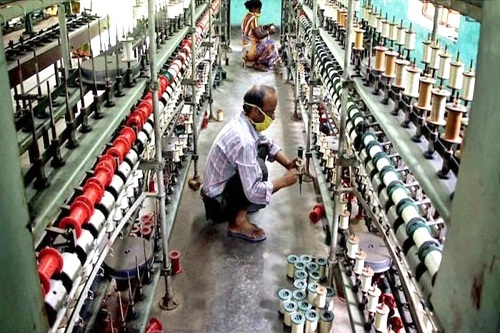 for Integrated Textile Park (SITP), etc to bolster sector’s growth. It recently introduced new schemes like National Technical Textiles Mission (NTTM) for four years with an outlay of Rs 1480 crore.
One of the largest textile and apparel hubs in the country, Tamil Nadu aims to drive innovation and reduce foreign dependence through its participation in the Techtextil India 2021 - the leading international trade fair for technical textiles and non-wovens. The state has also introduced a few other measures like the Scheme for Capacity Building in Textile Sector (SAMARTH) to train 10 lakh workers in the sector.
Low funds and other generic factors
One major challenge that the industry faces is low fund allocation, says the report. The sector received only Rs 3,631.64 crore funds as against the proposed outlay of Rs 16,883 crore during the FY22, it adds.
Manufacturing activities in the sector have reduced, raising prices of the final product as reflected in the annual NIC-2 digit and sectoral indices of industrial production, For the first time in a decade, the index for 'manufacturing of textiles' has fallen to as low as 91.1, adds the report.
The report further highlights, generic factors like weakened consumer demand or production networks; obsolete technology, inflexible labor laws, infrastructure bottlenecks and industry fragmentation due to the COVID-19 pandemic, has caused the yearly wholesale price index for 'manufacturing of textiles' to hover 6-7 notches above the decadal average of 118-point mark,.
Cementing global position
The reports emphasizes on the industry’s need to command premium prices; target niche products and markets; redesign products in higher value-added segments, the report emphasizes. The industry also needs to focus on regional and cluster subsidies, technology upgradation and skill development subsidies for sustained development, it adds.
To scale operations, the industry needs to invest in value added services, e.g., marketing, warehouse rentals, logistics, courier, other product fulfillment costs, it further adds. To cement India’s position in the global textile market, the report advises the industry to address the risk factors and the distinctive peculiarities of the sector and integrate the textile value chain.
Ted Baker’s Q3 revenue up 18 per cent
For the third quarter Ted Baker’s revenue jumped by 18 per cent. Ted Baker’s revenue from North America jumped by a third as sales are rebounding for the British fashion chain with office and party wear becoming popular again after the lifting Covid restrictions. Customers looking ahead to parties in the Christmas season are also helping. But lower level of tourism in places such as London has hurt store footfalls. Ted Baker which opened 34 years ago hopes for a full return to international tourism.
Ted Baker, known for formal wear, suiting and occasion wear, has 377 stores and concessions with three-quarters of those located in the United Kingdom, Europe and North America. Over the seven month period, the group’s revenue went up 18 per cent year over year but it’s still down 36 per cent compared to pre-pandemic levels in 2019, suggesting a longer road to recovery. Within the store portfolio there have been clear changes in footfall patterns and there is uncertainty over the timing and degree of the return to previous patterns. The upmarket retailer is now half-way through a three-year turnaround and is focused on cost cuts and boosting its online presence and product range.
Soorty introduces new stonewash for denim
Soorty, Pakistan’s largest vertically integrated denim company promises to revolutionize the traditional stonewash in denim laundry. It recently launched Zero Stone wash that offers several environmental and social advantages in the denim world, such as minimal use of natural resources, positive effluent discharge, increase in the speed of production permitting use of lower laser power and prevention of fabric tearing during laundry.
Zero Stone helps achieve stonewash appearance in denim garments without using the conventional pumice stones. This new method allows savings of resources like water, energy and chemicals. With traditional stonewash, the pumice stones and denim garments are put together in an industrial washing machine where garments are repeatedly pounded and beaten in a tumbler, which eventually gives jeans a vintage and worn look on a freshly made garment.
Zero Stone replicates the visuals of traditionally made garments but reduces the use of water and implements a positive effluent discharge rather than the emission of hazardous chemicals. Further minimizing the use of natural resources, the innovation transforms sustainable garment manufacturing at scale.
For years, Soorty has invested in disruptive technologies and developed environmentally and socially conscious denim laundry systems that help in reducing the use of water, chemicals, and energy.
Grasim Industries Q2 profit up 27 per cent
For the second quarter Grasim Industries consolidated net profit increased 27.36 per cent. Revenue from operations was up 25.71 per cent. Total expenses were up 24.16 per cent. Grasim’s revenue from viscose-pulp, viscose staple fiber and filament yarn segment was up 79.03 per cent. The viscose staple fiber business recorded the highest ever total sales volume with domestic sales volume back to the pre-pandemic level in the second quarter. The share of value-added products in the overall sales mix almost doubled year on year to 27 per cent. The revenue from the cement business UltraTech Cement was up 15.69 per cent. Revenue from the chemicals segment was up 44.48 per cent. Revenue from the financial services segment was up 21.73 per cent.
The caustic soda capacity utilization stood at 86 per cent, sequentially higher. The domestic demand for caustic soda was driven by the textile and pulp and paper sectors.
Grasim is making brisk progress to enter in paint business. The company has already acquired land at five locations as part of its pan-India footprint for paint manufacturing. These locations have been identified in different regions, based on proximity to key consumption hubs across India. Grasim Industries is an Aditya Birla Group firm.