FW
Amazon to buy JC Penney
Amazon plans to take over collapsed US department-store giant JC Penney in a move that could redefine the nature of US retailing. The retailer has a team of senior management and consultants at JC Penney’s Texas headquarters going through the numbers and the store portfolio.
And while JC Penney is planning to permanently shutter 245 of its 846 stores across the country as part of a restructure under Chapter 11 bankruptcy protection, Amazon may take over as much as the entire fleet.
The Seattle-based company already dominates the US e-commerce market with a market share of around 49 percent. Small businesses across the US reportedly sell some 4000 items every minute on the platform.
However, as a digital-native company, Amazon has very little physical presence in the form of brick-and-mortar stores. It bought the upmarket Whole Foods grocery chain in 2017 which it has now expanded to 500 stores in the US and it also developed a high-tech, small-format hybrid grocery-convenience store model called Amazon Go which now numbers 26 outlets.
Gap rolls out more robots in warehouses
Apparel chain Gap Inc is speeding the rollout of robots in its warehouses for assembling online orders in order to limit human contact during the coronavirus pandemic.
Gap reached a deal early this year to more than triple the number of item-picking robots it uses to 106 by the fall. Then the pandemic struck North America, forcing the company to close all its stores in the region, including those of Banana Republic, Old Navy and other brands. Meanwhile, its warehouses faced more web orders and fewer staff to fulfill them because of social distancing rules Gap had put in place.
Though sourcing parts in time for the eight-foot-tall robotic stations was not simple or cheap, the venture-backed startup was able to deploy 10 of them to Gap's warehouse near Nashville, Tennessee and 20 near Columbus, Ohio, with plans to finish the rollout to four of Gap's five U.S. facilities by July, months ahead of schedule, he said.
Each of these machines handles work typically performed by four people, Kuntz said. Neither the deal to triple the number of robots, nor the expedited installations have been previously reported.
Movement curbs make order execution difficult for Indian firms
According to Garment Exporters & Manufacturers Association (GEMA), curbs in inter-state movement of vehicles and shortage of workers are making it difficult to for many apparel firms to execute their current orders. Even though buyers in US and Europe are asking for discount in prices, the revival in demand is a big respite for garment firms. Peak demand season usually gets over in May but now that shops are finally opening in key markets, supply orders have been extended.
Even as Home Ministry has allowed states to decide on inter-state movement of passenger vehicles, many state governments have taken a cautious approach and are reluctant in permitting free flow of transport. While the move is aimed at containing the spread of coronavirus, restricted public transport and passenger vehicles are impacting movement of workers.
This has forced many factory-owners and garment mills to operate at a limited capacity ranging from 25 per cent to 50 per cent. Return of migrant workers to their home states has created massive shortage of manpower in industrial clusters and zones.
Deckers Brands posts 4.9% decline in Q4 sales
Deckers Brands, a designer of innovative footwear and apparel, posted 4.9 per cent sales decline to $374.9 million in fourth quarter of FY20 ended on March 31, 2020 compared to sales of $394.1 million in same period prior year. The firm’s net income during the quarter was $16.0 million while its gross profit was $192.9 million ($203.3 million).
Sales for its UGG brand during the quarter decreased by 17.9 per cent to $196.3 million while sales of Sanuk brand declined by 57.8 per cent to $13.3 million. However, sales of its Hoka One One brand jumped by 51.8 per cent to $101.9 million and Teva brand grew 12.5 per cent to $59.6 million.
Wholesale net sales for the fourth quarter decreased by 2.9 per cent to $230.7 million its DTC sales dropped by 7.9 per cent to $144.2 million. Sales in the domestic market declined by 8.4 per cent to $230.8 million. Whereas sales in international sales grew by1.4 per cent to $144.1 million.
Industry leaders urge M&S to broaden customer base
Marks & Spencer’s long-awaited move to add third-party clothing and home brands to its online and in store offer has been praised by industry insiders who also urged the retailer to capitalise on the chance to broaden its customer base.
M&S has long been fending off criticism that it should add third-party brands to its fashion offering. With the continued success of Next’s online marketplace launched in 2014, the high street stalwart has been behind the curve in enticing a younger shopper to its virtual and physical doors.
However, the recently the brand announced that that it plans to enlist the power of complementary fashion and home labels to “turbo-charge” M&S’s ecommerce channel and freshen up the retail offering in selected larger stores.
The retailer is already in commercial negotiations with a number of brands which will be introduced over the coming weeks and months. These will be across categories where M&S dominates, possibly lingerie or denim, and also sectors where it is lacking expertise or a stronghold in the market.
Post COVID-19 industry to shift to conscious consumption: Experts
During Fashion Snoops’ ‘Making sustainability the new normal’ discussion last week, many fashion experts anticipated an industry-wide shift to conscious consumption in the post-pandemic world.
Panelists agreed that sustainability is no longer optional—it’s a concept that’s now vital to staying in business.
One of the main reasons for this is society’s newfound connection with nature. As the pandemic continues on, consumer spending is slowing. People are now staying indoors more than ever and reflecting inward, taking inventory of what they truly need. Experts believe this shift in perspective will likely translate in their future purchases.
According to Nia Silva, Fashion Snoops’ materials editor, now that society is opening its eyes to the interconnectedness of all things, the industry needs to respond accordingly and start “championing the rights of nature.
But according to the experts, there’s still more that needs to be done—and sizable change requires sizeable adoption. Panelists agreed that legislation would help motivate businesses to act more sustainably, as companies that fail to adopt sustainable practices often do so because of budget concerns.
SIMA upholds extension of term loan moratorium period for the apparel industry
 Ashwin Chandran, Chairman, The Southern India Mills’ Association (SIMA) has stated that the extension of moratorium period of term loan for another three months i.e., upto August 31, 2020 has come as a sigh of relief for the ailing textiles and clothing industry. He stated that the MSME package announced by the Finance Minister on May 13, 2020 under ‘Aatma Nirbhar Bharat Abhiyan’ would benefit MSME segments and today’s RBI announcements would benefit the non-MSME industrial units to mitigate the financial crisis.
The deferment of interest on working capital, reduction of margin money for working capital and the relaxation of prudential financial norms are the welcoming features of the announcement made by RBI Governor. SIMA Chairman stated that the extension of the permissible period of pre & post-shipment export credits by three months and the time for remittances against normal imports from six months to 12 months would also greatly help the exporters and importers to ease their liquidity.
SIMA Chief has stated that the Indian textiles and clothing industry had been facing long drawn recession and demanding two year moratorium period for repayment of all term loans well before the COVID impact needs at least another seven months moratorium period i.e., upto March 31, 2021 to avoid large number of textile units from becoming sick and NPAs. He has stated that the international and domestic demand for textiles and clothing is likely to drop by 30 per cent with the existing lockdown condition during the current financial year. Ashwin pleaded with the government to allow one time debt restructuring for the textiles and clothing industry that would greatly help the mother industry that employ over 105 million people to prevent job losses and sustain the survival and revive from the unprecedented crisis.
SIMA Chairman has pointed out that though RBI has been making announcements, several banks are yet to extend the various benefits relating to interest rate reduction and additional working capital already announced by RBI on 27.3.2020. He has pleaded the Hon’ble Prime Minister to intervene in the matter, direct all the banks to extend the various benefits announced by RBI immediately so that the industry could tide over the COVID crisis.
Despite COVID-19 US apparel industry’s revenue to grow in 2020: Survey
 A new forecast by the Institute for Supply Management published in the ‘Spring 2020 Semiannual Economic Forecast’ indicates that in the US manufacturing, revenue, capital expenditures and utilization are all expected to contract substantially this year due to the coronavirus pandemic.
However, the same survey reveals a surprisingly buoyant outlook for US apparel and leather industry for the rest of 2020. This upbeat outlook mainly stems from the ability of these two industries to divert their production to the manufacturing of PPE when the pandemic forced their stores to close and orders dwindle, and the potential for new core business now that retail is beginning to reopen.
Textile production to decline by 3.6 per cent
The survey states, non-manufacturing industries including agriculture, transportation, warehousing and retailer are likely to record a 10.4 per cent net decrease in their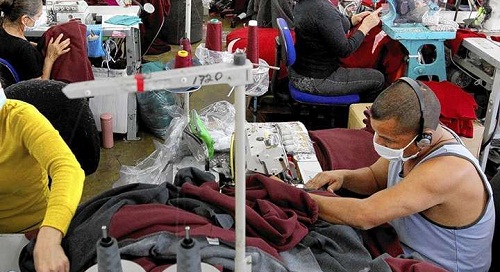 overall revenues. The capacity of these industries to produce products or provide services is expected to decrease 2.8 per cent during 2020.
In terms of manufacturing industries, the production capacities of 11 industries including textile mills is expected to decrease by 3.6 per cent in 2020. On the contrary, production capacities of five manufacturing industries are expected to increase in 2020. These industries include apparel, leather and allied products. Their capital expenditures is also expected to increase in 2020 compared to 2019.
Apparel prices to decrease by 2.8 per cent
In the December forecast, respondents had predicted a 0.4 per cent increase in prices they paid for products during the first four months of 2020. The industries that they reported an increase in prices included textile mills. These respondents now report a 2.8 decrease in prices in 14 industries that also include apparel, leather and allied products.
The prices of products in seven manufacturing industries including textile mills expect their prices to increase in 2020, while 11 industries including apparel, leather and allied products expect prices to decrease.
In non-manufacturing business, executives expect prices to increase on an average, 3.9 per cent as compared to prices at the end of 2019. The 11 industries predicting price increases for all of 2020 include wholesale trade, and transportation and warehousing, while among the seven industries expecting price decreases for 2020 were agriculture and retail trade.
Apparel revenues to grow, textile to contract
Apparel, leather and allied industries also expect their revenues to grow in 2020. On the other hand, revenues of 15 manufacturing industries including textile mills are expected to contract. The revenues of 18 non-manufacturing industries including agriculture, transportation and warehousing; retail trade and wholesale trade are also expected to fall.
The revenues of purchasing and supply management executives in manufacturing business are expected to contract by 10.3 percent. This is 15.1 percent lower than the 4.8 percent increase forecast in December.
L Brands’ revenues decline by 37.1 per cent
Revenues of L Brands the Columbus, Ohio-based owner of Victoria’s Secret and Bath & Body Works declined 37.1 per cent in the first quarter of 2020 that ended May 2, 2020. The company’s net sales declined to $1.654 billion from $2.629 billion in the prior-year period, largely due to the fact that the retailer’s stores have been closed since March 17, in response to the ongoing Covid-19 pandemic.
The largest decline was seen at the Victoria’s Secret the lingerie brand, whose sales declined from $1.5 billion to $821.5 million. The sales of Bath & Body Works saw a less notable decrease. Its sales declined to $712.7 million from $870.7 million recorded in the same period in the previous year. The brand’s direct business achieved a year-over-year increase of 85 per cent in sales, which totaled $288.9 million, compared to $156.4 million.
Overall, L Brands reported a net loss of $296.9 million plummeting from net income of $40.3 million in Q1 2019.
US online apparel sales grow 98.4 per cent
Recent data from eShopWorld shows, April’s year-over-year apparel orders in the US grew by 98.4 per cent followed by sporting equipment with 96.2 percent growth in order volume, and footwear which saw 60.2 per cent growth in order volume. The categories continued to see growth in the first half of May at 118 percent growth, 58.5 per cent growth and 106.6 per cent growth year-over-year, respectively.
Many brands in these categories experienced exponential sales during this time. Brands that reacted quickly to properly address international markets during the pandemic saw the most growth. Companies that were able to offer easy availability through e-commerce were able to effectively and efficiently acquire a larger share of the market with new audiences.
The top 10 countries that consumed US brands for April year-over-year included Israel, Ireland, New Zealand, Canada, United Arab Emirates, Chile, Australia, Belgium, Switzerland and France, ranging from 92 to 178 percent growth in order volume. Returns from e-commerce consumers also lowered during this period.