FW
L Brands in talks to sell Victoria’s Secret to Sycamore Partners
L Brands may sell Victoria’s Secret to Sycamore Partners. Victoria’s Secret is an intimate apparel brand selling bras, pajamas, perfumes and other accessories. For years the retailer has faced criticisms for an out-of-date focus on sexy styles while competitors prioritized comfort. This November, it canceled its once-annual fashion show as viewers increasingly shunned the provocative show.
For the past five years, L Brands has focused on the diversification of its supply chain over the past five years. The company has been in negotiations with Chinese suppliers to take costs out of the production chain to offset the increases. Sycamore has a history of taking bets that its peers eschew. The private equity firm is one of the few to continue to invest in retail. Many of these bets have been accompanied by bold and creative strategies. Sycamore financed its acquisition of beleaguered office retailer Staples in a way that allowed it the flexibility to wind down its retail business while retaining its stronger business-to-business segment. Sycamore has past ties with L Brands’ predecessor, Limited Brands. The firm took a 51 per cent interest in Limited Brands’ sourcing business, Mast Global Fashions, in 2011. The company, now known as MGF Sourcing, has helped Sycamore put together a retail and apparel empire that also includes Talbots and Torrid.
More US companies get GOTS certification
Almost 39 US textile companies were certified by the Global Organic Textile Standard (GOTS) in 2019. Among them were a knitter, four cotton gins, 14 manufacturers and some 20 retailers.
GOTS covers the processing, manufacturing, packaging, labeling, trading and distribution of all textiles made from at least 70 per cent certified organic natural fibers. Products may only be sold with a GOTS label only if the entire supply-chain is certified and the necessary scope and transaction certificates have been obtained to prove certification. An independent on-site inspection is carried out annually by GOTS-approved certifiers.
GOTS has a consumer facing label. This acts as a proof the product is organic and sustainable. It helps the consumer to take a buying decision when at a retail store. When buyers ask for a credible third party certification or GOTS certified products, this will ensure the production is done in an environmentally responsible manner. Plant based dyes are trending. India exports certified products. But certified suppliers now want to sell products in India. Airports sell GOTS labeled T-shirts. Zodiac has got a GOTS certification for their production activities in India. They sell organic certified shirts under the brand Z3.
Paris hosts World Linen Forum
World Linen Forum held in Paris from February 9 to 10 with over 200 international decision-makers from 15 countries. As per the European Confederation of Flax and Hemp (CELC), the first event met with great success in 2018. Among others, businesses from China, Japan and India were also represented. The event was the occasion to officially acquire ISO Standard 320706-1 certification for the sector. In the works for over seven years, this certification provides brands with a guarantee of the fiber composition in their collections, avoiding any risk of counterfeiting.
Europe accounts for 80 per cent of linen production. Eco-friendly, cultivated without fertilizers and with low-water consumption, this fiber is produced in Europe on a thin strip of land that spans from the Netherlands to north-western France, serving as the main supplier. Despite its 10,000 businesses across 14 countries in the EU, this sector must rely almost exclusively on foreign processors to yield thread and fabric. Creating a dialogue centered on common themes between the sector’s different players is thus strategically essential.
If flax represents only 0.4 per cent of the worldwide textile fibers today, it has many advantages pushing it towards one per cent. Linen Matrix 2019, a publication with a global cartography of the sector, provides informational guidelines and common foundations to guide the linen industry’s ambitious future.
Marks & Spencer doubles marketing spend for next season
Marks & Spencer, which sells 15 pairs of jeans every minute, plans to launch its first denim-based TV campaign besides doubling its marketing budget for an ad campaign. The brand plans to double on its “killer categories” of denims which also includes knitwear and sleepwear.
This is the third marketing campaign for M&S Denim in less than a year. It is designed to spotlight the progress and strength of M&S’s denim business focusing on style, fit and value.
M&S has reenergised its denim business recently by incorporating new styles and products like the “Harper” cigarette cut jean into the category. One of its new women’s styles, the “Ivy” skinny jean, is already a bestseller, prompting M&S to release a brand-new women’s style for the spring campaign known as “Magic Jeans. These jeans have a slimming effect thanks to high waists with gap-proof waistbands, “flattering tummy technology,” and bi-stretch denim. In fact, skinny jeans are the most popular cut at M&S and almost 300,000 pairs of its Ivy style sold between October and December of 2019 at a price of 19.50 pounds.
Men’s wear is more focused on old-school aesthetics, and M&S is taking on the trend with a Vintage range, selling for 29.50 pounds ($38.34) in three fits: skinny, straight and slim. Skinny styles are also increasingly popular among men with sales of the cut increasing by more than 150 per cent, year-over-year.
C&A partners Paikstan textile mill for Beluga denim
An off-white denim created by retailer C&A, Pakistan textile mill Rajby Textiles and circular economy consultants Eco Intelligent Growth (EIG) has become the world’s first to receive a platinum Cradle to Cradle certification.
Beluga denim is made from 100 per cent Global Organic Textile Standard (GOTS)-certified organic cotton fiber, is fully recyclable and is produced using a specially-designed closed-loop water system. It is 100 per cent carbon neutral in the final manufacturing stage.
To achieve the highest level Cradle to Cradle certification, Rajby and C&A worked together to research and identify the most suitable materials and chemicals for the ecru fabric. The denim had to be made entirely of safe and rapidly renewable ingredients, both fibers and chemicals, which meant that no oil-based dyes, auxiliaries or other chemicals could be used. Rajby and C&A also worked closely together to ensure that Beluga would be actively cycled into new product after its usable lifetime, instead of becoming waste. The fabric was tested to ensure it met the highest-level requirements for all five Cradle to Cradle categories: material health, material reutilisation, renewable energy and carbon management, water stewardship and social fairness. C&A is expected to launch the first garments made with Beluga denim in about four months.
Non-woven city runs at full throttle to supply
The outbreak of novel coronavirus triggers run on medical and health textiles, driving the production of non-woven at full throttle across the country, particularly in Xiantao city, Hubei Province, best known as China Famous City for Non-Woven, a city home to over a hundred of non-woven manufacturing companies.
According to the city government, there are 137 companies producing protective gear, of which
113 companies are specialized in medical and health textiles. As of February 9, 83 of them have resumed production in Spring Festival holidays to respond to demand urgency at a time when the whole country is mobilized to fight coronavirus. Among these 83 working manufacturers, 10 companies work on medical and health garment, 28 on non-woven, 45 for face masks and protective clothing, leaving 30 companies yet to go into production after in-situ qualification survey and accreditation by expert procedures.
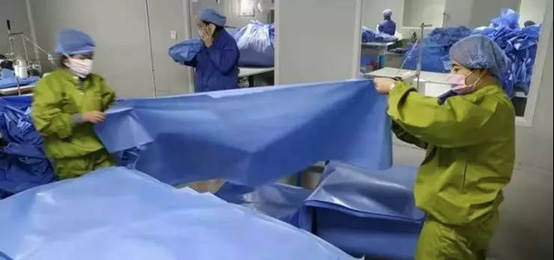
To stand up to the public health emergency, local government plays a very important role in marshalling resources through organizational efficiency and responsible leadership in stepped-up efforts to quickly resume production in time of need. The update on February 8th shows that the daily output of protective clothing has reached 30,000 pieces, a target set by provincial government, temporarily easing the shortage of supply.
Furthermore, the city government of Xiantao issued [Regulation on Production Order for Non-Woven Manufacturers] to make sure that the existing protective textiles companies measure up to the industrial, social and environmental standards in all perspectives on corporate-compliant basis, particularly in terms of the licenses for hospital appliances production and the registration certificate for medical and health supplies, enabling health-purposed products themselves to be healthy in a quality-centered supply chain.
Contributed by Mr. ZHAO Hong
He is working for CHINA TEXTILE magazine as Editor-in-Chief in addition to being involved in a plethora of activities for the textile industry. He has worked for the Engineering Institute of Ministry of Textile Industry, and for China National Textile Council and continues to serve the industry in the capacity of Deputy Director of China Textile International Exchange Centre, V. President of China Knitting Industry Association, V. President of China Textile Magazine and its Editor-in-Chief for the English Version, Deputy Director of News Centre of China National Textile and Apparel Council (CNTAC), Deputy Director of International Trade Office, CNTAC, Deputy Director of China Textile Economic Research Centre. He was also elected once ACT Chair of Private Sector Consulting Committee of International Textile and Clothing Bureau (ITCB)
New technologies, creative services to shape future fashion retail
"Marked by an unrelenting and disruptive consumer revolution, the past decade made mobility a make-or-break factor for fashion retail businesses. Factors responsible for this change included demographic shifts, rise of the smartphone, the ubiquity of the internet, the changing role of stores and competition from unexpected rivals."
 Marked by an unrelenting and disruptive consumer revolution, the past decade made mobility a make-or-break factor for fashion retail businesses. Factors responsible for this change included demographic shifts, rise of the smartphone, the ubiquity of the internet, the changing role of stores and competition from unexpected rivals.
Reevaluating the fundamentals of their businesses, retailers noticed certain factors like a transition from a linear to circular economy, globalisation of supply chains, explosion of cities and the need for sustainable energy testing the trust of their customers. As a recent Lifestyle Monitor survey revealed, though the expenditure of customers on apparels increased significantly in last 10 years, their mode of shopping changed. While in 2009, around 32 per cent consumers spent most of their money on shopping from brick and mortar stores. By, 2019, this figure dropped to 24 per cent with around 43 per cent consumers preferring to shop online.
Informed consumers lead to change in retail models
The decade also brought about the democratisation of information and an informed consumer class. The concept of a retailer or a company promoting an idea to shift the paradigm became harder to execute as consumers were already aware of what they wanted to buy. They also have access to all materials that industry insiders use as runway shows are live streamed and look books are posted the moment they drop.
An easy access to the internet also gives consumers innovative ideas to buy clothes online. As the Monitor™ survey revealed, last year around 38 per cent consumers got their clothing ideas online. On the other hand, the influence of store displays and windows decreased from 42 to 33 per cent. To meet changing needs, retailers started investing in mobility for top-down changes to their business models. They are delivering streamlined, personalised paths to purchase.
Digital disruption leading to store closures
A study commissioned by SAP in January 2019 assessed the adoption of intelligent technologies to support the digital transformation journey in the last decade. The research examined companies who were actively undergoing digital transformation and had already implemented at least two innovation technologies. The study revealed that digital disruption has taken a toll on the retail industry with thousands of store closures affecting everyone from mass merchants to luxury stores.
Although thousands of retail doors closed, many new stores opened, including previous online-only brands like Bonobos and Indochino. But another reality for the fashion industry is consumers aren’t purchasing as much as they used to. Their interest in quality has increased with around 51 per cent willing to pay more for better quality garments, a measurable increase from 47 per cent a decade ago, reveals the Monitor™ research.
Growing preference for cotton apparels
The preference for cotton apparel remained strong with nearly 79 per cent consumers preferring clothes made of cotton as against 3 per cent preferring silk and polyester each. Over 76 per cent consumers believe cotton garments to be of better quality compared to 49 per cent a decade ago. They prefer to shop from brands like Patagonia and Noah that have a point of view and ethos that squares with their own, as opposed to the label with the cheapest price.
Brands like Badgley Mischka, Levi’s, Adidas and Tapestry, who adopted SAP, have been able to make it through some of the retail’s roughest waters as they realised the value of intelligent digital transformation, enhanced mobility functionalities and an elevated customer experience.
In future, consumers will expect retailers to be more involved in their lives as trusted partners. To deliver on these expectations, retailers will need to earn their customer’s trust by embracing new technologies and being more creative about the services that they provide.
Nomadic inspirations dominate as designers create fashion styles
"For decades, United States has been inspiring designers to create new and innovative designs but now the growing influence of millennials and Gen Z is forcing them to look to other regions of the country for inspiration. As millennials value experiences over traditional markers of success and adulthood like home ownership, marriage and children, they are driven by tendencies like a nomadic lifestyle, wellness, spirituality and even psychedelia."
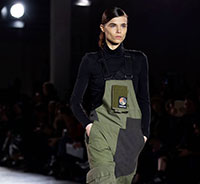 For decades, United States has been inspiring designers to create new and innovative designs but now the growing influence of millennials and Gen Z is forcing them to look to other regions of the country for inspiration. As millennials value experiences over traditional markers of success and adulthood like home ownership, marriage and children, they are driven by tendencies like a nomadic lifestyle, wellness, spirituality and even psychedelia. Designers are capturing their desire for freedom in a series of crisscrossing trends, including: utility, wider silhouettes, workwear, outdoor, unisex fashion, natural dyes, tie-dye, sustainable fabrications and performance fabrics for lifestyle.
A region that fulfills the desire of these designers is the Pacific Northwest where the natural beauty of Washington’s rainforests, Oregon’s windswept shorelines and snow-capped Mt. Hood coexist with a level of intelligence and imagination that rivals Silicon Valley. Hence, the fashion that comes out of this region is a mix of outdoor adventure and hoodie-wearing CEO. This look is grounded with garments like plaid shirts, utility vests and pants, puffer vests, polar fleece tops and CPO shirt jackets.
Loose fitting, nature-inspired patterns with rustic colors
For men, the nomadic look includes relaxed, loose fits, nature-inspired patterns and “active rustic” colors like orange and gray. Fabrics include traditional suede, faux leather, organic cotton and linen, while denim favors classic blue and earth colors like rust, brown and olive. The fabrics for women in this look are softer with blends like Tencel used to make jackets and tops accented with puffed sleeves.
Another fashion trend that nomadic outdoor life is sparking is of ‘Dad’ jeans that combines comfort with utility. The natural look is catching on with rising popularity of ecru denim. In these types of denims, brands are adding workwear details and Sherpa linings to basic denims to give it a rugged look. A part of Denim Dudes’ forecast for 2020, performance denim highlights the importance of utility details like D-rings, top-stitching and oversized cargo pants. Denim Dudes also sees tie-dye and references to camping and outdoor gear remaining strong for spring, while items like knit indigo base layers and indigo fur take shape for fall/winter.
Mixing fashion with politics
With aesthetic becoming more rural in feeling, the outdoor trend also mixes fashion with politics. For instance, F-Trend aligns the rise of outdoor fashion with the ascent of President Trump, particularly his “Make America Great Again” campaign slogan seen on red baseball caps across America.
In fashion, this political influence and heightened sense of nationalism translates to camouflage, traditional prints, an earthy color palette and Native American styling. Western fashion is beginning to flex its muscle here, too, with sartorial influences coming from ranchers and cowboys. Key details include: leather and patch pockets on the front and back of garments.
In mainstream, the ranch hand-inspired trend opens up opportunities for heritage denim brands to revisit archival designs. In March, Wrangler launched the Icons Collection, which included reissued styles like the men’s 11MWZ jean, a jean that was designed to fit over a cowboy boot, and the men’s 27MW western shirt and 27WW women’s western shirt.
Utility, outdoor and workwear all remain a part of the forecast for seasons to come. Soft utility was in focus on the Spring 2020 runway, with labels like Tibi and Alberta Ferretti showcasing workwear-inspired denim, cargo joggers, jumpsuits and relaxed iterations of safari jackets. .Eco warriors like Greta Thunberg are attracting the world’s attention towards environmental neglect and leading brands to get inspired by nature.
This inspiration is likely to become more global as designers re-imagine traditional weaves, dye techniques and patterns from all parts of the world.
Wrangler goes fully sustainable
By 2025 Wrangler hopes to source all cotton in its garments entirely from sustainable production fields. With this end in view the jeans brand launched a program to manufacture garments with sustainable cotton. The program consists of manufacturing products with the collaboration of European farmers, who promote the production of sustainable agriculture and practice land administration. The objective of this initiative, birthed in 2017, is to establish a stronger regenerative and cotton distribution chain that increases production performance while reducing water consumption and energy.
Wrangler hopes to help drive the entire industry toward more sustainable production. In 2019, the Wrangler Science and Conservation Program partnered with Basf, a company that through science and technology works to foster a more sustainable future. With this association Wrangler launched the first collection of jeans and sustainable cotton shirts, The Wrangler Rooted Collection.
The denim brand has become a steward for sustainable in the denim industry. In addition to recent investments in indigo foam dyeing technology, Wrangler launched a soil health program in 2017 to help increase the supply of sustainable cotton and encourage wider adoption of responsible farming practices. For Wrangler, sustainable farming is helping drive a more sustainable supply chain for its denim.
Cornavirus cuts Burberry’s China sales
The outbreak of cornavirus has scuttled Burberry’s plans to drive growth in China this year and is impacting its retail sales. Sales in Hong Kong already saw significant drop last year due to protests as sales halved in the third quarter. Around 40 per cent of Burberry sales are from Chinese customers. Almost 25 of the brand’s 64 stores in Mainland China are closed at the moment. Its remaining Chinese stores are operating with reduced hours and seeing significant decline in footfalls. In some ways, the company is trying to take a business-as-usual approach and intends to continue its key growth initiatives in preparation for a recovery in luxury demand. The firm is confident in its strategy and is pleased with the positive response to its brand repositioning and new product. It will continue to focus on newness and fashion, and on inspiring and engaging its customers globally.
Spending patterns of Chinese customers in Europe and other tourist destinations are anticipated to worsen over coming weeks. Those Chinese tourists who travelled before the outbreak led to mass trip cancellations are still spending. But when they return home, there will be fewer tourists replacing them so the big impact for stores in Europe could come later this month and in March.