FW
World Linen Forum to be held in Paris
The second World Linen Forum will be held in Paris from February 09-10, 2020. The event, to be organised by European Confederation of Flax and Hemp (CELC), expects more than 200 international decision-makers from 15 different countries. It will be the occasion to officially acquire ISO Standard 320706-1 certification for the sector. This certification will provide brands with a guarantee of the fiber composition in their collections, avoiding any risk of counterfeiting.
As a matter of fact, the CELC plans to launch a platform that would bring together all the tools and scientific publications related to the material. The Linen Matrix 2019, a long-awaited publication with a global cartography of the sector, is also awaited at the Forum. Carried out by the Gherzi expert firm, the publication will provide informational guidelines and common foundations to guide the linen industry’s ambitious future.
In addition to the publication of the "One Fiber, 10 positive impacts" manifesto, the World Linen Forum also intends to reveal the results of a study conducted by Tagwalk, the fashion-specialized search engine, during the Paris, Milan, London and New York fashion weeks, whose goal was to identify the role of linen in the collections.
FAM Brands acquires women’s wear brand Wildfox
FAM Brands, a Los Angeles-based apparel manufacturer recently acquired Wildfox, a contemporary women's apparel brand to launch a new range of retro-inspired collection and accessories. The company intends to partner the existing Wildfox factory base. Wildfox was founded in 2008 as a California stylish brand. FAM Brands, founded in 1985 by Frank Zarabi, offers a wide range of men's, women's and children's products including sportswear, outerwear, activewear, loungewear, swimwear, and fitness accessories.
Wildfox offers a full range of tops, bottoms, dresses, intimates, outerwear, swimwear and sunglasses. This collection of vintage inspired looks is available in luxury department stores such as Bloomingdales and Nordstrom, specialty boutiques and top online accounts including Revolve and Shopbop. In addition, it has a broad international presence in top retailers such as Selfridges and Harrods, as well as top boutiques throughout Europe, Canada, Australia and Asia.
Eurovet events focus on Back to Basics concept
The 2020 edition of the Salon International de la Lingerie and Interfiliere Paris, focused on the concept of Back to basics. Established brands, young designers, manufacturers, and industry stakeholders highlighted their commitment to sustainability at the event opening the way to more conscious, sustainable consumption in a fashion industry.
Aware of its responsibility, organisers Eurovet offered one of the most exquisite showcases at an attractive exhibit hall. Visitors were enchanted by the variety of different spaces: must-see zones – Exposed, at the Salon International de la Lingerie, and the new dedicated spaces – O.R.G.A.N.I.C., Millennials or Mint, and The Exception and Tomorrow. These offered many options for concept stores and buyers from all over the world.”
Many spaces were also available to foster conversations and encounters. Speed meetings, ambassador cocktail events, hosting of international boutiques, personal shoppers, inspiring talks, practical workshops, collaborative discussions and dialogue, and more.
This year, Eurovet once again focused on a program of events and expert content that offers optimal guidance to exhibitors, buyers, and journalists in their thought processes. In fact, the media was out in great numbers, thus becoming a voice to communicate what many industry stakeholders were seeking out.
India to restrict textile and clothing imports from Bangladesh
Indian government is exploring avenue to contain the imports of textile and clothing from Bangladesh. The persistent rise in exports of Bangladeshi ready-made garment (RMG) products to India provoked the Indian textile lobby to push the government to restrain the flow.
India offers Bangladesh duty-free, quota-free market access under SAARC Free Trade Area (FTA) or SAFTA in 2011. Textiles played a crucial role in pushing Bangladeshi exports to India from $672 million in 2016-17 to $1.04 billion during April-November period of 2018-19. During April-November this fiscal, total imports from Bangladesh stood at $781 million (annualised $1.17 billion). Bangladesh is the world’s second-largest exporter of RMG and its exports to India got a significant boost following the implementation of GST – which subsumed 12 per cent countervailing duty (CVD) – in July 2017.
What has particularly drawn the attention of the Indian textile industry is the absence of the minimum value addition criteria in SAFTA. Confederation of Indian Textile Industry (CITI) is apprehensive that this loophole might be used for diversion of Chinese man-made fibre-based garments through Bangladesh However, as amending SAFTA is not possible now, India might consider ‘imposing safeguard duty’ as per budget provisions.
HanesBrands’ revenue grows 25 per cent in FY19
HanesBrands, a leading global marketer of branded everyday basic apparels, posted 25 per cent increase in revenue at $803 million in FY19. The company’s net sales decreased by 1 per cent to $1.75 billion while its constant-currency organic sales increased slightly in Q4 that ended on December 28, 2019. For the full year, net sales increased 2 per cent to $6.97 billion.
Total International constant currency organic sales increased 10 per cent in Q4 and 12 per cent for 2019. In the quarter, sales increased in all International regions, including the Americas, Asia, Australia and Europe. Consumer-directed sales in constant currency increased 17 per cent in Q4r and 16 per cent for the full year. Consumer directed sales in constant currency represented 30 per cent of total sales in the quarter and 25 per cent for the full year.
The company generated $803 million in net operating cash in 2019 and paid down $609 million of debt. Of that, $559 million of operating cash generation and $460 million of debt reduction occurred in Q4.
International segment sales increased 7 per cent while operating profit decreased 2 per cent. On a constant-currency basis, net sales increased 10 per cent and operating profit increased 1 per cent.
Global demand for sewing threads to reaches $5,627 million by 2026
As per Global Sewing Threads Market report from Facts and Factors, global demand for the sewing threads is anticipated to reach around US$ 5,627 million by 2026. The anticipated CAGR for the market is around 4 per cent from 2020 to 2026.
Synthetic category in the type segment held 65 per cent market share in 2018. Demand for synthetic threads is anticipated to increase owing to its advantages such as superior resistance to chemicals, tenacity, and higher abrasion resistance. In addition, the environmental conditions and microorganisms such as insects, bacteria, and mildew have no effect on synthetic fibers, thus significantly increasing its applications in the textile industry and apparel.
In application segment, the apparel category accounted for almost 39 per cent market share in 2018 and is anticipated to grow over the forecast period owing to growing fashion industry and trends. High disposable income and Westernisation will surge demand for apparel.
Asia Pacific accounted for almost 48 per cent of the market in 2018. Growing textile and export activities in China are anticipated to help the global sewing threads market boom during the forecast period. The textile industry has become one of the key pillars for China in terms of the economy due to the low labor cost, high investments, easy availability of raw materials, growing e-commerce.
Global fashion market to grow 3.9 per cent annually by 2025
As per 2025 predictions and trends released by Kantar, the global clothing market is likely to increase by 3.9 per cent till 2025 totaling $64 billion in five years. Approximately half of this will be generated by five major players: Japan's Fast Retailing, owner of Uniqlo; Spanish company Inditex; H&M, from Sweden; and American brands TJX and Old Navy. The worldwide fashion retail market, which is currently valued at 300 billion dollars, is likely to $360 billion in 2025.
An overall analysis of global retail, including hypermakerts, brands and discounters, reveals that the market could reach $6,700 billion in 2020 increasing by 4.8 per cent in one year, bolstered by e-commerce which will jump by 15.7 per cent this year, reaching 861 billion dollars. The online market will lead future growth with online sales, increasing four times faster than physical transaction within five years.
Bangladesh listed textile companies face down turn
Most listed textile companies in Bangladesh declared poor financial results for July to December 2019 due to declining product prices, increased financial cost, overvalued local currency and rise in production cost. Of the 53 listed textile companies that have declared financial results recently, only nine were able to post profit growth while nine declared loss and the rest 31 witnessed a sharp fall in profits in July to December 2019 compared with that in the same period of the previous year. Profits decreased due mainly to a decrease in sales prices and an increase in financial expenses.
The cost of utility bills including gas and electricity has also increased that pushed up production cost for companies. Shortage of gas supply to factories hindered production. The new wage structure raised expenses of companies. Despite all investments made in workplace safety, compliance, implementation of the new wage structure and green industrialisation, the unit price has remained significantly lower.
Bangladesh is losing its competitive edge globally. Exchange rate has remained high for a long time while competing countries have devalued their currencies to gain share on the international market. Lending rates to businesses in Bangladesh are high in terms of international standards and have subsequently increased the financial cost.
Global industry moving away from traditional manufacturing methods
"One of the most successful garment machinery manufacturers in India, Macpi offers a wide range of machines to its clients. David Noli, Area Sales Manager of the Macpi Group elaborates on the company, its products and operations"
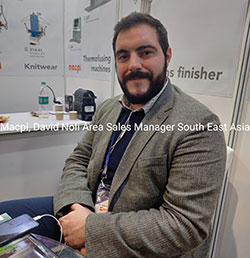
Starting as a manufacturer of formal wear, shirts and suits, over the years Macpi has progressed to offering garment logistics, stitch free and bonding technologies and laundry to health care institutions. “We provide various innovative solutions to our customers,” says David Noli, Area Sales Manager of the group.
Known for its vision to stay at 20 years ahead of the market, Macpi has been promoting fully automatic systems since the 80’s. “That was the time when everybody was still using manual machines. We provided customers with the latest technologies and products. We function not just as a supplier but as a partner to our clients. We help them avoid mistakes and overcome their inefficiencies,” asserts Noli. The automatic systems used by the company help it to recreate its computer workflow. Its machines are eco-certified and save both power and energy.
According to Noli, though stitching plays an important role in garment making, it’s time to give bonding and stitch free technologies a chance. “This will allow us to develop new styles,” he says. This technology is showcased in several machinery exhibitions. “However, designers are hardly aware of them. This creates a gap between technology inventors and the final users. We need to bridge this gap,” notes Noli.
To implement the Industry 4.0 solution, industry leaders need to invest more time on their customers. “They should be allowed to build their own structure around this concept,” states Noli further adding, “customers won’t trust you if you merely speak about the technology.”
According to Noli, three emerging global apparel markets include Vietnam, Bangladesh and Ethiopia. While Vietnam was earlier a sub contractor of China for suits and high-end garments, it can now develop its own industry. On the other hand, Bangladesh is involved in manufacturing shirts and light knits. “With sufficient support, both these countries will continue to grow. For instance, Italy, which was earlier a subcontractor for Europe and the US, later developed its own manufacturing label,” adds Noli.
The trade war affects everyone. “Suddenly, buyers realise that they can’t depend on any one country. This affects the entire global supply chain as orders spread out and countries start manufacturing according to their area of specialisation,” adds Noli.
It’s becoming increasingly difficult to work in China as workers are no longer interested in machines. “However, the country still offers the best combination of utilities, service and cost,” affirms Noli.
The global economy is moving away from its traditional ways of operations. “Some consumers are demanding low technology goods while others are asking for highly processed goods. There seems to be no mid-way in this,” adds Noli.
Though Brexit will impact logistics in Great Britian, the rest of Europe will not face any problems. The remaining 27 countries will continue to stay together. “Of these, Bangladesh can gain by reinventing its traditional methods of manufacturing. Similarly, Indian brands can approach the US and European markets with their products and under their own names. These brands can use our technologies for making their products,” he states further.
Noli views that the future prospects for the Indian apparel industry are very good. “However, it should not fall into the trap of cheap labor, cheap garments and more business,” adds Noli
Kornit Digital Brings On-Demand Eco-Fashion Technology to Pure Origin
Kornit Digital, a worldwide market leader in digital textile printing technology, announced that the company will be exhibiting at the upcoming Pure Origin event, taking place February 9-11 at the Olympia London. Hosted in conjunction with Pure London, Pure Origin is billed as “the UK’s only fashion sourcing show to bring every element of the fashion supply chain together in one location.”
The Kornit exhibit will call on brands and manufacturers to produce fashion in the most sustainable manner possible, approaching the fashion market with a statement that clothing can be produced on demand, in a profitable manner, without compromising on environmental concerns.
With its unique single-step printing solution and proprietary water-based NeoPigment inks, Kornit Digital enables on-demand textile manufacturing in a sustainable way. Furthermore, these solutions provide retail-quality impressions that enable retailers to become e-tailers.
“Kornit’s solutions answer the fashion industry’s rising need to correct its impact on the environment, a problem perpetuated by overconsumption and the growing number of designer collections,” said Omer Kulka, Kornit’s VP of Marketing and Product Strategy. “Conventional analog technology is ill-suited to this challenge, and not built for short runs or on-demand production. With e-commerce driving an expectation of immediate gratification, the industry demands efficient, sustainable, digital means of production, which lies at the core of Kornit’s value proposition.”