FW
Second pilot plant completed for TENCEL Luxe filament yarn to open up new fields of business
The Lenzing Group completed the second pilot production plant for its innovative filament yarn TENCEL Luxe. The new pilot production line, which was put into operation in the middle of December 2019, gives Lenzing sufficient capacity for commercial programs and further application development. Innovation in the eco-couture segment Thanks to TENCEL Luxe, Lenzing is able to embed the issue of sustainability in the premium luxury market in combination with superior aesthetics. The properties of the fine filament yarn can be compared to those of silk due to its airy feeling on the skin and the matte finish. At the same time, TENCEL Luxe also stands out because of its extensive strength and high level of environmental compatibility. It is perfectly suited for very fine fabrics and as a blending partner for silk, cashmere and wool. For example, the yarn is used for making blouses and shirts, dresses, scarves, ties and the inner lining of suits. “TENCEL Luxe opens up new markets for Lenzing and thus contributes to the successful implementation of our sCore TEN corporate strategy. At the same time, we are setting new standards in the luxury segment of the fashion industry with respect to sustainability”, says Stefan Doboczky, Chief Executive Officer of the Lenzing Group. “Many luxury brands have already realized what opportunities they would have by using this yarn made of the renewable raw material wood. The second pilot plant enables us to further press ahead with opening up new areas of application in collaboration with our customers”, Stefan Doboczky adds. Important basis for further growth, the new pilot production line will build upon the knowledge gained from operating the predecessor facility and leverage completely new and innovative automation models. The pilot plant developed by Lenzing and the knowhow acquired during the construction phase will comprise the basis for the company’s further expansion in the field of sustainable filament yarns. This will also comprise the starting point for the planned construction of a large commercial production plant at the Lenzing site.
Scoop to curate Gary James McQueen and Self Cinema AW20 collection
"The AW20 edition of Scoop, the UK’s leading premium contemporary womenswear show located at Old Billingsgate Market London from the 9th – 11th February, 2020 will see a meeting of minds and a discussion on slow fashion with fashion disruptor Caryn Franklin, designer Gary James McQueen, and Samuel Thomas and Anthony Rock from Self Cinema."
 The AW20 edition of Scoop, the UK’s leading premium contemporary womenswear show located at Old Billingsgate Market London from the 9th – 11th February, 2020 will see a meeting of minds and a discussion on slow fashion with fashion disruptor Caryn Franklin, designer Gary James McQueen, and Samuel Thomas and Anthony Rock from Self Cinema.
Taking place in the River Café at 5pm on Monday 10th February, Caryn aims to delve into the psyche of her guests to discover the motivation behind their creativity, and the choices that result when we choose to slow it all down.
Gary James McQueen is a British brand beyond fashion. Focusing on strong influences of heartfelt self-expression and digital design technology, this luxury house produces avant-garde designs and meticulously crafted artworks of fashion accessories and 3D sculptures.
As well as joining the conversation with Caryn, McQueen will also present his new collection at Scoop. This season, patterns and prints are inspired by a rubric curiosity between reality, surrealism and the visual clarity of a vast imagination. Gary James McQueen’s digital abilities, bring forth intricate motifs of psychedelic and optical art designs with print developed through a very thoughtful and personal creative process.
Founded by ex-Acne Studios design duo Samuel Thomas and Anthony Rock, Self Cinema is a project designed to offer a better way of dressing based on three enduring principles: high end design and quality, affordable high-end pricing, and sustainability.
Taking inspiration from the Scandinavian winter season tradition, expect thick wool coats, chunky folky knitwear, and down filled nylon coats recalling the arctic conditions of mid-winter in the north. Within this stylish comfort, a youthful sense of play and adventure draws inspiration from New York circa ’81, downtown 1981 – Debbie Harry, and Jean Michel Basquiat. Following on from the punk chaos with a clean, vibrant and edgy take on the post punk scene, to blend Harlem with the Bowery we see polka dot and leopard print dresses fused with a Wall Street parody to encompass out of proportion knitwear and clashing vintage prints.
Scoop is renowned internationally for its exclusive presentation and expertly curated edit of fashion designers and labels from Britain and the rest of the world, many of whom select the show as their launch pad. The show welcomes premium department stores from across the globe including Harvey Nichols, Brown Thomas, John Lewis, Voisins, Galeries Lafayette, Beymen and Le Bon Marche as well as independent boutiques such as Aria Boutique, Found, Iris Fashion, Jules B, and Sue Parkinson.
BIKINI FOR AUSTRALIA – Charity project to save the ecosystem
The Capsule Collection of Pin Up Stars Bikini for Australia is born. A one-piece swimsuit and a bikini depicting koalas and kangaroos made with Jersey Lomellina's Renew Action fabric, made from polyester yarn regenerated from pre and post consumer waste such as plastic bottles (PET) and food packaging.

The charity project signed by Pin Up Stars and Jersey Lomellina is designed to contribute to the recovery and protection of Australia's ecosystem, which has been hard hit by fires in recent months.

The proceeds from sales will be donated to Australian associations to help support and maintain the country's flora and fauna.
Teejay Lanka PLC financial results announced
 Teejay Lanka PLC has reported profit before tax of Rs 2.364 billion at Group level for the nine months ending 31st December 2019, an improvement of 56% over the corresponding period of the previous year.
Sales for the period grew by 15% to Rs 26.3 billion the Company said, with revenue for the 3rd quarter alone up by 5% to Rs 8.9 billion.
On the basis of these results, Teejay Lanka PLC has proposed a dividend of Rs 1.30 to shareholders in respect of the third quarter of 2019-20.
Attributing the Group’s performance to “Continuous focus on maintaining a strong order book with the commencement of the Operational Excellence journey during the year,” Teejay Lanka Chairman Bill Lam said overall growth in gross profit was primarily due to a healthier mix, continued stabilisation of cotton prices and improved capacity compared to the previous year, generated through internal efficiencies.
Teejay Lanka CEO, Pubudu de Silva, said that “Long term strategies adopted by the Group and economies of scale from expanding capacity have positively impacted performance during the quarter. He added that “As we celebrate 20 years in operation this year, the Group will continue to focus on creating sustainable products, innovations and modifications to improve the product portfolio for its customers.”
Teejay Lanka was adjudged the Best Textile Exporter in Sri Lanka at the Presidential Export Awards presented by the Export Development Board (EDB) in 2019, moved up three places in the Business Today Top 30 companies ranking that year and was named among the 100 Most Respected Companies in Sri Lanka by LMD.
The Company has been named among the Forbes ‘200 Best under a Billion in Asia’ and been recognised as the ‘International Textile Firm of the Year’ and the ‘International Dyer and Finisher’ by World Textile Institute, London.
Vietnam caught in crosshairs as the US-China conflict continues
"Caught in a cross fire, Vietnam is currently being squeezed between two economic superpowers -- the US and China. While it needs free access to the American market to keep its export-powered growth story going, the country also heavily relies on Chinese imports that span everything from yarn to chemicals and machines for assembly lines."
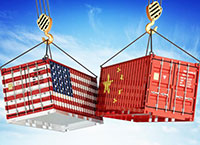 Caught in a cross fire, Vietnam is currently being squeezed between two economic superpowers -- the US and China. While it needs free access to the American market to keep its export-powered growth story going, the country also heavily relies on Chinese imports that span everything from yarn to chemicals and machines for assembly lines.
Vietnam’s relations with China have always ranged from unpredictable to turbulent. Its overreliance on trade makes it particularly vulnerable to geopolitical risks. This slender, S-shaped nation has long attracted the attention of foreign powers jockeying for regional influence. However, it is likely to fast lose ground if dragged into the trade war or embroiled in hostilities with China. Despite rough patches in their relationship, China, which supported Vietnam during its war with the US five decades ago, ensures that Vietnam remains within Beijing’s orbit of influence and promotes trade and investment in Vietnam. The country regularly promotes trade and investment in Vietnam. On its part, the US sends warships to visit the Southeast Asian country to participate in joint activities with the Vietnam People’s Navy.
Vietnam takes a neutral stance
In this clash between the two giants, Vietnam aims to remain neutral. To stay on an even keel, senior Vietnamese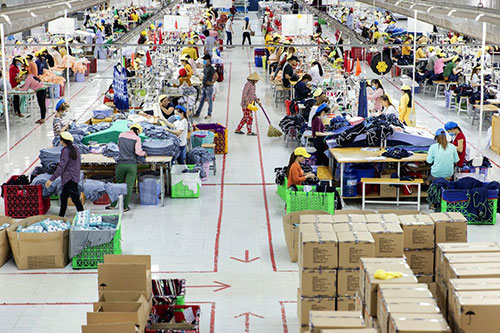 officials always pay a visit to Beijing whenever they visit Washington. The country knows how to maintain its independence without being gratuitously provocative.
However, territorial tensions between Vietnam and China have been escalating for the last four months. In mid-2014, China positioned an exploration oil rig off Vietnam, triggering violent anti-China protests. Then, Chinese competitors flooded across the border to set up factories, too. Investment from China and Hong Kong surged, from $3.4 billion in 2014 to $11.9 billion in 2019, on hopes of taking advantage of the proposed agreement.
Twin typhoons strike Vietnam
The trade war is attracting more Chinese companies to Vietnam putting the country at risk of new duties on its exports. Currently, twin typhoons are bearing down on the country as the fortunes of its Hong Le Trading Company are being inescapably exposed to two opposing forces. Its new fabric unit imports yarn from China which is further spooled into Chinese-made cotton-spinning machines to produce bolts of cream-colored fabric. These bundles of cloth are then trucked to Hong Le’s dye unit, Hao Hanh Trading Co. Chinese dye chemicals are used to treat this fabric before it’s sent to factories throughout Vietnam to be cut into shirts and dresses destined for clothing racks in the U.S
Cornavirus scare, brands close stores in China
The coronavirus has impacted businesses across China. Stores are being closed and the stores that do remain open are operating with reduced hours and seeing fewer shoppers. Roughly 150 of Capri’s stores in mainland China are closed. Nike has shut about half of the stores it owns in China. Adidas has shut a significant number of shops.
The companies join a growing list of global brands that have decided to limit operations in China, despite their reliance on the country for growth. All of Apple’s stores in China have been shut for now. Starbucks has closed more than half of its roughly 4,300 Chinese locations. Retailers are starting to worry that their businesses outside China will be affected as well if additional travel restrictions are put in place and there’s a drop in spending by Chinese tourists abroad. Such a dip in Chinese tourists seems inevitable as airlines cancel flights. American Airlines has suspended all flights between the United States and mainland China through March 27, while Delta Air Lines won't fly from the United States to China through April 30. Hong Kong carrier Cathay Pacific has slashed flights to mainland China by 90 per cent and making significant reductions elsewhere in its network over the next two months.
Sportswear brand Haglöfs names Fredrik Ohlsson as new CEO
Swedish sport and outdoor brand Haglöfs has appointed Fredrik Ohlsson, the company’s former global sales director, as its new CEO. Ohlsson will replace Carsten Unbehaun, who has in turn been appointed general manager of Asics EMEA.
Haglöfs’s strategic focus is on the relationship with customers, thanks to an increasingly targeted, sustainably developed product range, and on digital tools. Last year, the brand introduced new e-tail sites in eight countries, and also opened three monobrand stores.
Haglöfs was founded in Sweden in 1914 as a small-scale backpack producer. It is currently active in 20 European and Asian markets, via approximately 1,250 multibrand retailers, and has a staff of 200 people. Haglöfs also operates 11 monobrand stores in Europe: two each in Helsinki and Stockholm, one in Åre, Avesta, Haparanda and Göteborg (Sweden), one in Oslo, Chamonix (France) and London.
UCMTF introduces new logo
The French Textile Equipment Manufacturers' Association (UCMTF), a group of about 35 companies, has introduced a new modernised logo made of textile ribbons of blue, white, red colors of the French flag.
The new logo will be seen in the main international textile machinery fairs and in the textile magazines as France is the sixth textile machinery exporter with world leaders in such fields as long fibre spinning (wool, acrylic), yarn twisting and control (including technical yarns), space-dyeing, heat setting for carpet yarns, carpet systems, dyeing and finishing, felts and belts for finishing processes, nonwovens, air conditioning of textile plants and recycling processes of textile materials.
Zero-tariff becomes priority for UK post Brexit
Zero-tariff trade has become the number one priority for the UK after Brexit. Without a tariff-free trade deal, everything can get more expensive and difficult. Imposing tariffs would require bonded warehousing, to minimise the duty paid on moving goods. Though the EU is ready to offer a highly ambitious trade deal that includes zero tariffs and quotas, it would also demand specific and effective guarantees to ensure a level playing field.
The EU is the UK’s largest export market. Three fourths of the UK’s exports go to the EU across the fashion and textile industry, so an additional cost on top of that would be catastrophic. It will also be important for the UK and Turkey to secure a separate trade deal. Turkey is a big fabric supplier, and has a customs union with the EU, so the UK will have to do a deal.
At the same time there would be no need for a free trade agreement to involve accepting EU rules on competition policy, subsidies, social protection, the environment, or anything similar, any more than the EU should be obliged to accept UK rules. The UK exited the bloc on January 31, 2020.
Premiere Vision changes show dates
Parisian show Premiere Vision has adopted a new calendar. It will include a fall/winter event taking place in early July, rather than mid-September. In 2021, Première Vision Paris will take place from February 2 to 4, followed by an event from July 6 to 8. Blossom Première Vision, dedicated to premium brands and luxury labels’ pre-collections, was originally held in early July. It will now be transformed into a new event, set for the second week of September.
This new calendar has placed Première Vision’s main event only a week after Pitti Immagine Filati 87, the yarn and knitwear show that takes place in early July in Italy. At the moment, Munich Fabric Start is held in the beginning of September, before Première Vision. This will change with the new calendar. Première Vision will also be distancing itself from Chinese textile and clothing fairs, notably Intertextile and Chic, which advanced their dates from mid-October to late September in 2018.
There are three reasons behind the date change. First, products arrive in stores earlier now, with the common practice of pre-collections. Second, collections, along with their delivery, have increased in pace. Third, faced with these changes, collections now develop over longer periods of time, beginning the process earlier.