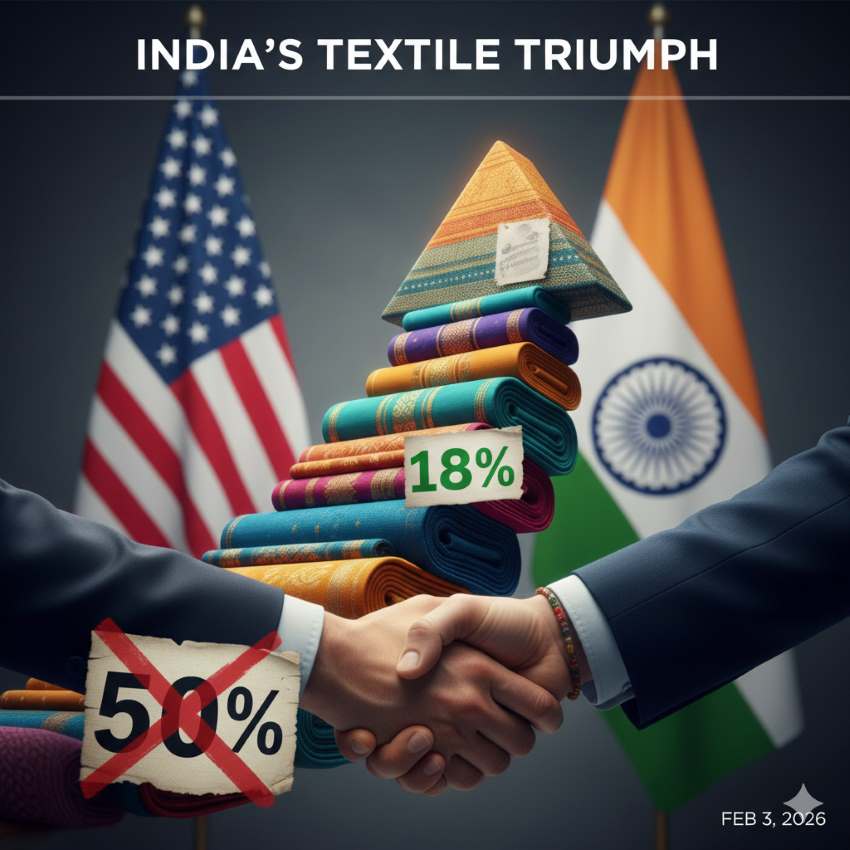
The high-stakes trade standoff between Washington and New Delhi has reached a decisive turning point. Following a strategic dialogue between Prime Minister Narendra Modi and US President Donald Trump on February 2, 2026, the United States has moved to slash reciprocal tariffs on Indian goods to 18%, down from a staggering peak of 50%. This aggressive de-escalation effectively rescinds the 25% punitive duty linked to India’s previous Russian oil purchases, signaling a massive relief for India’s multi-billion dollar textile and apparel engine.
Competitive edge restored against regional rivals
The tariff correction fundamentally rewrites the competitive landscape for Indian exporters. During the high-tariff regime of late 2025, Indian-made garments faced a 50% levy, making a standard $10 shirt cost American buyers $16.40. In contrast, similar products from Bangladesh and Vietnam were priced at $13.20 and $12.00, respectively. With the new 18% rate, Indian apparel is now positioned at a more aggressive price point than Vietnam and Bangladesh, and significantly undercuts Chinese exports.
|
Country |
New US Tariff Rate (Feb 2026) |
Peak 2025 Tariff Rate |
Competitive Status |
|
India |
18% |
50% |
Market Leader |
|
Indonesia |
19% |
25% |
Competitive |
|
Bangladesh |
20% |
25% |
Trailing |
|
Vietnam |
20% |
25% |
Trailing |
|
China |
34% |
34% |
High-Cost |
Supply chain resurgence and capacity utilization
Industry leaders are hailing the move as a "survival lifeline." Over the last two quarters, smaller manufacturing units in hubs like Tirupur, Ludhiana, and Panipat had reported up to a 30% plunge in yarn orders, with many factories operating at half capacity. The Confederation of Indian Textile Industry (CITI) expects this deal to trigger an immediate influx of summer-season orders that had been stalled. The reduction is projected to restore operating margins by 250-300 basis points, allowing manufacturers to stop the "bleeding" caused by absorbing tariff costs to retain US shelf space.
Strategic Trade-Offs: Energy and technology integration
The tariff cut is part of a broader "quid pro quo" where India has committed to a massive $500 billion procurement plan for US energy, technology, and agricultural products. Crucially, the deal hinges on India halting Russian oil imports in favor of US and potentially Venezuelan crude. For the textile sector, this macro-stability is vital; the recent Union Budget 2026 had already laid the groundwork by extending the export window for final products from six months to one year, providing the logistics flexibility needed to service this renewed American demand.
Forward Outlook: Modernization and market share
While the immediate focus is on volume recovery, the industry is now shifting toward high-value segments. With the US accounting for nearly 28% of India’s total textile exports, the goal is to leverage the lower tariff to dominate the "China Plus One" sourcing strategy. Exporters are increasingly focusing on sustainable "Tex-Eco" initiatives and specialized man-made fibers to lock in long-term contracts with American retail giants.
Sector Insight: The backbone of "Made in India"
India’s textile and apparel industry is the nation’s second-largest employer after agriculture, contributing roughly 2.3% to the GDP and 12% of total export earnings. Focused on cotton-based garments, home textiles (bedsheets/curtains), and technical fabrics, the sector aims to reach a $100 billion export target by 2030. Backed by a robust raw material base and recent capital support for machinery modernization in the 2026 Budget, the industry is transitioning from low-cost assembly to a high-tech, sustainable manufacturing hub.