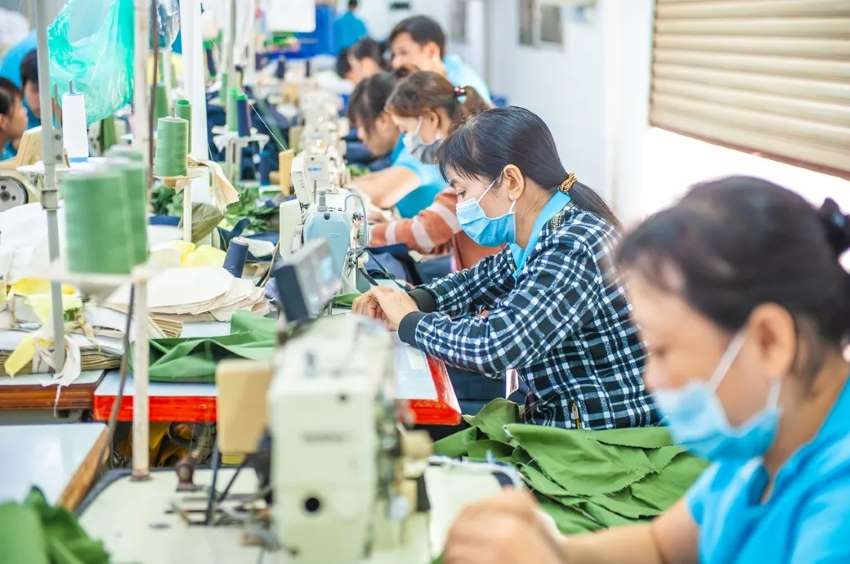
The garment industry in Cambodia expects orders to increase next year due to improved working conditions and the introduction of a higher minimum wage for the sector. The country expects purchasing orders in the garment sector in 2018 to be higher than in 2017.
There is a lot of room for progress in the garment sector and many opportunities for the government and buyer companies to work together towards a better future for the industry. After months of negotiations, the minimum wage for garment workers in Cambodia was recently raised to 170 dollars, with the new law coming into effect early next year.
Foreign purchasers appear to be satisfied with what Cambodia has achieved when it comes to worker welfare. Now, there is a stable environment, good relations between players in the industry. Cambodia has a great future for securing business and industry investment. The country works closely with national organisations and international partners like the ILO, the Global Deal Initiative, and GIZ to guarantee Cambodian garment and footwear products followed strict standards of quality and adhere to international good practice when it comes to workers’ rights. The country now wants GSP for its garment and footwear exports to the United States.

- 1
- 2
- 3
- 4
- 5
- 6
- 7
- 8
- 9
- 10
China’s inward turn, domestic demand is rewriting the export model
China is undergoing one of its most consequential economic recalibrations in decades, driven by geopolitical instability, rising Western protectionism, and... Read more
Why Shein sees itself as a technology company, not a fashion brand
The modern fashion industry has traditionally been defined by creativity, merchandising expertise and global sourcing networks. Yet few companies have... Read more
India’s textile sector turns crisis into competitive advantage
India’s textile and apparel industry has emerged from one of the most turbulent periods in its recent history, transforming a... Read more
India’s Export Divide: Textile mills advance, apparel makers face global headwin…
India’s textile and apparel (T&A) sector entered FY2027 with a striking internal contradiction. While the country’s overall merchandise exports increased... Read more
China’s inward turn, domestic demand is rewriting the export model
China is undergoing one of its most consequential economic recalibrations in decades, driven by geopolitical instability, rising Western protectionism, and... Read more
Egypt bets on a $2 bn green textile city to become Europe’s next sourcing hub
Egypt is making a decisive play to become one of the world's most important apparel manufacturing destinations after securing a... Read more
EU textile imports hit $295.66 bn as price wars mask manufacturing stress
The European Union’s textile and apparel imports grew to $295.66 billion in 2025, a 9.4 per cent year-on-year increase from... Read more
Landmark India-UK trade pact to supercharge textile export margins
The long-awaited India-UK Comprehensive Economic and Trade Agreement (CETA) is officially scheduled to commence on July 15, 2026. This breakthrough... Read more
Is it the end of aspirational luxury? Asia’s consumers demand more than logos
While the global personal luxury goods market remains broadly stable at around €358 billion, the apparent resilience masks a deeper... Read more
Vietnam wins, India slips as US apparel sourcing undergoes massive reset
A trade realignment is transforming the global apparel market, yet India’s manufacturing has stalled at the starting line. Newly released... Read more