


FW
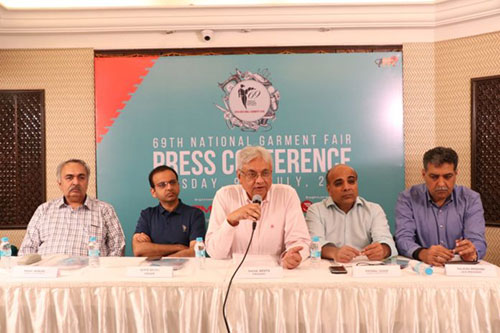
CMAI launches the 69th edition of the National Garment Fair
 The Clothing Manufacturers Association of India (CMAI) is organising India’s largest apparel trade show – The 69th National Garment Fair” from July 15-18, 2019 at the Bombay Exhibition Centre in Goregaon , Mumbai.
The B2B fair will be spread over approx. 700,000 square feet, covering all the halls at the Bombay Exhibition Centre. It will feature 882 exhibitors, showcasing 1,062 brands. This will be India’s largest ever garment fair held so far. It will display leading brands in men’s wear, women’s wear, kid’s wear and accessories. CMAI will also publish the ‘Show Directory’, popularly known as the Fair Guide at the event. Approximately 50,000 retailers and trade visitors from all over India are expected to visit this air.
The fair will be held over four days from 10 am to 9 pm. It will  be open only to trade visitors and garment
 retailers. It will also hold business networking sessions between the exhibitors, agents and distributors. Products and machinery at the show, will be presented by national as well as overseas companies
According to Rahul Mehta, President, CMAI, through this fair, the association aims to generate the advancement of the large-scale garment industry across the globe. The association has been the pioneer of the Indian apparel industry for over four decades. It has around 20,000 members, including readymade garment manufacturers, exporters, retailers and ancillary industry. With its headquarters in Mumbai, CMAI also has branches in New Delhi, Bengaluru and Pune.
The association has been organising such domestic garment fairs since its inception. These fairs are widely acclaimed by participants as a means to diversify their distribution base, absorb new trends in product-mix, style-wise, design-wise etc. and increase domestic business.
Sri Lanka apparel exports sees highest growth in five years from Jan to May
Apparel exports from Sri Lanka grew 6.38 per cent in May 2019 . From January to May apparel exports grew 8.7 per cent against the same period last year. This has been the highest growth rate recorded in the past five years.
Sri Lanka’s apparel exports have made a significant impact on American, European and other major export markets around the globe. The country’s target is to reach $ 8 billion in exports by 2025. However, the EU and the US may withdraw GSP Plus concessions for Sri Lanka. And if this happens, it will automatically reduce the country’s export earnings and the competitiveness of its products in EU markets vis-à-vis several Asian countries enjoying such concessions. If the US too withdraws its GSP concessions, it will be a double whammy for Sri Lanka. About 57 per cent of Sri Lanka’s total exports go to these two markets. Apparels are Sri Lanka’s biggest exports to the EU. Almost 90 per cent of Sri Lankan exports to the EU are exported under GSP Plus or with zero duty. The GSP Plus scheme encourages increased value addition within Sri Lanka and thereby promotes backward integration, resulting in the setting up of new industries, and creating new employment opportunities in the country.
Nigeria aims at being a global player in apparel and textile industry
Nigeria aims at being a global player in the textile and apparel sectors and attaining self-sufficiency in cotton production. The country is working towards making its cotton, textile and garment sector create more than two million jobs and reduce the cost of textile imports by 2020. By achieving that, Nigeria hopes to safeguard and earn foreign exchange and ultimately accelerate industrial development by making Nigeria a global player in the textile and apparel sectors. Action is being taken to grow, develop and revive the sector so that it generates enhanced revenue and transforms Nigeria’s rural economy. Necessary mechanisms are being put in place to ensure use of high yielding varieties that will produce top quality fabrics and those that can compete in the international market.
In the 1970s and early ’80s, Nigeria was home to Africa’s largest textile industry, with over 180 textile mills in operation, which employed close to over 4,50,000 people and contributed over 25 per cent of the workforce in the manufacturing sector. Today, most factories have stopped operations, as only 25 textile factories are operating today, at below 20 per cent of their production capacity, and the workforce in Nigeria’s textile industry stands at less than 20,000 people.
Natural looks dominate at latest edition of Pitti Filati
Most exhibitors at the yarn show Pitti Filati, June 26 to 28, 2019, had a natural element to their collections or went all out for natural, contemporary looks using muted shades and undyed yarns to soften the tone and soothe the soul. The Pitti project on sustainability included a broad definition from production through a sustainable chain to the use of biological raw materials and the salvage of pre or post-production waste from factories.
Iafil showed ceramic pima wool made of Pima cotton and wool with manmade ceramic crystal thread, absorbing UV-A and –B rays as a skin barrier, and thermal insulation allowing retention of body heat. Stoll showed spectacular 3D effects and referenced trad-African tribal dress with fabrics draped on a model mannikin as avant-garde fashion, accompanied by the extraordinary speed of machines knitting complete garments on the stand.
Filclass Re-Fashion collection used discarded fibers and overstocked materials and garments made into new material, inspired by creative recycling with fancy yarns, with a modern look for seasonless knits. Cotton, mostly with certificates or assurances of sustainable production, including the Better Cotton Initiative also made its presence felt, and linen is now a winter fiber, blended with animal fibers.
Liva extended to home textiles
Grasim’s viscose staple fiber brand Liva has been extended to the home textile category with the launch of Liva Home. Liva partners over 40 retail brands and is available across 3,500 outlets in exclusive business outlets and large format stores, in addition to many more MBOs in 250 cities of India.
Meanwhile Grasim’s revenue for the year is up by 23 per cent. A total capex plan of Rs. 6,454 crores is under execution for raising capacities in Grasim’s viscose staple fiber and chemical businesses, apart from ongoing modernisation capex at various plants. The acquisition of Soktas is aimed at expanding Grasim’s leadership in premium fabric, complementing its existing linen business.
Grasim’s viscose business has been registering a double-digit growth in the last few years and its market share in the overall fiber basket has gone up from 3.5 per cent to five per cent in the last four years. The company’s viscose staple fiber business will continue to focus on expanding the market in India by partnering with the textile value chain, achieving better customer connect through its brand Liva, extensions into new categories and enriching the product mix through a larger share of specialty fiber.
India reduces GST on manmade fiber yarns
India has taken measures to increase the competitiveness of the textile industry.
GST on manmade fiber yarns has been reduced from 18 per cent to 12 per cent. Garments and made-ups have a special package. Rebate of State Levies has been replaced by the Rebate of State and Central Taxes and Levies and will remain in force up to March 31, 2020. Rates under the Merchandise Exports from India Scheme have been enhanced from two per cent to four per cent for garments and made-ups, and five per cent to seven per cent for handloom and handicrafts.
Products such as fiber, yarn and fabric in the textile value chain are being strengthened and made competitive. Assistance is also provided to exporters under the Market Access Initiative scheme.
Interest equalization rate for pre and post shipment credit for exports done by micro, small and medium textile units has been enhanced from three per cent to five per cent. Benefits of the interest equalization scheme have been extended to merchant exporters. Earlier this scheme was limited to manufacturer exporters. To contain the increase in imports of textile and apparel, the basic customs duty on 504 lines comprising apparel, carpets, fabric, made-ups and others has been increased from ten per cent to 20 per cent.
Handicraft artisans get insurance cover
India has been implementing various schemes for the welfare and development of textile workers/weavers including handicraft artisans. Under the group insurance scheme, insurance cover is provided to all power loom weavers/workers in the case of natural death, accidental death as well as partial and permanent disability due to accident. Additionally, weavers/workers enrolled under this scheme are entitled for an educational grant for children for a maximum period of four years. Under the scheme, total number of power loom weavers/workers enrolled was 1.11 lakh in 2015-16, 1.32 lakh in 2016-17 and 1.62 lakh in 2017-18.
Welfare programs being implemented for handicraft artisans are the Rajiv Gandhi Shilpi Swasthya Bima Yojana, BimaYojana for handicrafts artisans, Aam Admi Bima Yojana, support to artisans in indigent circumstances, credit guarantee scheme, interest subvention scheme and issue of identity cards and creation of a data base.
Under the Textile Workers Rehabilitations Fund Scheme, which has been merged with the Rajiv Gandhi Shramik Kalyan Yojana, textile workers rendered jobless due to permanent closure of mills are provided a relief of 75 per cent of the wage employment in the first year, 50 per cent in the second and 25 per cent in the third year. Under the Handloom Weavers Comprehensive Welfare Scheme, life and accidental insurance is provided to handloom weavers/workers in the age group of 18 to 50 years.
Fall in Sangam net sales
Sangam has reported net sales of Rs 464.74 crores during the period ended June 30, 2019, as compared to Rs 491.44 crores during the period ended March 31, 2019.
Net profit was Rs 1.14 crores for the period ended June 30, 2019, as against Rs 0.71 crores for the period ended March 31, 2019. EPS was Rs 0.29 for the period ended June 30, 2019, as compared to Rs 0.18 for the period ended March 31, 2019.
Net sales were Rs 464.74 crores during the period ended June 30, 2019, as compared to Rs 476.68 crores during the period ended June 30, 2018. Net profit was Rs 1.14 crores for the period ended June 30, 2019, as against Rs 4.09 crores for the period ended June 30, 2018. EPS was Rs 0.29 for the period ended June 30, 2019, as compared to Rs 1.04 for the period ended June 30, 2018.
Sangam which opened in 1984 began with weaving and later integrated backward and forward and started expanding its capacities. Today it is a vertically integrated unit, starting from yarn right up to garments. It does cotton and synthetic yarns, denim fabrics, suiting fabrics, PV suitings. Sangam supplies fabrics to other companies which dye, finish their own way. As of today, it is 20 per cent into shirting.
Bangladesh gains from new markets
Bangladesh’s garment exports to non-traditional markets have grown by 26.37 per cent in the first ten months of the year. The US, Canada, and Europe are considered traditional markets. All others are known as non-traditional markets. Among these are Chile, China, Japan, India, Australia, Brazil, Mexico, Turkey, South Africa and Russia.
At one time Bangladesh apparel makers hesitated to go into a new market because of the trouble and effort involved. Moreover, when a manufacturer entered a new market, they needed to lower the product price. So garment manufacturers were dissuaded from exploring markets. But since cash incentives were offered in 2010, garment owners started exploring new destinations and markets. Presently, non-traditional markets contribute 15 per cent to 16 per cent of Bangladesh’s total export earnings. These markets offer duty-free access to Bangladesh apparel exporters. China, for instance, the world’s biggest apparel supplier, allows duty-free access to over 5000 Bangladesh products. Bangladesh’s earnings from exports to China have grown 37.48 per cent.
Accord and Alliance have helped to remediate factories in Bangladesh and prompted factory owners to emphasise workplace safety, which has eventually lifted the country’s image in the eyes of foreign buyers. Among the top ten green garment factories in the world, the first seven are located in Bangladesh.
Miami Swim Week is on
Miami Swim Week is on from July 11 to 16, 2019. The event features men’s, women’s and children’s swimwear, beachwear, active wear, resort wear, cruise and accessories for sale. It is a chance for retailers, fashion consultants, stylists, influencers and other industry leaders to find out what’s trending in the industry and to make purchases for upcoming seasons. The event is expected to attract some 5,000 buyers from 60 countries. Shows and activations are being organized in a variety of locations. The packed schedule is seeing labels including Badgley Mishka, Seeker of Sunshine, Agua de Coco, Chloe Rose and many more take to the catwalk. A range of runway presentations will be open to the public. Brands presenting in this format include Fernando Alberto Atelier, Sauvage Swim from San Diego, and local Miami label Liliana Montoya.
Furthermore, a pop-up shop called the Paraiso Bungalow is offering resort wear, accessories and beauty products from brands including Aloha Collection, Chopard, Olivela and Tropic of C.
The location will also serve as a venue for panel discussions on topics including influencer marketing, inclusivity and sustainability. A platform called The Upcycle Project is raising awareness on the waste that the fashion industry creates. Debuting this year is Nu Wave Swim, which is a brand new experiential platform for designers and buyers.











