FW
Lululemon expects 20 per cent revenue jump
Lululemon expects a revenue increase by 20.5 per cent. In 2019, Lululemon initiated a strategic transformation plan to accelerate its international expansion and diversify its clothing line to include men’s wear. The Canadian fashion and sporting company improved its initial economic forecasts between October and December. Lululemon planned to reach a maximum of 1,330 million dollars in the fourth quarter of 2019. However, its revenues are set to reach 1,380 million dollars.
Lululemon Athletica has acquired a stake in 7mesh. Lululemon makes performance gear for sports like yoga and running. And 7mesh, also based in Canada, makes cycling apparel like jackets and shorts. Lululemon wants to dispel the impression that it does only yoga gear and is a yoga-inspired apparel maker. In recent years, it has sought to sell more clothes meant for running, swimming, and even outer wear. New ventures like 7mesh are part of Lululemon’s ten-year plan to generate 50 per cent of net new profitability from businesses and product categories where it doesn't currently compete.
Athletic apparel has become a very crowded market and sales and traffic trends have put pressure on yoga-inspired manufacturers like Lululemon. Because athletic apparel has become increasingly trendy, a number of non-traditional players have jumped into the category and started competing with the legacy players.
Bangladesh sets up leather parks
Bangladesh will set up three footwear and leather goods industrial parks. The aim is to meet local demand for footwear and leather goods as well as to boost export earnings. Investments in these three proposed industrial parks will highlight industries like footwear and leather goods especially handbags, belts and wallets.
There is a huge demand for footwear and leather goods in Bangladesh and a big chunk of these goods is being imported from China. This initiative is expected to lower reliance on imports. Each of the three industrial parks will be environment-friendly, having a competitive edge and with international standards where there will be facilities for a training institute, CETP and other facilities.
Exports of leather and leather goods from Bangladesh have rebounded after more than two years due to higher shipments to non-traditional markets. The value addition to leather products is another reason behind the positive export trend. Work orders are expected to further increase after a certification is attained from the global rights body Labor Working Group. The LWG certification is awarded to companies based on points awarded for factors such as treatment and less use of water, solid waste management, chemical use and labor welfare.
Tie-ups help fashion brands in China
Fashion brands and platforms have turned to collaborations in China, particularly when trying to introduce themselves to the market for the first time. Since China is a unique market, collaborating with other brands already popular in China can help newcomers figure out who their audience is and the best way to reach them. The percentage of fashion brands promoting brand collaborations on the Chinese social network Weibo jumped up from 62 per cent in the first quarter of 2018 to 80 per cent by the midpoint of 2019.
As the Chinese market continues to slow down after several years of being the fastest growing market in fashion, these collaborations can provide the necessary boost brands need to keep Chinese customers engaged. Customers of European luxury brands in China tend to be 10 years younger than their customers in Europe, so a different strategy is required.
Thanks to China’s unique cultural sensibilities, and various platforms to advertise and sell on, many brands have found that hiring locals with first-hand knowledge of the market is crucial. The retail environment in China is very competitive and very fast. Brands always want to create a buzz. It also helps them reach new customers.
Chinese cotton yarn imports rise
China’s cotton yarn imports in December were up 19.33 per cent year on year and 3.81 per cent month on month. China imports yarn from Pakistan, Vietnam, India, Uzbekistan, Indonesia and Taiwan. Arrival of Vietnamese cotton yarn in December is estimated at 75.6 kilo tons; Indian cotton yarn was 28.3 kilo tons; Pakistan 29 kilo tons; Uzbekistan 20 kilo tons; Indonesian cotton yarn at 8 kilo tons, Taiwanese cotton yarn 6 kilo tons and that of other regions and countries at 10.3 kilo tons.
Chinese cotton yarn prices were stable in December as market confidence recovered amid low inventory. The market sentiment turned bullish. Sales of traders improved and inventory declined. Foreign spinners, taking those in Vietnam as an example, raised prices continually as US cotton prices moved up, and the sales were still under pressure. If cotton yarn prices cannot increase following cotton prices, spinners will stay burdened. Cotton futures rebounded, but cotton yarn spot prices only increased slightly, which meant lower profits for spinners.
China was a major buyer of Indian cotton yarn. But of late, its share has dwindled to less than one-fifth. The recent slide can be attributed to overall macroeconomic conditions globally, the falling manufacturing sector in China, and most crucial the US-China trade war.
Trade war affect, Sri Lanka’s apparel exports up two per cent in November
Sri Lanka’s apparel exports grew 2.8 per cent in November 2019. This is due to an increase in production capacity and a re-routing of supply chains amid the US-China trade war. The trade war to some extent helped with orders diverted to Sri Lanka. Apparel exports to the European Union grew 10.99 per cent in November 2019 compared to the same period in 2018. Sri Lanka’s total apparel exports from January to November 2019 grew 5.8 per cent. Apparel exports to the EU from January to November 2019 rose 5.7 per cent.
Exports to the EU have increased with continued leverage of GSP Plus preferential tariff benefits and market certainty with Brexit coming to a conclusion. However, Sri Lanka’s exports to the US in November fell 4.8 per cent though exports to the US for the period January to November 2019 recorded a growth of 3.7 per cent. The fall in exports to the US in November was due to continuous slowdown in sales of Victoria’s Secret, which is a large customer of Sri Lanka. Victoria’s Secret posted a seven per cent fall in same-store sales in the US and Canada in the third quarter. Victoria’s Secret has been bleeding sales and divesting its brand portfolio due to changing consumer tastes.
Germany to The International Cotton Conference in March
The International Cotton Conference will be held in Germany from March 25 to 27, 2020. Up to 500 participants from all continents of the world are expected, with science and trade equally represented. The conference will begin with keynote speakers focusing on the status quo and the challenges of the cotton industry. One topic will be the circular economy. The conference will be dealing with the life cycle of natural and renewable raw materials in the sense of a circular economy. Forms of growing raw material, of processing the raw material and its reusability in the sense of resource conservation will be procedurally looked at. For the first time, a guest country will be presented at the upcoming conference. Ethiopia has been chosen as a country where cotton is produced as well as processed. The focus is directed at a developing or emerging country where much has been recently brought on the way in order to further develop existing structures in cotton growing and cotton processing in a positive way.
Professionals from trade, acquisition, design, product management or textile engineering of cotton will get a first-hand inside view of the global cotton and textile industry. There will be lectures on topics relevant to the supply chain.
India hopes to triple textiles and apparel exports
India hopes to triple its textile and apparel exports by 2024-25. The country now has a five per cent market share globally and the target is to reach 15 per cent. The textile and apparel industry contributes 2.3 per cent to India’s GDP and accounts for 13 per cent of industrial production and 12 per cent of the country’s export earnings. It is the second largest employer in the country providing employment to 45 million people at present, and this number is expected to rise to 55 million people by the end of 2020. India is the largest producer of cotton and jute in the world, and the second largest producer of polyester, silk and fiber.
Indian exports are not competitive. Textiles from India are around ten per cent costlier than textiles from other countries. Also Bangladesh, Sri Lanka and Vietnam have low production costs and their exporters enjoy preferential duty access to key markets. In comparison Indian exporters face higher trade barriers in the US and the European Union. Bangladesh’s exports to the EU face zero per cent tariff and exports to the US face 3.9 per cent tariff. Indian textile exports face six per cent tariff in the EU and 6.2 per cent tariff in the US.
Bangladesh apparel exports to the US up nine per cent
Bangladesh’s apparel shipments to the United States edged up in the first 11 months of 2019 by 9.47 per cent. Primarily, the tariff war between the US and China played a vital role in raising shipments to the US. China, the largest apparel supplier to the US, saw its shipments slump during the period, in what can be viewed as a direct impact of the 25 per cent tariff. US total imports from the world have been declining since September but have been increasing from Bangladesh. However, US garment shipments from India and Vietnam, both Bangladesh’s competitors in the global apparel trade, has also grown.
The US is Bangladesh’s main export destination for apparel. And the country’s shipments to the US increased just nominally in the first two weeks of 2020. The average price of Bangladesh garment products though has decreased 4.50 per cent from a year earlier. Bangladesh’s earnings from garment exports are on the slow lane due to the appreciation of the currency against the dollar, the lack of diversified products and the rise of other competing countries, particularly of Vietnam and Cambodia. Between the months of July and December 2019 Bangladesh’s apparel shipments fell 6.21 per cent.
With growing popularity of licensed apparels, Disney clinches new brand deals
"Disney fashion was the exclusive prerogative of kids not so long ago but today, even fashion-conscious youngsters are choosing to wear Disney inspired apparels and accessories. Having seen the market potential Gucci at a recent runway show held at Le Palace in Paris by unveiled a $4,500 plastic purse shaped in the form of Mickey Mouse’s head as a part of its Spring/Summer 2019 collection. This ode by Gucci to Mickey Mouse was an attempt to widen its reach to individuals of all ages and income groups Thanks to its arsenal of licensed goods and the third party products that bear the names and images of the assets under its umbrella, the brand is able to cater to wide pool of consumers."
 Disney fashion was the exclusive prerogative of kids not so long ago but today, even fashion-conscious youngsters are choosing to wear Disney inspired apparels and accessories. Having seen the market potential Gucci at a recent runway show held at Le Palace in Paris by unveiled a $4,500 plastic purse shaped in the form of Mickey Mouse’s head as a part of its Spring/Summer 2019 collection. This ode by Gucci to Mickey Mouse was an attempt to widen its reach to individuals of all ages and income groups Thanks to its arsenal of licensed goods and the third party products that bear the names and images of the assets under its umbrella, the brand is able to cater to wide pool of consumers.
Licensing deals give intellectual property rights to brands
Disney licensed goods are incepted from the various deals the Walt Disney Company forms with brands that give them the right to use its intellectual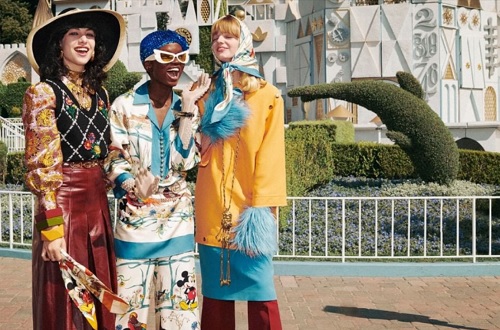 property in exchange for a lump sum and royalty payment based on sales of these goods. These products are a big draw amongst consumers and generated nearly $60 billion in retail sales in 2018. The California-headquartered company’s princess merchandise ranging– from dolls and toys to clothing and home décor – is a $5.5 billion enterprise and Disney’s second-most-profitable franchise. Similarly its licensed Frozen franchise sold $531 million worth of dolls and dresses in 2014.
However, according to Bloomberg, even this frenzy for Frozen products could not usurp the power of Disney’s top seller Mickey Mouse which raked in almost $1 million a year in sales within just five years of its debut in Walt Disney’s 1928 animated short film Steamboat Willie. Since then, Disney has added many new assets to its portfolio, some of them created in-house while others acquired. The company’s licensing deals with Star Wars in 2015 generated $5 billion in 2016.
Deals help Disney set new fashion examples
The deals also enabled Disney to amass a large pool of license-able assets, from the wildly valuable Star Wars trademarks to the names of its characters and their copyright and trademark-protected appearance. Star Wars specific elements were later translated into high fashion examples by brands and designers like the London based label Preen and designers Kate and Laura Mulleavy who imbued the classic Star Wars imagery into their creations such as t-shirts from Hot Topic and Target, alike.
By acquiring Lucasfilm, Disney not just gained rights to the characters and insignia associated with the iconic “space-opera” franchise, but also gobbled up the company that was responsible for transforming the market for movie merchandise since 1977. Its deal with Star Wars aims to focus on selling its goods to fans of the franchise no matter their age.
Besides introducing and/or acquiring new blockbuster franchises, Disney also employs an extensive network of marketing gurus who come up with new ideas to maintain the brand’s relevancy. And Disney relies heavily on its licensing partnerships with brands like Gucci, Sephora or Supreme to ensure the enduring relevance of its intellectual property assets over time. Though toys are still its top selling products, Disney’s sale of licensed apparels is also strong which reitereate the fact that fashion-centric deals are among some of the most lucrative in the licensing space.
KARL MAYER extends with the new brainstorming space at Interfilière
Emerging innovations in the fashion sector are the result of a close exchange between creative minds and experts with ideas and visions. It is said to be the reason why Interfilière offers with Innovative co-working a new platform for an individual get-together from January 18th to 20th 2020 in Paris.
The brand strategists, staff members of start-ups and designer Entrepreneurs have the possibility to start conversations with the top-level trendsetters from all fields of the textile supply chain. One of the innovative partners for an efficient in brainstorming is KARL MAYER, a pioneer in textile machinery building, who increasingly also develops textile product concepts.
In the last few months, KARL MAYER is focusing on the topics of Electronic Wearable, Bodymapping for Sportswear, One-Piece Creations for Lingerie and Genre-Mix, especially the combination of Lingerie and Swimwear with Athleisure. The developed styles and concepts already met with a great response at different trade fairs. In Paris also the company is looking forward to having many interesting conversations in this respect about the fashion topics, on which the visitors have the right to expect valuable inspirations and latest information.
In particular the lingerie business provides diverse development potential due to the know-how transfer, especially from the sportswear industry with its high demands on the function of clothing.