FW
Cotsworld launches packaging line using Repreve polyester
Cotswold has launched a line of pocketing that leverages Unifi Corp.’s Repreve ® recycled polyester, which gives new life to polyethylene terephthalate (PET) plastic bottles.
By leveraging Unifi’s Repreve recycled polyester, Cotswold is able to upcycle about two plastic bottles per garment. Cotswold is aiming for mass adoption of its Max Repreve collection to make the greatest impact. If every jean made each year in the world used Repreve fiber for their pocketing, we could upcycle over 1 billion plastic bottles each year.
According to Euromonitor, plastic drinking bottle consumption is on the rise and by 2021, 583 billion plastic bottles will be sold each year around the globe. The large majority of these bottles will not be recycled, instead ending up in landfills or polluting the oceans. Materials such as Repreve aim to save some of that plastic waste by turning it into new products.
While Repreve has environmental benefits, the material’s hand is somewhat softer than virgin polyesters. Meanwhile, the performance of Repreve is on par with virgin polyester, with traits such as durability with consistent shrinkage.
Products in the Max Repreve line range include fabrications that feature 100 percent Repreve recycled polyester and also twill products with a blend of Repreve. The pocketing also varies in heft, allowing for lightweight or heavyweight linings.
Bespoke brands in the US build and promote virtual fitting tools
With the vast majority of Americans quarantined and events canceled, several suit fittings have moved online. Colin Hunter, Co-founder of bespoke suit brand Alton Lane, has spent the past 10 days rapidly building and perfecting the infrastructure needed to get virtual fittings off the ground, to replace in-person fittings. The process has been informal and fast-moving, and fittings are now being conducted with customers over FaceTime, Google Hangouts and text. It’s Hunter hope that the virtual fittings, which kicked off last week, will be enough to see the brand through this rough period.
To transition, the company first created a digital catalog for its in-store stylists to use to conduct the virtual fittings. That involved digitising its thousands of fabric swatches so that customers could see high-quality images of available suit materials. Hunter said, with the catalog, associates can create a custom digital package of swatch options and cut recommendations for each customer in as little as 30 seconds. That is then emailed to customers before a fitting session.
Alton Lane is also working on a 3D tool that will let customers see those swatches transformed into full suits. To promote the new option, Alton Lane has been reaching out to regular customers directly, both through texts and emails, asking them to give an online fittings a try. A fitting appointment can be made for a range of styles, from dress shirts to full suits. Hunter did not disclose the brand’s exact sales figures or digital-wholesale breakdown, but he did say that sales slowed significantly since the COVID-19-induced store closures. The company has 12 stores, and a large majority of sales are made in-store.
Another custom suit brand, Sene Studio had already invested quite heavily in online fittings and orders, with more than 90 per cent of the brand’s orders coming from the company’s online fit quiz.
H&M not to cancel orders but halts new order placements
Much to the relief of some Bangladeshi exporters, Swedish retail giant H&M has assured its garment suppliers of taking shipment of goods that have already been manufactured. The brand will also pay for these goods under agreed payment terms. In addition, it will not negotiate prices on already placed orders. However, H&M has decided not to place any import orders in Bangladesh for now due to the adverse impact of COVID-19 outbreak on the global economy.
H&M made this announcement at a time when apparel suppliers across the world, including those from Bangladesh, are being slammed by work order cancellations and delayed shipments.
The Swedish company sources garment and textile items worth nearly $4 billion from more than 230 Bangladeshi factories annually. The brand will start placing orders again as soon as the situation allows. It is well aware that the suppliers, and their employees, are extremely vulnerable in this situation.
Companies such as H&M play a key role in many developing countries, as well as global trade. The brand is investigating how it can support countries, societies and individuals from a health and financial perspective. In this first urgent phase, It plans to focus our efforts on countries that are highly dependent on the textile industry.
Gap Inc diverts production to protective gears
At a time when there is a shortage of masks and other protective gears for doctors and health workers around the world due to the Coronavirus carnage, apparel manufacturing companies are seeking orders to make masks and other personal protective equipment (PPE). The latest retailer to use its resources to create PPE such as masks, gowns and scrubs for healthcare workers is Gap Inc. Founded in 1969, Gap is renowned for apparels and fashion accessories, among several other products.
The brand has temporarily closed its company-owned and operated stores with effect from 17 March 2020 across North America, including Old Navy, Athleta, banana republic, Gap, Janie and Jack and Intermix brands.
WTO members agree on a temporary mechanism to resolve trade disputes
The European Union, China and 14 other World Trade Organization members have agreed on a temporary mechanism to resolve trade disputes after US action rendered the WTO incapable of acting as the arbiter of global trade. Washington froze the WTO’s Appellate Body, which acts as a supreme court for international trade, by blocking appointments for over two years. Two of the body’s remaining three members came to the end of their terms in December, leaving it unable to issue rulings.
A WTO panel of trade experts will still make initial findings. However, it is no longer possible to appeal against a ruling at the Geneva-based body. Under the temporary fix, a pool of 10 arbitrators will be set up in the next three months. Three of them will hear any given appeal.
The European Commission said the WTO members involved had agreed to preserve the WTO’s two-step dispute system until the WTO’s own Appellate Body became operational again. The EU had previously teamed up with Norway and Canada to form a separate appeals body that could resolve disputes. The other countries that signed include Australia, Brazil, Chile, China, Colombia, Costa Rica, Guatemala, Hong Kong, Mexico, New Zealand, Singapore, Switzerland and Uruguay.
Apparel orders worth 40 bn at stake from 5 retailers
According to the market estimates, just five retailers contribute to over US$40 of business orders at stake and have claimed to have cancelled the same. These retailers are H&M (US$11.6 bn), Walmart (US$9.5 bn), Costco (US$9.4 bn), Inditex (US$6.8 bn) and Target (US$2.6 bn).
However, according the fresh reports H&M has assured its garment suppliers of taking shipment of goods that have already been manufactured. The brand will also pay for these goods under agreed payment terms. In addition, it will not negotiate prices on already placed orders.
Considering the kind of business at stake from brands and retailers across the world, apparel industry will have devastating impact on the entire supply chain of fabrics, and raw material textile industry.
Fashion and apparel being a seasonal business coming out of lot of variants in terms of sizes, colours and fits cannot generally be liquidated, being made specifically for specific regions, markets and brands.
China’s Xinjiang, a fibre, yarn producing region struggles for downstream buyers
Xinjiang is China’s largest far-west region, where long staple cotton is most famous and region is witnessing very fast investment growth in spinning industry. On March 25, the Industrial Park Working Committee of China National Textile and Apparel Council organized an online podcast meeting to discuss the current industry situation in the region, arising because of coronavirus impact.
Mr. Xieqing, Deputy Director of Industry and Information Technology Department of Xinjiang Uygur Autonomous Region and Mr. Yang Xiaodong, Deputy Director of Economy and Technology Development Zone of Korla City, Xinjiang from public sector and some companies from private sector were at the podcast.

Mr. Wang Xiaobo, Executive Vice President of Korla Fiber Company of Xijniang Zhongtai Textile Group stated that its fiber company produced 91,300 tons of viscose fiber and 51,400 tons of spun yarn with sales income for 458 million Yuan at production/sale ratio at 75.5% from January to February. Most of its clients, weavers, knitters, and garment manufacturers, are located far away in east and south of the country, where in those east and south regions, productions have not bounced back yet to their regular level after the outbreak of COVID-19. Since, the company is getting a high level of inventory piling up for its viscose fiber and yarns, led to its decision to scale down its production to balance the mounting inventory. As a consequence, because of less output, the cost of production/ton is increasing. If the sales continue to further slide down, the company will be under pressure not only for increasing production costs, but also will have problems in paying back bank loans, making business more difficult.
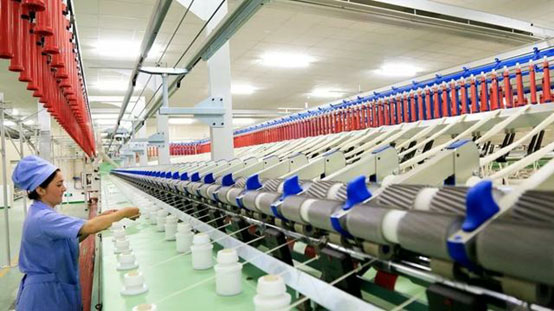
The similar situation is faced by many businesses in this industrial park. According to Mr. Liu Qin, Chief of Economic Development Division of Economy and Technology Development Park in Korla City, the first two months of this year witnessed a slowdown in industrial output value and yarn production with the big companies in the industrial park, like Zhongtai Textile and Litai Silk Road, business freefalling by 30% and 60% respectively, because of the global pandemic.
The companies in the park mostly produce fiber and yarns that are raw materials for the downstream production, where as fabric and apparel manufacturers are largely in the other provinces that were hit hard by the coronavirus infections. It will take some time before full recovery of production out there, so business orders from those clients are not projected to match up immediately. Because of the drop in orders and business and piling up inventory, price of fibers and yarns are dropping significantly, causing huge financial troubles, resulting in crippling of the businesses.
Mr. Yang Xiaodong, Deputy Director of Economic and Technological Development Zone in Korla city, introduced to the podcast attendees that , though the industrial park also has few downstream manufacturers who are also in the similar predicament because the business orders from international clients are quite a problem when foreign trade is impacted most.
Mr. Su Jianjun, Honorary Chairman of Shandong Dezhou Hengfeng Group, said its Group invested in a modern spinning mill with 1 million spindles in Caohu Industrial Park in Korla City, 85 percent of the capacity has already started with workers coming back to the mill on March 16, and the production/sale rate is 100% as of now, because its clients already had made a full payment for the yarns prior to the Spring Festival. But the new orders are not just as promising, for the reason clients are in wait and watch mood, to take advantage of possible drop in prices of cotton. What’s in store, remains to be seen, how much market changes with coronavirus fading away.

The podcast was successful to link China’s sparsely-populated Far-West to the commercially-prosperous provinces where they have common business interests, even though the new orders from some clients are kept in suspension for more favorable situation to come.
The Industrial Park Working Committee of CNTAC is now facilitating supply-demand matchmaking between different manufacturing clusters and parks at the national level to boost business with confidence in walking onto the land of hope out of mire.
Contributed by Mr. ZHAO Hong
He is working for CHINA TEXTILE magazine as Editor-in-Chief in addition to being involved in a plethora of activities for the textile industry. He has worked for the Engineering Institute of Ministry of Textile Industry, and for China National Textile Council and continues to serve the industry in the capacity of Deputy Director of China Textile International Exchange Centre, V. President of China Knitting Industry Association, V. President of China Textile Magazine and its Editor-in-Chief for the English Version, Deputy Director of News Centre of China National Textile and Apparel Council (CNTAC), Deputy Director of International Trade Office, CNTAC, Deputy Director of China Textile Economic Research Centre. He was also elected once ACT Chair of Private Sector Consulting Committee of International Textile and Clothing Bureau (ITCB)
Denimexpert diverts to mask manufacturing
Denim Expert is offering its world class facility for the production of protective face masks and Personal Protective Equipment (PPE) on a non-profit basis to help tackle the COVID-19 global pandemic.
The company is offering the capacity, skills and production expertise of its factory and wants to develop partnerships to meet much-needed short-term demand for masks and PPE in the battle against COVID-19.
Those willing to partner and wishing to utilise this production capacity would only be asked to provide fabrics and raw materials as well as meeting workers’ wages. Many hospitals in Europe and USA are already running short of masks and PPE as they creak under the strain of the pandemic.
At present, COVID-19 is most prevalent in Europe, where demand for surgical masks and other protective garments has sky-rocketed this past two months. However, other countries – including Bangladesh – are several weeks behind Europe but are expected to follow the same pattern in terms of cases and deaths.
Euratex scouts for options to increase masks availability
Euratex is identifying options to increase the availability of protective masks in the EU, both by enhancing the existing capacity and creating new manufacturing capacity, including support to textile value-chain companies reconverting their production Under normal circumstances two main type of face protecting masks are put on the market:
In the present circumstances, masks offering a general protection are used as well. These masks offer different degrees of protection, depending on which materials are used and how they are made. These are usually intended for use by the population and are not meant to be used by healthcare workers. Public authorities should communicate clearly on the difference between these masks, and their level of protection.
Euratex is working with its membership and the European Commission to quickly identify solutions that are workable and increase the relative safety of European citizens.
Vietnamese exporters anticipate new orders from Europe post EVFTA
Vietnamese exporters anticipate new orders from Europe after the EU-Vietnam Free Trade Agreement (EVFTA) takes effect and the COVID-19 pandemic is stamped out.
The EVFTA is expected to become effective in July this year if the Vietnamese National Assembly ratifies it in the May session. At that time, bilateral trade is likely to enjoy improvement.
Trade between Vietnam and the EU usually declines in the first three months of a year as there are many holidays during the period.
This year, a number of firms have also limited exports and imports in the three months to wait for preferential tariffs under the EVFTA, which was ratified by the European Parliament (EP) in February, when the deal comes into force.
Besides, the novel coronavirus SARS-CoV-2 outbreak has also forced most of European firms to suspend imports, suggesting gloomier prospects of bilateral trade growth in the first and second quarters of 2020.
The EU has not issued any bans on imports from Vietnam, but its businesses have reduced imports by themselves as COVID-19-driven travel restrictions have discouraged customers from shopping.
Vietnam’s trade office in the EU recommended Vietnamese exporters ensure production capacity and stockpile goods so that when there are favourable conditions such as the pandemic is over and the EVFTA becomes effective, they will be ready to receive orders from Europe.