FW
Collaboration with China imperative for Pakistan cotton industry: UAF member
Pakistan needs to collaborate with China to exchange cotton germplasms and share knowledge and scientific approaches for higher quality yield, says Muhammad Tehseen Azhar, Faculty Member, Department of Plant Breeding and Genetics, University of Agriculture Faisalabad (UAF), and Lecturer-Chair of Germplasm and Genetic Stocks, ICGI in a TexTalks report. Collaboration is imperative as Pakistan does not have the required cotton for machine picking. It is still on the list of developing countries, and there’re lots of differences in cotton research between Beijing and Pakistan, like the lack of proper infrastructure in agriculture, added Azhar.
Germplasm is the baseline of breeding, so a breeder cannot conduct any experiment without germplasm. Therefore, a gene pool that has all the desirable genes needed for the development of variety is longed by scientists and it calls for efforts from scholars of different nations
Azhar also emphasized on the consolidation and standardization in the cotton seed industry in Pakistan. He noted that cotton outputs in Pakistan have plunged to 21-year lows these days, threatening the livelihoods of growers and textile sector’s viability.
Denim circularity in focus as brands launch collections from recycled materials
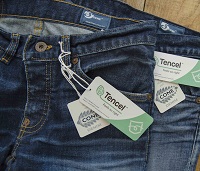 Held digitally, the recent Carved in Blue seminar, showcased the industry’s views on low-impact denim and the inclusion of wood-based Tencel branded fibers in new collections.
Denims from biodegradable materials
Pierette Scavuzzo, Design Director, Cone Denim, opened the discussion highlighting the company’s new range of Tencel Lyocell fabrics. Known as Indigo Revive, Sweet Leaf and Cone Community, these fabrics are made from a new innovative yarn upcycled from the brand’s mill dye waste. Each blend hemp with Tencel in the warp, creating a nice juxtaposition between the rustic nature of hemp and the softness that Tencel Lyocell brings.
Cone Denim also develops lower impact denims fabrics that promote circularity, are made from biodegradable material and reduce water, chemical consumption. Its product Bodh uses internal dye waste to create a new yarn and blends that with navy dyed modal. This reduces any additional dyeing and accounts for a 65 per cent water savings, Scavuzzo explained.
Mapping the product’s lifecycle
Mexico-based Global Denim has launched Circl-a new group of fabrics made from a blend of 100 per cent recycled cotton yarn. A part of its Ecoloop program, these fabrics are made at the company’s new recycled cotton facility from post-consumer and post-industrial waste, informed Anatt Finkler, Creative Director. The brand offers Circl fabrics both in rigid and comfort stretch.
The brand is expanding its Superflex collection by including fabrics with Tencel Lyocell into this product category. It believes in looking at the entire lifecycle of products. Hence, conceptualizes new dyeing, energy and water saving solutions from their inception through to end-use.
Offering an authentic 90s look, Tavex’s Nostalgic Cozy fabrics are the perfect combination of modern with retro. Made from recycled cotton, these fabrics have Tencel Lyocell finishing that reduce water consumption, noted Arlethe Sánchez, Marketing and Sample Room Coordinator. They keep consumers comfortable in their day-to-day life, offering them freedom of movement. Tavex has also launched a collection of Cotton Less Denim made from Tencel Lyocell fibers. Sanchez believes final garments should have an ecological story behind them that can help the industry change consumption patterns.
Blending environment with tradition
Having Tencel Lyocell and Modal fibers in several denim and denim colors, brand Vicunha mixes cotton, polyester and elastane threads in several products. The brand considers denim as the most democratic fabric in the world. Millennials, and especially Generation Z, are driving its growth, said German Alejandro Silva, Chief Marketing Officer.
Its constant investments in new innovations enable Vicunha reach new heights. The company has been emphasizing on the use of recycled fibers, residues from production, certified raw materials, water saving and water treatment processes. It is possible for a denim brand to be eco-friendly without sacrificing the traditional characteristics of their jeans, Alejandro Silva added.
Zero machine duties and simple tax laws can advance Pakistan’s textile growth
 A strong pillar supporting the country’s economy, the Pakistan textile sector is experiencing a massive contraction in its global trade value. This year, the country lagged behind Bangladesh, India, China, and Vietnam in textile growth. Factors that stalled growth included an o
vervalued rupee and exorbitant power tariffs. Though the issue of an overrated rupee was immediately addressed, Pakistan’s electricity costs continue to remain high. Local textile players are forced to pay 9 cents per kWh which is costlier than what exporters in other countries pay. This intensifies the industry’s grievances.
Relief package to foster productivity
To address these issues, the government has introduced a relief package that fosters productivity and employment in the industry. The package seeks to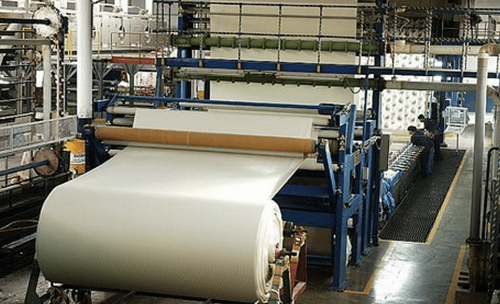 reduce the burden on textile and other manufacturing units. Currently, Pakistan has bagged numerous international orders including those rerouted from America. To execute these orders, exporters plan to operate double shifts. The energy costs of both these shifts will remain similar. However, suppressing additional electricity tariffs during peak hours will make second shift inevitable.
This will also include 50 per cent and 25 per cent concessions for small and medium enterprises (SMEs) and large-scale manufacturing (LSM) respectively. SMEs will now be charged 7.875 cents per kWh for LSM. According to a report ‘Pakistan in the Apparel Global Value Chain’, published by the World Bank and Duke Value Chains Centre, SMEs contribute roughly 10 per cent to Pakistan’s textile industry. Hence, the effective average tariff for the sector needs to be in the range of 7.76 cents or Rs 12.4 per kWh ($1 = Rs 160).
Stimulus to boost SMEs
The government package stimulates industry growth by reducing exporters’ tariff by 13.7 per cent. It not only provides a level-playing field in the post-lockdown global trade dynamics but also offers a greater relief to the SMEs. It enables SMEs to avail a 25 per cent markdown for further two years, even if the government decides against a renewal.
The favorable returns of the package will remain till the government reduces customs and regulatory duties on imported cotton yarn and machinery. Pakistan has been importing cotton yarn due to a reduction in local cotton production. However, productivity levels are being affected by duties on machinery. The country needs to relax these duties besides simplifying tax laws, and amending rules to further expedite the sector’s growth.
Suvim to export 10 million towels for Tokyo Olympic Games
Chinese textile company Suvim will export 10 million towels for the upcoming Olympic Games in Tokyo. The company’s towel exports to Japan have increased despite the pandemic and tariff rates for China that are far above those for its neighbors like Vietnam. Significantly, the manufacturer is preparing ten million towels for the upcoming Olympic Games in Tokyo.
Since their first overseas order from Japan three decades ago, Sunvim has built a partnership with over 100 Japanese companies.Over the years, they've been among traders reshaping the two markets.
The company has R&D facilities in Japan where it hoped to benefit further from IP cooperation through joint programs,says Xiao Maochang, Chairman. This is a great chance for China's textile industry to showcase its competitive advantage in global trade, he adds.
Though the true effect of the RCEP pact remains to be seen, the company has already received orders of towels for Tokyo Olympic village and the Games' commercials.
Texbrasil buyers visit Brasil Eco Fashion Week
Held online on November 26, the Brasil Eco Fashion Week was visited by international buyers invited by Texbrasil. The stores Alejandra Montaner, from Spain, Brazilian Bikini Shop, from France, Borogodó, from Spain, and Boutique Bloom, from Mexico, participated in rounds with eight Texbrasil brands. They are: Pano Social, Natural Cotton Color, Ana de Jour, Antique Chic (Panoh), Contextura, Juliana Gevaerd, Ecofante and Timirim.
The event also had fashion shows, where brands like Natural Cotton Color showcased collections made from organic colored cotton from Paraíba.The event also featured brands like Nuz Demi Couture, Nalimo, Ronaldo Silvestre, TA Studio, AfroRicky, EneasNetto, Rico Bracco, JustaTrama, W’e’enaTikuna Arte Indígena, Movin, Comas + FlaviaAmadeu, ManuíBrasil, Libertees, Leandro Castro, VIHE, Catarina Mina, and Jouer Couture.
Catarina Mina debuted on the BEFW (Brazilian Eco Fashion Week) catwalk with a collection developed in a project with 120 craftswomen from Ceará. Meanwhile W’e’enaTikuna Arte Indígena presented the indigenous graphisms, and the Tururi fabric, typical of the Tikuna people.
John Lewis to halt international expansion plans
As per Apparel Resources, John Lewis, one of the well-known British fashion retailers, plans to halt its international expansion plans.
The fashion retailer has announced that it will no longer be accepting any orders for international delivery with effect from next week. The retailer saw its international sales fall by nearly 17 per cent last year to £10.6 million, while its operating profits slumped by 10.3 per cent to £2.1 million.
The fall in last year’s international sales has probably been one of the factors to have influenced the retailer to take the decision.
John Lewis intends to focus more on business areas that will deliver products and services for its local customers in the UK. It will stop its international delivery service next week.
John Lewis & Partners is a brand of high-end department stores operating throughout Great Britain, with concessions also located in the Republic of Ireland and Australia. The brand sells general merchandise as part of the employee-owned mutual organization known as the John Lewis Partnership, the largest co-operative in the United Kingdom. It was created by Spedan Lewis, son of the founder, John Lewis, in 1929.
Garmon Chemicals becomes bluesign system partner
Kemin Industries, a global ingredient manufacturer, announced today that Garmon Chemicals (Garmon), Kemin’s textile auxiliaries business unit and the chemical solutions brand for the denim and fashion industry, has officially become a bluesign® system partner.
bluesign® is a leading global, independent verifier that supports the textile industry in its efforts to improve sustainable processes. Created in 2000 and supported by some of the world’s most important chemical suppliers, textile manufacturers and brands – such as NIKE® and adidas® – bluesign® has become a guarantee of responsible and transparent production processes.
To become a bluesign® system partner, a chemical company must undergo a strict onsite assessment to examine the transparency of its manufactured chemical products and their risks. To pass the assessment, the chemical company must meet strict criteria of resource efficiency, work safety and environmental and consumer protection.
Becoming a bluesign® system partner was a natural progression for Kemin Textile Auxiliaries, as Garmon is a pioneer in sustainability with a long history of developing eco-friendly and safe solutions. Garmon was one of the first chemical companies in the garment finishing industry to certify its products, offering its customers further guarantee of their superior ecological performance.
With many Garmon products already in the ZDHC Gateway, the database of safer chemicals adopted by the majority of fashion brands, and the company’s adherence to bluesign® system, Kemin Textile Auxiliaries can meet all its customers’ needs in terms of sustainability – all while maintaining the highest standards of quality and traceability to meet brand expectations.
Center for Sustainable Business launches new framework
Center for Sustainable Business launched its new apparel sustainability framework, developed in collaboration with Reformation, Eileen Fisher and REI. The framework is based on its Return on Sustainability Investment methodology launched with other sectors two years ago. The project was funded by HSBC Bank US’s foundation.
As part of the framework, the Center for Sustainable Business identified eight key strategies for making the apparel industry more sustainable, uncovering more than 60 best practices to address environmental, social, and governance-related issues.
Key strategies outlined included: reducing chemical impact, improving water management, improving energy management, investing in the reduction of material waste, implementing sustainable raw material sourcing, investing in circularity and innovation, investing in employee and supplier well-being, and investing in sustainable brand marketing and communications.
Reformation helped steer the framework’s initial findings on circularity, having engaged in consultative conversations with NYU’s team on its circular strategy, specifically providing data and insight on its resale partnership with ThredUp and fabric waste solution strategies, like its L.A.-based post-production recycling partner OsomTex.
Off-white’s face masks emerges as the most searched item on Lyst index
As per Lyst’s “Year in Fashion 2020” review, off-white’s face mask was the hottest item with a 496 per cent increase in searches from January to March, reports Sourcing Journal. Searches for masks increased by 502 per cent during the year as they were rated as the must have accessory.
Birkenstock’s Arizona sandal, known for its double-strap upper and contoured footbeds—saw a 225 percent spike in searches during the second quarter of 2020, a time when consumers looked for easy slip-on footwear for their at-home lifestyles.
At No 3, is Telfar’s signature faux-leather shopping bag the ‘Bushwick Birken’ increased 163 percent week-on-week after congresswoman Alexandria Ocasio-Cortez gave the brand a shout-out on Instagram. The bag got another celebrity seal of approval this month from Oprah, landing on the tastemaker and media mogul’s coveted “Favorite Things” list for the holidays.
Nike saw the greatest increase in loungewear searches, Lyst reported. The brand’s most popular item in 2020 was the jogger pant, which searches spiking 213 percent year-on-year.
Crocs continued to defy the fashion gods by being the statement shoe of choice in 2020. Average monthly searches for Crocs total 135,000, and the brand hit its peak in the spring after boasting in January that it was producing the season’s “must-have” silhouette. The EVA foam style receive received several makeovers this year thanks to a myriad of collaborators including Vera Bradley, Peeps and KFC. Justin Bieber is teed up to be the brand’s next creative contributor.
2020 Rivet 50 honorees provide collective outlook for denim industry
An international group of executives, retailers, creatives and influencers nominated and voted for by their peers, The 2020 Rivet 50 honorees provided a collective outlook on the trials and tribulations that lie ahead for the denim sector, as well as the opportunities within its grasp.
First-time Rivet 50 honoree Dan Feibus, CEO, Vidalia Mills Co, said he expects a structural overcapacity, partially fueled by an industry that has a lot of extra capacity chasing a limited number of orders. According to him, the net impact of COVID-19 on retail will lead to the emergence of a smaller industry
Denim designer Maurice Malone sees a digital evolution in the retail industry. His eponymous brand, Malone is committed to selling direct-to-consumer. He expects to see more small direct-to-consumer businesses with a better understanding of their end-consumer spring up.
James Bartle, Founder and CEO, Outland Denim expects less emphasis on traditional seasons and more capsule collections in the next 18 months—a strategy that he is already putting in place for his own award-winning brand. While Omar Ahmed, CEO, Artistic Milliners says, it will take time for the denim industry to understand the depth of damage caused by the pandemic. With near-term consumption dropping and future forecasts also looking bleak for most, the industry is being forced into an overall consolidation, which will be healthy for the ecosystem in the mid- to long-term, he adds.