FW
7th ITMF Corona Survey: Optimistic future with a drop in turnover decline

The 7th ITMF Corona Survey brings some cheer to the textile industry. The survey reveals the turnover of global textile companies declined 9 per cent in 2020. However, this decline is significantly better than the expected drop of 33 per cent in 3rd survey conducted at the peak of Corona wave in April 2020. The 7th ITMF survey was conducted from January 25 to March 10, 2021 among ITMF members and affiliated companies and associations. It polled around 196 companies from across the world.
The survey termed year 2020 to be one of the worst for global textile and apparel industry. However, compared to what was expected in 6th ITMF Corona Survey done between November 20 and December 14, 2020, the actual turnover for 2020 improved by 3 percentage points from -12 per cent to -9 per cent.
Highest decline in textile chemicals
The survey shows, the pandemic impacted the entire textile value chain including producers of textile machinery. All segments were impacted to a certain degree. The textile chemicals segment declined 20 per cent while the weaving/knitting machinery segment declined 15 per cent.
Finishing/printing machinery segment was the third largest loser with a 13 per cent decline. The nonwoven segment witnessed a zero per cent decline while the fiber segment recording 10 per cent growth. These two segments benefitted from the extraordinary demand for masks during 2020, which compensated for their loss in other areas like automotive or apparel.
Africa to emerge biggest gainer
Regionwise, Africa seems to be biggest gainer with textile turnover increasing almost 31 per cent from 2021-2024. The turnovers of South America and South East Asia are expected to increase by 21 per cent while that of North America is expected to increase 16 per cent. Europe and South East Asia are expected to record lowest turnovers with only 12 and 5 per cent increase by 2024.
An international forum for the world's textile industries, The International Textile Manufacturers Federation (ITMF) keeps members across the world constantly informed through surveys, studies and publications, participating in the evolution of the industry's value chain and through the organization of annual conferences as well as publishing considered opinions on future trends and international developments.
Myanmar crisis, an opportunity for brands to support garment workers
 On February 1, Myanmar’s attempts to reinstate democracy in the country were badly thwarted by its military as voters in the recent election overwhelmingly supported the party of popular leader Daw Aung San Suu Kyi. The coup can be used by fashion companies to establish ethical working standards in the garment industry, says a new report by Quartz.
As per the report, fashion companies operating in the country can use their influence in various ways. They can publicly denounce worker exploitation at supplier factories. These factories are known to fire workers or cut payments on slightest pretext such as holiday leave for time off. Ma Moe Sandar Mynt, Chairperson, Federation of Garment Workers of Myanmar urges brands to help workers and create a fair working environment in the country.
Low-cost labor makes Myanmar a favored garment hub
For the last few years, Myanmar has been increasingly relying on garment exports to fuel its economy. As per World Trade Organization, the country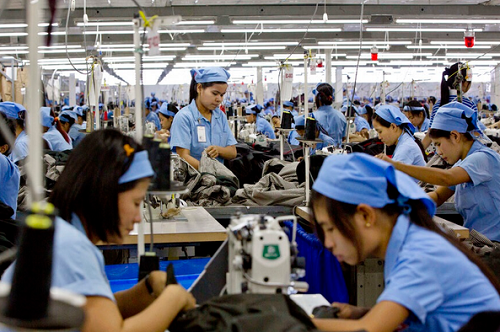 exported over garments worth $5 billion in 2019 making up over 30 per cent of its total exports. In recent years, many clothing firms have set up factories in Myanmar taking advantage of low-cost labor and favorable relationship with the European Union. Swedish brand H&M has 42 manufacturing sites in the country while Primark sources from 21 factories, Next buys from 40 factories. Uniqlo’s parent company Fast Retailing also has six suppliers in Myanmar
Ensure safety and financial security of workers
These international fashion companies have urged military to restore democracy in Myanmar. Trade groups including Ethical Trade Initiative, American Apparel & Footwear Association, Fair Labor Association have also urged brands to severe ties with military-controlled businesses and ensure the safety and financial security of workers.
In response to this call, H&M has paused new orders in the country. The brand has halted orders due to practical difficulties being faced in import of raw materials and export of finished clothes. However, the company has not made any long-term decision as yet.
Cotton USA arranges technical seminar in Bangladesh
Cotton USA, leading U.S. cotton fiber promoter and manufacturer of cotton products, arranged a technical seminar on ‘Driving Long Term Profitability for Mills and Manufacturers with Cotton USA Solutions’ on March 31, 2020 at Radisson Blu Water Garden Hotel in the Capital.
This program was aimed to widely introduce ‘Cotton USA Solution’ a cotton consultancy service to uphold the next level of business transformation for greater profitability, improved productivity and the latest techniques by Cotton Council International (CCI).
Around 200 stakeholders from different factories, brands, technology providers and cotton specialists were present at the event.
The event was organized in two sessions. In the first session, Ali Arsalan, Managing Director, Atiya Consulting and CCI Consultants and Representative in Bangladesh delivered the welcome speech and hosted the whole event; Bruce Atherley, Executive Director of CCI gave the latest updates on Cotton Council International; US Cotton Trust Protocol (USCTP) News by Stephanie Thiers-Ratcliffe, Director (Brand and Retails) of CCI; COTTON USA Solutions + Mill Mastery Course Introduction by Chris Faerber, Member of CCI Technical Team and Dr. Rubana Huq, President, BGMEA also joined in the program virtually and shared her remarks in the seminar.
An expert pool of CCI technical team combining from different countries is assuring all these solutions to the factories by connecting virtually or physically. Currently, Bruce Atherley, Executive Director of CCI (from the USA) is leading this 10 members, technical team.
Consumers’ investment in sustainability increases post pandemic: Survey
A new survey by the US Cotton Trust Protocol notes an increase in consumer spending and investment in environmentally friendly practices. As per Sourcing Journal, the survey of decision-makers at 1,000 brands and retailers in the US and UK seeks to determine the impact the pandemic on brands sustainability standards.
The survey shows, 69 per cent brands and retailers believe the pandemic has emphasized the importance of environmentally friendly products, with 61 per cent respondents reporting an increased demand for sustainable products. Around 63 per cent brands and retailers noted positive impact of the pandemic on their proactive investment in sustainability, with the main areas of focus being sourcing sustainably produced raw materials, manufacturing sustainability and reducing impacts of chemicals, water and energy, and safe working environments.
Almost 50 per cent brands and retailers expect consumers to increase their investment in sustainable apparel over the next 12 months. They attribute this to a need for people to get back to normal and increase in their savings during the pandemic.
Cotton sector to recover with higher mill use and vaccination
As per the April 2021 edition of Cotton This Month, the cotton sector is expected to recover with mill use of cotton increasing by 8 per cent in the 2020-21 and vaccines slowly making their way around the globe. However, as per IOAC report, vaccine deployment varies widely from one region to other, with many countries providing no vaccinations at all. In addition, a shift in consumer spending on services is likely to reduce demand for durable goods.
Furthermore, while estimates for global consumption have increased, the estimates for production have declined. This is leading to a decline in stock level proving future support for prices. Finally, no progress has been made since the Phase One trade agreement between the US and China went into effect last year with tensions also between China and Australia.
Phygital Mercedes-Benz Fashion Week to be held from April 20
The phygital edition of Mercedes-Benz Fashion Week Russia is scheduled from April 20-24 at the Museum of Moscow. The shows will take place in Moscow, Kazan, Nizhny Novgorod, St. Petersburg, and Sochi. The program will include live streamed shows by designers from Italy, Spain, France, and other countries.
Over 50 designers will present their collections at this season. Some brands that will showcase their collections are: Selfétude, N. Legenda, Nastya Nekrasova, Ónoma, Sergey Sysoev, Yana Besfamilnaya, Elena Souproun, Hard By Hse Art And Design School, Julia Dalakian, Alena Nega, Lena Karnauhova, Mercedes De Alba, B&D Institute of Business and Design, etc. The event will also present designer Emma Bruschi for the first time on the MBFW Russia schedule. On April 7, names of winning designers will be announced.
The virtual edition of MBFW Russia will be held on a unique digital platform with gamification elements, exclusive materials from designers, as well as content and insights offered by industry experts. At the digital platform, MBFW Russia live streams from anywhere globally will be available. Moreover, interactive online features will offer a dive into the spirit of the event.
Soorty’s new project to pioneer use of organic cotton in denim production
Soorty’s new project, the ‘Soorty Organic Cotton Initiative’ aims to pioneer the use of organic cotton farmed with regenerative practices in denim production. The project aims to reach out to farmers across Balochistan in Pakistan and identify receptive communities which would like to transform their small holdings into exclusively organic farmlands over long term. The project will kick off in Nall in Balochistan’s Khuzdar District.
Soorty has partnered WWF-Pakistan and the Department of Agriculture Extension, Balochistan to carry out its new initiative and will also receive support and input from the Laudes Foundation. Over the coming four years, SOCI aims to bring around 7,000 acres of land under organic cotton cultivation and produce over 17,000 metric tons of Seed Cotton and 6,000 metric tons of Cotton Lint.
By guiding Balochistani farmers to produce organic cotton, Soorty aims to uplift communities and enable them to increase their income. Ameliorating organic farming practices in the region will also help the environment and help to promote sustainably produced denim across the fashion industry.
Pandemic creates mismatch in US retailers, consumer’s perceptions on clothing purchases: Survey
A survey by Blue Yonder and Coresight Research reveals, consumer perceptions and that of retailers on apparel purchase decisions made during the pandemic are highly mismatched. Around 68 per cent retailers believe their customers preferred apparels made in the US while only 19 per cent shoppers preferred clothes made by domestic brands.
Additionally, 64 per cent retailers believe price to be an important driver for customers while making clothing choices while only 32 per cent consumers actually sought the lowest price. As per the research, shoppers are keen to return to stores. Around 45 per cent expressed their preference for shopping in stores compared to 37 per cent who prefer a combination of in-store and online and 18 per cent who prefer to shop online only.
China’s industrial output increases 35.1 per cent in 2021
National Bureau of Statistics shows, China’s value-added industrial output above designated size increased by 35.1 per cent year-on-year, in the first two months of 2021 .In February, it edged up 0.69 per cent from the previous month.
China’s manufacturing output increased by 39.5 per cent year-on-year in the first two months. Textile industry's value-added output also increased 39.5 per cent. In the first two months, production of 565 out of 612 kinds of products increased year-on-year. Output of fabric increased 24.1 per cent year-on-year to 5 billion meters in January-February period, while the output of chemical fibers increased by 32.4 per cent to 9.77 million tons in January-February. And the sales-output ratio of industrial enterprises was 1.1 percentage points higher than the same period of last year.
CCOO criticizes H&M’s shop closures in Spain
The Workers' Commission (CCOO) union has called H&M’s shop closures in Spain absolutely disproportionate and the layoffs of furloughed staff unjustified. Swedish fashion giant H&M has announced plans to close 30 shops and lay off more than 1,000 staff in Spain. The brand plans to close 350 of its 5,000 shops worldwide, while opening 100 others to adapt to the increased digitalization of the retail industry.
The Spanish government has announced €40 billion funding schemes to ease the current crisis in the industry. In return for the funding, companies are banned from laying off staff for six months after the end of the scheme which is currently set to run until May 31, but is likely to be extended.
However, H&M has refused to abide by this rule saying it is not subject to any job maintenance commitment. The brand’s net profit tumbled tenfold in 2020 as a result of the pandemic, although its online sales leapt more than 40 percent on the figures for a year earlier, accounting for almost a third of its overall turnover.