


FW
Selyn Textiles promoting sustainable handlooms through blockchain in Sri Lanka
 Post COVID-19, many businesses are adapting consumers’ growing demand for sustainability. The Sri Lankan handloom industry too has seen increased demand for blockchain technology, allowing brands to demonstrate their products sustainability and ethos, says Selyna Peiris, Director-Business Development, Selyn Textiles.
Having a long and venerable history of over 2, 500 years, the Sri Lankan handloom industry has been a sustainable industry since its inception, Peiris says. Energy consumption is low and the industry has created thousands of jobs for rural artisans and communities across the country. However, despite these efforts, the industry is deteriorating due to the diminishing importance of handlooms in the sector, adds Peiris.
Sri Lanka no longer sees the handloom sector as an embodiment of its history and culture. The country needs to treat the sector on par with premium and luxury sector, opines Peiris. Further, it needs to increase transparency in production by integrating blockchain technology into supply chains. This will help the country address the ‘green-washing’ debate, and provide consumers with verifiable data to inform the purchase of a higher value textile.
Humanizing the fashion supply chain
A perfect tool to validate authenticity, blockchain can make a consumer fully aware of products by integrating it from the point of sourcing to point of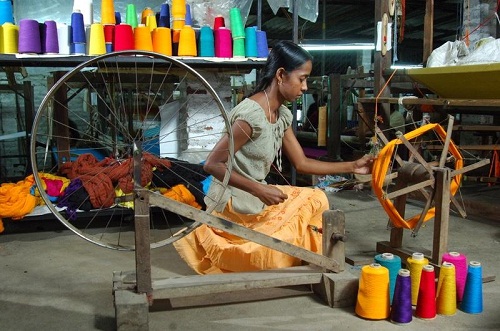 purchase with the swipe of a QR code. The technology each stage of the production process to enable consumers to access independently verified, real-time, detailed metadata. Consumers can also input their own information to the QR code which makes the product more circular.
Technology enables the handloom sector to openly share information about the origin and making of a product. It demands attention to all stages of the supply chain besides making consumers aware of the waste they create in environment. Further, the technology allows fashion industry to humanize its supply chains and share the profits gained fairly among all those involved in making profits.
Brands that have already invested in fair trade/ethical trading and operating standards would find it easy to integrate this technology into their businesses. To achieve this, they would have to shift from traditional business mindset and engage into more collaborations and cooperation, says Peiris. For this, they would have to form effective partnerships across the sector, she adds.
Presenting an authentic and responsible brand
Sri Lanka's only fair-trade handloom company Selyn Textiles aims to promote a sustainable business model that empowers the livelihoods of over a thousand women in the country. Operating for the last 30 years, the company aims to transforming the industry by encouraging full transparency of supply chains, integrating new production technologies, and revolutionizing the product it offers. Its purpose-led business model aims to meet sustainability goals, and restore pride and dignity amongst artisans, Peiris explains.
Integrating blockchain into its supply chain, Selyn a truly authentic and responsible craft brand, says Peiris. The company is repositioning its work in the sector by drawing on fair-trade foundations and using its social enterprise credentials, she adds. It aims to carve a niche in the handloom sector by committing to ethical and sustainable practices combined with greater transparency. It believes, blockchain is the future of handloom, and the apparel sector at large, adds Peiris.
Nike starts operations at all Vietnam units
Nike’s factories across Vietnam have resumed operations since the Covid outbreak. About 200 contracted factories in Vietnam make sportswear for Nike. Almost half of American sports giant's footwear is made in Vietnam. At least three million people in Vietnam work in textile and footwear manufacturing. The country has also prioritized vaccinating employees working in industrial parks to spur manufacturing activities.
Vietnam has recorded over 9,30,000 infections in total and 22,000 deaths, with about a third of the country's population vaccinated. An export powerhouse, Vietnam not only survived but even thrived during the US-China trade war and the early phases of the pandemic. Still, its trade outlook was starting to show signs of faltering in the first half of July 2021. Shipments of computers and electronics, as well as telephone equipment, contracted in the first half of this month from the same period a year ago,
Nike has filed several new trademarks prompting speculation that it is gearing up to launch into the metaverse. Nike will make and sell virtual Nike-branded sneakers and apparel. Nike is planning to launch brands in a different web atmosphere that would allow them to provide online, non-downloadable virtual footwear, clothing, headwear, eyewear, bags, sports bags, backpacks, sports equipment, art, toys, and accessories for use in virtual environments. Nike has lowered its fiscal 2022 outlook after its revenue rose to $12.25 billion from $10.59 billion in the first quarter ended August 31.
Textile emissions set to rise 9.5 per cent by 2030: Study
The manufacturing and sale of textile goods and clothing generate 2.5 billion tons of greenhouse gas emissions annually, says cKinetics, which aims at identifying solutions to reduce emissions.
This represents 7.25 per cent of total manmade emissions presently and is expected to reach 9.5 per cent by 2030. Even if leading players meet their climate commitments, textile and apparel sector’s emissions from production are likely to increase in this decade.
Increasing consumer demand for textile goods and clothing as well as growing use of polyester are some factors contributing most to the increase. The textile sector is intertwined with everyone’s daily lives and its value chain employs over 400 million people globally. And the sector’s highest impact is concentrated in emerging economies.
Hence, there are several interlinked components. Some 165 companies across the globe and across the production value-chain (from fiber all the way to product) generate and influence 608 million tons of greenhouse gas emissions (or about 24 per cent of the sector’s emissions). In the last few years, some 50 of these companies have set climate goals and shared details on them. However, these goals are not sufficient as per the analysis and more companies would have to step up.
Puma develops experimental biodegradable sneaker Re:Suede
Puma has developed an experimental version of its most iconic sneaker, the Suede, to test for a product to make it biodegradable. The Re:Suede, which uses latest technology, will be made from more sustainable materials such as Zeology tanned suede, biodegradable TPE and hemp fibers. The experiment is a pilot in circularity. Designed to help address the challenge of waste management in the footwear industry, Re:Suede experiment will allow Puma to take more responsibility when it comes to tackling the after life of its products.
The pilot will launch in January 2022. Participants will wear Re:Suede for six months to test the durability of product using biodegradable materials in real life, before sending them back to Puma via a takeback infrastructure, designed to move the products to the next step in the experiment. The sneakers will then be subject to an industrial biodegradation process in a controlled environment. The findings will help Puma assess the biodegradable process and unpick essential research and development for the future of sustainable shoe consumption.
Re:Suede is the first circular program to launch under Puma’s Circular Lab – a new innovation hub, which is led by Puma’s sustainability and design experts who work to develop the future of the company’s circularity programs.
Report debunks cotton myths about its water consumption
The notion that cotton is a water guzzler is a myth reveals denim and cotton industry groups Transformers Foundation and ICAC. They say figures like “it requires 20,000 liters of water to make a T-shirt” are not true. According to ICAC, cotton uses around 1,931 liters of irrigation water to produce one kg of lint, which is about what is needed for one T-shirt.
Another myth that the groups debunk is the idea that cotton is a direct contributor to water stress, and is an inherently water-thirsty crop. They say though cotton grown in many water-stressed regions can contribute to water management challenges, cotton is a drought-tolerant plant adapted to arid regions and that it is not a proportionally high consumer of irrigation water (blue water) compared to many other crops.
Other factors that play into water stress include the lack of water-saving technologies and local water availability. They say the relationship between farming, cotton, and sustainable water management is complex and that calling cotton water-thirsty is misleading and can lead consumers to demonize a crop or a fiber rather than open up a conversation about water stewardship and sustainability in the cotton sector. Their suggestion is brands and companies across the fashion supply chain should offer better reporting, monitoring and data on their environmental practices.
India to boost technical textile exports over next three years
India targets a fivefold increase in export of technical textiles in the next three years. There will be production-linked incentives for the textile sector including affordable infrastructure for manufacturing like cheap land and power and alignment with the best standards in textile manufacturing.
Growth of technical textiles in India has gained momentum in the past five years, growing at an eight per cent per annum. The aim is to hasten this growth to 15 to 20 per cent over the next five years. The growth will be directed toward high technology and indigenously innovated products. With these objectives in mind, the National Technical Textiles Mission was launched in February 2020, with a view to making India a self-reliant, vibrant, export-oriented economy. In January 2019, for the first time in India, 207 HSN Codes were issued for technical textiles, and in less than two years India turned a net exporter in technical textiles.
Technical textiles are textiles that are engineered to give the desired output suitable for specific applications. The basic raw materials are natural fibers like jute, silk and cotton. India has an eight per cent share in this market. The biggest players are the US, western Europe, China and Japan.
Growing use of synthetics in fashion damaging human, environmental health
Fashion brands use a significant amount of fossil fuel like oil to create synthetic materials such as polyester, says Changing Markets Foundation. Each year, production of synthetic fibers, such as polyester, produces the same amount of greenhouse gas emissions as 180 coal power plants and this is set to nearly double by 2030. Synthetic fibers represent over two-thirds of all materials used in textiles. This amount is expected to reach nearly three-quarters by 2030.
Cheap synthetic fibers have become the most significant driver of fast fashion’s overproduction and overconsumption. Polyester – fast fashion’s preferred fiber – is half the price of cotton and its use has more than doubled since 2000. As production has boomed, the average person now buys 60 per cent more clothing items than 15 years ago and almost as much clothing produced every year is thrown away.
Heavy use of plastic fibers has also seen an exponential rise in invisible microfibers, which are damaging to human and environmental health. Airborne microplastics from synthetic clothes get into the human body, becoming engulfed by immune cells, which can cause significant inflammation.
Jeanologia develops unique customer experience
Jeanologia has developed an innovation laboratory to transform physical stores into digital and sustainable experience centers for consumers. The company has worked with top brands and retailers in a new in-store model focused on eco-efficiency, personalization, and digitalization. Consumers are at the center as participants in the sustainable finishing of their garments.
Jeanologia has two success cases developed using its technology to bring to retail the experience of real-time personalization in front of the consumer. A Levi’s Haus store in Miami is an example of the future of garment finishing that demonstrates the next level of personalization powered by Jeanologia’s laser. The consumer can customize every detail of the garment. Levi’s Haus in Miami has marked a retail milestone, bringing together jean design and production physically in-store with the fun of the in-person experience for the consumer.
Another Jeanologia case study is Bershka’s flagship store in Italy, transforming it into a digital denim customization laboratory. Consumers can have an unique experience in real-time, designing their own garments in a quick and sustainable way with laser technology, in only 45 minutes and being present during the whole live process.
For Jeanologia, the three pillars for the future of retail are consumer experience, sustainability, and the omnichannel that connects the physical world with the digital.
Cannes beachwear event MarediModa opens tomorrow
MarediModa will be held in Cannes from November 9 to 11, 2021. The event focusing on beachwear, underwear and athleisure will have a 100 European companies presenting their fabric and accessory collections for summer 2023.
Visitors will receive free access to the exclusive spring/summer 2023 trend book. This is a unique and indispensable online tool available in ebook format. The goal of this project is to provide a quality tool that can spark creativity, gain access to new visions and accompany the creative process till its end starting from a social background up to the fashion themes to come.
MarediModa makes its trend book available to creative talents worldwide as a source of inspiration and a true sextant for designing a beachwear, underwear or athleisure collection featured by explorations into the closest territories and identified by cross-contaminations.
Lycra is the event partner. The commitment of Lycra to key issues such as innovation, sustainability and traceability of the supply chain will be highlighted.
Finland opens Nordic’s first textile recycling plant
Finland has opened a textile recycling center with a capacity of processing about 12 million kg of textile annually, or roughly 10 per cent of the country’s cloth material waste. The facility, set up jointly by textile recycling company Rester and waste firm LSJH, is the first in Nordics that will turn waste textile materials into recycled fibres on a large scale. A commercially-viable solution of recycling and processing industrial and household textile waste into raw materials has been developed. The recycled and processed textile fiber can be used to make new cloth products.
Finland throws out about 100 million kgs of textile waste every year, and the material has remained a poorly-recycled resource. There are plans to build similar plants across Finland. It will become mandatory to sort textile waste in Finland in 2023, and a similar change is planned across the EU in 2025. Manufacturers are increasingly interested in using recycled fibers, due to growing concern for the environment and tightening regulations in the EU.
Finland has created significant expertise in textile recycling as well as a wide network of cooperation. They will help in finding sustainable textile solutions in line with the recycling and circular economy goals of Finland and the EU. However, sorting technologies must also be developed to ensure sufficient volume and quality of material for industrial recycling processes.











