FW
Aurora develops new coating capabilities
Aurora Specialty Textiles has developed next-generation, custom-coating capabilities and products to meet the needs of pressure sensitive tape, industrial belt, home furnishings and printable textiles industries.
Aurora Specialty Textiles, based in the US, is a leader in coating, dyeing and finishing of both woven and nonwoven fabrics. A leading custom-coater and finisher for the North American textile industry supply chain, Aurora provides a wide variety of finishes – water repellency, antimicrobial and FR – and is well-known for engineering industrial belting and printable textiles as well as backings for pressure sensitive tape fabrics.
In the printable textiles category, Aurora has the Expressions Canvas line. Treated with a proprietary coating developed by Aurora, Expressions has been engineered to maximise print output and throughput with the newest digital printing equipment. The entire line is cross-compatible with the latest generation of latex, solvent/eco-solvent and UV printers without sacrificing quality or productivity.
Founded in 1883, Aurora operated solely as a bleaching operation before adding finishing, dyeing and coating capabilities. As the global textile industry changed, the company saw the opportunity to move into ultra-wide-width coating of textiles and establish Aurora as a premier textile coater. That move required finding a larger manufacturing facility and investing in new equipment.
Demand for Asian streetwear growing across the globe
Asian streetwear like hoodies, T-shirts, trainers, and tracksuit bottoms is the flavor of the moment. A fashion genre, streetwear is a style of comfortable, casual clothing inspired by skateboarding, surfing, hip-hop, punk and other subcultures.
In recent years a growing number of new Asian labels have entered the sphere. And their sales are increasing strongly. While a few Japanese labels have long had a presence on the global streetwear scene, the big growth in recent years has come from companies in other Asian nations, from China to South Korea, Singapore even Indonesia. Seeking out fresh, unique pieces rather than just flashy logos from big name heritage brands is a major trend both within streetwear and the luxury market.
Asian streetwear has grown in popularity around the globe because it is of an increasingly high standard. The world is looking east because of the tremendous amount of young talent that has emerged in recent years. It is a reflection of Asia rising. The big increase in the worldwide popularity of Asian streetwear has been further helped by fashion bloggers and others in the online and social media sphere. These individuals are increasingly focusing on Asian designers, who had previously been ignored by established fashion publications.
Active consumers seek lighted apparel
The active wearable lighted apparel and fabric market is expected to grow significantly in the next few years.A major factor driving growth is consumers who prefer practising sports at dusk or dawn. Low visibility often results in accidents, therefore, consumers are opting for lighted apparel.
The concept of lighting apparel and fabric was initially introduced for people working in hazard-prone environment such as mining and construction sites. Reflective fabric, which uses the phenomenon of light reflection to enhance the contrast of the clothing, was used. Soon enough fashion brands introduced the idea of lighting apparel and fabric, which gained rapid popularity among celebrities, hence establishing a new trend.
As consumers around the world are taking conscious efforts to implement a healthier lifestyle, retailers are extending the technology of embedding smart sensors to active wear as well. Lighted apparel is made by a special kind of fabric, stitched with light emitting devices, such as LEDs. The apparel is embedded with lights that can be charged using a USB charger. Companies are focusing on introducing interesting innovations in lighted apparel, such as interactive garments, to attract potential customers. Prominent fashion brands embed lights in apparel, in order to enhance its look.
Japan hosts denim event next March
Denimandjeans will be held in Japan, March 4 to 5, 2020.
The trade show will primarily focus on technology. The event will showcase 40 exhibitors representing various areas of the denim production process. Their latest innovations will not only add function but also a design appeal for consumers. Attendees will share insights on design innovation, sustainability and other topics surrounding the denim and sportswear industries. The aim is to create a niche show in Japan which will aggregate the best innovators in the denim and related sportswear industries and showcase the latest products to visitors.
Japan is a key market for denim. The country imports more than 179 million pairs of jeans annually. Denim is a favorite apparel for Japanese customers and in spite of high costs a decent amount of production still happens in Japan. But the prevailing narrative of price sensitiveness while buying a product fails in Japan. Quality and design are the clinching factors.
Denimandjeans was launched in 2007 as a global resource for B2B denim news, reports and analysis. Since then, the company has held a number of conferences and fairs around the world. In 2014, Denimandjeans launched its first trade show in Bangladesh, followed by shows in Vietnam and India.
US secondhand fashion on the roll, exponential growth expected next five years
"While there was a stigma attached to buying secondhand clothes earlier, now, “one person’s trash is another’s treasure,’ the resale market for secondhand fashion has become a runaway success with everyone jumping on to the bandwagon. In the United States alone, the secondhand market generated $24 billion sales in 2018. This is expected to increase to $51 billion by 2023. As the per ThredUp estimates, the secondhand market in the United States is likely to grow bigger than conventional market in the next five years."
 While there was a stigma attached to buying secondhand clothes earlier, now, “one person’s trash is another’s treasure,’ the resale market for secondhand fashion has become a runaway success with everyone jumping on to the bandwagon. In the United States alone, the secondhand market generated $24 billion sales in 2018. This is expected to increase to $51 billion by 2023. As the per ThredUp estimates, the secondhand market in the United States is likely to grow bigger than conventional market in the next five years.
Internet shaping growth
Around 56 million of American women shopped for secondhand clothes in 2018. This was around 64 per cent of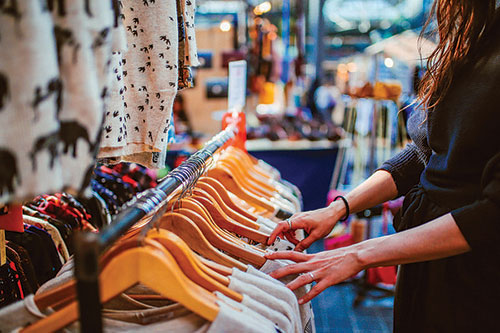 the total world’s female population over 18 years of age. One of the most important growth drivers was increasing use of Internet. Through e-commerce platforms, ranging from eBay to Rent the Runway, Internet not only shaped but also professionalised the universe of secondhand clothes.
Another business that is forecasted to grow at a rapid speed by Reuters is that of garment rentals. It is estimated that the clothing rental business will grow at an annual average rate of 10.8 per cent until 2023, when it is expected to reach $1.9 billion.
Changing consumer mentality a big plus
Although several factors like sustainability and transparency have led to the growth of secondhand clothes market, an important factor that has driven this growth is the change in the mentality of the new age consumers. The new generation of consumers prefers to experiment with their lot more clothes rather than own just a few of them. This gives fashion rentals the biggest growth potential in the next few years.
Several brands and retailers in the United States have opened their doors to secondhand, rental or even subscription market, either through their own resale channels or by collaborating with specialized marketplaces. This can be seen from ThredUp which started its resale service this year in collaboration with companies like Macy’s or JCPenny. The company has also tied-up with Reformation to resale around 7,500 garments at the beginning of this year.
Similarly, Farfetch has launched the Farfetch Second Life platform, which enables luxury bag makers to exchange them for credit for Farfetch’s own ecommerce. H&M organised secondhand sales in April through the ecommerce of &Other Stories, whileNeiman Marcus, bought a stake of Fashionphile last April, a company specializing in selling secondhand accessories.
Rental market attracts consumers
The rental or subscription market is also attracting conventional retailers Urban Outfitters, Nike or Gap. Urban Outfitters launched the monthly clothing rental service Nuuly; Nike created the Adventure Club service of footwear for children between two to ten years old, while Gap has begun testing this terrain with Banana Republic, through the new Style Passport platform.
Vietnam August cotton imports down 25 per cent
Vietnam’s cotton imports in August 2019 were down 25.6 per cent year on year and 22.8 per cent month on month. From January to August 2019, cotton imports were down 8.2 per cent year on year. In August the export value of textiles and garments was up 6.6 per cent year on year and 2.2 per cent month on month. In the first eight months of 2019, the export value was up 10.2 per cent year on year. In August, Vietnam’s imports of US cotton were up 23 per cent year on year, but down four per cent month on month. From January to August 2019, imports of US cotton were up 16.19 per cent year on year.
But imports of Indian cotton were down 56.29 per cent, imports of Brazilian cotton down 0.67 per cent and imports of Australian cotton down 65.25 per cent. Due to a high product inventory, Vietnamese plants have reduced their demand for cotton. In September, cotton imports may continue to fall.
US cotton exports to Vietnam have increased 294 per cent over the last five years. Vietnam is the largest export market for US cotton. Vietnam has overtaken China to become the largest cotton importer in the world.
Women’s wear is profitable but tricky
Global women’s wear market has shown good growth rate. The market is bifurcated into five categories: clothing, footwear, sportswear, accessories and others. Brand loyalty and brand recognition are keys for successful business. Europe represents the largest market for women’s wear, followed by North America. But Asia Pacific is expected to be the fastest growing market for women’s wear. Increasing promotional activity, rising disposable income, increasing consumer confidence and increasing eagerness to keep up with the latest fashion trends are some of the major driving forces for the women’s wear market. Women’s footwear particularly is showing good growth. Rubber owing to its high endurance and versatility remains a preferred material for women’s footwear over other material types such as leather, velvet, plastic, and textiles. Plastic is positioned as the second most favored base material for women’s footwear. Customization is trending in the women’s footwear landscape. Therapeutic women’s footwear holds a promising outlook. Sports shoes dominate women’s footwear. Sneakers have huge sales potential in the casual shoes category.
There are various channels where women’s wear can be purchased. These include department stores, boutiques, retailers, specialty stores and online. However, it is difficult for a company to establish itself in the women’s wear segment due to fast changing styles.
Super changes schedule
Super will be held in Italy from September 19 to 22, 2019 during Milan Fashion Week and will open one day earlier than have prior editions. The decision to bring forward the opening date was made after a careful analysis of foreign buyer flows and in the hope of gaining a very busy day.
This is a trade show mainly of the accessory and women’s prêt-à-porter producers. The new format caters to the needs of more sophisticated international buyers. The show continues to bet strongly on scouting new and interesting brands while constantly discovering new international creative hubs. A vast selection of designers both Italian and international will be part of this edition and Italian designer Vivetta Ponti will present her new footwear line and will be the subject of a special installation in the Visconti Pavilion and will also show on the runway during Milan Fashion Week. A special area will show a series of up-and-coming talents from all over the world including Alighieri (UK), Gogo Philip Studio (Italy), Helena Bajaj Larsen (France), Liudmila Footwear (Kuwait), Roma Narsinghani (India) and Sabry Marouf (UK). Super will also present a selection of brands from Armenia. They are Damink, Demiurge, Kivera Naynomis, Loom Weaving, Made, Nikolyan, Ruzane, Soncess and Teress. Some of them are making their international debuts.
Southeast Asia offers tax breaks
With the ongoing tariff war between the US and China, Southeast Asian countries are intensifying their efforts to attract companies planning to move production bases outside China. To attract investment, they are offering tax incentives and other benefits.
Thailand for example is offering preferential measures for companies that relocate factories and other facilities from China. A corporate tax deduction of up to 50 per cent is one of the main pillars of the package. The Philippines is attracting more export-oriented manufacturing foreign direct investments by relaxing rules. Cambodia, with its cheap labor, is increasing its presence as an alternative production base to China for apparel and other products. As one of the least developed countries, Cambodia has an advantage of low tariffs when exporting to the United States and Japan. In Myanmar, more companies that operate in China have been visiting a special economic zone supported by Japan. Myanmar wants to further relax regulations to attract companies that can become partners in its economic development. Moves toward transferring production from China to Southeast Asia are gaining momentum. Southeast Asian nations hope that more production bases will mean more exports to developed countries, which will make up for sluggish exports to China.
Shima Seiki offers fully integrated cutting system
Shima Seiki’s Cutting Solutions is a fully integrated cutting system that offers smooth workflow from design and programming to fabric spreading, labeling, cutting and pickup of cut parts. The company’s CAD/CAM line-up consists of the SDS-ONE APEX4 design system, the P-SPR2K fabric spreading machine with labeling option, the P-CAM161 multiply computerised cutting machine, and the pickup table with pickup projector.
The P-CAM161 offers high-quality, efficiency and productivity with good cost-performance. It is designed to handle precision cutting of a variety of fabrics and materials for flexible high-volume production. The pickup table features a pickup projector that projects images of cut parts onto the fabric to increase efficiency and prevent human error in pickup and sorting. The P-CAM160 is a single-ply computerised cutting machine. The P-SPR2K computerised spreading machine provides smooth spreading and stacking of knits and other fabrics with stretch characteristics. The labeling option is available for affixing labels to each part for smooth pickup. SDS-ONE APEX4 is a brand-new design system. Its fabric simulation capability in circular knitting, flat knitting, weaving, pile weaving and printing is designed to reduce sampling time, cost and material. The new PGM software features improved interface and up to a 40 per cent increase in productivity compared to the previous APEX3 system.