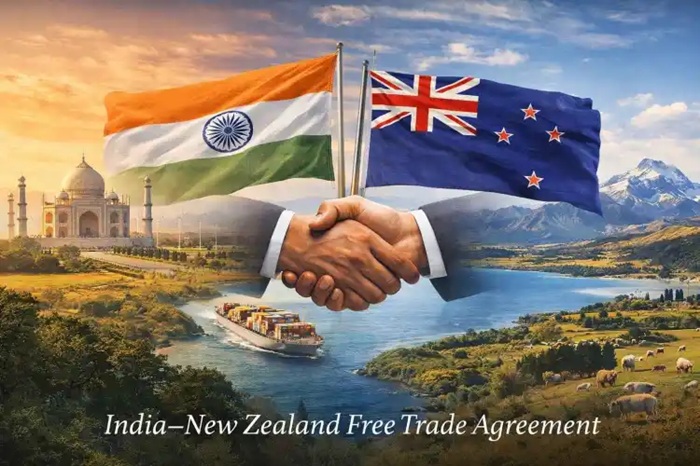
India and New Zealand have inked a ‘once-in-a-generation’ Free Trade Agreement (FTA), one that will have a profound impact on Indian textile and apparel industry. Signed by commerce & industry minister Piyush Goyal, and New Zealand’s minister for trade and investment Todd McClay, the pact offers 100 per cent duty-free access for Indian exports. This will dismantle the 10 per cent tariff wall that previously hindered Indian garments from challenging the market dominance of regional competitors like China and Bangladesh.
Tariff disadvantage gives way
The primary catalyst of this agreement is the removal of peak tariffs on nearly 450 Indian tariff lines. For the apparel segment, where India currently holds a modest 4.4 per cent market share the removal of 10 per cent import duty is a game-changer for price-sensitive retail chains. As A Sakthivel, Chairman, Apparel Export Promotion Council (AEPC) points out, emphasized this fiscal relief will allow Indian MSMEs to scale volumes rapidly. "With zero-duty access, Indian products gain immediate price parity. We are now looking at trebling our ready-made garment (RMG) exports to New Zealand within just two years," he opines.
The table data outlines the baseline from which India is launching its expansion strategy. While apparel is the growth target, home textiles already show significant strength.
Table: India’s market footprint in New Zealand as of 2025
|
HS code |
Product group |
India's exports to NZ (US$ mn) |
NZ imports from world (US$mn) |
India's share (%) |
|
63 |
Home Textiles, Made-Ups |
48.59 |
282.33 |
17.20% |
|
61 |
Knitted Apparel |
24.03 |
622.77 |
3.90% |
|
62 |
Woven Apparel |
24.28 |
562.52 |
4.30% |
|
57 |
Carpets |
11.08 |
110.69 |
10.00% |
|
53 |
Other Vegetable Fibres |
4.31 |
9.99 |
43.10% |
|
54 |
Man-Made Filaments |
5.6 |
47.75 |
11.70% |
A unique commercial angle of the deal is the reciprocal raw material strategy. Trade experts say India will leverage the FTA to import New Zealand’s world-renowned premium wool at lower costs. Ashwin Chandran, Chairman, Confederation of Indian Textile Industry (CITI), highlighted this synergy, “New Zealand is a major exporter of high-quality wool. The FTA makes it lucrative for Indian companies to import this premium fiber and manufacture high-end garments in India, and then re-export them globally, including back to the Oceania market.” This circular trade model is expected to move Indian manufacturers from basic commodities to the luxury retail segment.
Diaspora demand and niche market peresence
The agreement also seeks to tap into New Zealand’s demographic shift; nearly 5 per cent of the population is now of Indian origin. This diaspora creates a steady demand for ethnic wear and traditional made-ups, categories where India already enjoys a 17.2 per cent share. Retailers in Auckland and Wellington are increasingly looking to diversify sourcing away from a single-country dependence, and India’s reputation for natural fibers (cotton and silk) gives a reliable alternative. Trade analysts point to HS Code 53 (Other Vegetable Fibres), where India already has 43.1 per cent share, as a blueprint for how specialized Indian products can dominate niche high-value categories.
Tirrupur knitwear opportunity
The Knitted Apparel (HS 61) sector was the largest untapped opportunity. In 2025, New Zealand imported over US$622 million in knitwear, but India’s contribution was a mere US$24 million. High tariffs made Indian basic tees and polos 10 per cent more expensive than those from duty-free competitors. However, post-FTA, the knitwear cluster in Tirrupur, , can now ship a high-volume consignment of organic cotton T-shirts to a New Zealand retail giant like The Warehouse with zero landed duty. Experts forecast this cost-saving alone will shift 5-7 per cent of New Zealand's total knitwear sourcing to India by 2028.
The AEPC is the nodal agency for promoting Indian garment exports, representing over 8,000 exporters. With a focus on cotton, the council is now steering the industry toward Man-Made Fibers (MMF) and sustainable fashion to align with global ESG standards. The AEPC aims to support India's broader goal of reaching US$350 billion in textile production by 2030. Currently, the council is focused on high-income ‘Oceania’ markets to reduce dependence on traditional EU and US buyers, using the New Zealand FTA as a strategic beachhead for the wider Pacific region