FW
China’s depleting textiles market share an opportunity for India
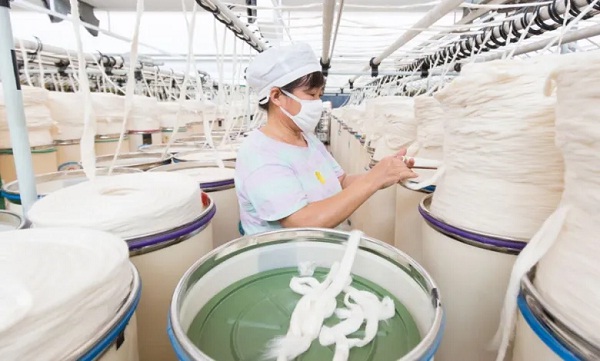
China’s current textile troubles can bring new opportunities to India’s exporters as demand for cotton from China has dropped this year. A few Chinese companies have lost up to 30 per cent orders, as per Beijing Cotton Outlook, the South China Morning Post. The number of textile factories with operational machines has also declined 13.3 per cent, as per the China National Cotton Information Centre. Experts believe, this could worsen as more countries stop buying cotton from East Asian countries.
Step up exports to China
KK Lalpuria, the Executive Director and CEO, Indo Count Industries, opines, India should take this opportunity to increase textile exports to China. India currently holds about 6 per cent market share. The government should aim to increase textile exports to $100 billion by 2030. To reach this goal, Indian exporters need to overcome numerous bugbears indicates a CRISIL Ratings report. Cotton prices have more than doubled in one year, making the situation even worse. Rise in domestic cotton prices has led to exports becoming less competitive.
Gautam Shahi, Director, CRISIL Ratings, attributes this to an increase in the price of raw materials like cotton due to a US ban on cotton produced in Xinjiang, China which is the biggest producer of the fiber. He urges the government to help players in the sector achieve steady growth. Experts also advise the government to introduce policies that encourage diversification of textiles portfolios, capacity building, and competitiveness. Also, there is a need to focus on new foreign trade agreements (FTAs).
Include textiles in FTAs
Anand Ramanathan, Partner, Deloitte India, urges the government to include textiles into all FTAs. These agreements can significantly impact India’s textile industry. For example, the India-UAE trade pact will help lower import duties for Indian exporters. This will boost trade between the two countries besides making the textile industry more competitive and help create jobs. As per a report by the Press Information Bureau, India’s textile and clothing industry adds about 2 per cent to the country’s GDP. Before COVID began, it employed close to 105 million people. Hence, the government needs to help the sector by adopting the ‘China Plus One’ strategy to get a more significant share of the global textile market. Lalpuria says, India can benefit from this policy as many international brands have diversified to other places instead of China.
Boost prices cotton through mechanization
India can also benefit from its huge cotton production and a well-established industry that makes all kinds of fabrics and yarn. Schemes like the Production-Linked Incentive (PLI) scheme and the Interest Equalisation Scheme have helped make the country more competitive. Growing at a 6.2 per cent CAGR from 2020 to 2025, India’s technical textiles exports are worth $2 billion with the country aiming to reach a goal of $10 billion exports in three years.
Cotton prices can be fixed by increasing the number of cotton crops and using machines, says Ramanathan. He advises farmers to connect with banks to get money and ensure more mechanization and investments in new technologies.
Adopt sustainability
Farmers also need to monitor new trends catching on around the world. They need to learn about sustainable ways to make things. RK Dalmia, Senior President and Director, Birla Century says, they aim to integrate sustainability throughout the entire value chain. About 84 per cent of trash being produced by them is being recycled or reused. It recently also started recycling of fly ash from power plants to make factories more in line with international standards, he adds. Ramanathan opines, ensuring responsible production of fabrics can help boost exports. It can also help manufacturers procure all raw materials from one place. This can give India a big advantage over Bangladesh and Vietnam, he adds. Thus, to achieve the $100 billion export goal, Indian government and players need to focus on resolving the current problems, adds Ramanathan.
US apparel imports rise by 40.14% Y-o-Y in H12922
During the first half of 2022, the US apparel imports increased by 40.14 Y-o-Y to $49.58 billion.
Particularly in June ’22, the imports grew by 40.30 per cent Y-o-Y to $8.64 billion, while the growth noted on monthly basis over May ’22 was 1.52 per cent.
As per OTEXA data, analyzed by team Apparel Resources, top six Asian countries (China, Vietnam, Bangladesh, India, Indonesia and Cambodia) together exported garments worth $32.82 billion to the US in H1 ’22, which is 66.20 per cent of total import values of the US.
China remained the top shipper to the US in the period with $10.25 billion worth of apparel exports, growing by 40.15 per cent on yearly basis.
Vietnam exported garments worth$9.19 billion to the US in H1 ’22, noting 35 per cent yearly growth, while Bangladesh and India upped their shipment by 60.30 per cent and 57.27 per cent, respectively.
Indonesia stayed on fifth position and shipped $3 billion worth of garments to the US, noting 60.27 per cent yearly jump.
Revenues of China’s textile machinery firms surge in H1’22
Revenues of China’s textile machinery firms surged in the first half of the year, according to the China Machinery Industry Federation (CMIF).
The operating revenue of firms in the sector grew by 5.44 per cent to 12.95 trillion yuan (about $1.9 trillion) during the period. The added value of the sector rose 0.7 percent Y-o-Y during the period, the data showed.
The federation attributed the expansion to a package of pro-growth measures since the beginning of the year.
The total export volume of the machinery industry also saw a year-on-year increase of 10.41 percent, showing the resilience of the sector, says Chen Bin, Executive Vice President
Looking ahead, more efforts should be made to ensure solid implementation of the pro-growth policies, stabilize industrial chains and solve the difficulties facing enterprises, he adds.
NCTO conference highlights domestic industry’s achievements
Spanning the fiber, yarn, fabric, and finished product textile industries, North Carolina textile executives participated in a roundtable discussion with Representative. Kathy Manning (D-NC) to highlight innovative achievements and competitiveness of the domestic industry and outline priority issues in Washington that impact their daily operations.
Hosted by Unifi Inc. and sponsored by the National Council of Textile Organizations (NCTO), the roundtable discussion was held at Unifi’s headquarters in Greensboro, North Carolina.
During the roundtable, North Carolina executives showcased the industry’s important contribution to the state and the US economy as well as its advanced sustainability initiatives. They also outlined critical policies, such as the importance of Buy American and Berry Amendment government procurement policies, maintaining strong rules of origins in free trade agreements, supporting a domestic PPE production sector, and the need to address larger systemic trade issues with China.
ReshMandi launches new venture to offer personalized credit solutions
India’s largest farm-to-fashion natural fibre digital ecosystem, ReshaMandi launched its new venture ReshaMudra to offer personalized credit solutions for the textiles industry. ReshaMudra will give business partners across the ecosystem access to working capital solutions as well as long-term loans, enabling them to secure crucial funding to help them grow their businesses or tide over challenging times. All of these offerings are subject to regulatory approvals from respective authorities.
The suite of services offered by ReshaMudra are aimed to be cost-effective with quick turnaround time, thereby creating an engaging customer experience.
A majority of India’s micro, small and medium enterprises currently face working capital pressures as they lack access to credit. Today, only 20% of their credit needs are met by the formal sector and 40% by the informal sector. ReshaMudra aims to bridge this need gap, enabling MSMEs to expand their operations and thereby boost revenues, margins and profits.
ReshaMudra with its strong focus on PSL and MSME segment for lending across Tier II - IV cities aims to have exclusive tie- ups with banks and NBFCs to facilitate business growth with moratorium period upto 3 months, attractive interest rates and a turnaround time of seven days for farmers, yarn manufacturers, manufacturers, exporters, traders/distributors and mill owners.
In an industry-first, ReshaMudra will also offer short-term financing in the form of the Buy Now, Pay Later (BNPL) scheme. This is a type of financing that allows consumers to make purchases and pay for them at a future date. Buy Now, Pay Later in B2B is the key to unlocking SME growth, as it frees up inclusive credit to the underserved SMEs in India.
LNJ Denims showcase new A/W 2023 collection at the Denim Show
A denim-manufacturing facility established in 2007 under RSWM LNJ Denim showcased its new active wear themed autumn winter 2023 collection at the Denim Show at Gartex. The collection featured denim fabrics with multiple blends, exclusive and specially designed sustainable products using fibres like recycled yarns, post-consumer waste, hemp yarns, etc. The collections included; Arrow-a range of vintage garments assimilated with various blends and in different weights suitable for various silhouettes;
Club: a premium collection of various blends and technologies curating special fabrics for niche looks; Googly: a collection including unique faux knit patterns using complex weaving techniques creating products; Shaft: an exclusive range of high fashion lightweight fabrics in various designs and shades and Somersault: a varied feminine collection from LNJ with a great range of super-flex denims
China’s garment companies’ profits and revenues surge in H1,FY2022
Revenues and profits of China’s garment enterprises reported stable increases in in the first half of the year, shows official data from the Ministry of Industry and Information Technology.
As per a Macau Business report, the combined revenue of around 13,000 main garment enterprises surged by 4.5 percent year on year to 688.5 billion yuan (about $102 billion), in the first six months of the year.
The companies’ profits rose by 4 per cent to 30.7 billion yuan during the January-June period, from a year ago. The proportion of loss-making enterprises in the sector declined by 0.9 percentage points to 27 per cent.
Meanwhile, their combined output edged down 1.5 per cent Y-o-Y to 11.3 billion pieces. The exports of garments and accessories rose by 12 per cent to $80.2 billion.
Manufacturas Eliot collaborates with Coats Digital to transform supply chain
Colombian fashion textile group, Manufacturas Eliot SAS has collaborated with Coats Digital’s FastReactPlan to digitally transform its supply chain. This will enable the company to respond in an agile and integrated way to growing market requirements, reduce its manufacturing lead times and manage its complex network of sewing manufacturers effectively.
Established in 1957, Manufacturas Eliot designs and produces fashion goods for its Patprimo, Seven Seven and Facol brands. The vertically integrated manufacturer produces more than 20 million garments per year and employs over 4,500 workers across Colombia.
The implementation of FastReactPlan is part of Manufacturas Eliot digitization strategy to re-engineer its entire supply chain. The project will include automatic planning of sewing and embellishment processes, as well as provide greater visibility to over 200 workshop teams across the company. The expansion of the project to the denim factory will be factored in as a second project phase, later in the year.
Extension of duty-free facilities to help Bangladesh boost exports to China
The extension of duty-free treatment to 98 per cent of tariff lines will help Bangladesh to further increase its exports to China, says, Wang Yi, State Councilor and Foreign Minister, Chinese Embassy in Dhaka.
During his recent visit to Bangladesh, Yi announced that the duty-free treatment of 98 per cent of goods in the different tariff lines originating from Bangladesh will take into effect on September 1.
This will further help to boost Bangladesh’s export to China.
China had been providing duty-free facility to 97 percent of Bangladeshi products, including all garment products, since July 1, 2021. Around 383 new products, including leather items, have been added to the list now, thereby expanding the benefit to 98 percent of the products.
Businessmen in the leather industry have already been focusing on the opportunity provided by the duty-free treatment, according to the Chinese Embassy.
Programs are even underway to facilitate Chinese manufacturing enterprises related to leather products to form business relations with Bangladesh’s leather exporters, it said
API organized TPT Indo Intertex-Inatex 2022 exhibition
The Indonesian Textile Association (API) is organizing the TPT Indo Intertex-Inatex 2022 exhibition from August 10-13, 2022, According to JemmyKartiwaSastraatmaja, General Chair, API, this year's exhibition triggers optimism and investment interest among national textile business players in the post-COVID-19 pandemic. It echoes the spirit that the textile industry still has a long and bright future, he adds.
The Indo Intertex-Inatex 2022 exhibition is being held at the Jakarta International Expo after being delayed by two years due to the COVID-19 pandemic. The 18th edition of the exhibition presents over 130 participants from 16 Asian and European countries displaying products and technological innovations from textile and garment machinery, raw materials, digital printing machines, textile chemicals, accessories and other textile products.
Paul Kingsen, Project Director, PeragaExpo, says, the Indonesian textile and apparel industry recorded the highest growth and played an important role in the national economy.
Based on the Making Indonesia 4.0 roadmap, the textile and clothing industry is one of five manufacturing sectors that are being prioritized.
According to him, the Indo Intertex exhibition plays an important role as a credible platform to pioneer and lead the transformation of the local textile and garment sector by introducing new technologies from the world.
The industrial machinery and accessories on display allow companies to make a faster transition to Industry 4.0 without much hassle. Despite being one of the world's leading apparel manufacturers, until 2021 Indonesia still has not been able to enter the ranking of the top 10 world textile producers.
Previously, in 2017-2020 Indonesia was one of the largest apparel exporters in the world. Based on TexfilesBD, currently, the leading countries in textile exports include Asian countries like China, Germany, Bangladesh, Vietnam, India. Indonesia is considered to still have to struggle to encourage increased competitiveness to be able to compete better with these competing countries. The increase in competitiveness is carried out through the encouragement of regulatory improvements and industrial reforms.