FW
Forever 21 launches on metaverse
Forever 21 is a celebrating a year on Roblox. Since its launch on Roblox last year, Forever 21 has pushed boundaries, becoming the first and largest retailer to make on-trend virtual fashion accessible.
The brand will offer a product range based on a virtual collection that already exists on Forever 21 Shop City. The collection is called F21 Metaverse Collection and includes a variety of hoodies, T-shirts and other accessories Forever 21
Shop City is designed to allow Roblox users, fashion influencers and creative designers to own and manage their own stores. Additionally, in preparation for the holiday season, Forever 21 Shop City will launch a limited-edition product line in December that will offer one item each day for 24 hours.
These products will be sold both offline and online.In the realm of the metaverse, which millennials are still discovering, GenZ seems to be winning the race in product discovery and has already begun to enjoy digital fashion. GenZ is particularly interested in and appreciates the virtual world of fashion and now when such brands launch physical collections, the visibility is a sure shot way to rise with the increase in revenue along with product accessibility irrespective of users present on the virtual platform or not.
Drop in Bangladesh export value addition
The value addition in Bangladesh’s garment exports decreased in the first quarter of the current fiscal year. The value dropped due to the increase in prices of raw materials in the global market.
The United States, Germany, United Kingdom, Spain, France, Netherlands, Italy, Canada, and Belgium were the top destinations for Bangladesh’s readymade garment exports during the quarter. Bangladesh’s earnings from these nine countries accounted for 72 per cent of the country’s total readymade garment exports.However, export earnings from these nine countries decreased by nine percent as compared to that of the previous quarter but were 12 per cent higher than that of the corresponding quarter of the preceding fiscal year.
Moreover, the total export earnings of Bangladesh from the garment sector in the quarter outperformed that of the previous year’s corresponding quarter and the quarterly target. Bangladesh has undertaken a number of initiatives to ease the manufacture and export of readymade garments. Pre-shipment credit, incentives for export expansion, and incentives for export expansion are some significant actions made to increase production and export.
At the same time, Bangladesh should also put priority on the diversification of manmade fibers and global technical textile markets as they fetch higher profits than cotton items.
Europe turns to secondhand clothing
Reselling platforms are giving clothes a new life. So says Savoo. Among these platforms are Depop, eBay, Asos Marketplace and Vestiaire Collective.
Zara, Nike and Adidas are among Europe’s most sought-after brands for pre-loved clothing.The number of pre-owned Zara items being sold on Depop alone has reached 439,696. Nike comes in second, with 7,447 listings currently active on the Asos marketplace. Adidas has a total of 467,022 listings across the four different marketplaces. H&M has the next most lively resellers market, with 238,677 items listed on Depop making it the app’s fifth most popular second-hand brand. Lingerie brand Victoria’s Secret follows in fifth place, with 340,000 listing on eBay.
Finland is the country most interested in pre-owned brands and clothing. The UK ranks in sixth place overall as Europe’s most sustainable shoppers, despite being home to nearly 68 million people.The importance of being sustainable is rising as shoppers have become more aware of their ecological footprint. From food waste to buying secondhand clothes, consumers are not only more conscious of protecting the environment they live in, but are also looking at ways to save money with sustainable practices in light of the cost of living crisis.
Shoppers are making more of an effort to become more environmental-friendly while still looking fashionable, and wasting less at the same time.
Germany hosts View Premium Selection
View Premium Selection took place in Germany, November 29 to 30, 2022. The show successfully opened the spring/summer 2024 season.
In a tense market environment, exhibiting weavers, producers and accessories manufacturers and their around 300 pre-collections positioned themselves with strong trend statements and solution-oriented new developments. Providing confidence and trend-setting answers in uncertain times was the overriding theme.
From robust natural materials in contrast to shimmer, glitter, stretch and mesh in a colour spectrum ranging from light natural tones and off-white to pastel, bright power colours and warm, reddish purple and brown tones to black, the show had it all. The focus was on materials that evoke emotions on both a visual and tactile level for styles that range from super sexy, sheer and tight, to classical suit looks and extremely wide cuts, to workwear elements. Whether in fashion, design or gender, the season was about finding more optimism and harmony. In men’swear, gender identity and sensuality met boundless imagination and became an integral part. Women’swear confidently and uninhibitedly emphasised all facets of femininity, from glamour to easygoing.
The trend was toward a casual attitude; sexiness became practical and was found either in workwear or in functional styles. The colour palette ranged from muted white and grey to eye-catching, summery red and rich pink or bright yellow.
Bangladesh fair in February
‘Dhaka International Textile Garment 2023’ will be held in Bangladesh, February 15 to 18, 2023.The event provides an unrivalled business platform for the entire industry including textile, knitting, garment, leather goods, garment accessories, machinery and components.
Exhibitors are eligible for a variety of event and promotional opportunities. Exhibitors have a great branding exposure with an excellent stage for textile and garment services and highly skilled professionals. The main goal of the exhibition is to promote commercial activities by bringing advanced technology and innovative services from domestic and foreign businesses.
The exhibition provides an opportunity for Dhaka's textile industry to integrate and grow and a bridge for Bangladesh textile and garment enterprises to meet and exchange experiences, introduce new products, and expand.
There will be more than 250 exhibiting companies from 40 countries, thousands of visitors, most of whom are decision makers, and new product launches.
Dhaka International Textile Garment is being organised by the Federation of Indian Chambers of Commerce and Industry (FICCI) with the support of the Ministry of Commerce and Industry and the Indian Mission in Dhaka, Government of India.Bangladesh is now the second largest garment exporter in the world after China. Buyers from the US are shifting their orders from China in large volumes to Bangladesh.
10th Intex India to be attended by leading Indian and Overseas buyers from 18+ countries and regions
The 10th Intex India, the premier international textiles sourcing show of South Asia, will be held in Hall 3GF, Pragati Maidan New Delhi from December 8 to 10, 2022. This year, alongside the exhibition, Intex India will hosted RBSM which is jointly organised by FICCI Federation of Indian Chambers of Commerce & Industry under the aegis of Ministry of Commerce & Industry, Government of India.
Since 2015, Intex India has connected 35,000+ buyers from 15+ countries to 1350+ textile suppliers and has empowered industry players to explore new business opportunities and expand business globally making Intex India the annual calendar event for South Asia’s textile & apparel industry.
The Indian economy is a bright spot in the world with a GDP estimated to grow 6.5% in 2022-23 as per the World Bank and to grow 6-7% in 2023-24. This bodes well for a country where 60% of GDP is fuelled by private consumption. The booming Indian textile & apparel industry is fuelled by India’s 800+ million youth aged between 13 to 35 years who are driving industry growth making India the 6th-largest fashion marketplace in the world. Demand is expected to propel India’s $54 billion apparel & fashion retail industry to $118 billion by 2028 and fuel the domestic textile & apparel market to touch $220 billion by FY26 from $106 billion in FY20.
To keep accelerating the positive growth in the textiles and apparel industry in India for domestic and export markets, Intex India will showcase 100+ Indian and international textile suppliers of Fibres, Yarns, Apparel Fabrics, Denim Fabrics, Clothing Accessories, Dyes & Chemicals, Software & ERP Solutions, Colour & Textile Trends Studio and other allied and support services for the textile and apparel industryfrom Belarus, Egypt, Uzbekistan, Italy, USA, South Korea, China, Thailand, Vietnam, Sri Lanka, Bangladesh & others. The show fulfils the growing demand for innovative, fashion and sustainable textiles inIndia.
Mayank Tiwari, Founder & CEO of ReshaMandi, the official online sourcing partner of Intex India 2022 said, “Intex India is South Asia region's leading and most successful international textiles sourcing show. ReshaMandi, as India's first digital platform for the natural fibre supply chain from farm to retail, is proud to be the online sourcing partner for this expo. We invite you to come and explore ReshaMandi's sustainable offerings in yarns, fabrics, apparel, home and living and lifestyle accessories and look forward to seeing you at the 10th Intex India in Delhi from 8th to 10th December, 2022."
Arti Bhagat, Executive Director of Worldex India and organiser of Intex India said, “It has been a wonderful journey so far. Since 2015, we have organised 9 successful shows across the most relevant South Asian textile markets of Sri Lanka, Bangladesh and now looking forward to the 10th edition in New Delhi, India. As an organiser, we are determined to bring a fresh wave of opportunities for manufacturers and buyers from domestic as well as international markets to connect with each other on this platform.”
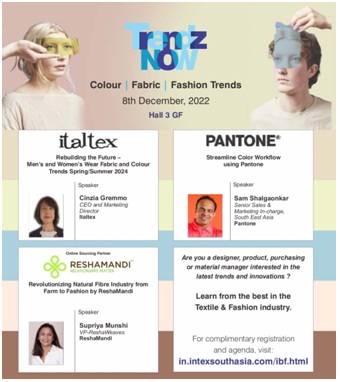
This year, Intex India would also be organising the renowned Interactive Business Forum (IBF) Seminar Series and ‘Trendz Now’ – the colour, fabric and fashion forecast showcase by Italtex Italy and Pantone / X-Rite Asia Pacific Limited alongside Intex India, thus creating a premium B2B and world-class international textile sourcing platform. Also, there are buyers’ delegations attending from major cities across India as well as overseas buyers from 18+ countries and regions will be attending the show for their textile sourcing requirements and exploring new business opportunities in India through our international trade platform.
Cotton production faces sustainability challenges
Cotton is the most used natural fiber. Cotton originates from the Arabic word quton, meaning fancy fabric. This is a staple fiber made up of short fibers twisted together to form yarn.Cotton is present in our everyday life, from clothes to coffee strainers, and more recently in masks to control the spread of Covid.
Currently, approximately half of all textiles require cotton fibers.The earliest production of cotton was around 5000 BC in India, and today around 25 million tons of cotton are produced each year.
Currently, five countries make up around 75 per cent of global cotton production, with China being the world’s biggest producer. The country is responsible for over 23 per cent of global production, with approximately 89 million cotton farmers and part-time workers.
Cotton’s importance cannot be understated, as it is the primary input for the Chinese textile industry along with many other nations’ textile industries.The United States is the leading global exporter of cotton, exporting three-fourths of its crop with China as the top buyer.
Despite its importance for the global economy, cotton production faces significant sustainability challenges. Cotton is one of the largest users of water among all agricultural commodities, and production often involves applying pesticides that threaten soil and water quality.
India: Orissa seeks textile and apparel investors
Orissa is inviting investors for textile and apparel.
The aim is to facilitate setting up of apparel units, parks, skill development centers and more. Investors can get a capital grant of 20 per cent for projects costing up to Rs 20 crores and interest-free loans up to ten percent with a maximum limit of Rs 10 crores.
For attracting investment in the textile and apparel industry, the state has ensured ready availability of developed land with adequate infrastructure in several textile parks, skilled manpower by setting up centers of excellence along with the creation of new mega parks, lowering the cost of production and logistics and encouraging new entrants through startups. For meeting the manpower demand, the state has planned to set up various institutes to create trained and certified workers. A World Skills Center recently opened in partnership with Asian Development Bank and the Institute of Technical Education Services, Singapore, will help in creating more skilled manpower.
A Petroleum, Chemical, and Petrochemical Investment Region is aimed at attracting investment in the chemical and petrochemicals sector. An upcoming technical textile park will provide state-of-the-art facilities and best-in-class facilitation and will be close to two major ports like Paradip and Dhamra.
Despite sustainability challenges, fast fashion market set to grow
The fast fashion market is growing at four per cent a year.
Fast fashion is an approach to the design, creation, and marketing of clothing fashions that emphasizes making fashion trends quickly and cheaply available to consumers. Fast fashion is clothing designs that move quickly from the catwalk to stores to take advantage of trends.
Fast fashion has three main components from the consumer’s perspective. It’s cheap, it’s trendy and it’s disposable. The fast fashion industry plays a huge role in the global economy. It employs 300 million people around the world.The increasing adoption of affordable clothes by the rising youth population is driving the market’s revenue. Other factors are a growing youth population and the expansion of emerging economies. The growing demand for trendy and stylish clothing coupled with the rising per capita disposable income of consumers is the major factor driving the market growth. The increasing innovations in supply chain management are driving the market growth.
Women hold the largest share of the fast fashion market. North America is the fastest growing region in the fast fashion market. The growing demand for stylish and original clothing drives the region’s market growth. The US is the largest market supporting the growth of fast fashion. Asia Pacific also presents lucrative prospects.
Metaverse emerging the new playground for fashion retail: McKinsey-BOF report

In 2014, when Mark Zukerberg acquired the virtual reality platform Oculus for Facebook, no one knew what would follow. Leap forward by seven years and October 28, 2021 saw Facebook Metaverse launched. This virtual platform was the opening up of Pandora’s Box, in a good way. The myriad possibilities of creativity that presented itself on this virtual world seemed to know no bounds.
Metaverse, new way forward for fashion
The avant-garde fashion retail leaders recognized the Metaverse for its worth. As Gucci’s executive vice president and chief marketing officer Robert Triefus states in the just released ‘The State of Fashion 2023’ McKinsey & Company and The Business of Fashion states there are more and more ‘second worlds’ where people can express themselves but brands have probably not yet understood the value attached to such individuals who want to express themselves outside the box. That’s where a virtual world with virtual products comes to play.
Triefus states, Gucci was quick on the uptake of Metaverse as a platform to engage with its customers – Gucci Garden was created within the Roblox gaming Metaverse and experience 19 million visitors. Other fashion retail marketers witnessed Gucci’s success story and are eyeing the $176 billion gaming industry with over three billion players worldwide as the perfect platform for building their communities and keeping them constantly engaged. The commitment to gaming by gamers is becoming increasingly their real world and the pandemic-lockdown was when this phenomenon surged right through the roof. American fashion retailer Ralph Lauren jumped in with South Korean social network app Zepeto and created a virtual fashion collection for users to dress their personal avatars in exclusive apparel and appearance altering skins.
Digital fashion retail just begins
For many fashionistas, digital fashion is just an organic extension of applying social media filters like they do on their Snapchat and Instagram accounts according to Simon Windsor, Cofounder and Joint Managing Director, Dimension Studio, an agency that worked with Balenciaga on its video game. Windsor reinforces with Metaverse, fashion retail is at its tipping point as it leads the way fashion will be interpreted and accepted. Fashion retail has understood just how big a game changer the Metaverse is going to be. AI and AR have already been used to showcase 360 degree views of products on many online sites of fashion retail brands to present their seasonal collections and avatars of models have strutted virtual catwalks in all 3D glory.
NFTs will become the ultimate bespoke item
Meanwhile, the McKinsey-BOF report also states Nonfungible tokens, popularly known as NFTs has seen a huge surge of interest, one of the most sought after virtual assets. These unique crypto assets are blockchain authenticated and verified before purchase. NFTs are bought, sold and exchanged on the Metaverse, and often with cryptocurrency.
Beeple, the digital artist on Metaverse (his real name is Mike Winklemann) sold an NFT at a Christie’s online auction for a record-breaking $69.3 million. Marketing experts feel that NFTs are revolutionary. Karinna Nobbs, Co-chief Executive and Chief Experience Officer of NFT marketplace The Dematerialised explains NFTs are bigger than the Internet. They will apparently change the way we view digital ownership, creative structures, creative economy and also how we view money. A bold statement indeed which fashion retail has heeded well. Fashion brands can create their NFTs that are not only authenticated but also serve as exclusive collectibles in their own right. For its 200th anniversary, Louis Vuitton roped in Beeple who designed Louis Vuitton collectible NFTs on a video gaming platform owned by the brand. As demand for NFTs grow, the world of fashion retail is plunging into the Metaverse to ride this wave of hype of digital ownership of exclusive pieces.