


FW
Japan’s apparel imports decline during January-April’21
Japan’s apparel imports declined by both weight-wise and value-wise in the first four months of 2021, as per Apparel Resources
From January-April’21, Japan garment imports declined by 5.52 per cent to 853.70 billion yen as compared to 903.54 billion yen in the same period of 2020, noting 5.52 per cent yearly downfall.
In terms of weight, Japanese apparel import declined to 2,070.28 million kg in the mentioned period as against 2,076.55 million kg in the corresponding period of 2020 which is a 0.30 per cent yearly decline.
The fall has been witnessed due to lowering demand of woven clothing in Japanese apparel market, while knitted segment remained positive
The share of knitted garments in overall imports was 433.52 billion yen while woven garments constituted 420.17 billion yen. Low unit prices in 2021 have put exporters to Japan under immense pressure as per kg garments imported by Japan valued just 410 yen in 2021’s first four months as compared to 440 yena year earlier.
Particularly in April ’21, the country’s import revenues slumped by 7.25 per cent to 223.82 billion yen as compared to April ’20.
AATCC launches new virtual educational program
AATCC has launched a new virtual educational program from July 21 through September 15, 2021.
Known as the E-Textiles Exploratory Series, the program will feature industry experts discussing a variety of topics including safety, data privacy, design, methodology, standards, cyber security, commercialization, as well as e-textile fundamentals. The Consumer Product Safety Commission will host a free session on safety through risk assessment, and other presentations will be available for purchase as a series or individually, both live or on-demand.
Presenters at the program include Ashish Kapoor, Intel; Jacqueline Campbell, Consumer Product Safety Commission; Madison (Maddy) Maxey, Loomia; Chris Jorgensen, IPC; Diana Wyman, AATCC; Travis Norton, Bureau Veritas; Chris Crowley, Montance and Pratyush Rai, Nanowear
Founded as the American Association of Textile Chemists and Colorists (AATCC), the Association continues to evolve to meet the needs of those in the ever-changing textile, apparel, and materials industries. AATCC has served textile professionals since 1921. Today, the Association provides test method development, quality control materials, education, and professional networking for a global audience.
Lenzing extends fiber identification technology to Tencel branded fibers
The Lenzing Group has extended its revolutionary fiber identification technology to Tencel™ branded lyocell and modal fibers. Lenzing’s fiber identification technology provides physical identification of fiber origin at different stages of textile products such as the fabric and garment level. This makes the fiber fully traceable and protects it from counterfeiting. It also guarantees that the fibers are produced in state-of-the-art-production facilities that meet high standards for resource efficiency and environmental and social responsibility.
Lenzing plans to make fiber identification a vital part of its fabric certification process within Lenzing E-Branding Service. As of November 2021, the brand plans to test all fabrics for fiber identification, enhancing the security of Lenzing’s online services and testing facilities and increasing transparency and security between value chain partners. By the first half of 2022, it will integrate additional services into Lenzing E-branding Service for brands and retailers.
ASOS becomes the sole UK brand to be included in Kantar report
ASOS has become the only UK brand to be included in Kantar’s BrandZ Most Valuable Global Brands 2021 report. As per Fashion Network, the brand has been ranked on the basis of its performance across 51 markets. The rankings show, the value of some of Europe’s biggest brands increased during the year as they continued to increase their investments. The value of apparel category grew 53 per cent as it benefited from shoppers preference for loungewear and athleisure brands such as Lululemon, Nike, Puma and Adidas.
Nike emerged as the fastest growing brand with a 68 per cent increase in brand value followed by Adidas whose value increased by 51 per cent. The third position was bagged by Zara with its value increasing marginally to $21.38 billion. Most of this growth was driven by diversifying channels such as live-streaming content, gamification and subscription models, says Kantar.
The luxury apparel category grew 34 per cent with European brands dominating the luxury rankings. Louis Vuitton emerged as the growing luxury with a 46 per cent year-on-year rise in value. The brand followed by others such as Chanel, Hermes, Gucci and Rolex
SRTEPC appeals for a special package for MMF sector
Dhiraj Raichand Shah, Chairman, The Synthetic and Rayon Textiles Export Promotion Council (SRTEPC), has urged Prime Minister Narender Modi to announce a special growth package for MMF sector. Shah points out MMF exports declined 19 per cent during 2020-21. Export of fibers declined 28 per cent, yarn 15 per cent, fabrics 18 per cent and made-ups 23 per cent, according to the data released by DGCI&S.
He therefore, urged the Prime Minister to release all pending dues of exporters under Drawback, MEIS, IGST, ROSL, RoSCTL, TUFS on an urgent basis; grant moratorium for repayment of principal and interest for at least one year; allow banks to restructure loans for one year without any additional charges/ penal interest, etc; direct RBI to relax NPA norms for six months; provide at least 35 per cent of the workers’ salary payments for a period of 12 months to protect the MSMEs reeling under severe impact of COVID-19; extend ECGC support to address the cancelled and deferred orders; onclude entire MMF textile value chain viz., fibres, yarns, fabrics, made-ups, etc under RoDTEP Scheme & declare RoDTEP rates immediately with a minimum rate of 7 per cent; extend the EPCG Scheme for the next 5 years; introduce a uniform 5 per cent GST rate for entire value chain in the MMF textiles segment and continue the Interest Equalization Scheme (IES) benefit for exports and enhance the IES to 5 per cent.
Cancelled orders increases workers’ exploitation in apparel factories: Study
Reduced demand from brands and cancelled orders have led to a rise in wage theft, reduced hours and violations of workers’ employment and pay rights, says a new study by the University of Sheffield and the Worker Rights Consortium.
Based on a survey of 1,140 workers from 302 factories in India, Honduras, Ethiopia and Myanmar the report reveals, almost 80 per cent workers had not received full severance pay while the pay and working conditions of over a third of workers had deteriorated. Around 68 per cent of workers had been employed without a formal contract, reports Business of Fashion. More than one third workers reported experiencing verbal abuse, threats or intimidation, while 22 per cent reported unfair reduction or withholding of wages. Around 39 per cent said they were forced to work without adequate COVID-safe measures such as PPE and social distancing.
The study further shows, number of workers with no personal savings have increased in all four countries compared to pre-pandemic levels, and their average household debt levels have increased by 16 per cent.
RMGEC lowers prices to boost RMG exports
To maintain the country’s position in the global RMG market, the Readymade Garments Export Council of Egypt (RMGEC) has been striving to increase exports by lowering prices and bearing some of the losses. As per Textile Value Chain, this will help the nation demonstrate strength of its RMG sector besides maintaining sales volume. Last year, Magdy Tolba, Chairman said, international brands’ decision to halt production worldwide has impacted around 350-400 Egyptian garment factories.
To recover losses, the Egyptian Council for Industrialization and Entrepreneurship plans to promote exports by using cutting-edge marketing techniques. The council held several virtual meetings between RMG exporters and international customers from Jordan and Saudi Arabia to discuss Egypt’s export potential.
Post COVID trade shows to take-off with physical editions this year
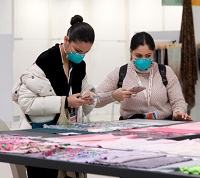 After a year of being confined to the digital platforms, trade shows are back in action with physical editions this year. Apparel and accessories show organizers have scheduled several in-person events during the second half of this year to attract international buyers. As per Women’s Wear Daily, organizers have also planned virtual meetings for customers who can’t attend these events in-person.
Paris shows with new formats and partners
The venues and modes of most of events in Paris have undergone a huge transformation since last year. Trade shows in Paris are being modernized with new partners, digital services and a renewed focus on sustainability. To be held at the Grand Palais near Eiffel Tower, the Premiere Vision will showcase Fall 2022 collections of fabrics, leather, accessories and designs. The other edition, the Made in France Première Vision will be held at the Carreau du Temple in Paris on September 8 and 9, 2021. It will focus on exclusively on French fashion while Premiere Vision Paris will focus on all sectors. The event will be held in a hybrid format at Paris Lord Villepinte from September 21-23, 2021. Organizers have expanded their digital systems to enable exhibitors connect with buyers even after the event completion. They have also regrouped the marketplace and the Première Vision Paris site under the premierevision.com banner.
To be organized by Messe Frankfurt from July 5 to 9, 2021 at Rue du Mail and Atelier Richelieu, Texworld Evolution Paris will focus on Fall/Winter 2022 trends, and feature around 7,000 fashion styles from manufacturers in 10 countries, including Taiwan. The event will focus on themes denoted by colors. It will also include individual sections focusing on earthy tones and brighter colors.
Tranoï will organize the Paris Fashion Week at Palais de Tokyo from June 25 to 27, 2021. The show will feature designers curated by the Fédération de la Haute Couture et de la Mode. Who’s Next, the ready-to-wear, accessories, lifestyle and beauty show, will be held from September 3 to 6 at Porte de Versailles.
UK trade shows with safety protocols
Physical fashion trade shows will make a comeback in the UK with Moda, to be held at the National Exhibition Centre near Birmingham. Organized by the Hyve Group alongwith the Association of Event Organizers, the event will follow strict government protocols and introduce sanitizer stations in busy areas. The event will follow a no handshake policy and make face masks compulsory within the exhibition and conference venues. Exhibitors will also have to follow a cleaning routine before, during and after the show opens each day.
The Hyve Group will also collaborate with Pure to present an edited lineup of emerging and established British and international fashion, home, and lifestyle collections at The Old Truman Brewery in East London from September 7 to 9, 2021. With wider aisles and more floor space, the exhibition will capture the true character of Scoop x Pure while maintaining social distancing, says Gloria Sandrucci, Event Director, Pure London.
Italy to focus on European, Korean, Japanese buyers
After over 16 months of hiatus, the, the Italian government has permitted event organizers to hold physical trade shows. The first show to resume its physical format will be Pitti Uomo will be held from June 30 to July 2 followed by the Pitti Bimbo and Pitti Filati shows. Each fair will implement strict safety protocols and launch new safety initiatives with Italy’s trade agency. For instance, Milano Unica plans to arrange COVID-19-free flights for European buyers, as well as Koreans and Japanese.
Milan’s leading show organizer, Fiera Milano will launch bridal fair Sì Sposaitalia from June 25 to 27 at Fieramilanocity. The physical show will be accompanied by a digital platform to broaden its global reach. This will help organizers guarantee continuity of the event, says Emanuele Guido, Director-Lifestyle, Fiera Milano. The event will feature physical bridal shows and a digital showcase to help the sector resume its activities.
Trade shows Micam, Mipel and Lineapelle will hold their physical events from September 18 to 24, 2021, under the Milano-Rho fairgrounds banner. Mipel also plans to team up with Lineapelle and Pitti Uomo to host the first Mipel Lab showcase at the Florentine fair on June 30. This event will help manufacturers connect with international brands, says Danny D’Alessandro, CEO, Mipel.
UK, US sign deal to suspend dispute hitting luxury sector
UK and US have signed an agreement to suspend a long-running trade dispute that hit export sales of luxury goods, until 2026. As per Fashion Network, the two countries have agreed to end a 17-year trade dispute that grew out of subsidies for plane-makers Boeing and Airbus and resulted in retaliatory tariffs of up to 25% on exports of key luxury goods.
The UK had made the first by suspending retaliatory tariffs on the US earlier this year. The US then agreed to a four-month tariff suspension while a more durable deal was negotiated.
Helen Brocklebank, CEO, Walpole said, luxury goods shouldn't become part of a trade war about plane parts. Liz Truss, International Trade Secretary, UK, added, the deal will support jobs across the country and is fantastic news for major employers.
The deal will help UK focus on taking its trading relationship with the US to the next level, including working more closely to challenge unfair practices and using the power of free trade to build back better from the pandemic, Truss added.
Rieter, Uster targeted for exports to China
Two Swiss textile machinery companies, Rieter and Uster have been singled out for exporting machines to China amid allegations of forced labor in the clothing supply chain including Uyghur and other minorities.
As per a report by the Textile Focus, Xinjiang purchased $6.4 million (CHF6 million) worth of machines from Switzerland in 2019. According to customs data from the Observatory of Economic Complexity (OEC), the region imports the majority of its machinery from three nations, Germany ($26.8 million), Japan ($23.4 million), and Italy ($7.4 million). Switzerland, on the other hand, is a major exporter of knitting machine accessories like spindles, dobbies, and automatic stop motions, which are used in large spinning, weaving, and knitting machines. Over the previous three years, Switzerland has shipped $2 million worth of knitting machine accessories to the autonomous area.











