FW
Sweden’s TMAS members to focus on nearshoring technologies at upcoming textile shows in Frankfurt
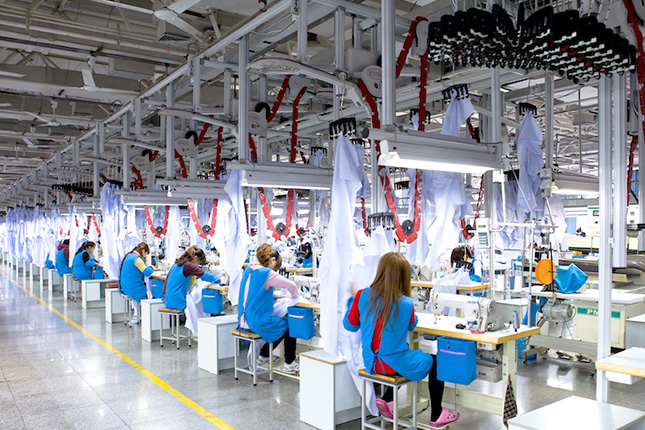
The pandemic, alongwith escalating cost of global transportation and growth in online retailing has once again reinforced the benefits of nearshoring in the textile industry. The pandemic has exposed vulnerabilities of countries to shortage of essential items like PPE during national lockdowns and long periods of restricted travel, thus reemphasizing the need for nearshoring operations
TMAS members focus on nearhsoring technologies
In this background, upcoming editions of Texprocess, Techtextil and Heimtextil shows – to be held in Frankfurt from June 21-24 – will showcase a solutions aligning with growing nearhsoring trend from the Swedish Textile Machinery Association (TMAS). Members of TMAS constantly reinvent their technologies, says Therese Premier Andersson, Secretary General. They continue to test new automated solutions and digital technologies at a rapid speed to avoid being impacted by COVID-19 restrictions. They plan to showcase these technologies at the upcoming exhibitions.
Nearshoring to secure supply chain
Eton Systems plans to launch latest ingenious software solution that enhances the company’s Opta Unit Production System (UPS) at Texprocess. The technology has helped enhance productivity of many garment manufacturers, explains Jeker Krabbe, Manager Director. The systems reduce producers’ manual tasks and increase their efficiency. This equalizes production in high and low-cost countries, making reshoring an attractive option. Having a few production facilities closer to home also helps manufacturers ensure safe product supply, says Krabbe.
The newly installed first industrial scale dyeing system by Imogo in Sweden can reduce fresh water, energy and chemicals use by almost 90 per cent compared to conventional jet dyeing systems. It facilitates a wide range of fabric pre-treatments and finishing processes to help make production more flexible.
Robotics a highlight at Hemitextil
A specialist in automation solutions for filled products such as quilts, pillows and mattresses and live demonstrations of robotics, will once again attract visitors to ACG Kinna Automatic at Heimtextil this year. The company will use robotics to handle soft materials such as textiles this year, informs Christian Moore, Managing Director. ACG Kinna Automatic focuses on eliminating obstacles to increase product flows. It built a new nonwovens fabric converting and single-use garment making plant during the pandemic to supply medical gowns to Swedish authorities.
Automation for increasing efficiency
Svegea will promote its latest EC 300 collarette cutting machine at Texprocess 2022. Used by garment manufacturers to produce tubular apparel components such as waistbands, cuff and neck tapes and other seam reinforcements. The machine produces around 20,000 metres of apparel components per hour. Automation has made the company’s machines more efficient, says Hakan Steene, Managing Director. The garment components manufactured by them can be integrated into manufacturing operations, says Steene.
Making operations more flexible
Sweden-based Eltex has introduced advanced yarn tension monitoring technologies to repair defects in weaving, tufting and composite reinforcement operations. The machines create correct tension between warp and weft threads, affirms Anoop Sharma, Global Marketing and Sales Manager. Constant monitoring and automatic control of the thread’s stiffness helps simplify operations, Sharma explains.
Denim fabric manufacturers most difficult to develop: Chairman, APSyFI
Among the sub-sectors of the textile and textile products (TPT) industry, jeans or denim fabric manufacturers are among those that are difficult to develop, says Redma Gita Wirawasta, Chairman, Indonesian Fiber, Yarn and Filament Association (APSyFI) The main reason for this is the Preferential Trade Agreement (PTA) with Pakistan since 2013. Wirawasta explained denim fabric is made from cotton. While Pakistan is one of the largest cotton producers in the world with a production volume of about 3.5 million tons per year, Indonesia must import cotton from the United States.
n addition to the Indonesia-Pakistan PTA, the two countries are also involved in similar agreements with Developing 8 or D8 countries that have been running since 2011. Its members include Indonesia, Bangladesh, Egypt, Malaysia, Pakistan, Turkey, Nigeria, and Iran.
Among the D8 members who are Indonesia's competitors is Bangladesh with its superior garment industry. Recently, the government issued a stipulation of PTA import duty tariffs among D8 countries through Minister of Finance Regulation (PMK) No.57/2022.
Elis Masitoh, Director-Textiles, Leather and Footwear, Ministry of Industry previously said that the regulation of import duty rates had actually been in effect since 2011. The new regulation is a revision with the entry into force of the 2022 Indonesian Customs Tariff Book (BTKI).
Meanwhile, Elis projects that the textile industry will grow 3.5 percent in the first semester of 2022, driven by the momentum of Lebaran and the opening of homecoming. Year-on-year (YoY) growth in the first quarter of 2022 is projected to be 2.94 percent, followed by a second quarter of 4.12 percent. Meanwhile, quarter-to-quarter growth in the second quarter of 2022 is estimated at 1.63 percent.
ZhejiangTex to be held from June 08-10, 2022
Trade fair for the textile and garment industry, ZhejiangTex will be held under the name YIWUTEX/YIWUSEW from June 08–10, 2022 at the Yiwu International Expo Centre.
Zhejiang International Trade Fair for Textile and Garment Industry (also known as ZhejiangTex) has been successfully held for 20 editions and accumulated rich network resources, large customer base and high market value. The 2022 edition will be renamed as “The 22nd China Yiwu International Trade Fair for Functional Yarn & Knitting & Hosiery Machinery” (YIWUTEX) and “The 11th China Yiwu International Trade Fair for Sewing & Digital Printing Machinery” (YIWUSEW) and will take place at the Yiwu International Expo Centre in Zhejiang, China. The show is jointly organized by Adsale Exhibition Services Ltd. and Yiwu China Commodity City Exhibition Co to present two thematic zones catering to knitting, garment & printing industries, with a comprehensive showcase of the world's leading textile machinery and cutting-edge technology.
YIWUTEX/YIWUSEW 2022 will be held under the theme of “Smart Production for New Textile Vitality”. Through more segmented industries, it will gather digital high-tech knitting and clothing equipment, exerting advantages for the knitting industrial cluster in Yiwu, and empowering the industry with innovative technologies.
The trade fair will feature two thematic zones including Exhibition on Functional Yarn & Knitting & Hosiery Machinery and Exhibition on Sewing & Digital Printing Machinery.
Curated Meetings to hold Autumn Fair from September 05-06, 2022
Following its hugely successful beta trial and launch within the UK at Spring and Autumn Fair, Curated Meetings is now opening its doors to buyers and brands from across Europe and the rest of the world, inviting them to take part in this new game-changing way of doing business at Autumn Fair on September 05 – 06,2022 at NEC Birmingham, England. The program now open to retailers and buyers who have purchasing responsibility and are actively sourcing across product categories including home decor, housewares, garden, toys, party, beauty, wellbeing, seasonal, accessories, jewelry, white label and more.
Attracting brands and buyers from across the UK, Europe and rest of the world, Curated Meetings facilitate efficient, 15-minute pre-scheduled, 1:1 meetings between qualified buyers and relevant suppliers based on a mutual interest to drive new business opportunities together. Working closely with DIT representatives, Curated Meetings is specifically focused on attracting buyers and brands from Central & Eastern Europe, The Netherlands, Italy, Spain, Switzerland, Nordics, France, US, Mexico, and India, with buyers from Four Sister, The Smug Hedgerows and HeneryVokesAdarefrom Ireland, Mango from Switzerland, Kosmelita from Lithuania, and Pro-92 from Slovenia, already confirmed.
Global polyester filament yarn market to reach $106.23 billion by 2030
The worldwide polyester filament yarn market is expected to grow to $106.23 billion by 2030. As per Reports and Data, the market development will be fuelled by rising utilizations of polyester fiber yarns among the end-clients.
Polyester fiber yarns have great flexibility, shape maintenance, wrinkle obstruction, remarkable wash and wear execution, launderability, and life span, among others, and subsequently, track down broad application in different sorts of attire textures. It is utilized to make elegant dresses, and climate safe apparel, and is a favored material for youngsters’ wear. Developing interest from the development business is probably going to help the market interest. Polyester Fiber Reinforced Concrete (PFRC) is utilized in concrete substantial asphalt material. Polyester fiber yarns are impervious to antacid assaults, and PFRC tracks down use as overlays and in asphalt quality cement. The utilization of filaments might bring about a concrete investment funds of almost 10.0%, and with fly debris, the concrete saving might be expanded to around 35.0%. Polyester fiber yarns, inferable from their non-biodegradable property, are utilized in concrete substantial street works, consequently aiding the protection of the climate.
Key members incorporate Tongkun Group Co., Shenghong Corp., XinFeng Ming Group, Reliance Industries Ltd., Reliance Industries, William Barnet and Son LLC, Hengli Group, Indorama Ventures Public Company, Polyfibre Industries, Toray Industries Inc., and GreenFiber International SA, etc.
Sustainability-focused organization CRB releases new report
Delhi-based sustainability focused organization, the Centre for Responsible Business (CRB), has released a new report titled ‘Circular Textiles and Apparel in India: Policy Intervention Priorities and Ideas’. The report is based on secondary and field-level research and engagement with key stakeholders. It makes specific recommendations for incorporating principles of circular economy in the sector. CRB launched the report to identify priority areas for Circular Economy interventions in the Indian textile and apparel value chain. The report highlights the potential for the apparel and textile sector and recommends policy interventions to support its growth.
It states, linking circular economy priorities with social benefits such as fair wages, good working conditions, augmented by transparency in business practices, may open new business opportunities for the apparel and textile sectors. The sector can boost exports by adhering to global norms and voluntary sustainability standard, says the report. It can also create new jobs by prompting and formalizing activities such as recovery, repurpose, repair and recycling of garments, managing post-production and post-consumer textiles waste, etc, it adds.
Spinners Association (Gujarat) plans Rs 3500 cr investment to boost capacity
Spinners Association (Gujarat) or SAG plans to invest Rs 3,500 crore over the next year and a half for adding 7 lakh new spindles in the state to boost its spinning capacity. As per SAG, many spinning mills in Gujarat plan to expand operations while 10 new spinning mills are expected to start operations during this period. Saurin Parikh, President, SAG notes, at least 7-10 lakh spindles will be added across the state over the next 18-24 months.
Gujarat currently has about 110 spinning mills with an installed capacity of 45 lakh spindles. Most of these mills were set up after the implementation of the Textile Policy of 2012. Bharat Boghara, Chairman, SAG adds, Gujarat did not have significant spinning capacity till 2012 despite being a leading cotton producing state. The state needs to increase spinning capacity to create higher demand for cotton.
Levi Strauss & Co joins Organic Cotton Accelerator for secure cotton supplies
Levi Strauss & Co. (LS&Co) has joined a multi-stakeholder organization - the Organic Cotton Accelerator (OCA) to make supplies more secure and measure social and environmental impact on organic cotton farming. As an OCA member, Levis Straus will help increase the global organic cotton supply besides helping the program empower organic cotton farmers. Jeffrey Hogue, Chief Sustainability Officer, LS&Co says, the program will bring measurable improvements to farmers’ livelihoods and local communities, creating conditions for change. It will enable the company to source more sustainable cotton for its products besides providing new opportunities to resolve industry challenges.
LS&Co.’s participation enables the company to source more responsible fibers. In a sustainability report published in September, the company pledged to reach 100 percent more sustainable cotton by the end of 2025.
Earlier this month, OCA launched Textile in Transition, a multi-year project targeting transparency and fairness across the organic cotton sector. The project has attracted brand partners Bestseller, G-Star Raw and Essenza Home. Funded by the Netherlands Enterprise Agency Fund for Responsible Business, it leverages OCA’s established Farm Program in India to support the participating companies in achieving transparency while improving farmer livelihoods, worker rights and environmental impact.
Century Textiles to explore new products and markets in coming year
Century Textiles plans to focus on offering new products after considering retail price points. It also plans to focus on blending manmade fibers and expanding into new markets such as Australia, Saudi Arabia and Russia. In Q4 FY22 Century Textiles & Industries’ consolidated net profit increased to Rs 84.43 crore as against a net loss of Rs 4.89 crore in Q4 FY21. Net sales was up 44.62 per cent to Rs 1,186.22 crore during the quarter over Rs 820.21 crore in Q4 FY21. Consolidated EBITDA grew 66.25 per cent to Rs 133 crore in Q4 FY22 as against Rs 80 crore in Q4 FY21.
Century Textiles and Industries’ textiles annual turnover grew 54 per cent Y-o-Y during Q4 FY22 backed by strong sales growth and improved operational efficiencies. The company’s capacity utilization reached 97 per cent during the quarter as compared to 92 per cent in Q4 FY21. The company also launched home textile product for domestic market under the brand name 'Hill & Glade'.
Southern Gujarat Chamber of Commerce and Industry plans textile fairs in US
The Southern Gujarat Chamber of Commerce and Industry (SGCCI) will hold a four-day-long ‘Global Textile Trade Fair’ in three states of the United States -- Atlanta, New Jersey, and Los Angeles from June 9. This first-of-its-kind Global Textile Trade Fair will endorse the official logo of the Ministry of Textile, Government of India. It will be supported by the Consulate General of India in Atlanta and various American institutions and organizations.
To begin from Atllanta, Georgia, the three-day textile show will showcase a wide range of products including polyester, nylon viscose, Indoethnic wear, home textile, medical textile, clothing and garments, handicraft and handloom, and Khadi. The exhibition will depict fabrics and styles from Surat and across the country.
It will be attended by buyers sellers and textile manufacturers from across the globe, the Atlanta exhibition will be followed by a B2B and B2C exhibition in New Jersey on June 17 and the B2C Table Top Buyer-Seller meeting n Los Angeles on June 19. Featuring home textiles, the exhibition will also be attended by hotel owners and associated agents.