FW
Economic sanctions on Russia hurt Italy’s fashion sector
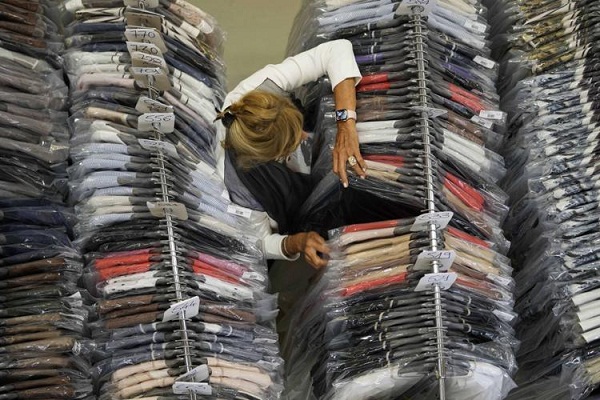
The economic sanctions on Russia following its war with Ukraine are making business difficult for many fashion brands in Italy -- the fashion capital of the world. They are especially hurting clothing and shoe manufacturers, as Italy is the largest global producer of these goods. The country exports fashion goods worth $101 billion annually.
Huge number suppliers losing business
Russian customers account for around 3 per cent of Italy’s total portfolio. However, their loss affects around 80,000 suppliers, says Fabio Pietrella, President, Fashion industry trade group in Italy. These customers account for 80 per cent of the money made by small Italian businesses every year, he adds. The Marche, Vento, Umbria and Emilia-Romagna regions in Italy are completely dependent on orders from Russia for survival. They connect the entire supply chain, adds Pietrella.
Some of the world’s most famous fashion companies like Gucci, Versace and Armani are Italian with a few having operations in Russia. However, these companies have been unable to find ways to get past the sanctions, notes Jeffery Sonnenberg, Professor-Business, Yale University.
Practical concerns stop companies from snapping ties
Even though fashion makers in Russia are extremely concerned over the aggression in Ukraine, they are compelled to continue doing business owing to practical reasons as it difficult to find a substitute, says Pietrella. Companies like D Exterior are also reluctant to cut ties with Russia as it has taken them years to build business in the country. D’Exterior makes 40 per cent of its revenues from Russia every year. The company is unsure of getting payments for 400,000 garment orders for Spring/Summer season, says Nadia Zanola, Owner.
Zanola however, does not intend to abandon Russia business as customers there appreciate the extra efforts needed to make good clothes, she says. She hopes, common Russian consumers are able to raise themselves from the crisis.
Infinited Fiber Company to set up regenerated textile fiber factory at Lapland
The Finnish fashion and textile technology company Infinited Fiber Company plans to set up a factory to produce regenerated textile fiber from textile waste in the Veisiluoto industrial area in Kemi, Lapland. The factory will be set up inside a shut paper plant leased to the company by Stora Ensos. The company will invest approximately €400 million in the project that is expected to create an estimated 270 jobs.
The factory will begin operating at full capacity in 2025 with the annual fiber production capacity totaling 30,000 metric tons. Most fibers produced in the factory will be exported. Infinited Fiber Company is a Finnish biotech founded in 2016 to commercialize a breakthrough recycling technology that can turn cellulose-rich raw materials – like cotton-rich textile waste, used cardboard, or wheat or rice straw – into high-quality textile fibers with the look and feel of cotton. The patented technology has been validated by leading brands and is ready to be scaled.
West Bengal to boost garment industry with an apparel hub in Maheshtala
The West Bengal government plans to boost the state’s garment industry by setting up an apparel hub on 10 acre in Maheshtala. As per a Knitting Industry report the hub will span a built-up area of 12 lakh sq. ft. and will be set up under the aegis of MSME and textile department.
The park will create over 1 lakh jobs for thousands of people residing in the neighborhood of Nungi and in adjoining Metiabruz. It will accommodate around 30,000 people, says Rajesh Pandey, Secretary-MSME and Textiles. The investment in the project will be to the tune of several lakh crores, he adds
The project will be developed on a develop-build-finance-operate-and-transfer (DBFOT) model that gives private operators the right to operate the hub. The state government is offering a parcel of land along with a boundary wall on lease for 99 years for developing the hub. The government will select interested private partners by this week.
Ensure sustainable cotton sourcing, urge Vietnam’s garment producers
Apparel manufacturers need to ensure they source cotton through sustainable supply chain and manufacture in an environment-friendly way, said leaders attending a conference on Sustainability in cotton supply chains held at HCM City in Vietnam recently. As per Trần Như Tùng, Deputy Chairman, Việt Nam Textile and Apparel Association the country is committed to achieving zero emissions by 2050, many local companies are reducing their environmental footprint. They need to ensure their cotton is sourced in a responsible way and is free from forced labor, he added.
Việt Nam’s textile and apparel industry aims to use power and water in a more circular, efficient and sustainable manner by 2039, he added further. Vũ Đức Giang, Chairman explained, companies making textile and apparel products need to ensure sustainability across all stages of production such as raw material farms, manufacturing lines and dyeing processes.
They need to use environment-friendly technologies and abide by global conventions on labor. Many Vietnamese businesses cannot export their goods to the US since they do not fulfill origin traceability requirements, he opined.
Võ Mạnh Hùng, US Cotton Council International, advised, businesses, especially exporters to the US, to partake in sustainable cotton programs to help certify businesses using transparent and sustainable material sources.
The US accounts for around 42 per cent of Việt Nam’s textile and apparel exports, and Việt Nam is one of the US’s biggest buyers of raw cotton. This year, Vietnam’s textile and garment exports to the US increased by 23 per cent to $22 billion.
Pakistan, Malaysia to benefit from bilateral trade: Chairman, PHMA
Pakistan and Malaysia can both benefit from the bilateral trade between the two countries, said Mian Kashif Zia, Chairman, Pakistan Hosiery Manufacturers and Exporters Association (North Zone) while addressing a Malaysian trade delegation at PHMA office in Malaysia. Zia said, the joint ventures and business-to-business meetings between business leaders of the two countries will help promote trade between them. Malaysia imports knitwear products worth $759 million from across the world. But, Pakistan’s exports to the country amounted to only $6.60 million in 2021.
Pakistan has a growing potential in the local market. Availability of abundant natural resources and independents investment systems, makes it the best investment destination, Zia explains. Muhammad Izwan Zainuddin, CEO, PUNB said, the balance of trade has always been in favor of Malaysia and we aim to get our legitimate share in trade with the country.
Mud Jeans launches Tuesday jeans range
Denim manufacturer, Mud Jeans has launched Tuesday jeans made from 100 per cent post-consumer recycled (PCR) cotton. As per a Sourcing Journal report, the jeans have were developed in partnership with Saxton University of Applied Sciences in the Netherlands and combine mechanically recycled fibers with chemically recycled fibers.
The brand used 67 per cent mechanically recycled fibers and 33 per cent chemically recycled fibers in the weft and 67 per cent chemically recycled fibers and 33 per cent mechanically recycled fibers in the warp. It recycled styles by own brand as well as jeans by other brands. The mechanically recycled portion was 98 per cent cotton and 2 per cent foreign fibers. The chemically recycled portion was 100 per cent cotton.
Meeting industry standards for durability, Mud’s 100 per cent PCR fabric is softer than the brand’s regular jeans that are blended with cotton. The chemically recycled fibers result in a softer fabric compared to the jeans it makes with virgin organic cotton.
Luxe sales in FY22 Q1 sales to grow by 17%: Bain & Co
Global luxury sales in the first quarter of this year are expected to grow by 17-19 per cent, says analyst Bain & Company. The luxury market is expected to grow in the range of 10 to 15 per cent this year, says the report issued jointly with Italian trade group Fondazione Altagamma.
Luxury sales are currently impacted by high inflation rates in the US and Europe, slowing GDP Growth and the war in Ukraine. A slower-than-expected recovery from China’s latest round of COVID-19 lockdowns in key population cities like Shanghai and Beijing could also cause the market to slowdown in the months to come, the report adds.
Last year, the personal luxury goods market grew 7 per cent above 2019′s pre-pandemic levels to total €288 billion ($305 billion). The sector remained resilient due to consumers’ growing desire to return to pre-COVID lifestyles, affirms Federica Levato, Partner, Bain & Company. The pandemic also forced brands to discover untapped opportunities that could benefit growth in the longer term. Companies appealed to a more diverse group of consumers across generations, locations and ethnicities, adds Levato.
By 2025, around 30 per cent more non-white consumers will spend on luxury purchases in the US. However, most of the sector’s growth will come from the Mid-West, the report adds.
This year, sales from Europe and the US will surpass 2019 levels, it avers. South Korea, too, will play an increasingly prominent role in the global luxury market, adds Levato. According to him, the market will not recover before 2022-end.
Jeanologia introduces new digital finishing plant
Sustainable finishing technology company Jeanologia has introduced a new digital finishing plant known as Urban Factory by combining interconnected hardware and software. As per a Sourcing Journal report, the plant will help Jeanologia provide companies a solution for on-demand production closer to key markets. Carmen Silla, Marketing Director says, through this project, the company aims to create a new operating model awy from fast fashion to accurate fashion with on-demand production.
The factory is based on a process called postponement. It allows brands greater flexibility and a much wider product range as they will be able to test their designs in stores and react quickly to consumer demands, adds Silla. Jeanolgoia showed off its Urban Factory concept last week at Texprocess Frankfurt. The company also showcased updates to its two-year-old designer software, eDesigner, an intuitive platform that standardizes formats and communication between designers, wash developers and manufacturers. The software’s new ‘hyper realistic visualization’ render engine enables brands to develop virtual collections with confidence of what you see on the screen is what you get in production.
Vietnam’s garment-textile exports to suffer in second half of the year: VITAS
Despite positive results in the first half the year, Vietnam’s garment and textile exports are likely to encounter a host of challenges in terms of market and supply chain in the second half, said Vu Duc Giang, Chairman, Vietnam Textile and Apparel Association (VITAS) at a seminar organized in collaboration with the Cotton USA. Vietnam’s textile and garment exports will grow 23 per cent Y-o-Y to $22 million with FTAs including the Comprehensive and Progressive Agreement for Trans-Pacific Partnership (CTPP), Giang says. This has boosted the domestic industry over the past five years with its regulations on product origin, he said.
Vietnam exported $5.6 billion worth of yarn last year and $3 billion in the first half of this year as investments in new technologies and digital management The sector has also shifted towards green energy and water resources, thus better meeting international standards and winning confidence of customers, Giang added.
However, escalating inflation in the US and Europe would affect orders in the third and fourth quarters of the year. The ongoing Russia-Ukraine conflict, along with surging oil and gas prices and transportation costs, would also push up production prices, Giang noted.
Than Duc Viet, General Director, Garment 10 Corporation added, the adverse impact of COVID-19 can be seen in the disruption of supply chain and logistics services. Given this, domestic enterprises said they have kept a close watch on the market to adjust their production plans, diversified material supplies, and sought new clients to maintain production.
ITM 2022 achieves €1.5 billion sales in five days
The ITM 2022 Exhibition achieved sales worth €1.5 billion in 5 days with innovations in weaving, knitting, yarns, digital printing, finishing to denim sold in large numbers. Organized by Teknik Fairs in partnership withTüyap Tüm Fuarcilik Yapim, ITM 2022, was held at Tüyap Fair and Congress Centre between June 14-18, 2022. The fair was held in 12 halls spread across on 120,000 sq. mt. and was attended by 1,280 companies and company representatives from 65 countries. Visitors included 64,500 people from 102 countries, consisting of 44 per cent international and 56 per cent domestic visitors. The fair generated a business volume of over €1.5 billion.
Due to Istanbul's ease of transportation and the absence of visa requirements, ITM 2022 Exhibition hosted thousands of visitors from all over the world. The ITM and Hightex Exhibitions will be held in Istanbul from June 4-8, 2024.