FW
Pakistan to continue with the Textile and Apparel Policy 2020-25
The Pakistan Ministry of Commerce has decided to continue with the Textile and Apparel Policy 2020-25 and the Drawback of Local Taxes and Levies (DLTL) scheme to enhance export of value-added textile, says Abdul RazakDawood, Adviser to Prime Minister on Commerce.
At a meeting arranged by the Pakistan Readymade Garments Manufacturers and Exporters Association (PRGMEA), the adviser assured businessmen that their problems would be taken up with Prime Minister Imran Khan and in the federal cabinet.
Highlighting the positive outcome of the “Make in Pakistan” strategy, the adviser pointed out that investment of billions of rupees was in the pipeline and new textile units were expected to be established.
The government has reversed the de-industrialization process. In August 2020, it announced the “Make in Pakistan” policy to promote export-oriented industrialization in the country
Under the policy, the government has reduced duties on hundreds of tariff lines including the raw material for industries to make their products competitive.
ITMF Annual Conference 2022 postponed to September
To be held earlier from April 10-12, 2022 in Davos, Switzerland, the ITMF Annual Conference 2022 has been postponed to September 18-20, 2022.
As per a Knitting Industry report, the event has been postponed due to the uncertain and unpredictable outlook with regard to travel and event restrictions caused by the new Covid-19 variant Omicron. The decision was taken by the ITMF Board in consultation with the two co-hosts – Swiss Textiles and Swiss Textile Machinery.
ITMF is an international forum for the world's textile and related industries founded in 1904. ITMF members are associations and companies covering the entire textile value chain – producers of fibres, textile machinery, chemicals, textiles, apparel, and home textiles. The membership is from more than 40 countries and is representing around 90 per cent of global production.
Claire’s Stores appoints Richard Flint as new president
Global fashion brand Claire's Stores, Inc. has appointed Richard Flint as President of Europe where he will focus on growth across channels in the European market. As per reports, Flint will report to Claire's Chief Executive Officer, Ryan Vero.
With over two decades of experience in retail, Flint's proven track record in key leadership roles, along with his strategic approach to growing and evolving businesses, will help him expand the brand's international footprint throughout Europe. He will focus on amplifying Claire's European presence through a strong growth pipeline and developing the international supply chain to optimize the flow of products to customers through Claire's channels, with an added emphasis on its growing concessions business.
Most recently serving as Chief Growth Officer and Executive Board Member at HEMA Flint delivered significant growth through his digital and multichannel leadership and vision. He was also intimately involved in the company's M&A initiative, playing a key role in the leadership team responsible for the sale of HEMA BV in 2018 and the subsequent sale of the company to a private equity consortium in December 2020. Prior to HEMA, Flint served as the Vice President, Direct-to-Consumer at Nike, leading the company's business in Greater China, including the retail turnaround of its brand fleet, and dramatically increasing e-commerce performance across platforms and owned digital properties.
Artilect adopts YKK Touchlink fastener in its F/W 2022 collection
Outdoor performance brand Artilect has adopted YKK’s Touchlink™ Near Field Communication (NFC) enabled zipper on seventeen different styles for men and women in its Fall/Winter 2022 collection.
The adoption of this zipper will help Artilect provide its consumers with richer user experiences and enhanced product functionality. With a tap of their smartphone on the Touchlink™ zipper, customers can access product information, register their warranty, get care instructions, and a host of other functions, including safety benefits offered by the Lifekey™ software platform.
In addition to giving access to important product information, the Touchlink™ fastener provides Artilect customers the ability to check in with family or friends before and after outdoor activities and even dispatch first responders in an emergency. These opt-in safety features powered by the Lifekey™ software platform can be triggered with a tap of a smartphone to the Touchlink™ zipper.
The Touchlink™ fastener is also helping Artilectachieve its circularity goals by making key information about the garment available to anyone with a smartphone, helping to facilitate garment resale, repair, and recycling. It eases the barriers that hinder these types of services due to lack of information. One of the advantages of the technology used for YKK’s Touchlink™ fastener is its permanence and durability. The NFC chip is molded into the zipper puller, which completely encases it, making it highly resistant to moisture and breakage.
Support industries can boost Vietnam’s success in textiles and garment industry
To succeed the Vietnam textile and garment industry needs to make the required investments in support industries. With 65 percent of their inputs imported, Vietnam’s businesses have outsourced to overseas partners. This enables them gain favorable tariffs and a competitive advantage in member markets thanks to free trade agreements.
The textile and garment manufacturing industry has benefited the most from these agreements. The industries benefit from Vietnam’s compliance of norms of origin. For example, Vietnam’s products comply with the yarn forward rule to qualify for favorable tariffs under the CPTPP (Comprehensive and Progressive Agreement for Trans-Pacific Partnership).
The fabric forward rule governs the EVFTA (EU-Vietnam Free Trade Agreement). This implies that the yarn used to make the fabric, as well as the fabric used to make textile and apparel items, must be sourced from Vietnam or FTA members. However, Vietnam’s ability to produce yarn and fabric is limited, and these resources are largely imported.
Vietnam can create a chronology for the development of the weaving and dyeing businesses. It can also establish textile and garment clusters, which include not just yarn, textile, dyeing, and garment industries, but also downstream businesses.
Apparel exporters hope growth momentum will continue despite Omicron
Apparel manufacturers hope, the current growth in apparel exports will sustain for the next few months with new orders coming in despite the Omicron wave in Europe and the United States.
As per a Business Standard report, retailers in these two major destinations continue to witness high footfalls even in the post-Christmas lean period as consumers have kept on releasing pent-up demand for clothing. The retailers are also getting 6 per cent higher prices because of increasing freight costs.
In the first seven days of 2022, apparel shipments grew by 32 per cent to a little over $869 million year-on-year, according the Bangladesh Garment Manufacturers and Exporters Association (BGMEA), citing data from the National Board of Revenue.
Receipts in 2021 and 2020 amounted to $659 million and $677 million respectively, according to Faruque Hassan, President, BGMEA
FazlulHoque, Former President, Bangladesh Knitwear Manufacturers and Exporters Association (BKMEA), adds, the new variant of COVID-19 will not have any impact on exports until lockdowns and business shutdowns are enforced in export destinations."
The garment sector maintained around 28 per cent year-on-year export growth on average in the first six months of the current fiscal year. Data from the Export Promotion Bureau shows, RMG exports in December amounted to $4.04 billion while the half-yearly export in July-December of the current fiscal year reached $19.90 billion.
Hassan hopes, apparel exports are able to reach $7-$8 billion by the end of this fiscal year.
US’ jeans imports surge by 29.57% in November: OTEXA
A renewed appetite for denim and the new designs dominating the industry have led to a huge surge in jeans imports by the US.
As a report by Sourcing Journal shows, jeans imports by the US surged by 29.57 percent to $3.32 billion year to date in November compared to a year earlier
Data from the Commerce Department’s Office of Textiles & Apparel (OTEXA) shows, US’ imports from Bangladesh rose by 34.06 percent in the 11-month period to $699.9 million, while imports from Mexico increased by 41.67 percent increase to $424.74 million.
Imports from Pakistan surged by 56.68 percent rise to $356.92 million, from Egypt by 63.93 percent to $158.81 million, Nicaragua’30.78 percent to $116.52 million, Sri Lanka by 43.45 percent to $65.11 million and from Turkey by 61.54 percent to $62.37 million.
Imports from Vietnam registered a modest growth of 6.51 percent to $364.34 million while imports from China, surged by 16.53 percent gain in the period to $355.22 million, and those from Cambodia rose by 19.05 percent to $155.68 million.
Imports from second tier suppliers including Madagascar, India, Colombia, Macau, Guatemala, Italy and Japan also surged in the first 11 months of 2021 compared to a year earlier. Nations with declines or minimal increases in the period were Lesotho, , Indonesia, Jordan, Ethiopia and Tanzania.
On the other hand, jeans imports from Western Hemisphere countries rose by 39.63 percent to $779.85 million in the period.
Mens’ fashion matures in 2021 with new collection launch
 Moving over from women’s wear, fashion brands flocked to menswear in 2021. Most expanded their menswear collections during the year, inspired by rising fashion sense amongst men.
Athletes influence menswear collections in 2021
Athletes were the focus for most fashion brands during the year, as per a Glossy report. Most brands launched new collections for athletes during the year. For instance, Frame relaunched its seven-year old menswear range. The brand aims to grow its men’s collection to 50 per cent of total business from the current 10 per cent, says Nicolas Dreyfus, CEO. The range is being used to outfit NBA and NFL players for the game day.
Jens Grede, Co-Founder, believes athletes can greatly influence fashion. This year, he collaborated with Tom Brady on a men’s fashion brand, called Brady. The brand will make its debut in mid-January. The new Pinterest Predict 2022 report also backs the notion that men’s fashion is greatly influenced by athletes. It says, searches for “pearl necklace men” increased 7X in the year ending in June 2021. Besides Gen Z, men form Pinterest’s fastest-growing user base.
In response to men’s rising interest in fashion, brands are launching new menswear styles, sometimes, indirectly partner retailers. For instance, the New York label Commission launched a fall menswear collection while Paris-based Gauchere launched a collection in September. Both collections were inspired by online luxury retailer Ssense whose half customers are men.
Men’s apparels grow by four times over women’s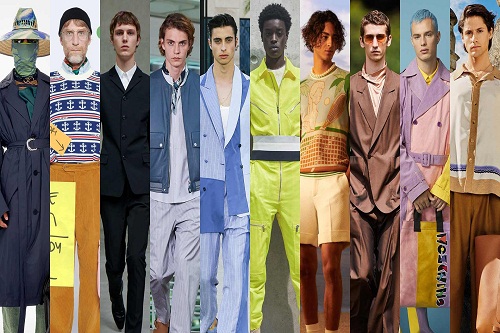
Based on the knowledge that around 50 per cent of men’s sales come from women’s customers buying for their partners, contemporary brand Sanctuary launched a menswear range in September, notes Ken Polanko, CEO. The brand partnered retailers Nordstrom, Bloomingdale’s and Macy’s for the collection.
Men’s apparel wear growth outpaces women’s, says the NPD Group. From January to November 2021, men’s apparel sales grew four times than women’s apparel. The category grew 12 per cent, compared to the same time period in pre-pandemic 2019.
Men plan wardrobe refresh
Men are re-assessing their fashion needs, says Kristen Classi-Zummo, Fashion
Apparel Industry Analyst, NPD Group. They are planning to refresh their pre-pandemic wardrobes by testing new brands, she adds. For these customers, the market is filled with new brands and retailers. Nili Lotan, who owns a namesake brand, will launch her menswear collection in summer 2022. Similarly, luxury brand Erdem will launch a new menswear collection next year and so will The Outnet.
This year, mall retailer New York & Company launched a menswear collection in August while Louis Vuitton opened its first standalone men’s store in Miami. Tracy Margolies, Chief Merchant, Saks also dedicated the first floor of its new store Barney at Saks in Greenwich, to men’s accessories.
16 brands to stage physical shows at Paris Couture Week
The final calendar published by the Fédération de la Haute Couture et de la Mode, French fashion’s governing body, shows that 16 brands are scheduled to stage physical events at the upcoming Paris Couture Week with Dior and Chanel holding two separate shows.
Valentino, which showcased its collection in Italy and online during the last three season also returned to the fashion week. Other brands that will participate in the event include Azzaro Couture, Alexis Mabille, Stéphane Rolland, JulienFournié, AlexandreVauthier, Viktor & Rolf, Elie Saab, Yuima Nakazato, ImaneAyissi and Yanina Couture. In addition, there are seven physical presentations and six digital-only shows.
Gaultier’s show will feature a collection designed by Glenn Martens. The Belgian designer behind Paris-based Y/Project, and also the creative director of Diesel, follows Sacai’sChitose Abe as the house’s second guest couturier.
The Paris Couture Week will make a return from January 24 to 27 ever since Giorgio Armani cancelled his privehalte couture spring 2022 show due to the surge in COVID-19 infections in Europe.
French AIDS charity Sidaction subsequently postponed its fundraising gala to July 7, and it is understood that most events have been called off.
GiambattistaValli has opted for a digital presentation that is scheduled to go live at 7:30 p.m. Paris time on Jan. 17, the eve of Men’s Fashion Week. The shows will comply with reinforced safety protocols. In addition to travel restrictions, which are regularly updated, the French government plans to upgrade its existing health pass to a vaccination pass on Jan. 15.
Timberland launches product take-back program
Timberland has launched Timberloop- its product take-back program. The” policy encourages customers across the US to return any Timberland apparel, footwear or accessories to give them a new life.
Through this program, Timberland aims to refurbish a few of its products and sell them on a resale site later in 2022. It will also disassemble other used products and reuse a few of their parts. The program will include markets in Europe, the Middle East and the Asia-Pacific region later this year.
As a financial sweetener to encourage the brand’s customers to participate in this circularity program, customers who participate in the Timberloop plan will score 10 percent off their next purchase.
Susie Mulder, Global Brand President, says the program is a huge step as it work towards its vision of a more equitable and green future.
Timberland has also furthered its investments in regenerative agriculture while striving to ensure social impact can occur across its global supply chain in nations such as Haiti.