


FW
Cotton production falls in India
Cotton production in India is either declining or stagnant. So says the RBI. Production in Andhra Pradesh declined from 2.508 million bales to 1.6 million bales in fiscal 2020-21. Production has increased in Rajasthan and Maharashtra.Gujarat’s cotton production has declined from 8.617 million bales to 7.212 million bales.India’s total cotton exports were estimated at four million bales in fiscal year 2022.
India’s cotton exports account for ten per cent of the total global export. In fiscal year 2021, India’s cotton exports were worth $6.3 billion, with production hitting 352.5 lakh bales. India’s cotton exports this year may fall short of estimates. Export enquiries are poor as Indian cotton is more expensive compared with world cotton prices. The season started with very poor opening stock. Arrivals are not picking up as expected and domestic mills are gradually increasing capacity utilization. Cotton arrivals in November usually surpass 1.5 lakh bales a day. At present, it is at 1.3 lakh bales a day. In several areas, sowing and harvesting have been delayed. Further, farmers are waiting for prices to improve. Prices are down 35 per cent already. So farmers are not selling cotton. But there are no signs that prices would improve either.
Made in Bangladesh event highlights progress
Made in Bangladesh Week was held from November 12 to 18, 2022, organized by BGMEA. The event highlighted the progress of the Bangladesh apparel industry in safety and sustainability in recent years.
The industry is now focusing on optimum use of resources, including making a shift from the linear to the circular model of business as Bangladesh’s apparel industry generates about 440 million tons of pre-consumer waste every year. Awards were given to the country’s apparel design talents both in the professional and student categories.
Bangladesh’s policy makers, apparel manufacturers, buyers and stakeholders were given a platform to discuss the stories of transformation and progress in workplace safety, workers’ well-being, environmental sustainability and innovation, and to decide the ways forward for the sustainable development of Bangladesh’s apparel industry. Bangladesh is setting up 100 economic zones in different parts of the country, for which local and foreign investment will be encouraged. Made in Bangladesh Week provided industry stakeholders across the world an opportunity to see the take off of the apparel industry as Bangladesh continues to pursue new areas of expansion, manufacturing excellence and sustainable growth. The event ended with a collective promise to attain equitable growth.
Indian exporters welcome FTA with Australia
India’s free trade agreement with Australia is expected to come into force from January 2023.
The agreement will provide Indian exporters duty-free access to the Australian market in sectors including textiles, leather, furniture, jewellery and machinery. Labor-intensive sectors which would gain immensely include textiles and apparel, a few agricultural and fish products, leather, footwear, furniture, sports goods, jewellery, machinery, and electrical goods.
Under the pact, Australia is offering zero-duty access to India for about 96 per cent of exports (by value) from day one. This covers many products that currently attract four per cent to five per cent customs duty in Australia.India has got visas for Indian chefs and yoga instructors and also got a commitment that every child going to study in Australia will get an opportunity to work there depending on the level of education.
The pact will help farmers growing grapes for making wine to explore more business opportunities in Australia. The wine industry has welcomed it wholeheartedly since it will help attract investments. There are 6000 farmers in India who grow grapes for wine purposes. Australia has also approved an amendment to the Double Taxation Avoidance Agreement, a move which would help the Indian IT sector operating in that market.It would stop the taxation on the offshore income of Indian firms providing technical support in Australia.
Intex India- The Leading International Textile Sourcing Show in South Asia
• Intex India – The Leading International Textile Sourcing Show in South Asia
• Exhibitors from 10+ countries across South Asia, South East Asia, China, MENA Region, the EU, Central Europe, the USA and Central America
• 125+ Leading Manufacturers from around the world and India
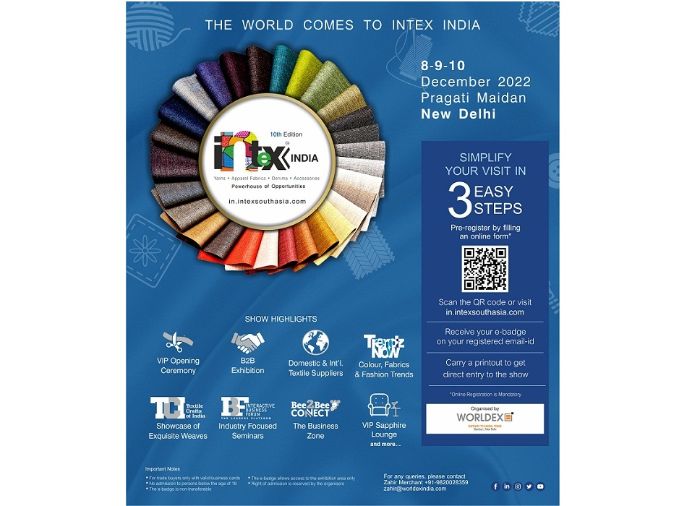
The 10th edition of Intex India, one of the premier International Textiles Sourcing Show of South Asia, will be held in Pragati Maidan, New Delhi from December 8 to 10, 2022 with the sole aim of powering India’s growing textile industry.
India is one of the world leaders in textiles andas the world’s fifth-largest exporter for apparel, home, and technical textile products, Indiaholds a key position in the global value chain.
At the same time, India is also one of the faster-growing domestic textile consumption markets, expecting growth at 8% CAGR to reach $100 billion by 2026thanks to the rising penetration of products driven by increased purchasing power. This is a good sign for India’s textile producers as the growing domestic market provides an ample boost to production prospects.
India is now the global hub of opportunities for the textiles and apparel industrywith a number of strong positives going for it. The positives include a favourable global supply chain stressing the need for ‘China Plus One’ strategy. With other regional countries having a narrow bandwidth given their limited geographic size, India can build a strong global position by leveraging its relatively large strategic depth, play to its strength in fabrics by positioning India as a regional fabric hub,increase focus on MMF to gain increased share in global MMF products and emerge as a strong manufacturing alternative in the global value chain.
Taking this forward in a concrete manner, Intex India will enable businesses to explore trade opportunities with leading Indian and overseas suppliers via joint ventures, trade deals and cross-border investments across exhibiting categories including Fibres, Yarns, Apparel Fabrics, Denim Fabrics, Clothing Accessories, Dyes & Chemicals, Software & ERP Solutions, Design Studios, Testing Equipment & Compliance Solutions, Textile Allied Services, etc.
The Indian government has also geared up to support the industry through the launch of numerous key initiatives, such as the Production-Linked Incentive (PLI) Scheme, MITRA (for world-class infrastructure in mega textile parks), providing subsidies such as the Remission of Duties and Taxes on the Export Products (RoDTEP) Scheme to exporters, and removing anti-dumping duty on key MMF raw materials.
This focus on textiles by the Government bodes well for the industry’s future.With targeted actions from government and industry players, India can gain a leading edge on the global stage.
Intex India has been organised with the sole purpose to accelerate this growth by supporting it through a strong business platform. To further strengthen industry, Intex India will see the presence of international suppliers from China, Korea, Thailand, Belarus, Italy, USA, Vietnam, Uzbekistan, Sri Lanka,Bangladesh& others.
In a bid to boost export-oriented domestic manufacturing, the Indian Government has been pursuing free-trade agreements with several partners – both bilateral and regional – which include the UK, Canada, the GCC, Bangladesh, Israel, European Union, and Southern African Customs Union.
Trade deals have already been reached with the UAE and Australia enabling India’s exports of textiles and apparel to these countries.Once FTAs with the other countries are signed, India will truly become the supplier of textiles and textile products to the world.
The future of the Indian textiles industry looks promising, supported by strong domestic and global demand. Intex India looks to supplement these positives by empowering industry players to explore new business opportunities, forge worldwide connections and stay up-to-date with contemporary developments.
Featured exhibitors at Intex India includeReshaMandi, Alok Industries, Reid & Taylor, Lukshmi Yarn Impex, Sky Textiles India, Ginza Industries, Texperts, FASHiNZA, Orsha Linen Mill (Belarus), Changzhou Wushuang Textile (China), M & F Company (South Korea), Baeksan Jacquard Co., Ltd (South Korea), Preview In Daegu (DGTIA) - South Korea, Egypt Cotton Association (Egypt), Pantone (Hong Kong) and Italtex (Italy).
This year, Intex India would also be organising the renowned Interactive Business Forum (IBF) Seminar Series and ‘Trendz Now’ –the colour, fabric and fashion forecast showcase alongside Intex India, thus creating a premium and complete B2B international textile trade & sourcing platformmaking Intex India the annual calendar event for South Asia’s Textile & Apparel industry.
Intex India is supportedby the Federation of Indian Chambers of Commerce & Industry (FICCI) under the aegis of the Ministry of Commerce, Government of Indiaand also supported by the Ministry of MSME, Government of India as well as by apex chambers from India and across the world.
Intex India is the gateway to the dynamic markets of India and South Asia, making it one of the must-attend events in the textile sourcing industry.
For more information, you can call on +91 9820028359 or write on This email address is being protected from spambots. You need JavaScript enabled to view it.
CRISIL predicts gradual rise after a current slowdown in 2023

Weak consumer demand and the slowing down of private investments are the main reasons behind the global slowdown which is pulling down India’s export figures and industrial activity, according to the Union Budget 2023. Catching up to pre-pandemic levels is not a walk in the park for the apparel and garment industry as the country’s growth is expected to be lowered for the fiscal 2023-24.
Lower industrial activity and exports affects GDP
As per CRISIL’s recent ratings, India’s GDP growth will be lowered to 7 per cent in fiscal 2023 and then further to 6 per cent in fiscal 2024 as global growth slows down. Monetary policy tightening and a general weakening of growth momentum in Western countries have affected India's slowdown in exports and volatility in foreign portfolio investment inflows. Merchandise exports have come under pressure and some other services exports such as related tourism and money remittances are also facing the brunt.
India’s export segment, particularly non-oil - has been sharply hit with a slowdown since July 2022. The country’s exports to the US are only 0.4 per cent in September versus 28.7 per cent in June while to the European Union (EU) it is 2.8 per cent versus 38.9 per cent. India’s exports will also see further weakening income prospects in the labour-intensive manufacturing segments of textiles and gems and jewellery.
“The hit to industrial activity could intensify in fiscal 2024, as aggressive rate hikes in the US and the EU reach closer to consumers. Yet, rising domestic demand in some pockets has been partially cushioning industrial activity. For instance, robust government Capex is supporting manufacturing growth through higher demand for infrastructure and construction-related goods," says Dharmakirti Joshi, Chief Economist at CRISIL.
Although demand for household goods helped by services catch up and government Capex is holding up this year, it will flatten out and moderate next fiscal year. Consumer non-durables have been recording their sharpest decline in growth among major IIP components since March 2022.
Hike in domestic demand will boost growth
To add to the misery, agriculture production was impacted by unusual weather conditions this year which ruined rural income prospects. The heatwave in March-May damaged the wheat crop at harvesting stage, which was followed by delayed rains that affected the sowing of rice crop. Then finally, excess rains in October hit several Kharif crops at the harvesting stage.
Currently, the RBI has raised the policy repo rate by 190 basis points (bps). Although the repo rate is higher than the pre-pandemic level of 5.15 per cent, it is still lesser than 6.50 per cent peak reached in 2018 during the last rate hike cycle. However, this will change soon "as transmission increases, higher borrowing costs could take some steam off from the current strength in domestic demand," says the CRISIL report.
Stronger domestic demand to drive growth
However, there is an emerging light at the end of this tunnel as stronger domestic demand is predicted to drive India’s growth premium over peers in the medium run. Investment prospects look good with the government’s Capex push, the progress of Production-Linked Incentive (PLI) schemes, better corporate balance sheets, and a well-capitalised banking sector with low nonperforming assets. India benefitting from China-plus-one policy as global supply chains get reconfigured and private consumption playing a supportive role in raising GDP growth over the medium run will also be helping this change.
Although the Union Budget 2023 predictions state that India’s growth will slow down in the next two years, industry analysts are in hope that pre-pandemic growth levels will return after a mild recession downturn next year, as after all, there is always a rise after a fall in the development process of just about anything in life.
Despite recession fears, global luxury market grows 21%, outlook bright: Bain

The global luxury market has grown 21 per cent from 2021, says a recent report by Bain & Co. and Altagamma. Despite worsening economic conditions, high inflation and rising costs of living, coupled with ongoing Covid restrictions, some 95 per cent luxury brands have clocked in positive growth in 2022.
Chinese consumers will represent 40 per cent of all luxury consumers by 2030. But as China remains challenged due to Covid restrictions, other parts of the world have begun to shine. The US luxury market is still leading in size while Europe has managed to surpass pre-pandemic levels thanks to an uptick in local demand and overseas shoppers. Newer luxury markets have emerged, too, including Southeast Asia, although it lacks the infrastructure to facilitate expansion locally. In South Asia, India is a country to keep tabs on, with a luxury market forecasted to swell 3.5 times today’s size by 2030.
Gen Y, Gen Z key growth drivers
Gen Y and Gen Z accounted for the entire growth of the global luxury market in 2022. In coming years, Gen Z and Gen Alpha spending will grow three times faster than other generations until 2030, when they will make up a whopping one-third of the market.The impact for brands of these young consumers entering the market will be substantial. Brands will be asked to adapt their value proposition, where purpose and expanded brand meaning have a central role in order to remain relevant.
Old loyalty programs are now being innovated with social incentive schemes. These flip traditional VIP schemes on their head, incentivizing brand engagement and advocacy pre-purchase rather than post-purchaser, attractive user experience with points, rewards for each interaction with a brand to be redeemed against exclusive content and discounts.
Brands perform using current dynamics
Not only does the current luxury industry have a larger consumer base than it did during the 2009 financial crisis, brands have done a better job at developing and balancing business across regions and generations.
Furthermore, brands have been able to nurture their top, ultra high net worth customers, traditionally less impacted by economic downturns. They constitute a safer bucket of sales for brands to rely on, especially during periods of economic pressure.
In the third quarter, Kering’s sales in Western Europe jumped 74 per cent year-on-year, while LVMH and Hermès posted double-digit growth thanks to strong performances in Europe and the US. Aditya Birla Fashion and Retail along with Galeries Lafayette will bring luxury department stores to New Delhi and Mumbai by 2025.
Top brands exhibit at Denim Premiere Vision Italy show
Denim Premiere Vision was held in Italy, November 23 and 24, 2022. The specialised trade show registered high attendance, from both Italian and international visitors, and saw the presence of high-level players from the denim and fashion segments.
Busy halls, a vast crowd of insiders, a rich program of talks involving top speakers, and a happy atmosphere characterised the event focused on presenting spring/summer 2024 novelties from the denim industry. The show hosted 67 exhibitors, 14 upcoming brands, and three trend areas and also hosted a series of highly inspiring installations and projects. The show worked well both for its content and as a container. Among the topics of discussion there were Made in Italy, the jeans creative process, sustainability, education, and more. It hosted prestigious industry speakers. Among the main trends, colored denim -- both with yarn-dyed fabrics and by using ready-for-dye- - remain a must for the upcoming season.
Mixing different fibers, while keeping great attention on environmental care, was a must for many manufacturers. Among the most interesting collections some of them presented new creative mixes of hemp with cotton, cotton and Tencel, viscose or recycled polyester. The show registered the attendance of creative teams from top pret-à-porter brands.
US garment imports up 34 per cent
America’s imports of garments between January 2022 to September 2022 increased by 34 per cent. However imports in September 2022 fell compared to imports in August 2022. Though the import value fell in September, it is still the second highest in 2022.
All major Asian apparel exporting countries have seen significant increases in their shipment to the US during January to September. China is still the largest supplier to the US though its share in the US market has shrunk to 22 per cent in 2022 compared to 2021.Vietnam, Bangladesh, India and Indonesia increased their shipments to the US by 34 per cent, 51 per cent, 53 per cent and 54 per cent respectively.
With just one quarter left in 2022, all eyes are on the festive season that is said to be a season when retailers will plan to sell all the piled-up inventories. US imports of garments from January 2022 to August 2022 increased by 37 per cent. Import values in August 2022 were 11 per cent higher than imports done in July 2022. Most big retailers in the US are holding back new inventories and are not placing fresh orders in their partner factories located worldwide.
Global retailers saddled with unsold clothing
Fashion retailers across the spectrum are sitting on piles of unsold clothing.
M&S has asked suppliers to postpone deliveries to its warehouses and has delayed confirming orders for next year. The retailer has resorted to discounting coats, jackets and boots by 20 per cent in a bid to clear excess stock as milder weather combined with shoppers cutting back has led to slow-moving winter clothing. Like other retailers, M&S is re-adjusting stock flow as supply chain disruption has eased.
An easing of supply chain disruption has also led to a pile up of products in warehouses. Lead times from east Asia have shortened which means retailers faced with clearing last year’s delayed stock are receiving new stock quicker than expected.
Asos’ unsold stock is up a third on the year before. Next has returned a very small amount of stock to its third party brands although its inventory was at planned levels. Tesco’s clothing suppliers are preparing for delays after the grocer wrote to them to remind them of its stock holding policies. When brands have unsold stock, they sell at a reduced price through sales. H&M also actively moves garments to stores or markets where it sees a greater demand or stores them for the next season. At a last resort, it considers external buyers of its overstock.
UK: Primark to open stores, while others shutting shops
Primark is investing in opening stores across the UK. This British fashion chain is betting on its rock-bottom prices luring customers as the country grapples with a cost-of-living crisis.
The plan contrasts with other retailers who have shut shops due to weak footfall and rising costs, while a shift to online shopping, accelerated by the pandemic, has also hampered store revenues. Exacerbating the pain from rising costs, footfall at UK retail destinations still remains 15 per cent lower on an average this year compared with pre-pandemic levels.
Even before the pandemic pushed more shoppers online, many high street retailers were struggling due to stiff competition from online-only brands leading to the collapse of household names like Debenhams.That saw Primark, which has shunned the extra cost of home delivery, launch a click and collect online service earlier this month. Although there was an uptick in UK retail sales in October 2022, driven by clothing, a bleak winter lies ahead and consumers are looking at how they can tackle the fallout from the cost-of-living crisis in their spending decisions.
There’s still little sign of early Christmas cheer for retailers. Online sales of textiles, clothing and footwear were down 8.4 per cent compared to a year ago and down 2.7 per cent compared to September, while department store sales online were down 6.8 per cent compared to a year ago and 1.7 per cent against the previous month.











