FW
Indian craftsmanship being acknowledged by global luxury
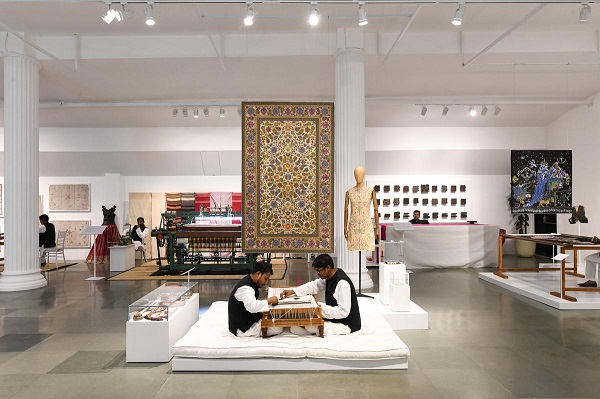
The contribution of India’s legacy craftsmanship to the world of luxury is a well documented fact but getting well-deserved spotlight and acknowledgements is fairly rare. Many world-class it items in luxury fashion, jewellery, home textiles and furniture have been lovingly crafted in luxurious detailing that India has always been famous for but never quite mentioned in its own right and more often than not, a mere footnote mention. However, that is changing as acclaimed studios and designers are not only showcased in collaborations but also on their individual platforms.
Indian ateliers make a mark in global fashion
Mumbai-based Chanakya International is a renowned export house of hand-embroidered pieces with a clientele portfolio that reads like the A list shows at the London, Paris, Milan and New York fashion weeks. It all started when Chanakya’s creative director Karishma Swali led a project translating art works by the Delhi-based couple Manu and Madhvi Parekh as embroidered installations for Christian Dior’s Haute Couture Spring/Summer 2022 show at Paris’ Musée Rodin. Then came the much publicized collaboration between Dior and Chanakya Atelier that inspired the world , the Dior Fall 2023 collection staged against the backdrop of the Gateway of India, a visible symbol of colonialism, and the Dior x Chanakya Atelier retrospective.
That Dior mostly outsources a lot of the surface ornamentation and embroidery for its women’s wear, bags and shoes to an atelier in India was a well-guarded secret. But it’s out in the open now as India takes the seat at the international luxury table. Luxury brands have been zoning in on destination India as the growing middle class’ aspirations are now achievable and designer shoes, bags and frocks are often seen around at work places, social events and most of all at weddings, the perfect platform for opulence.
European luxury salutes Indian craftsmanship
For years, Europe’s luxury houses have been outsourcing embroideries, surface ornamentation and carvings from Indian master craftsmen, seldom was this contribution acknowledged as European luxury brands wanted to justify their European value through ‘Made Exclusively in Europe’. With India gaining ground rapidly through its resilient and successful economy and a strong foothold in the international corridors of power, European labels such as Dior have been smart to assess the future of luxury shifting rapidly Eastwards and paying a long-overdue homage to those who toiled endlessly in the by lanes of Lucknow, Mumbai, Varanasi and Kolkata, putting together exquisite perfection that shone the glory of European haute couture and luxury.
While Dior, like most European luxury brands, has often turned to Indian master craftsmen for their exceptional skill with embroideries and surface ornamentation, this relationship has been under the radar. Designer Rahul Mishra points out a significant portion of international luxury industry's supply chain has always been outsourced to India.
But most brands have denied credit to Indian ateliers for their handcrafted work. Indian craftsmanship has long been unfairly spoken about as being “too kitschy” and European brands have worked hard to preserve the snob value and symbolism associated with being a ‘Made in Europe’ brand.
So, fashion insiders are calling the showing a way for Dior to say ‘thank you’ for years of collaboration on intricate couture pieces, bags and shoes. The trend for crediting Indian ateliers for their craft and handmade collaboration most likely began with the ultra-glamorous shoe and accessories brand Christian Louboutin, which spoke about their work with Vastrakala, a Chennai-based Indian-French atelier run by Frenchmen Jean-Francois Lesage and Patrick Savouret and Indian Malvika Shivakumar.
Harmful practices by apparel corporate buyers continue during Covid-19, says NYU Stern report
A new report from the NYU Stern Center for Business and Human Rights has called for urgent reforms in the outsourcing practices of the apparel industry, following harmful practices by corporate buyers and their representatives, which have continued during the Covid-19 pandemic.
The report, titled “A Broken Partnership: How Clothing Brands Exploit Suppliers and Harm Workers and What Can Be Done About It”, includes practical recommendations for clothing brands and retailers to establish constructive relationships with outsourced suppliers that protect the human rights and economic well-being of workers.
According to the report, harmful practices by corporate buyers include pressuring suppliers for unreasonable price reductions, delaying delivery and withholding payment, canceling bookings and projections, and relying on sourcing intermediaries who exacerbate exploitative practices. These practices have resulted in reduced worker pay, and the report recommends that buyers end unreasonable price reductions and excessive discounting practices.
The report also recommends that corporate buyers commit to payment timelines that take suppliers’ raw material purchases into account, recognize that a projection or booking is as good as a contract for many suppliers, increase transparency and communication with third-party sourcing agents, and reconcile commitments to factory safety and worker wellbeing with the commercial terms negotiated with manufacturers.
The report’s recommendations provide a crucial roadmap for the apparel industry to ensure that such tragedies never happen again, and to create a fair and sustainable supply chain that benefits workers, suppliers, and buyers alike.
Strategies for Zero Carbon and Zero Waste Textile to be discussed at TIWC 2023
The University of Huddersfield will host The 92nd Textile Institute World Conference (TIWC) from 3-6 July 2023.
The conference theme, "Sustainability of the Textile and Fashion Supply Chain – Transitioning to Zero Carbon and Zero Waste," focuses on identifying sustainable practices throughout the entire textile and fashion supply chain, from raw materials to end-of-life phases.
The conference will address strategies to manage the impact of the textile and fashion supply chain on the environment and climate change, aligning with global initiatives to move towards zero carbon emissions.
Academic and industrial experts will cover sub-themes such as Future Fashion, Composites, Green Skills, Dyes, Pigments, and Polymer, Nonwovens, and Technical Textiles.
The conference aims to benefit the industry through the triple helix model of academic-industry-government dialogues and create a roadmap for achieving zero carbon ambitions before 2050.
UK clothing, textile and fibre imports decline in February 2023, says ONS Data
UK's textile industry continues to experience fluctuations in imports and exports, influenced by various factors, including economic conditions and global demand, according to the latest data released by the Office for National Statistics (ONS).
UK’s clothing imports declined by 11.51% in February 2023, reaching £1.294 billion ($1.62 billion).This is a significant drop from the £1.443 billion recorded during the same period in the previous year. The decline was also observed on a month-on-month basis, with January 2023 imports standing at £1.384 billion.
Despite the recent decrease, UK's clothing imports had experienced a surge in 2022, amounting to £21.256 billion ($25.86 billion), a 23.50% increase compared to the imports of £17.034 billion in 2021. However, it remains to be seen if this trend will continue in the coming months.
In addition to clothing, the UK's textile fabric imports also recorded a decline of 4.94% in February 2023, amounting to £462 million, down from £486 million in February 2022. These imports also experienced a month-on-month decline, with January 2023 imports at £469 million. ONS data shows that textile fabric imports reached £6.359 billion between January and December 2022.
Furthermore, the UK imported £39 million worth of textile fibres in February 2023, compared to £45 million during the same month in 2022. Textile fibre imports were also lower in January 2023, at £35 million. The total textile fibre imports for 2022 amounted to £545 million.
On the other hand, the UK's clothing exports decreased annually, reaching £3.931 billion in 2022 compared to £4.263 billion in 2021. In February 2023, the country exported clothing valued at £296 million, a decline from £323 million in February 2022 and £306 million in January 2023. Meanwhile, exports of textile fabrics and fibres were recorded at £2.716 billion and £616 million, respectively, in 2022.
The recent decline in clothing imports in February 2023 highlights the need for continued monitoring of the industry's performance to identify future trends and potential opportunities for growth.
US: Clothing, accessories stores hit hardest as consumer spending drops, inflation concerns linger
Consumer spending in the US has taken a hit for the second consecutive month as the latest retail sales data from the US Census Bureau shows that consumers pulled back on their spending in March.
The decline in spending is seen across several categories with clothing and accessories stores being hit the hardest, slipping 1.7% month on month and 1.8% from a year ago. Spending on electronics and appliances was also down 2.1% month over month, while furniture and home furnishings dropped by a respective 1.2% and 2.4%.
Overall, spending declined 1% month over month on a seasonally adjusted basis, following a 0.2% decline in February versus January.
The research from PYMNTS suggests that this pullback in consumer spending is due to the average consumer not expecting inflation to return to normal until the end of 2024.
Bangladesh looks to India for increased textile sourcing to achieve USD 100 Bn export target
Representatives from BGMEA and Bangladesh Garments Executive Association recently visited Tamil Nadu to discuss the possibility of sourcing yarn and fabric from the state. Bangladesh is exploring increased sourcing raw material from India to achieve its ambitious annual export target of USD 100 billion, jumping from its monthly garment exports currently valued at USD 3.9 billion.
Over 85 Indian textile entrepreneurs from the Federation attended the meeting and discussed the demand for blended fabrics and value-added yarns, sustainability-related certifications, sustainable practices, sourcing more from India, ready-to-cut processed fabrics, and demand for woven fabrics in Bangladesh.
Bangladesh wants to source more woven fabric and processed, ready-to-cut fabric of different fibres from India. Furthermore, about 40 spinning mills and 60 fabric companies in the state of TN are already supplying to Bangladesh. Earlier, the Bangladesh delegation had also visited clusters such as Surat and Delhi to explore additional sources.
This move by Bangladesh also comes as part of its efforts to reduce its reliance on China for textile imports, amid concerns over the supply chain disruptions caused by the COVID-19 pandemic.
India, with its abundant supply of cotton, polyester, and other raw materials, is a natural alternative source for Bangladesh. Moreover, India's textile industry has been actively promoting sustainable practices and certifications, which aligns with Bangladesh's growing emphasis on sustainability in the garment industry.
The growing trade relations between India and Bangladesh in the textile sector are expected to further strengthen their economic ties and benefit both countries in the long run.
US Government accuses Shein, Temu of unfair market practices and data risks
US government accuses Chinese-backed fast fashion digital platforms Shein and Temu of posing risks to data privacy and engaging in unfair market practices, according to a report by the US-China Economic and Security Review Commission (USCC).
Shein has outpaced competitors, including Zara and H&M, to take a dominant position in the US market, which other Chinese firms are seeking to replicate. The report alleged that these firms exploit trade import exemptions and pose challenges to US regulations, laws, and principles of market access. Shein's business model relies on tracking and analysing user data to discern emerging fashion preferences and patterns. Temu has also replicated Shein's process of quickly manufacturing and shipping clothing to US consumers.
Other established and emerging Chinese e-commerce firms seek to penetrate the US market by modelling their strategies on Shein and Temu's businesses.
The report stressed that the government should ensure that these firms adhere to US laws and regulations and are not granted unfair advantages over US firms.
What led to the unforeseen surge of YoY 19.7 % in China's T&A exports in March?
China's textile and apparel exports showed an unexpected surge in March, with a year-on-year increase of 19.7%, leaving industry experts to wonder about the reasons behind the growth.
This positive development is particularly noteworthy given the concerns expressed by the industry in the first quarter about the significant drop in export orders. The growth is primarily attributed to a 31.9% increase in the export of garments and accessories, while yarns, fabrics, and related products also experienced a modest rise of 9.1%. However, the exact factors contributing to this unexpected rise are not entirely clear.
Some market observers believe that the epidemic prevention and control policy, which led to an increase in orders, played a role in the rise. However, the outbreak of the virus in December and the Spring Festival in January affected domestic production and overseas orders, which might not have been reflected in the data until March.
On the other hand, some experts believe that the stock of fabric and apparel enterprises was not extensive, and there was demand for replenishment overseas, which further stimulated the downstream production in China. It is also possible that the downstream fabric mills resumed works after the Lantern Festival, leading to a wave of hot sales.
Furthermore, cross-border e-commerce orders also received positive feedback, providing a significant boost to terminal exports. However, it is difficult to account for the 32% growth in apparel exports, despite the above-mentioned reasons. As a result, industry experts believe that it is essential to monitor the trend in the coming months to see if the growth continues or if it was a temporary phenomenon.
The monthly export report and detailed data of exports issued by China customs in late March will provide a better understanding of the situation. Additionally, China's future textile and apparel exports to Europe, the US, and Japan will help confirm whether the export growth will sustain or not.
Walmart unloads Bonobos to brand management and apparel firms
Walmart is selling its direct-to-consumer menswear brand, Bonobos, to brand management firm WHP Global and apparel retailer Express Inc. for a combined $75m, six years after acquiring it for $310m.
WHP Global is paying $50m for the Bonobos brand, while Express will acquire the operating assets and assume the related liabilities of its business for $25m.
Analysts suggest that Bonobos may have a better chance of thriving under its new owners, given Walmart's lack of development of the brand since acquiring it in 2017.
For Express, the acquisition provides a chance to diversify from its core, middle-market business, and for WHP Global, the deal enables the company to expand its portfolio.
The deal is expected to close in Express' second quarter, subject to customary closing conditions.
Bangladesh under scrutiny, second devastating fire in Dhaka shopping complex in two weeks
The latest fire broke out in the Bangladesh capital of Dhaka, when most of the complex's nearly 1,500 shops were shut. Firefighters and military personnel finally extinguished a blaze that swept through a three-story shopping complex over the weekend, causing injuries to 30 people.
The majority of stores were fully stocked ahead of the Muslim festival of Eid later this month, and shopkeepers were seen trying to salvage their stocks amidst the devastation.
This is the second such incident in just two weeks, following a massive fire that destroyed 5,000 stores on April 4.
Lax regulations and poor enforcement have been blamed for industrial fires that have plagued Bangladesh in recent years, with the country and international clothing brands that manufacture there coming under intense scrutiny after several disasters that killed over 1,200 workers.
While the garment industry has made strides to improve safety, fires continue to occur in other sectors.