


FW
Hong Kong signs FTA with Asean
Hong Kong is looking forward to the upcoming free trade deal with Asean. Five Asean countries – Singapore, Thailand, Vietnam, Laos and Myanmar – have their free trade deals with Hong Kong taking effect soon. Similar agreements with the rest of Asean members – Brunei, Cambodia, Indonesia, the Philippines and Malaysia – will take place a bit later. The Asean free trade arrangement will allow Hong Kong firms access to ten markets for goods, services, investments, economic and technical cooperation and dispute settlement. Asean is Hong Kong’s second largest trading partner, after mainland China.
Battered by the intensifying US-China trade war, Hong Kong is looking to new markets and trade mechanisms. The pact with the ten-member Association of Southeast Asian Nations would be a crucial alternative for Hong Kong companies that rely on traditional markets, such as the United States and the European Union. Hong Kong has provided billions of dollars in funding to subsidise ventures by small and medium-sized enterprises into new markets. The free trade agreements have material and virtual impact that give Hong Kong companies business links and new business positioning.
Hong Kong’s exports fell 2.5 per cent in the first four months of 2019 from the same period last year.
Lindauer Dornier to launch a new customer portal at ITMA 2019
Lindauer Dornier will launch a new customer portal at ITMA 2019. Based on state-of-the-art database technology, this portal will provide an online shop with permanent availability for original parts for all product lines. In future, it will also include remote maintenance and networking of weaving machines to improve their run characteristics. The purpose is to make the job of machine operators and production planners easier.

On the occasion of a recent VDMA press conference themed ‘ITMA countdown’ in Frankfurt, speakers from member companies Lindauer DORNIER, Herzog and Mahlo showed how Industry 4.0 solutions will impact the textile process chain and what technologies visitors can expect to see at ITMA 2019. The products examples of the respective companies made clear that Industry 4.0 helps to improve production processes and results and supplements the range of services.
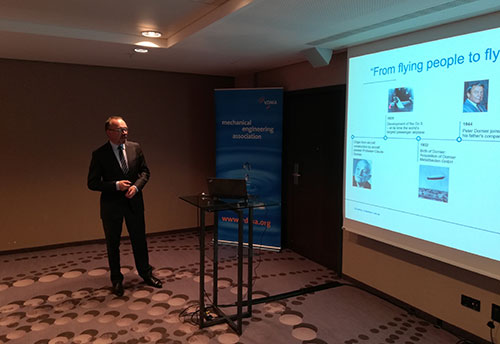
Dr. Janpeter Horn, CEO of Herzog, the leading company in braiding technology, introduced the company’s latest Industry 4.0. product: An app-box with which the customer can easily access the data of Herzog and other machines, e.g. on a PLC (Programmable Logic Controller). The data can be visualised on dashboards created by the customer on terminals or others. The data can be processed. by creating key figures, alarms or analyses.
Superba to introduce MCD/3 space dyeing machine at ITMA 2019
 Superba, a Vandewiele company, will introduce the latest version of its MCD/3 space dyeing machine for carpets at ITMA 2019 along with further new developments in heat-setting, texturizing and winding technologies.
The latest MCD/3 space dyeing machine is capable of handling a layer of 72 ends with an unequalled range of spot length – especially for the ultra-short spots of below 25mm.thus enabling “one-pile/one-color” process on the carpet.
In combination with a TVP3 heat-setting line, the machine can space dye polyester or 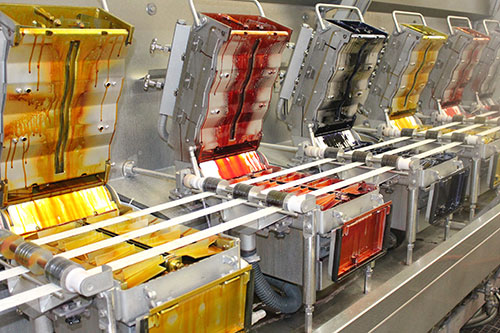 polyamide yarns with up to six colors and also allow special dyeing effects such as bi-colour printing to be achieved.
For acrylic yarns, the MCD/3 can similarly be combined with Superba’s new high capacity DL/5 setting line. It can also be combined with Vandwiele weaving or tufting machines, with all technologies now being equipped for machine-to-machine interaction and learning, as part of the company’s comprehensive TEXconnect programme. The company’s sensors, software programmes and servers have become increasingly sophisticated and the real-time data from different machines –across connected manufacturing sites and across different countries and even continents – can be collected and shared.
Digital models of both machines and production processes can be created and analysed for the optimisation of production settings, to vastly improve scheduling and planning and also make considerable savings on raw materials and energy.
Monforts to launch CYD multi-colour yarn dyeing system at ITMA 2019
 Monforts Textilmaschinen GmbH & Co. KG will launch a revolutionary new system for yarn dyeing based on the proven Econtrol® dyeing system for fabrics at ITMA 2019 in Barcelona, Spain, from June 20-26, 2019.
This latest CYD denim processing technology integrates new functions and processes into the weaving preparatory processes – spinning, direct beaming, warping and assembly beaming, followed by sizing and dyeing – in order to increase quality, flexibility, economic viability and productivity.
Econtrol® is a pad-dry process employed in Monforts continuous dyeing in which the reactive dyestuff is fixed 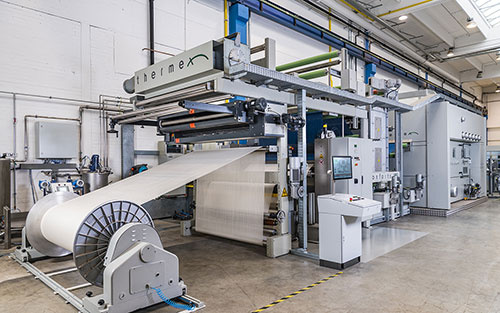 to the cellulose fibres during drying and the CYD multi-colour yarn dyeing system introduces a number of new concepts based on it, including the unique Eco Bleach process.
This is the first bleaching system for yarn treatment available on the market and will be of particular interest to denim manufacturers. The Eco Bleach system is combined with the washing units and the fabric is then dyed immediately, resulting in considerable savings in waste water and chemicals.
The most effective dyeing process for fabrics is now being applied for yarn dyeing and it is possible to process short batches of between 5-10,000 metres of yarn in order to produce 2-300 metres of fabrics in a single continuous process.
In its raw state, cotton has a light brownish/yellow tinge and bleaching is necessary to ensure its pure whiteness prior to dyeing. On conventional systems, this involves a separate process step, but with the CYD multi-colour yarn dyeing system it is now integrated into the Econtrol® process for full dyeing pre-treatment.
Uster Technologies to launch the Management Platform™ at ITMA 2019
"Uster Technologies will launch the Management Platform™ at ITMA 2019. The Management Platform™, collects and evaluates information from different production stages and expands its insightful analytics with valuable intelligence as each additional instrument is connected. The entire process becomes more transparent for managers and operators."
 Uster Technologies will launch the Management Platform™ at ITMA 2019. The Management Platform™, collects and evaluates information from different production stages and expands its insightful analytics with valuable intelligence as each additional instrument is connected. The entire process becomes more transparent for managers and operators. Finally, the Quality Management Platform™ drives consistent quality in every part of the spinning process.
The introduction of the Management Platform™ marks an important evolution for Uster Technologies. It  combines collection and smart data analysis from more process steps with the next level of knowledge-based alerts about possible defects and extended prognosis of yarn performance in subsequent processes. Also very new is the possibility for better contamination control and quality-based optimization of the ring spinning process, including the possibility to stop defect production as early as possible.
The Management Platform™ provides alerts on a mobile app and important performance indicators on dashboards – to trigger early reaction to problems. Its reporting is also accessible on client terminals across the plant.
X-Rite, Pantone to showcase new color formulation software at ITMA 2019
X-Rite Incorporated and Pantone LLC will showcase their latest Color iMatch formulation software for the textile industry at ITMA 2019. The software offers better initial matches and fewer corrections for faster dyeing times, cost savings and reduced waste.
The Color iMatch improves color matching by addressing this interdependence. It intelligently processes color data to provide optimal initial color matches and reduce wasteful formulation attempts. With a high return on investment, Color iMatch streamlines complicated textile workflows, improves formulation efficiency, and reduces material waste.
It offers textile and apparel manufacturers the following benefits
• Increases match rate up to 50 per cent and cuts correction steps by more accurately identifying likely dye combinations and accounting for current process conditions.
• It has the ability to dynamically update dye characterisations to maintain dye behavior, which may shift over time due to variations in ambient conditions, procedures, equipment or materials.
• Its fully-integrated Colorant Editor offers improved database performance by providing specific guidance that guarantees match prediction confidence.
• Digital specification of Pantone standards, including Pantone Fashion, Home + Interiors System for cotton and nylon, through PantoneLIVE™, which provides the official spectral values for Pantone standards.
• Easy transition between jobs by applying dynamic Formulation Rules that include process, material and customer specifications. • A gamut viewer to visually evaluate achievability by offering a unique target overlay to help lab professionals make educated formulation decisions.
AEPC launches SLCP operations in Haryana
"Apparel Export Promotion Council (AEPC), in association with the Social and Labour Convergence Program (SLCP), organised a workshop to announce the launch of SLCP operations in Gurugram, Haryana on June 7, 2019. "
 Apparel Export Promotion Council (AEPC), in association with the Social and Labour Convergence Program (SLCP), organised a workshop to announce the launch of SLCP operations in Gurugram, Haryana on June 7, 2019.
SLCP uses a multi-stakeholder and inclusive organization and approach. Signatories include manufacturers, The converged assessment framework of SCLP provides a data set with no value judgment or scoring. It is compatible with existing audit systems and codes of conduct, and can be used by a wide-range of stakeholders & interpreted according to their interests and criteria. This eliminates the need for repetitive audits to be carried out on the same facility.
The 190+ SLCP signatories are now preparing for wide-scale adoption across apparel and footwear supply chains. Towards the India launch, SLCP held one-day seminars in Bangalore, Tirupur, Mumbai & NCR to introduce facilities and their business partners to the SLCP process.
HKL Magu, Chairman, AEPC believes this programme will encourage sustainable and innovative management systems which ensure holistic growth of all the stake holders.
Sharon Hesp, Sr. Manager, SLCP, Dr. S Sunanda, SG CITI, Reema Agrawal, Sr. Program Manager, GAP Inc and Balaso Malagave, Sr. Manager, Intertek also attended the workshop.
Zappos partners with Cotton Inc
Zappos for Good has partnered with Blue Jeans Go Green on denim recycling. Zappos for Good is the charitable wing of the footwear and apparel retailer. Blue Jeans Go Green is a Cotton Incorporated initiative. Blue Jeans Go Green works on recycling and waste, an issue currently plaguing the fashion industry. The arrangement will allow consumers to mail in old denim to Blue Jeans Go Green via a Zappos prepaid shipping label that will be available to customers with a Zappos account. Zappos is working to close the loop on cotton sustainability and give back to communities across the US.
Beyond simply ensuring more denim gets reused instead of dumped into a landfill, the program is also a step in the right direction for the entire denim recycling movement. Providing consumers with pre-paid mailing labels makes participating in the denim recycling movement more accessible. With Zappos for Good’s new partnership with Cotton Inc., the door has been opened wide for anyone that wants to participate in denim recycling.
Denim with a high cotton percentage is a perfect candidate for textile recycling and it turns the cotton it receives into natural cotton fiber insulation, as opposed to harmful and chemically intensive fiberglass insulation. Cotton Inc. even uses some of this insulation to help build houses in communities across the United States.
Tariff war lowers cotton prices
Cotton is bearing the brunt of the escalating tariff war between the US and China. Prices have collapsed to multi-year lows in the US, the world’s largest exporter of the natural fiber. China — the world’s largest consumer and importer — has almost stopped buying American-origin cotton, and has imposed a retaliatory tariff on US-origin material. Also, the Asian major has slightly tweaked its inventory policy, by moving to stock rotation rather than de-stocking. In the absence of large-scale Chinese purchases, cotton prices have collapsed to a three-year low.
Pessimism now pervades the world cotton market. Production is projected to outpace consumption in 2019-20, and will add to already high stocks. This expectation too is seen as exerting a downward pressure on prices. Short-term oriented market participants are more pessimistic about cotton prices and are exiting their positions in droves. This has had a consequential impact on the price of the fiber in other countries, including India. Because the Indian market is integrated with the global market through the trade route, global cues impact Indian prices.
A very substantial part of US’ cotton production is intended for the overseas market, especially China. The US is most likely to harvest a bigger cotton crop — possibly 20 per cent higher — in 2019 compared to the previous year, and will end up with multi-year high stocks.
World economy slows down
The global economy has slowed over three years, says the World Bank. Of particular concern is a slowdown in global trade growth to the lowest level since the financial crisis 10 years ago. International trade and investment have been weaker than expected at the start of the year. Economic activity in major advanced economies, particularly the Euro area, and some large emerging market and developing economies has been softer than previously anticipated. Because equitable growth is essential to alleviating poverty and increasing shared prosperity, emerging market and developing economies need to reinforce the protections they have against sudden economic downdrafts. Current economic momentum remains weak, while heightened debt levels and subdued investment growth in developing economies are holding countries back from achieving their potential.
Though growth in the emerging and developing world is expected to pick up next year, a number of risks could disrupt that delicate momentum: a further escalation of trade disputes between the world’s largest economies, renewed financial turmoil in emerging and developing economies, or a more abrupt deceleration of economic growth among major economies than is currently envisioned. Countries need to make significant structural reforms that improve the business climate and attract investment. They also need to make debt management and transparency a high priority so that new debt adds to growth and investment.











