


FW
Comfort still rules denim as brands innovative with style, design features
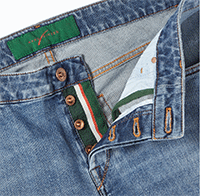 The average five-pocket jean is going through a transformation with denim brands and designers taking creativity to new levels through innovative fabrics and designs. Increasing competition from the athleisure category has made denim brands realise the need to innovate their offerings in order to stay relevant in a competitive market. As the chief industry advisor of the NPD Group noted earlier this year, women today want to wear more than just leggings and yoga pants. To inspire these women to buy new jeans, denim marketers need to find new ways to design their jeans and deliver products that appeal to their tastes.
A recent NPD Group survey reveals 364 million pairs of women’s jeans were purchased in the US in the 12 months ending February 2019. Amongst all brands, Levi’s is still the most favorite for one-third consumers; followed by Lee, Wrangler, American Eagle, Old Navy, Gap, Calvin Klein and True Religion.
New styles at the New York Fashion Week
Denim was also the point of discussion at the New York Fashion Week’s Spring/Summer 2020 shows. At the show, the Brock Collection showcased its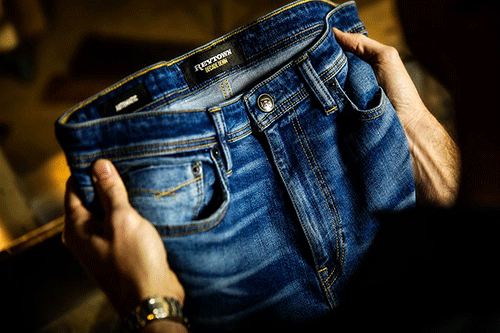 wide-leg denim jeans with light and airy gowns, while Rag & Bone’s introduced ultra-short denim skirts, tiny shorts, waistband-less jeans and a ragged-edged denim vest. Prabal Gurung went with denim work jackets, overalls and dresses. And Brandon Maxwell showed jeans with ripped knees and frayed bottoms, a classic denim shirt paired with leather pants, and a full-body look that paired a rolled-sleeve work shirt with matching deep blue jeans.
Unusual detailing fuels denim purchases
These shows also introduced new denim styles such as painted and sequined jeans and rompers that were showcased by the brand No Sesso at its runway show. Similarly, Alexander Wang exhibited denim shirts with leather collar and plackets, as well as blue jeans overlaid with leather and suede chaps. Kaimin showcased an adjustable-length denim skirt, jeans with metallic and embroidered appliques and denim bottoms that looked as if the pant legs were breaking away, leaving only tiny shorts. EDGII delivered extra wide-leg jeans, as well as bottoms with flyaway pant legs that split at the knee. And Alice + Olivia collaborated with designer Everard Best of the men’s wear labels Murder Bravado and Who Decides War, on a collection of hand-embroidered, dyed, and distressed denim. Designers are banking these innovative styles and unusual details to keep consumers coming back for more of what the denim category has to offer.
However, despite these innovations, designers need to remember that consumers still value traditional features in their denim. As a Monitor Research reveals, 9 out of 10 consumers rank comfort, fit, quality, durability and price as being the important parameters for their denim purchase decisions followed by style and color.
Indorama Ventures commits to eliminate plastic pollution
Indorama Ventures (IVL), a global chemical producer recently announced its commitment as part of the ‘New Plastics Econom’y to help create a world where plastic never becomes waste. The company is now accelerating its efforts in support of a very ambitious goal to increase recycled content volumes by at least 750,000 tonne, while also recently pledging $1.5 billion towards achieving this target by 2025.
Indorama Ventures is among 400 organisations committed to eliminate problematic plastic packaging, and increase the use of recycled plastic in packaging. The New Plastics Economy Global Commitment calls on companies and governments to innovate solutions enabling plastic to be 100 per cent reusable, recyclable, or compostable. The Ellen MacArthur Foundation and the UN Environment Programme have released the first New Plastics Economy Global Commitment progress report, which reveals signatories’ efforts to manage plastic waste and pollution.
IVL wishes to invest globally in the circular economy and in new technologies that can steer further its aspiration of being a world-class chemical company making great products for society. The Company announced a joint venture with Loop Industries aimed at commercialising their chemical recycling technology for sustainable PET packaging resin and Polyester fibers. In June 2018, the company also unveiled its partnership with Ioniqa Technologies, together with Unilever Europe, to unlock the potential of PET recycling with ground-breaking technology to pioneer a new approach to processing PET waste as renewed feedstock for virgin PET.
New companies join Fashion Pact
The Fashion Pact recently added 24 new members such as Auchan Retail, Bally, Calzedonia, Celio, Darmartex Group, Decathlon, Eralda, Etam Group, Farfetch, Mango, Gant or Geox. The new representatives met recently in Paris to discuss the plan that each member must carry out and translate sustainable commitments into practical and achievable goals like carbon footprint reduction and the use of water.
Fashion Pact is backed by the different actors in the industry, from luxury to retailers, sports and fast fashion. Among the companies are Inditex, Adidas, Bestseller, Burberry, Capri, Carrefour, Chanel, Fung Group, Gap, Giorgio Armani, H&M, Hermès, Kering, Nike, Nordstrom, Prada, PVH, Ruyi, Stella McCartney or Tapestry, among others.
The companies signed to work within the framework of the Science Based Targets (SBT) initiative, with scientifically measurable goals. This program is based on three points: stop climate change, restore biodiversity and protect the oceans.
Jeanologia partners with Browzwear
Jeanologia and Browzwear are entering a partnership to ease out the denim making process and make it more efficient and sustainable. The software will allow the designers to visualise their creation with photographic-quality rendering of Jeanologia laser and eco-friendly finishes. Also, the instructions for production and finishing are included together so as to ensure that the results of the finished products look exactly like the digital one.
Jeanologia is a denim finishing technology specialist. Browzwear is a provider of 3D fashion design. This technology integration is just the first step in what Jeanologia and Browzwear envision as a partnership. Just as Jeanologia has been committed to reducing waste and prevent the contamination of the world’s precious water supply, Browzwear is keeping thousands and thousands of rejected samples and unsold styles out of landfills. At the same time, both want to encourage experimentation and creativity, and through this partnership, is confident designers will find freedom along with responsibility.
Browzwear’s pioneering 3D solutions for apparel design, development and merchandising are the key to a successful digital product lifecycle. Through the power of true-to-life 3 D, designers, developers, production and marketing can now collaborate effectively to get creative products to market faster than before. With Browzwear, brands and retailers around the world can connect people and processes, reduce iterations and samples and merchandise garments even before they are made.
Browzwear to integrate with laser-wash technology from Jeanologia
Browzwear one of the leading fashion technology firm serving designers like Adidas, Tommy Hilfiger, and Nordstorm, etc, recently collaborated with laser-wash technology from Jeanologia, the creator of sustainable and eco-efficient technologies for the garment finishing industry.
The collaboration aims to provide fashion designers with tools for creating a sustainable future by working on production planning. It will draw blueprints on how production and lifestyle management can balance sustainable fashion and how sustainable clothing can be made without restricting creativity.
5th Intex South Asia to witness over 200 exhibitors
The 5th edition of Intex South Asia will be held at BMICH, Colombo, from November 13-15, 2019. The event will witness more than 200 quality suppliers from 12 countries and regions who will showcase top quality yarns, apparel fabrics, denim fabrics, chemicals, clothing accessories and allied services.
The Indian Pavilions at Intex South Asia will be organised by The Cotton Textiles Export Promotion Council Federation of Indian Export Organisations and Basic Chemicals, Cosmetics & Dyes Export Promotion Council under the Ministry of Commerce & Industry, Government of India. Also, Taiwan Textile Federation, KOTRA Colombo and The Indonesian Embassy in Sri Lanka will organise Smart Textiles Showcase Pavilions respectively at this edition.
The participation from India will grow by 30 per cent from last year making it the largest country pavilion with over 100 Indian companies that would exhibit with their latest product offerings to connect with the leading buyers from Sri Lanka, Bangladesh, India, and other international markets.
This year, Intex South Asia will introduce “Indian Textile Dyes & Chemicals Zone” which would be represented by leading textile chemicals, dyes intermediates, pigments and auxiliaries companies. With the growth of textile dyes and chemicals imports to Sri Lanka, Indian companies under this zone will find it fruitful to connect with their Sri Lankan counterparts to explore business opportunities. With the inclusion of this pavilion, Intex South Asia has successfully consolidated the textile value chain at a single global trading platform.
Some of the top companies participating this year include PT Sinar Para Taruna from Indonesia along with PT Kewalram International; Grasim Industries (Liva), Sangam Ltd., Birla Century, Garware Bestretch from India; PAK Denim Ltd. and MN Textiles from Pakistan, and Eco Transfer Prints and Sigiri Weaving Mills from Sri Lanka and Yetom New Materials and PHK Knitting from China. Also, from the buyers' side, Intex South Asia is inviting delegations from India, Bangladesh, Pakistan, Thailand, Middle East, Nigeria, Mauritius and more make it a truly global sourcing platform of South Asia.
For the first time, world-renowned organisation – Cotton Council International will partner with Intex South Asia as its Innovation Partner. This marks the entry of Cotton USA in Sri Lanka. Cotton USA will showcase the latest innovations which would be beneficial for the growth and development of the textile and apparel industry of the region. Alongside the exhibition, The Interactive Business Forum will deliver high-quality market intelligence to support industry efforts to upgrade, the value chain and better understanding for intra-regional trade to help manufacturers gain a competitive edge.
Arti Bhagat, Director, Worldex India said, “There is a clear shift from the west to the east. While the western economies are slowing down, the economies of South Asia are among the fastest-growing in the world. Industry and businesses are coming to this region and Intex South Asia is there to speed up this process while ensuring that genuine buyers from around the world meet with quality suppliers at the only international textiles sourcing show of South Asia.” Therefore, Intex South Asia is the perfect platform to take the industry forward.
Sangam sees a rise in September sales
Sangam’s net sales were Rs 489.88 crores during the period ended September 30, 2019, as compared to Rs 464.74 crores during the period ended June 30, 2019. Net profit was Rs 3.11 crores as against Rs 1.14 crores for same period ended June 30, 2019.
Net sales were Rs 489.88 crores during the period ended September 30, 2019 as compared to Rs 472.69 crores during the period ended September 30, 2018. Net profit reached Rs 3.11 crores in September 2019 as against Rs 9.16 crores for the period ended September 30, 2018.
Bangladesh to have impactful subsidies
Bangladesh will review the effectiveness of existing export subsidies. Alternative policy benefits will be looked at considering the country’s probable graduation from a least developed country to a developing one. The effectiveness of the existing export subsidies will be enhanced. Future export subsidies will be in line with World Trade Organisation rules and international best practices. Products under 37 categories will get cash incentives ranging from two per cent to 20 per cent in the current fiscal year.
Subsidies are given in various forms, mainly in cash incentives and duty and tax benefits, to exporters to promote diversification of export products and keep the country’s exports competitive in the international market. Almost all the export products including readymade garments, textiles, electronics, leather goods, jute, handicrafts and pharmaceuticals get cash incentives. Export-oriented industries, mainly the apparel sector, also get the bonded warehouse facility while others get duty drawback facilities. Cash incentives are usually given based on applications from the export-oriented sector. Currently, four sectors of readymade garments receive export incentives at four per cent. The subsidies and incentives given to export oriented sectors include agricultural subsidies, other agricultural input incentives and support cards including those for fertilisers and seeds, support for agricultural rehabilitation, agriculture credit at easy terms etc.
US hosts advanced textile event IFAI
Industrial Fabrics Association International (IFAI) expo was held in the US, October 1 to 4, 2019. This is North America’s largest specialty, industrial and advanced textile event. The event hosted more than 325 exhibitors and 4,412 participants from 64 countries. The expo provided access to the industry's leading companies, latest innovations in technology and textiles as well as valuable education and insight into current and future trends. Attendees had the opportunity to meet with different exhibitors, hear expert advise at more than 83 educational sessions and gain inspiration. Sessions provided valuable information for the advanced textiles, specialty fabrics and shade and weather protection markets. The expo hosted three days of market specific classroom education with 33 sessions focused on shade and weather protection, graphics, marine, sustainability and business operations, along with a wealth of other specialty fabrics and advanced textiles focused content.
The session on advanced textiles included challenges and applications of soft goods in human spaceflight, a look at trends that affect textile needs within the nation’s defense strategy and how to find opportunities and respond to military bids, regulations and advances with medical textiles, a systems level overview of smart textiles as well as a look at prototyping, innovation and diversification.
Nonactive casual clothing gains traction in the US
Nonactive casual clothing represents more than half of the US fashion industry’s sales. This category includes casual pants, polo shirts and blazers. It does not include active wear, outerwear, tailored apparel and underwear. Casual is becoming more specialized. Casual styles have embraced fabrics that formerly were the sole domain of active wear, such as antimicrobial and wicking fabrics. Other features in demand include stain-resistant and wrinkle-resistant clothes.
Fashion’s future depends on casual clothing. But today’s casual fashion is different from what was once referred to as sportswear in the American fashion industry. Along with casual, comfort is a major concern for consumers. The definition of everyday apparel has no clear boundaries. Specialty stores take up 29 per cent of the American casual wear business. Department stores make up 15 per cent of the market and off-price retailers make up 14 per cent. Growth in casual wear market is expected to come from off-price and manufacturer-owned/direct-to-consumer stores. In the 12 months ending May 2019, total US sales of sweats and active bottoms, including adults’ and children’s products, grew eight per cent and sleepwear sales increased two per cent. Sweats, swimwear, dresses and sleepwear are expected to drive fashion-industry growth.











