FW
Louis Vuitton emerges the most favourite fashion brand across the globe
 So which are the most favourite fashion brands across the world? As per a reworked world map the most popular fashion brands across the world is Louis Vuitton, a favourite in most continents. The map generated using 12 months of Google search data, country names have been supplemented by their residents’ most-searched-for fashion label, reports UK-based Mailonline.
Louis Vuitton, Gucci, Chanel top the chart
The map drawn by financial advice site money.co.uk, established the most-searched-for fashion brand on Google in each country over the past year. As per the map top-ranked Louis Vuitton was “seen as the mark of success for the rich and famous for decades.” It adds: “Celebrities from Audrey Hepburn to Billie Eilish have donned the designer over the years, with recent ambassadors including Sophie Turner, Lea Seydoux and Thandie Newton.” In fact, Louis Vuitton tops the list in 47 countries, including the UK and Australia.
Gucci stood second, topping in 13 countries, including Italy. Chanel is third most-searched-for brand in 12 countries, including Pakistan and Thailand. In fourth place is Calvin Klein, most searched in 11 countries including Russia. Rolex is at fifth position with countries like Israel, Cambodia and Kenya making the brand their number one fashion search.
Louis Vuitton leads across continents
In Europe, Louis Vuitton is the clear favourite. However, in Greece, Gucci is favoured; Valentino is top in Croatia and Balenciaga is most-searched-for in Poland. The North and Central America map shows Loewe is the most-searched-for brand in the US and Canada, while in Mexico it's Gucci. Luxury leather goods label Coach is sixth and top in four countries including Saudi Arabia and South Korea, while New York label Tory Burch is seventh and the most-searched-brand in three countries including Jamaica.
Joint eighth and leading the way in two countries are: Loewe, the most-searched-for label in the US; Valentino and Fendi. In Oceania region, Louis Vuitton is far ahead as the most popular brand except in New Zealand, where it is Gucci.
In Asia, Louis Vuitton tops the fashion charts in Qatar, the United Arab Emirates and Oman. And Chanel is number one in Bali, Vietnam and Indonesia. Interestingly, India is the only country where Prada is the most popular fashion brand.
In Africa, again Louis Vuitton leads in most countries but the most-searched-for fashion brand in Egypt is Calvin Klein, while in Tunisia it is Fendi. In North and Central America, Canadians search for Loewe the most, Mexicans can't get enough of Gucci and St Lucia's top-rated brand is Ray-Ban.
Pandemic Effect: Fast-fashion, lifestyle brands face the heat from sportswear, footwear
 Work from home, depleted social events, adoption of a fitter lifestyle has given a shot in the arm to sportswear and footwear brands as they have seen both demand and sales grow. In fact, fast-fashion and lifestyle brands have felt the heat with increased sales of sportswear brands. As per industry estimates, the sportswear market grew 8-10 per cent year-on-year from July to December 2020, as consumers stayed at home and preferred athleisure for both fitness and as work-from-home attire.
Lifestyle, fashion brands had a tough year
As per a Economic Times report companies like Decathlon, Asics, Puma, Skechers and Reebok clocked in 7 to 24 per cent annual growth in 2020, outpacing top apparel and lifestyle retailers like Zara, Benetton, Marks & Spencer, Levi's and Lifestyle. As per there regulatory filings lifestyle brands either recorded a dip or grew in low single-digits during the year.
AltInfo, a data insights firm states, French sporting goods retailer Decathlon grew 24 per cent in the year ended March 2020 to Rs 2,231 crore, doubling sales over the past two years; Reebok grew 7 per cent to Rs 428 crore. German brand Puma’s sales went up 22 per cent to Rs 1,413 crore in the year ended December 2019.
Comparatively, most apparel companies, recorded slow growth due to store closures and COVID related fear which resulted in fewer people stepping out of their homes even with various phases of unlock. Sportswear sales however, continued to increase. In fact, sportswear brand which had for long relied on bricks-and-mortar stores also benefited after boosting their online platforms.
As Rajat Khurana, MD, Asics India and South Asia told the Economic Times, “There is an increasing number of people who are getting inclined toward health and fitness, and more people going to the gyms, where young consumers don't just want to be fit but also want to look good. So athleisure products have a blend of performance and looking good,” said. “The market dynamics is working in our favour and we grew 30 per cent last calendar year." Comparatively, in 2019, the company had reported 18 per cent growth.
Abhishek Ganguly, MD, Puma India said “This is a trend which is pronounced since the last two-three years and has been revalidated and become more pronounced since unlocking.” He feels consumers are more focused on health and the market for sportswear has grown during the pandemic while the apparel segment is seeing headwinds.
Online retail heightens sportswear sales What helped the sportswear and footwear business during the pandemic was the growing popularity of e-retail. Flipkart recorded a surge in demand for T-shirts, track pants, running shoes, walking shoes and women’s tights. In fact, sports shoes sales grew in Tier-III markets. And as per a Flipkart spokesperson “Fitness as a category has been consistently growing year-on-year, and during the evolution of the pandemic we have noticed the trend of consumer searches increasing for fitness wear and gear on Flipkart as they continue to explore different fitness routines.” Amazon India too witnessed higher demand for sportswear and comfort wear besides work from home essentials like open footwear. During the festive season, Amazon saw 1.2 times higher demand year-on-year for sportswear with consistent demand for running shoes, and 1.6 times growth in women running shoes.
Meanwhile, India is one of the fastest-growing and largest international markets for footwear companies. Global brands like Reebok, Adidas, Nike and Puma, around for over two decades, have established themselves with strong sales and dedicated consumers. Now new players like Skechers are positioning themselves as comfortable lifestyle and regular athletic wear. In fact, Skechers saw strong double digit growth for the full year.
Sri Lanka’s apparel exports slowdown with second wave of lockdowns
With a second wave of lockdowns in the West especially Europe, demand for Sri Lankan-made apparel in its key customers in the US and European Union has been hampered. Data shows from May to November, Sri Lanka’s monthly apparel exports picked up quickly to earlier year levels within a month since the first wave of lockdowns ended but the momentum started fading from October and the gap further increased in November.
Sri Lanka’s apparel exports was worth $403.7 million in June, doubling from what that of May and increased further to $469.2 million in July, just 1.4 per cent off from the same month in 2019. The momentum was maintained in August and September, with earnings recording at $440 million and $433.7 million, respectively, which were off by 11.9 per cent and 3.7 per cent, respectively, compared to the same months in 2019.
However, the country started feeling pressure from October, as the US, UK and EU, collectively accounting for half of total exports, began going for lockdowns. October and November showed Sri Lanka’s apparel exports fell to $358.2 million and $324.9 million, respectively, increasing the gap from 18.9 per cent to 32.8 percent in the two months from the same two months in 2019. The lockdowns significantly altered the buying habits in the West, as people shunned in-person visits while purchasing more food stuff and other house improvement items, instead of spending on fashion, a commodity which is of limited use when sheltering-in-place.
Bangladesh home textile exports moves north amid pandemic
Bangladesh’s exports earning from home textile products in 2020 clocked in 15 per cent growth and reached $936 million, very close to its target of $1 billion, says Export Promotion Bureau. The work from home culture in the West has turned out to be a mini blessing for Bangladesh’s home textile exporters.
Bangladesh, the second-largest exporter of apparel goods, has been able to take the advantage of rising demand for cosy home textile as it has a range of quality products at reasonable prices. Home textile include bed linen, bed sheet and other bedroom textiles, bath linen, carpets and rugs, blankets, kitchen linen, curtains, cushions and cushion cover and covers for quilts.
Bangladesh’s exports earning from home textile products posted a 15 per cent growth to $936 million last year, close to its target of $1 billion. In contrast, apparel, which brings home the lion’s share of export earnings, posted a 17 per cent drop in receipts to $27.5 billion in the same year. However, during the July-December period of fiscal 2020-21, home textile shipments registered a 48 per cent growth to $547.48 million.
March edition of Munich Fabric Days cancelled
The Fabric Days scheduled from March 2 to 4, 2021 will not be taking place, it said the Munich Fabric Start the organizers on its Fabric Days website. Due to the ongoing pandemic related measures, the original date of fabrics trade show had already been shifted from January 26 to 28, 2021, to March 2 to 4. But the challenging circumstances and planning uncertainty have now forced Munich Fabric Start to pull the plug and cancel Fabric Days altogether.
“Unfortunately, the number of infections in Germany and Europe have not changed fundamentally in the last few weeks, which is why the federal government has provisionally extended the current lockdown to January 31, 2021 and tightened it even further. There are only seven weeks left until the start of Fabric Days–in this short period of time a necessary turnaround is unfortunately still not in sight. We must therefore currently assume that there will be no political basis for approving and holding trade fairs in Germany by then,” says Sebastian Klinder, Managing Director, Munich Fabric Start. “I regret the cancelation very much, especially in view of the numerous registrations and the great support in the industry.”
As order recover, Philippines garments, hard goods exports grow 15 per cent
Philippines’ garment and hard goods exports are expected to grow 15 per cent to about $1.4 billion this year with buyers reinstating cancelled orders. The country is looking at 2021 as a recovery year for garments and hardgoods/furniture and housewares. As per Robert Young, President, Foreign Buyers Association of the Philippines (FOBAP) $280 million worth new orders were received by domestic factories.
He said, the 2021 outlook for troubled mid to high fashion items was dim, therefore a price recosting/re-levelling is a must. Only the basics and essentials, such as undergarments, fast fashion are now staying alive. He went on to add, there have been confirmed export orders for soft goods mostly garments worth $200 million for the first quarter. The buyers are Wacoal, Adidas, Ralph Lauren, Ann Taylor, JCPenny, among others. Last year, Philippine exported garments worth $900 million. Bulk or almost 70 per cent orders were from the US, and the rest came from European Union, Canada, Australia, among others.
India’s kids wear market to be worth $22 billion by 2026
The Indian kids wear market valued $16.62 billion in 2020 and is forecasted to grow at CAGR of 5.89 per cent through 2026 to reach $22.53 billion by 2026, says ReportsAndMarkets.com study. Growing Rising disposable income and changing lifestyles, is propelling kids wear demand. Growth will be drive by increasing number of nuclear families and rising number of dual income households is in coming years.
The market is categorized on gender, category, season, sector, distribution channel and competition. Based on distribution channel, the market is categorized into multi brand retail outlets, online, exclusive stores, supermarkets and hypermarkets and others. Multi brand retail outlets account for the 1/3rd share in FY2020 and the trend is likely to continue until 2026.
Berlin to host 202030-The Berlin Fashion Summit
With Covid-19 emergency, the difficulties faced by the industry, with numerous cancelled shows, Berlin is hosting a new project, 202030-The Berlin Fashion Summit. This is a digital collective content format meant to create and encourage future fashion systems.
The event envisages international and local experts and innovators from fashion, science, business, education, politics, art and tech and consists of two parts: The Pop Up Think Tank (January 7-14) and the Summit (January 21-24). The latter will happen within the upcoming (digital version of) Berlin Fashion Week happening on January 18-24, 2021.
The initiative is designed to become an interdisciplinary platform, which enables avant-garde creative and critical grassroots protagonists to meet industry stakeholders to work together. As per Max Gilgenmann, of studio MM04, a Berlin-based creative strategy consultancy and co-organizer of the project together with Sqetch, an innovation agency and IT company, and the Beneficial Design Institute, a design research and development institute for sustainable and circular products with a focus on fashion and textiles, “We see the challenge in finding solutions for the needs of diverse fashion industries, consumer cultures, innovation-driven sustainability and the tech movement. Thus, knowledge exchange, translation and collaboration between stakeholders is key.”
Bangladesh RMG sector look hope for business stability 2021
 The pandemic has adversely affected global apparel supply chains with countries like Bangladesh, India, Vietnam, and others facing the brunt. Their exports have tumbled, factories have closed down, workers have lost jobs and revenues pushed down.
Tough time for RMG sector across value chain
In fact, Bangladesh the second largest apparel exporter in the world after China has been severely affected by the pandemic. As per BGMEA, exporters got 30 per cent less orders for the December to March season compared to pre-pandemic levels. However, while orders started returning in the last few months, the sector faced fresh bumps with second wave of lockdowns in Europe. As per a Textile Today report, “Primarily, the supply of raw materials to local garment factories was disrupted when China, —Bangladesh’s main source for raw materials —paused all shipments between March and April due to the coronavirus outbreak.”
Indeed, some PPE orders did trickle in and a few factories continued operations through the lockdown if they got orders from global buyers. However,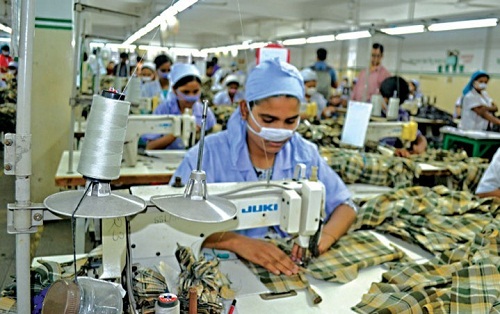 overall the sector suffered as most buyers kept away with low demand and store closures. What’s more the prices being offered were much lower and payments delayed or deferred, shipments of finished orders too were hampered. The sector saw major job losses as mills closed with low production.
That’s not all in a chain reaction, suppliers to the RMG sector faced a tough time as well. Textiles, dyeing, packaging, trims and accessories, apparel labels, and services such as washing, printing and embroidery faced loss of business. With many RMG units unable to make payments it put a lot of pressure on accessory and allied suppliers.
New year, new optimism
With all this uncertainty, Bangladesh RMG industry is now looking at 2021 with a lot of hope and optimism. They hope for a new beginning, and doing things in a better manner with the arrival of Covid-19 vaccine, they feel lives and businesses can look up again.
Moreover as per Textile Today “2021 is going to be a significant year for Bangladesh as it will celebrate its 50th year of independence and graduate from a least developed country (LDC). 2021 should be a year where promoting the country’s export competitiveness will be a top priority.”
The RMG industry is hoping 2021 will be more stable “if no major side effects of the vaccine and new COVID wave are exposed.” With changing consumer mindset, demand for sustainable and value-added products is expected to increase. As per BGMEA, over 33 companies are making PPE for exports. In future, PPE exports are expected to grow.
Experts also point out Bangladesh needs to now focus more on man made fiber products moving away from cotton as demand for these products are higher globally.
As global ethical fashion market surges ahead, men’s segment will see higher growth
 The growth curve of global ethical fashion market risen to touch $6,345.3 million in 2019, increasing at a compound annual growth rate (CAGR) of 8.7 per cent from 2015. Growing further, the market is expected to be worth $8,246.1 million in 2023 at a CAGR of 6.8 per cent, states a report ‘Ethical Fashion Market Global Opportunities and Strategies to 2030: COVID-19 Growth and Change’ by ResearchandMarkets.com.
Growing awareness boosts ethical fashion market
The market for ethical fashion has got a boost with growing awareness about sustainability. The study forecasts, the market is expected to be worth $8,246.1 million in 2023 and further grow to $9,808.5 million in 2025 at a CAGR of 9.1 per cent. And by 2030 it will be worth $15,173.7 billion at a CAGR of 9.1 per cent.
Ethical fashion includes sale of apparels by organizations, sole traders or partnerships primarily engaged in designing, production, retail, and purchasing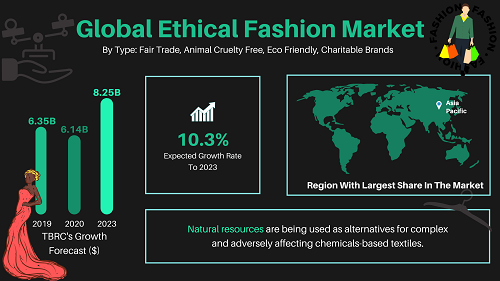 of ethical fashion apparels. It involves designing and making clothes while caring for people and communities involved in the process, and minimizing the impact on environment. It focuses on both the social and environmental impact of fashion, seeking to improve the working conditions and the environment. In fact, COVID-19 has given a huge flip to the ethical fashion market with growing consumer awareness.
The report highlights, rising awareness, social media, growth of e-commerce and government initiatives are expected to drive the market ahead. However, lack of standardization, reduction in free trade and impact of COVID-19 are major factors that could hinder the growth of the ethical fashion market in the future.
Organic to be the largest segment
The ethical fashion market is segmented based on products: organic, man-made/regenerated, recycled and natural. Among these, man-made/regenerated was the largest market segment based on product type, accounting for 54.5 per cent of total market in 2019. However, going forward, organic is expected to be the fastest growing with a CAGR of 16.2 per cent.
The market is also segmented based on fair trade, animal cruelty free, eco-friendly and charitable brands. In 2019, animal cruelty free was the largest segment by type, accounting for 43.9 per cent. But moving ahead eco-friendly is expected to be the fastest growing at a CAGR of 11.6 per cent. Ethical fashion is also segmented as: men, women and kids. In 2019, women’s segment was the largest accounting for 54.3 per cent of total in 2019. However, in future men’s segment is expected to be the fastest growing with CAGR of 10.2 per cent.
Asia Pacific the largest market
Asia Pacific was the largest region accounting for 32.7 per cent of total in 2019; followed by the Western Europe, North America and others. However, the reports suggests in future the fastest-growing regions in ethical fashion market will be Eastern Europe and South America, with at CAGR of 11.9 per cent and 11.4 per cent respectively. They will be followed by Asia Pacific and Africa, with CAGRs of 11.3 per cent and 11 per cent respectively.
However, the market is highly fragmented, with many small players. The big players are: Reformation, Everlane, Tentree, Alternative Apparel, (Hanes Brands), Eileen Fisher, and H&M Conscious among others.
Productwise top opportunities will be in the organic segment, where sales are expected to touch $686.3 million by 2023. Eco-friendly segment will grow and touch $840.1 million in annual sales by 2023. The top opportunities by end-user will be for men’s category, which will see sales reaching $954.1 million by 2023. And China market will be the biggest in terms of size at $367.1 million.