FW
Gap joins the 15 Percent Pledge
The 15 Percent Pledge and Gap Inc announced that Gap Inc. is the latest in a series of major companies to commit to using their financial power to create more equitable industries and profit structures. Gap Inc will be working in lock-step with the Pledge to develop its own unique strategy for reaching the company’s commitments, with additional updates to come over the next few months.
Gap Inc, the nation’s largest specialty apparel company and collection of purpose-driven lifestyle brands including Old Navy, Gap, Banana Republic, and Athleta, has joined the 15 Percent Pledge as an advocacy partner, aligning with the Pledge’s mission of creating a more equitable industry. Gap Inc. will increase their pipeline programs by 15 percent to drive access and opportunity for the Black community within the Gap Inc. family of brands starting with early empowerment programs, including internship, externship, apprenticeship, and training. Gap Inc. is proud to donate $200,000 to the organization to further support their mission. In February, Gap Inc. will share the company’s progress to create for all, with all.
The 15 Percent Pledge is a 501c3 non-profit advocacy organization urging major retailers to commit 15 per cent of their shelf-space to Black-owned businesses. It offers large corporations accountability, support and consulting services with the goal of advocating for and supporting Black-owned businesses.
Union Budget to ensure robust economic recovery: AEPC
A Sakthivel, Chairman, AEPC opines the Union Budget for 2021-22 will ensure robust economic recovery going forward. He believes the Budget will promote production and export of MMF based garments. The Rs 10,683 crore production linked incentive scheme for MMF garments and technical textiles, along with new Mega Investment Textile Parks scheme for setting up seven textile parks in India over three years will bring in huge investment in the MMF sector, he added.
Sakthivel further said, the mega textile parks with plug-and-play facilities by the government will create world class infrastructure in the textile sector, bring in investment, increase exports and provide employment. The reduction in custom duty on nylon will further promote the MMF garments while the doubling of budget provision to micro, small and medium enterprises (MSME) sector with the allocation of Rs 15,700 crore in the coming fiscal will strengthen the sector crucial for employment, manufacturing and exports.
Sakthivel also lauded the announcements related to the shipping sector wherein an allocation of Rs 1,624 crore has been made. He said the scheme to promote flagging of merchant ships in India will help in reducing our shipping costs,” he said. He welcomed the government’s decision to increase the capital expenditure to Rs 5.54 lakh crore in FY’22 from revised estimate of Rs 4.39 lakh crore in FY’21, saying it will prop up the economy by improving aggregate demand.
Myanmar military coup prompts US’ investors to move out
The ongoing military coup in Myanmar is prompting some US investors to pull out of the country. Prominent amongst them are luggage maker Samsonite and privately owned apparel maker LL Bean along with retailer H&M and Adidas. Myanmar’s army has usurped power and declared a year-long emergency. The move was condemned by many Western leaders while the US government threatened to impose renewed sanctions.
Lucas Myers, Analyst, Woodrow Wilson International Center for Scholars, said the coup would further strain trade relations between US and Myanmar while William Reinsch, Trade Expert, Center for Strategic and International Studies think tank, feels the move could lead to US. companies pulling out of Myanmar, given new developments and the Biden administration’s vow to focus more on human rights.
Stephen Lamar, President, American Apparel & Footwear Association, said many of the trade group’s members did business in Myanmar and found the coup deeply concerning. He urged for the full and immediate restoration of democratic rights in the country.
In the first 11 months of 2020, the total trade in goods between Myanmar and the United States amounted to nearly $1.3 billion, according to U.S. Census Bureau data. Of this, apparel and footwear accounted for 41.4 per cent of total US goods imports, followed by luggage, which accounted for nearly 30 per cent, said Panjiva, the supply chain
PVH Corp appoints Stefan Larsson new CEO
Parent company of brands like Tommy Hilfiger and Calvin Klein, PVH Corp has appointed Stefan Larsson as the company’s new chief executive officer and board member. Larsson succeeds Manny Chirico, PVH’s former CEO, who will continue to be the chairman of the board of directors.
Having joined PVH in June 2019 as president, Larsson helped the company’s regional teams and branded businesses, including Calvin Klein and Tommy Hilfiger, sail through the COVID-19 pandemic. He also helped the company recover from its COVID-19 losses. He previously served as the CEO of Ralph Lauren Corp from October of 2015 to May of 2017. Prior to that, he held roles as global president of Gap Inc. and in multiple global key leadership roles at H&M. In his current role, he aims to build the company’s core strengths and connecting them closer to its customers. In December, PVH reported a 18 per cent decline in its third quarter revenue. The company total revenues declined to 2.12 billion from $2.59 billion in the prior-year period. Its Direct-to-consumer revenue fell by 11 per cent.
CFDA, PVH release report on inequality in fashion industry
The Council of Fashion Designers of American (CFDA) and American fashion group PVH have released a report on inequality in the fashion industry. As per Business of Fashion, the report documents the initial results of efforts made by US-based companies to foster fairer and more equitable access and development for underrepresented groups.
The analysis recognizes the industry’s efforts in working towards meaningful equality. However, it does not clarify the long-term results of such actions. More than half of respondents believed though their organizations were making genuine efforts to improve diversity, equity and inclusion, people of color are still widely underrepresented, especially at the executive level, and perceptions of the industry and its progress were much worse among Black respondents.
The report is based on a survey of more than 1,000 fashion industry professionals across more than 41 companies, as well as focus groups with college students and emerging designers and one-on-one interviews with key stakeholders. The CFDA and PVH also included data from McKinsey & Company to draw its final conclusions and recommendations.
Manufacturers protest customs duty on finished leather imports
Leather manufacturers are against the imposition of 10 per cent customs duty on import of finished leather products as it will not only lead to price hike but also threaten the competitiveness of footwear and leather products exporters. Nirmala Sitharaman, Finance Minister has proposed to impose a basic customs duty of 10 per cent on wet blue chrome tanned leather, crust leather, finished leather of all kinds, including splits and sides from nil duty.
Harkirat Singh, Managing Director, Aero Club opines this could lead to an increase in costs. Ashish Jain, Director and CEO, Latric Industries says, the Budget does not offer any major benefits to footwear manufacturers. He believes increased leather prices would make things difficult for leather footwear exports and domestic prices.
Ishaan Sachdeva, Director, Alberto Torresi says, withdrawal of tax exemption will force leather exporters to derive incentives of their products and substitute normal leather with special leather which can be quite expensive.
Garmon Chemicals launches new range of enzymes for garment washing
The textile auxiliaries unit of Kemin Industries, Garmon Chemicals has launched launched Kemzymes, a new range of enzymes specifically for garment washing. The first Kemzymes products launched by the company include stonewashing enzymes: Kemzymes KS and Kemzymes K.
Of these, Kemzymes KS are the uncompromised, concentrated version of Garmon’s new neutral cellulase enzymes for denim stonewashing. Designed to work at room temperature and included in the ZDHC Gateway, Kemzymes KS open the possibility to truly eliminate the use of pumice stones. Kemzymes K, also included in the ZDHC Gateway, are strong powder enzymes for denim stonewashing. Delivering a perfect combination of abrasion power, sustainable characteristics and superior value for its price point, Kemzymes K are designed to become the best seller of denim stonewashing enzymes for all types of industrial laundries.
Relentlessly tested by dedicated teams using the most modern equipment available, Kemzymes are a blend of Kemin’s expertise in enzymes and Garmon's historical success in developing chemical solutions.
Asos acquires new brands for $364 million
British online fashion retailer Asos has acquired the Topshop, Topman, Miss Selfridge and HIIT brands for $364 million. As per reports, the acquisition makes Asos the number one fashion destination for young customers worldwide. Its brand equity is strongest in the UK and it has also established a strong presence in both the US and German. The newly acquired brands will join Venture Brands portfolio alongside others, including Collusion, AsYou and Reclaimed Vintage.
Asos will retain its established brand and customer positioning by applying industry leading design talent and online retail experience. Retailer will also invest in customer engagement and brand positioning in line with its existing mode. The British fashion company anticipates incremental sales in fiscal year 2022 to be broadly flat as it focuses on driving growth on Asos platform and through select strategic retail partnerships. The acquisition is expected to be margin accretive, with strong operating leverage given the relatively low incremental costs of operation once integrated onto the Asos platform. Asos expects the transaction to deliver double-digit return on capital (post tax) in the first full year.
India Budget 2021-22: Focus on MSME with seven mega textile parks across India

Focusing on health and well-being of citizens, physical and financial capital and infrastructure, inclusive development for aspirational India, innovation and R&D, minimum government, maximum governance are some of the highlights of the Union Budget for the financial year 2021-22.
Finance Minister, Nirmala Sitharaman allocated Rs 15,700 crore for the Ministry of Micro, Small and Medium Enterprises (MSME) sector. She also proposed to reduce the money requirement under the Stand Up India scheme for the Scheduled Castes and Scheduled Tribes from 25 per cent to 15 per cent besides approving loans for activities in allied activities in agriculture.
Scheme for new textile parks
In view of global pandemic, the Budget also introduced a new scheme for setting up mega textile parks in the country. These parks will help the government position India as a fully integrated, globally competitive manufacturing and exporting hub for the sector.
Under this scheme, the government has sanctioned 59 integrated textile parks, of which 22 have been completed. The textile ministry also plans to set up a Mega Integrated Textile Region and Apparel (MITRA) Park, spread over 1,000 acres with state-of-the-art infrastructure, common utilities and Research and Development (R&D) lab. The government has also approved production-linked incentive (PLI) scheme for 10 key sectors including textile and automobiles which would help India become self-reliant, boost manufacturing and enhance exports. The scheme takes the total government outlay for such incentives to nearly Rs 2 lakh crore over a five-year period.
Industry needs a new law to end labor exploitations, say experts
 Dominique Muller from the Labor Behind the Label believes, the fashion industry is the root cause of exploitation of low-paid and undervalued workforce in development. He and other industry experts say, COVID-19 has highlighted the exploitative nature of global garment supply chains. In an Open Democracy report, experts advise fashion brands to end exploitation in supply chains and offer fair salaries and working conditions.
Pandemic exposes workers’ realities
Labor exploitation in garment supply chains began with the rise of globalization in the 1970s. Previously, the direct employees of fashion brands, garment workers became distant actors in complex global supply chains. Fashion brands were no longer held responsible for paying fair wages or offering employment benefits to their workers. COVID-19 has exposed this dark reality of brands, retailers and manufacturers, says Kalpona Akter, Executive Director, Bangladesh Center for Workers Solidarity. According to her, for years, brands and manufacturers have been exploiting workers by refusing to pay their salaries
A recent study by the Worker Rights Consortium further reports a 21 per cent decline in workers’ incomes between March and August 2020 – with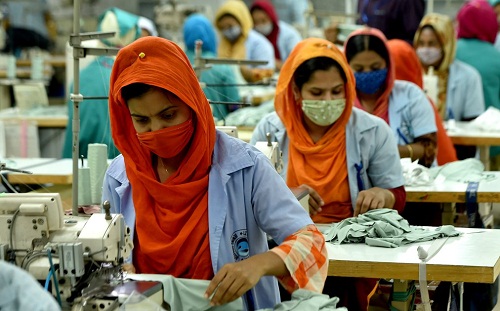 monthly wages falling from $187 to $147. They are made to work overtime without being paid even their minimum wages, adds Akter. Even when workers are paid full wages, 30 per cent goes on housing. A 20 per cent wage cut forces them and their children to starve as they still have to pay for accommodation and other compulsory charges, states Akter.
Workers in Sri Lanka also face a similar situation. Abiramy Sivalogananthan, Asia Floor Wage Alliance, explains, many workers in Sri Lanka’s vast free trade zones are migrant workers who support not just themselves but their families in rural villages. Workers also lost their December bonus due to the pandemic. This bonus helps them pay off their debts.
Sharp decline in retailers’ profits
The pandemic has affected not just workers but also many fashion retailers across the globe. For instance, retailers in North America and Europe– including Philip Green’s Arcadia collapsed. In the US over 25,000 physical shops were closed and McKinsey expects fashion companies to post a 90 per cent decline in profits in 2020. According to a McKinsey report based on2018 data, the top 20 fashion corporations based on total annual profits including Nike, H&M, Zara’s parent company Inditex, Lululemon, and adidas and luxury companies like Burberry, Kering, and Hermes which are ‘Super Winners’, have managed to weather the COVID-19 storm with 22 per cent higher indexed stock valuations. By October 2020, the share price of these corporations was 11 per cent higher than pre-crisis levels. It attributes their success to robust digital presence and quick diversification to the Asia Pacific region which has been less affected by the pandemic than the US and Europe.
Need for a human-centered approach
Henceforth, the fashion industry needs to adopt a sustainable and human-centered approach to rebuild its past glory, say experts at the International Labor Organization. It needs to ensure fair salaries and conditions for garment manufacturers in the Global South. It needs to work towards building a more resilient, inclusive, sustainable and garment industry, adds Tara Rangarajan, Head, Brand Engagemen, Better Work Program, ILO.
As COVID-19 disrupts work and health, workers are being forced to work when feeling unwell. They just take Panadol or a vitamin C tablet to pass through the temperature checks on fear losing jobs if they don’t show up for work. The profit model has not only made lower strung of supply chain more vulnerable to economic pain, it has also pushed the social and personal costs of the virus onto the same people. Muller believes the industry needs to adopt a new way of thinking that does not exempt the brands from responsibility for their workers. He further opines governments across the globe need to introduce a new law to curtail worker exploitation and hold companies responsible for labor abuses.