FW
Cotton Association of India retains cotton estimate
The Cotton Association of India (CAI) has retained its cotton production estimate at 315 lakh bales. In the last cotton season, total output stood at 365 lakh bales. The cotton season runs from October to September.
The total cotton supply from October 2018 to May 2019 was 325 lakh bales. Total supply includes arrivals of 287.72 lakh bales up to May 31, 2019, imports of 9.28 lakh bales and the opening stocks of 28 lakh bales at the beginning of the season. Cotton consumption during October 2018 to May 2019 stood at 209 lakh bales. Export shipments till May 31 are estimated at 44 lakh bales. Stocks at the end of May 2019 are estimated at 72 lakh bales, including 32.68 lakh bales with textile mills and the remaining 39.32 lakh bales with the Cotton Corporation of India and traders and ginners.
Total cotton supply till the end of September 2019, is estimated at 374 lakh bales, which includes the opening stock of 28 lakh bales at the beginning of the season. Imports are estimated at 31 lakh bales, this figure is higher compared to the previous year’s import estimate of 15 lakh bales. The carryover stock at the end of the season is estimated at 13 lakh bales.
Bangladesh knit imports up 27 per cent
Bangladesh’s imports of knitted fabrics are up 27.69 per cent. Western retailers demand the use of fabric from a particular country or vendor to manufacture apparel in Bangladesh. For instance, some western retailers recently suggested using knitted fabrics from India as the apparel products would be sold in the neighboring country, where foreign brands have set up shop. This trend has led to stockpiling of yarn and knitted fabrics.
Local spinners are in big trouble due to rising imports of knit fabrics, jeopardising investments in the primary textile sector over the years to get the industry up to speed. They are losing competitiveness due to buyers’ nomination of fabrics. Stockpiling of unsold yarn and knit fabrics has been growing every month due to such decision by buyers.
Meanwhile, brands operating in India have been encouraged to focus on sourcing from within and increase engagement levels with apparel clusters in the country. The appeal comes in the wake of a 53 per cent jump in import of garment products from Bangladesh. The expenditure on imports would have created an additional 6,000 jobs in the spinning sector, 500 jobs in the processing sector, 1,00,000 jobs in the garmenting sector and another 40,000 jobs in the printing and embroidery sector of the textile value chain.
Truetzschler offers new spinning, nonwoven and man-made fibers solutions
"Truetzschler Group will present intelligent machine technologies, digital solutions and installations for sustainable nonwovens at ITMA Barcelona 2019. The group will launch a carding technology- the new intelligent card TC 19i which automatically and continuously optimises the carding gap setting of 3/1000 inch."
 Truetzschler Group will present intelligent machine technologies, digital solutions and installations for sustainable nonwovens at ITMA Barcelona 2019. The group will launch a carding technology- the new intelligent card TC 19i which automatically and continuously optimises the carding gap setting of 3/1000 inch.
In addition, the new cloud-based digital monitoring and management systems offered by the company provide yarn manufacturers with transparency over all processes in the spinning mill. The My Wires app, for example, provides information on the status of clothings and service intervals and helps with the planning of reorders. Competent service for re-clothing can be provided immediately by Truetzschler Card Clothing (TCC).
Truetzschler is also breaking new ground with drawframes, the quality filters in the spinning mill. The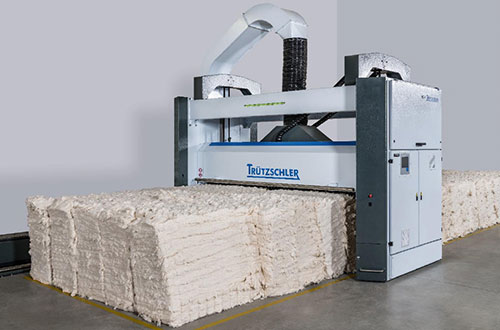 autoleveller draw frame TD 10 automatically adjusts the perfect break draft for optimum sliver quality and realises significant cost savings due to its compact design and energy-efficient suction system. Like the TC 19i and the BO-P, the TD 10 provides the operator-friendly T-LED remote display which visualizes important machine and production information in a simple way.
Truetzschler Nonwovens division has developed an alternative technology in cooperation with Voith. In this wet-on- wet process, a web is formed from cellulose-based short fibers suspended in water and then bonded by means of hydroentanglement. The sustainable, high-quality wipes and cleaning cloths that result from this process can be completely degraded by microorganisms in the environment after usage by the consumer.
The Man-Made Fibers division offers the new four-end BCF machine MO40 based on the proven M40 concept. The symmetrical design in combination with the lamellaless HPc texturing results in maximum yarn and bobbin qualities. As each spinning position produces four BCF ends simultaneously, the machine achieves high productivity at moderate speeds, which ensures a stable process.
Truetzschler Group will also present the comprehensive services and high-performance clothings for cards and roller cards from TCC on 1400 sq m. The group completes its portfolio of special flat clothings with the MT 52, which demonstrates outstanding stability, particularly at high card productions in ring and rotor spinning. In addition, TCC has developed the new PRECISETOP flat clothing, which is essential for the intelligent self- optimization of the carding gap in the TC 19i. Thanks to the close cooperation between machine developers and clothing specialists at Truetzschler, customers benefit from tailor-made and compatible solutions along the entire value chain.
Archroma to launch five innovations and 24 system solutions at ITMA Barcelona 2019
Archroma will launch five innovations and 24 system solutions at ITMA Barcelona 2019. These solutions will help textile manufacturers to optimise productivity and create value in their markets. The company will hold “Innovation & Solutions Sessions” at its booth to launch these.
The systems and innovations presented by Archroma have all been selected for their compliance with ‘The Archroma Way: safe, efficient, enhanced, it’s our nature.’ The approach finds its origin in the company’s belief that it is possible to make the textile industry sustainable.
Archroma offers a wide portfolio of dyes and chemicals to increase sustainability and innovation along the entire value chain, from fiber to finish. The company is known for its continuous flow of ground-breaking innovations, such as the EarthColors®, a range of dyes made from non-edible natural waste from the agricultural and herbal industry, Inkpresso®, a digital printing system that enables ink mixing on site and on demand, Smartrepel® Hydro, a nature-friendlier protection that keeps cotton, polyester and polyamide textiles dry, the Color Atlas, a revolutionary color system comprising of a physical and online library of 4,320 new colors developed on cotton poplin.
More recently, Archroma introduced the purest indigo, Denisol® Pure Indigo, an aniline-free* synthetic pre-reduced liquid indigo launched in 2018, Appretan® NTR, a new nature-based binder for nonwovens, and Fadex® AS New, a new “super UV protector” for automotive & transportation textiles, both introduced in May 2019.
NCTO CEO Kim Glas to revive the American textile industry
"Kim Glas, new the president and CEO of the National Council of Textile Organisations since April 2019, has set a definite goal to revive the flagging American textile industry. She notes the American industry in the last few years has seen a remarkable uptick in employment with the industry currently employing 600,000 workers across the supply chain. In 2018, around 594,147 people were employed in the textile chain and the country’s textile and apparel shipments during the year added up to $76.8 billion. "
 Kim Glas, new the president and CEO of the National Council of Textile Organisations since April 2019, has set a definite goal to revive the flagging American textile industry. She notes the American industry in the last few years has seen a remarkable uptick in employment with the industry currently employing 600,000 workers across the supply chain. In 2018, around 594,147 people were employed in the textile chain and the country’s textile and apparel shipments during the year added up to $76.8 billion. The key market for yarns and fabrics, the Western Hemisphere, is seeing strong growth trends with the FDI in the market increasing.
The industry is also witnessing an increasing emphasis on innovation with $22.8 billion being invested in new plants and equipment from 2006-2017. The US manufacturers recently opened new facilities across the entire textile production chain to convert waste materials into new yarns and resins.
Focus on sustainability and reshoring
Glas’ top focus is to inform the Congress, the administration and key decision makers about key priorities in terms of legislation or trade policy. Glas also aims to focus on developing the Western Hemisphere, a core trade region that imports around 70 per cent of the yarns and fabrics that the country produces.
In addition, Glas, aims to focus on sustainability by manufacturing more tenable products and revamping the entire production process. NCTO also plans to build a strong communications strategy both for the industry and key decisions makers in the government and beyond.
As the industry prioritises on reshoring manufacturing process for fiber, yarn and fabrics, a lot of apparel suppliers in Los Angeles and New York are planning to expand their operations to other regions. However, it is important for the industry to know the FDI flow in the country and number of jobs that are being created. For this, the country has proposed the U.S.-Mexico-Canada Agreement, which continues the free-trade status with Mexico and Canada and improves certain areas that benefit US producers.
Plans to regulate tariffs
As the tariffs being applied on US manufacturers sourcing of certain materials from China are resulting in additional penalty and tighter profit margins, Glas looks to impose tariffs on finished items imported from China
NCTO has also demanded fair and expeditious exclusions process as it doesn’t believe that under the current framework the tariff process is absolutely correct. As per Klas, the process abuses intellectual property rights and it needs to properly balance the application of these tariffs on finished goods.
As per Commerce Department’s Office of Textiles & Apparel figures, apparel sourcing has already diversified across Asia, the Western Hemisphere, etc. Brands and retailers are shifting over the uncertainty surround next round of tariffs and how it will hit them. Brands expect this to attract more interest either in the Western Hemisphere or with those that have trade benefits with the US.
Euratex and AAFA oppose ongoing tariff war
The European Apparel and Textile Confederation (Euratex) and the American Apparel & Footwear Association (AAFA) have opposed the tariff war between the EU and the US. They say imposing additional tariffs on travel goods, textiles and clothing products will adversely affect companies and consumers on both sides of the Atlantic, add costs to supply chains and will be at the expense of manufacturing jobs and investments in innovation.
The US preliminary list of targeted products includes yarns (high tenacity aramids and polyester), home textiles (carpets, bed linen, blankets), some clothing items (dresses, sweater, suit, swimwear), and a travel goods item (handbags). The EU list includes raw cotton and cotton waste, as well as travel goods including those of textile materials.
The European Apparel and Textile Confederation’s main objective is to create an environment within the European Union which is conducive to the manufacture of textile and clothing products. Textile and apparel manufacturing is an essential pillar of the EU regions. Representing more than 1000 world famous name brands, the American Apparel & Footwear Association is the trusted public policy and political voice of the apparel and footwear industry, its management and shareholders, its four million US workers, and its contribution of 400 billion dollars in annual US retail sales.
Tariff hike to impact retail prices
The tariff hikes may force US retailers to raise prices. Some have reached out to suppliers to look for ways to reduce costs. However, it is not clear how the tariffs will affect prices on imports from China, such as luggage, furniture, bicycles and vacuums.
Walmart indicated a possible price hike for the products it sells in order to offset the impact of the additional tariffs the US has imposed on Chinese goods. Warehouse club operator Costco is looking to accelerate shipments before certain tariffs go into effect.
US retailers depend heavily on China in their supply chains, as China accounts for about 41 per cent of all apparel, 72 per cent of footwear, and 84 per cent of travel goods imported into the United States. Duties on US imports of these consumer products from China already represent more than 22 per cent of all tariffs the United States collects from all countries on all products. These duties fall on US workers, US consumers, and US companies -- not China. Over 12,000 US apparel and textiles stores, which have about $40 billion of annual revenue, would be at risk because of possible new tariffs. The US retail industry has already lost more than 3,000 stores, or more than five per cent in the first quarter of 2019.
Pitti Uomo to showcase menswear evolution
Pitti Uomo, to be held in Italy from June 11 to 14, 2019, will showcase 30 years of men’s wear from 1989 to the present. The exhibition will display clothes of designers who breathed life into special events at Pitti Uomo between 1989 and 2019 along with a selection of garments coming from 110 brands exhibiting at the show, with their special presentations, have also characterised this period of time. The show will recount the history and evolution of men’s wear and the fashion talents from the international contemporary scene together with the experiences of leading men’s wear entrepreneurs. Each room will feature pages of an oversized book that presents its contents. Page after page, the exhibition will trace in a pop-up format the different currents present in men’s fashion thanks to the presentations of numerous Pitti Uomo special guests.
Published and distributed worldwide by Marsilio Editore and designed by Studio Lenthal, the book will feature pieces by Angelo Flaccavento, Antonio Mancinelli, Frédéric Martin-Bernard, Suzy Menkes, Serena Tibaldi and Olivier Saillard with commentary by Giorgia Cantarini and photography by Astra Marina Cabras.
Many men and also women who have transformed men’s clothing into creative works have passed through Italy.
Tariffs spark global recession fears
Factory activity has contracted across Asia and Europe due to the escalating trade war between the US and China. A world recession is feared. The trade war has damped automotive demand. Higher trade tariffs may take their toll on global commerce and further dent business and consumer sentiment, leading to job losses and delays in investment decisions. The outlook remains grim as output growth slips, factory prices stall and businesses get pessimistic on production. The trade war has not only become a technology war but also a broad-based business war.
Central banks in Australia and India are expected to cut rates this week, with others around the world seen following suit in the coming weeks and months. While US manufacturing is expected to grow steadily, the global malaise is expected to eventually feed back into the US economy. In Britain, the Brexit stockpiling boom of early 2019 gave way last month to the steepest downturn in British manufacturing in almost three years as new orders dried up, boding ill for economic growth in the second quarter. The euro zone economy is under pressure.
America’s new tariff threats against Mexico have also contributed to global recession fears, with stock markets tumbling around the world.
Indian apparel exports keep falling
Three years after key regulatory and labor changes were put in place, India’s textile and apparel exports have declined from 2014 to 2018 while imports have increased. Particularly hit has been the apparel sector, where the time taken by the industry to adjust to the Goods and Services Tax regime, downward revision of export incentives, and a credit squeeze faced by small and medium scale enterprises have pushed production downwards. India’s apparel exports fell by 1.2 per cent in fiscal year ’19 from fiscal ’18, which in turn was four per cent lower than the previous year. Even the share of apparel exports in the country’s total textile exports fell from 51 per cent in fiscal ’17 to 45 per cent in fiscal ’19. The fall is attributed to the ever tightening pressure on export markets by higher shipments from low-cost competitors like Bangladesh and Vietnam.
The recent slowdown in global demand has also increased competition in the markets which has coincided with taxation changes in India. Barring a few months, apparel exports have been continuously declining since October 2017, mainly due to stiff competition, slowdown and discontinuation of certain export incentives. There was a six per cent to seven per cent impact on costs, which hurt profitability of garment makers.