FW
FTA will give Vietnam tariff benefits
Vietnam will get tariff benefits from the free trade agreement with the European Union. Garments, worth around 10 per cent of Vietnam's exports and currently subject to EU tariffs of around nine per cent, will be by far the biggest beneficiary of the FTA. The tariff-slashing free trade agreement promises to bring an influx of orders and pave the way for Vietnamese garments to dominate the European market. All tariffs imposed on garment-textile products will gradually go down to zero per cent, with 77 per cent of the goods seeing their tariff immediately eliminated right after the pact comes into force.
The EU is the top apparel importer in the world and the second biggest import market of Vietnam’s garment-textile products.
However, staff shortages have already started to manifest in Vietnam's garment industry, where the vast majority of manufacturers are focused on labor-intensive sewing and cutting processes. Factories’ demand for workers has increased by seven per cent since 2018. The industry lacks human resources especially high-level employees who have specialised skills. Finding people to operate dyeing or weaving machines is one thing. These are workers and can be trained. But finding experienced chemical engineers with a thorough knowledge of chemistry and dyeing is another.
Women opting for relaxed denim styles
A study by fashion website Lyst has indicated that women are opting for loosing fitting and relaxed denims over skinny denims. Mom jeans are becoming popular with 200,000 fashionistas opting for these type of jeans in a month. Demand for wide-legged jeans has also increased by 68 per cent while that for pastel coloured jeans has also increased by 103 per cent.
According to Lyst white jeans are also on many womens' wishlist, with searches up 42 per cent since the beginning of March. In the last week of May, white jeans sales came close to surpassing sales of blue jeans for the first time. However, 7 out of 10 shoppers search for blue jeans, making this style of denim the most sought after in the world.
The low rise cut that was beloved of Britney Spears and Girls Aloud in the noughties is also making a comeback with an increase in searches for ‘low cut’ and ‘hipster’ jeans in the last 6 months.
Eurozone fashion sales up two per cent
Fashion sales in the Eurozone in June 2019 rose 2.9 per cent compared to the same month last year. This is an improvement since it dropped 4.3 per cent in April and 2.4 per cent in May. In general, last year was a dark one for retail sales in the sector in the Eurozone. The only months that showed a rise were April, August and October. The rest of the year marked negative with drops higher than two per cent between May and July.
In the European Union (28 countries), textile commerce, garments and footwear grew 3.3 per cent. Despite starting the year with a drop of 0.6 per cent in January, revenues of retail made a comeback in February and March with rises of 3.6 per cent and 3.4 per cent respectively. However in April and May the numbers dropped 1.7 per cent and 1.9 per cent.
In general, retail in Europe has shown positive results. Both in the Eurozone and in the European Union, total sales rose 2.6 per cent and 2.8 per cent respectively compared to last year. By countries, Croatia and Rumania were the territories with the best performance, with jumps of 7.4 per cent and 5.7 per cent.
Gen Z dictates denim trends
Denim brands in the US are figuring out how to appeal to Gen Z. These are consumers born since 1996. They will account for 40 per cent of all US consumers by 2020. Shapeless T-shirts, sweatshirts, dresses and other low-key staples like denim appeal to Gen Z because they’re effortless and without pretense, which is exactly what they aspire to be, says Zion Market Research.
Most of these consumers prefer their denim jeans be made of 100 per cent cotton or cotton blends. Vintage vibes delivered in lighter weights is just what the younger set prefers. After years of wearing athleisure’s joggers and yoga pants, 94 per cent of Gen Z consumers say lightweight jeans are more comfortable than heavier weight options. Lightweight denim is defined as under 12 ounces per square yard, midweight ranges from 12 to 16 ounces and heavyweight denim comes in above 16 ounces. Even though these young consumers spend the least on their denim, Gen Z shoppers say price isn’t the most important factor when they buy new jeans. Rather, they put a higher value on fit, comfort and quality.
Globally, the denim jeans market was valued at $44.02 billion in 2018 and is expected to grow to $85.4 billion by 2025.
Chromuch collaborates with Promostyle for 2021 Color Guide
Chromuch, a manufacturer of sustainable and color-rich synthetic fibers, has collaborated with trend agency and color specialist Promostyle for curating 50 colors for 2021 Color Guide.
The 2021 Color Guide includes 50 signature hues in five color collections for applications in apparel and equipment, including activewear, athleisure, tents and sleeping bags. The collections range from sophisticated and urban “Push & Go” tones to calm, but intense colors in “Drift Away.”
Chromuch noted that its solution-dyed synthetic fibers are fade-resistant, made from post-consumer recycled plastic bottles and use no water in the dyeing process.
Chromuch is also introducing Chromuch Now, a developer-friendly program of competitively priced, trend-right colors that are in stock for better lead times and low minimum order quantities. The program allows developers to select Promostyle-curated colors while eliminating the need to color-match.
Promostyle is an international design and trend-forecasting agency that deciphers the latest and most relevant lifestyle and design currents that reflect the trends across design, fashion, consumer behavior and marketing to give clients a strategic edge in the marketplace.
New York sees shows galore in July
From July 16 to 25, 2019, New York City was home base for an array of different textile shows.
Première Vision showcased fall/winter 2020–21 trends and the focus was on natural fibers to create ecologically sound textiles with a softer hand. At Functional Fabric Fair, there was an increase in exhibitors. Attendees and exhibitors were focused not only on sustainable fabric sourcing such as recycled fibers but also eco-friendly finishes for apparel. This edition went beyond the sustainability conversation of the past and was a curated show with a lot of content. A lot of the work and presentation went into explaining technology with sustainability.
At Texfusion, buyers looked for sustainable products and asked for certification from exhibitors. Demand was strong for raw materials such as certified-organic cotton, recycled materials, biodegradable products and intensive fibers such as linen, hemp and bamboo in addition to green production practices. Though the core of the show remained the trade, the central topic was sustainability within the fashion industry.
DG Expo accommodated buyers who were searching for fabrics, trims and accessories without the requirement of high minimums. Focused on North American and European collections, the show saw attendees from companies, big and small, and several fabric retailers.
Nigeria joins ICAC as its 29th Member
Nigeria has joined the International Cotton Advisory Committee (ICAC) as its 29th Member and 11th Member in Africa. This would help the country to enhance its cotton industry. Nigeria has been reinvigorating its cotton and textile industries for years as finished goods generate more revenue than exporting raw fibre, leading to higher incomes and new job creation.
The country is a key producer in West Africa and its membership underlines not only the importance of cotton to its economy but also the importance of the ICAC and its role in fostering a healthy and sustainable cotton economy for its Members. The ICAC is working hard to increase yields in Member states and for Africa in particular; there should be no reason why yields in most if not all cotton producing countries cannot be doubled’.
ICAC is currently working on two major initiatives that would hold great promise in Nigeria. These include an interactive, voice-based Soil and Plant Health app that allows farmers to diagnose and treat pests and diseases right in their fields, even if they are illiterate, and a Virtual Reality training program that will allow scientists and researchers to ‘visit’ a cotton field and view best practices, seeing the plant in various stages of development in a short period of time, all without leaving the classroom.
US textile industry supports tariffs
The US textile industry supports the 10 per cent tariff on the remaining $300 billion of imports from China. This move will lead to more re-shoring of production to the United States and the Western hemisphere production platform—and will also address and mitigate China’s rampant trade distortions.
Supporters of the tariff represent the full spectrum of the US textile industry from fiber through finished sewn products. This includes domestic textile manufacturers, including artificial and synthetic filament and fiber producers. The industry has long supported efforts to crack down on China’s abuse of intellectual property rights and also wants finished apparel and home furnishings to be included in any retaliatory tariffs against China. Finished apparel, home furnishings and other made-up textile goods equate to 93.5 per cent of US imports from China while fiber, yarn and fabric imports from China only represent 6.5 per cent. The industry has long wanted to include finished products on the tariff list.
Chinese imports of finished goods into the US market are seen as unfair trade practices and having a significant impact and disruption on domestic textile and apparel production, investment and jobs. China is seen as a rampant intellectual property abuser.
AAFA decries US President tax move on Chinese imports
The American Apparel and Footwear Association expressed its deep frustration following the announcement by President Donald J. Trump’s decision to impose a punitive 10 per cent tariff on a list of $300 billion worth of U.S. imports from China beginning September 1, 2019.
This decision will increase the tariff bill on all clothes, shoes, and home textiles, like blankets and sheets – products that already account for the vast majority of the duties collected by the US government. The list of products, which was under a public comment period in June, includes all imports of apparel and footwear products. In 2018, 42 per cent of apparels and 69 per cent of footwear sold in the US was imported from China.
The punitive tariff would be added on top of the tariffs already imposed on these products – in 2017, 5 per cent of the duties collected by the US government came from the apparel, footwear, textiles, and travel goods industry, despite accounting for only 6 per cent of all imports. Most textiles, all travel goods, and many accessories are currently being hit with a 25 per cent additional tariff as part of previous steps taken by the administration in the trade conflict with China.
‘No gain from the US-China trade war’, says VITAS Chairman
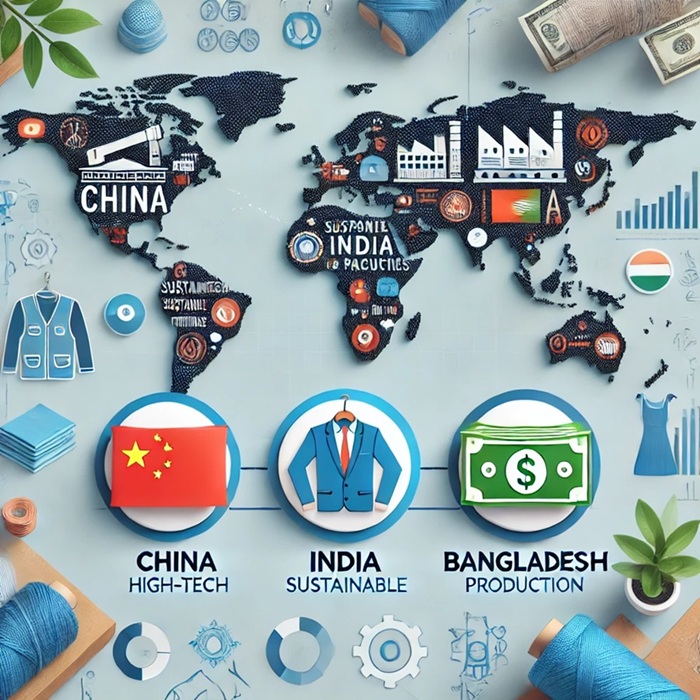
Vu Duc Giang, Chairman, Vietnam Textile and Apparel Association (VITAS) says that contrary to what people expected, the shifting of orders from China, amidst US-China trade war, hasn’t helped Vietnam much. He added though many experts feel Vietnam has the opportunity to get big orders shifting from China, it’s not actually true. Vietnam manufactures products only for the medium and high-end markets. Therefore buyers are likely to shift their orders to other countries like Bangladesh and Myanmar as the average minimum wage in these countries is US $ 150, whereas it is US $ 350 in Vietnam.
He also said that Vietnam’s yarn exports to China too have declined by 80 per cent in the first 6 months of 2019. He was, however, optimistic that the garment and textile sector, despite all challenges, will do well in 2019.