


FW
USDA to grant $50 million to apparel makers under CAWA
As a part of its new Cotton and Wool Apparel (CAWA) Program, the US Department of Agriculture (USDA) will grant $50 million in funds to assist eligible apparel manufacturers of worsted wool suits, sport coats, pants, or pima cotton dress shirts; pima cotton spinners; and wool fabric manufacturers and wool spinners.
A part of USDA’s Pandemic Assistance for Producers initiative and the Department’s efforts to help US’ food, agriculture and forestry sectors get back on track, the CAWA program supports eligible entities whohave experienced a decrease of at least 15 per cent in 2020 gross sales or consumption of eligible products. Payments to eligible entities will be based on their pre-pandemic market share
The relief will support American workers and the domestic pima cotton growers and wool producers who rely on this industry. USDA’s FSA national office is administering the direct payments which will be funded by the Commodity Credit Corporation.
Eligible entities must have filed an affidavit for a payment in any year from 2017 to 2021 for the Pima Agriculture Cotton Trust Fund or Agriculture Wool Apparel Manufacturers Trust Fund through USDA’s Foreign Agriculture Service (FAS).
Seven mega industrial estates to be set up in Ludhiana Textile Park
The Central Government plans to develop seven mega industrial estates in the Ludhiana Textile Park at the cost of Rs 4,445 crore
The ambitious industrial project, which has been approved under the PM Mitra scheme, will be set up over 1,000 acre at KoomKalan village in the industrial capital of the state as a joint venture between the Centre and Punjab.
The project will be established over a period of five years up to 2027-28 at the cost of Rs 4,445 crore, which has been approved under the scheme.
A special purpose vehicle (SPV) with 51 per cent equity from the Punjab Government and 49 per cent from the Central Government will be set up by the state government for implementing the PM Mitra scheme project. The state government will transfer the land at notional price to the SPV.
Under the Competitive Incentive Support (CIS), an outlay of Rs 300 crore has been earmarked for Textile Park, which will be incurred towards giving incentive at the rate of 3 per cent of sales turnover of manufacturing facilities in the park on first-come first-serve basis.
Putting an incentive capping, the government will offer Rs 10-30 crore for investment over Rs 300 crore, Rs 5-15 crore for investment between Rs 100-300 crore, and Rs 1-3 crore for investment of less than Rs 100 crore with an employment generation of over 100 employees.
The Ministry of Textiles will develop model RFQ, RFP and concession agreement for selection of master developer in parallel with preliminary selection of sites with the assistance of PMA.
Bangladesh RMG sector on a roll with new projects and factories lined up
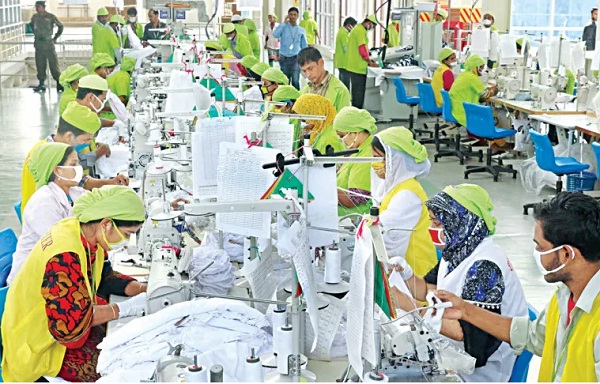
Insufficient power and energy supplies have failed to discourage Bangladesh entrepreneurs from investing in the country’s RMG sector, witnessing excellent flow of work orders. Big domestic entrepreneurs like the Team Group, Urmi Group, RDM and Sheltech are expanding their garment manufacturing capacities to corner a bigger market share. They entrepreneurs are setting up new facilities in rented buildings with a minimum investment of Tk5 crore.
So far, 160 big and small companies have invested approximately Tk4,000 crore to set up knit, woven and denim factories in Bangladesh, says a Business Standard report. Their total investments in the sector is between Tk18,000-Tk20,000 crore.
Aim to grow garment exports to $1 billion by 2026
Around Tk720 crore has been invested by the Team Group to develop an industrial village housing a denim factory with 32 production lines, a washing plant, a sweater factory, and a blouse manufacturing unit.
The project will allow exporters to influence the growing global apparel market in which Bangladesh has a major stake, opines Abdulla Hil Rakib, Managing Director, Team Group. The new units will commence production by 2023, he informs. Besides adding $90 million to the group’s annual export turnover, the facilities will also create jobs for 5,000 people, hopes Rakib. They will boost Bangladesh’s annual apparel exports to $1billion by 2026, as the country graduates from being LDC to a developing country.
High-value products with latest technologies
Real estate pioneer, Sheltech Group plans to set up a denim garment and a knit composite factory in Bangladesh by 2023, says Engr Ktubuddin Ahmed, Chairman, Envoy Textiles. These eco-friendly factories will produce high-end apparels. Both factories will be developed as a joint venture with well known international garment maker and manufacture of high-value apparels. They will produce high-value garments with latest technologies for high-end buyers, Ahmed says.
Urmi Group has also expanded with a new garment factory in Tejgaon. The unit set up with an investment of Tk120 crore has 40 production lines. It has generated about 3,000 jobs, claims Asif Asraf, Managing Director. At present it employs around 1,400 with more hiring in the offing. The unit’s turnover is also set to reach $200 million by the end of this year.
Chattogram-based RDM Group plans to establish a 12-line capacity garment factory by the end of this year. The group also own seven production units.
BGMEA, BKMEA add new members
Planning to set up new units, around 14 new groups obtained provisional memberships of the BGMEA this year, confirms Rakibul Alam Chowdhury, Vice President, BGMEA. Around 110 new factories obtained BGMEA memberships for setting up new factories in Bangladesh, adds Sahidullah Azim, Vice-President. Around 50 factories have approached BKMEA for permissions to import garment machinery, says Fazlee Shamim Ehsan, Vice-President. Most of these factories are expanding their production capacities, he adds
A few entrepreneurs are setting up factories despite the ongoing energy crisis. They plan to negotiate increased prices with buyers. These new factories will help entrepreneurs bag new work orders in the next two-three years, informs Shamim.
High inputs costs, weak demand may slacken future textile growth: ITMF survey
In March 2022, the situation of textile business across all regions and segments remained positive with +14 percentage points reveals the 13th ITMF Corona Survey conducted amongst over 220 companies across the world. As per the survey of all segments in the textile value chain, around 43 per cent companies considered their situation satisfactory during the month, indicating strong demand for their products. However, positivity in textile business remained below the +26 percentage points seen in November 2021 and +18 percentage points observed in January 2022.
Rebalancing supply chain key for future growth
Over the next six months, the global textile value chain remains quite optimistic about its growth prospects. However, this optimism rests on a much weaker foundation because since September 2021, the gap between more favorable and less favorable business expectations has narrowed from +32pp to +7pp. This clearly indicates the textile value chain has already achieved peak growth levels in Q4 of FY 2021.
Now, whether economic growth will slacken in future or spread across categories will largely depend on rebalancing disrupted global supply chains and outcome of the Russia-Ukraine war. As per ITMF survey, the outlook for textile business remains positive across all regions except East Asia and Africa where more companies expect the business situation to remain negative than those expecting positivity. On the other hand, companies expect the business situation in North, South America and Africa to remain largely positive
Upstream segment shows positive growth
Among segments, the business situation for downstream segments like weaver, knitters, finishers, printers, and garment and home textile producers remain negative at the same time upstream segments like fiber producers, spinners, and textile machinery producers, remain positive; especially in terms of passing on the higher costs to consumers.
The business situation for order consumption remains largely negative with order intake falling from +38pp in November 2021 to +12 percentage points in March 2022. Expectations for new orders also deteriorated from +34 percentage points in January to +22percentage points in March 2022.
Order backlog to stabilize at 2.9 months
The order backlog for textile manufacturers has risen from 2.3 to 3.1 months since 2021. This is expected to remain constant at 2.9 months. Manufacturers are utilizing 80 per cent of current capacities and will continue to do so despite persistent supply chain bottlenecks, the survey states.
The survey also indicates, higher cost of raw materials, energy and transportation are main cause of concerns for textile companies across the world. They are also likely to be troubled by weaker demand and their ability to pass on only 40 per cent of additional costs to consumers.
Guess enters into €250 million revolving credit facility
Guess, Inc. has entered into a €250 million revolving credit facility through its wholly-owned Swiss subsidiary, Guess Europe Sagl. The facility has an initial term of five years, with an option to extend the maturity date by up to two years and an option to expand the facility by up to €100 million, subject to certain conditions. The new facility replaced certain short-term borrowing arrangements with various banks totaling €120 million.
The Guess Sustainability Plan focuses on three key pillars including operating with integrity, empowering our people and protecting the environment. In line with the third pillar, the interest rate for the new facility will be subject to an annual adjustment based on the achievement of specific sustainability goals aimed at reducing greenhouse gas emissions, increasing the use of sustainably sourced materials and increasing the penetration of the Company’s Guess ECO products.
Forever 21 to launch new store in China
Making its third attempt to enter China, renowned US apparel retailer Forever 21 plans to launch a new bricks-and-mortar store in the country by June end.
As per an Apparel Resources report, the fashion retailer will open its physical store at the Jingjiang Impression City shopping centre in Taizhou. The brand tried to re-enter China last year by selling exclusively online through platforms such as Vipshop and Pinduoduo.It also launched a store on Alibaba’s Tmall marketplace.
Founded in 1984, Forever 21 sells accessories, beauty products, home goods and apparels for women, men and children. The brand is a fashion retailer of women's, men's and kids clothing and accessories and is known for offering the hottest, most current fashion trends at a great value to consumers.
In July 2016, Aditya Birla Fashion and Retail acquired the exclusive online and offline rights to the India network of Forever 21. The brand reaches out to customers in over 300 towns and cities of the country to meet the aspirations of the fashion conscious women and men. It is one of the most searched brands online and occupies a unique position in the fast fashion space.
Copenhagen Fashion Summit to return as a physical event
Formerly known as the Copenhagen Fashion Summit, the Global Fashion Summit will return as a physical event at the Royal Opera House in Copenhagen, Denmark on June 7 and 8, 2022. To be organized by the Global Fashion Agenda, the international forum for sustainability in the fashion industry organizes discussions focusing on environmental issues, human rights and the consequences of textile pollution since 2009. The summit will include an innovation forum and plenary sessions. It will allow participants to expand their network of contacts. Students benefit from a reduced rate of €350.
The forum will begin with an opening speech by Crown Princess of Denmark, Mary Donaldson. Fatima-Zohra Alaoui, Director General, AMITH (Moroccan Association of Textile and Clothing Industries), will speak about sustainability at the first conference. The conference will also include a debate on the role of fashion in times of crisis, led by Achim Berg, Partner, McKinsey & Company. It will also address topics like circularity and sourcing materials. In addition to Copenhagen edition, Global Fashion Summit will also be held in several major cities in future.
Sustainable Apparel Forum focuses on sustainability in Bangladesh industry
Held in Dhaka, the 3rd edition of the Sustainable Apparel Forum focused on accelerating the momentum of sustainability in the Bangladesh apparel industry. Attended by over 50 speakers and 20 green growth exhibitors from over 20 countries, the forum was organized by Bangladesh Apparel Exchange (BAE) partnering with Bangladesh Garment Manufacturers & Exporters Association (BGMEA).
It included five plenary sessions on topics such as ‘Demystifying Climate Action’, ‘Purchasing Practice’, ‘ESG (Environmental, Social & Governance) & Green Finance’, ‘Closing the Loop: Circular Economy in the Fashion Industry’, and ‘Due Diligence and Legislation’ along with an opening plenary and a closing plenary.
Speakers included: Tipu Munshi, Commerce Minister, Bangladesh; Md. Atiqul Islam, Mayor, Dhaka North City Corporation and Former President, BGMEA; Charles Whiteley, Ambassador & Head-European Union delegation to Bangladesh; Anne Van Leeuwen, Ambassador, Kingdom of the Netherlands to Bangladesh; M Riaz Hamidullah, Ambassador, Bangladesh to the Kingdom of the Netherlands; Faruque Hassan, President, Bangladesh Garment Manufacturers & Exporters Association (BGMEA); Mohammad Hatem, Executive President, BKMEA; Anna Athanasopoulou, Head - Social Economy & Creative Industries, European Commission, etc.
Founder and CEO of Bangladesh Apparel Exchange (BAE) Mostafiz Uddin said: “At this year’s SAF we have brought all the fashion stakeholders under one roof to accelerate the momentum of sustainability in Bangladesh apparel industry, especially after the Covid-19 pandemic which has had immense impact on global apparel supply chain. This is high-level networking where it has been discussed how we can turn the needle so that the lofty sustainability goals our industry so often talks about are translated into meaningful, practical actions?”
BGMEA president Faruque Hassan said: “Today our clothing factories are not only safer, but also have become more dynamic, modern, energy-efficient and environment-friendly. Bangladesh has by far the highest number of green garment factories in the world. US Green Building Council (USGBC) certified a total of 160 Bangladeshi factories as LEED (Leadership in Energy and Environmental Design), among them 48 are LEED platinum-rated. 40 out of the world’s top 100 garment factories are in Bangladesh. Moreover, 500 more factories are in the pipeline for certification.” BGMEA joined the UN Fashion Industry Charter (UNFCCC) with an ambition to reduce GHG emission by 30 per cent till 2030.
Levi Strauss deploys new size finding widget, MySize ID
To help find the ideal garment size for each customer and sell its fashion products, denim leader, Levi Strauss has deployed the MySize ID size-finding widget. Developed by Israeli company My Size, led by Ronen Luzon, the MySize ID widget was first tested by Levi’s in the Turkish Market. The widget helped the company reduce clothing returns by 47 per cent.
Levi's has opted for a simple version of the widget that can be installed on a computer and through a mobile app that, once the customer has indicated their size and weight, advises them on the ideal product. These criteria can be fine-tuned based on individual customers’ requirements, emphasize the founders of the wideget
Levi’s has decided to deploy the solution in Europe. It is currently deployed in France, Spain, Germany, the UK, the Netherlands and Italy, and will be available as a mobile app on the US market in June. The widget will be promoted online by pictures of people wearing Levi's clothes that match their morphologies.
Study highlights use of toxic PFA chemicals in 60% kids’ clothing
As study published in the journal ‘Environmental Science and Technology’, says around 60 per cent of children's clothing, including fabrics used in pillows, bedding and furniture, often with green certification, contain toxic PFA substances that remain forever in the environment. Many children’s products, including those labeled as ‘waterproof’ and ‘stain-resistant’ or ‘environment-friendly,’ contain harmful chemicals although not mentioned on their labels.
Recent tests by a team led by Laurel Schaider, Senior Scientist, Silent Spring Institute, on 93 different products often used by children and adolescents detected PFAs in 54 of the 93 products, including 21 with labels such as ‘eco’, ‘green’ or ‘non-toxic.’ The chemicals were most widely used in products labeled ‘water-‘or ‘stain-‘resistant.’
These products should not contain PFAs as they are handled by children everyday and over a long period of time, says Kathryn Rodgers, Co-author and Doctorate Student, Boston University School of Public Health. She recommends Green certifiers to include PFAs in their criteria and conduct a more thorough review of the products they certify.











