


FW
Number of installed short spindles increase to 227 million in 2022: ITMF
According to the International Textile Industry Statistics on productive capacity and raw materials consumption in the short-staple organised sector, number of short-staple spindles installed across the globe grew to 227 million units in 2022 from 225 million units in 2021. The number of installed open-end rotors increased to 9.5 million during the year from 8.3 million in 2021 while the number of installed air-jet spindles increased across all regions in 2022.
Installation of shuttle-less looms increased to 1.85 million in 2022 while that of shuttle looms reached 952 thousand. Total raw material consumption in the short-staple organised sector slightly decreased to 44.26 million tonne in 2022. Consumption of raw cotton and synthetic short-staple fibers decreased by -2.5 per cent and -0.7 per cent, respectively while consumption of cellulosic short-staple fibers increased by 2.5 per cent.
China loses ground, Mexico, Malaysia gain as U.S. reshapes sharply dipping apparel sourcing
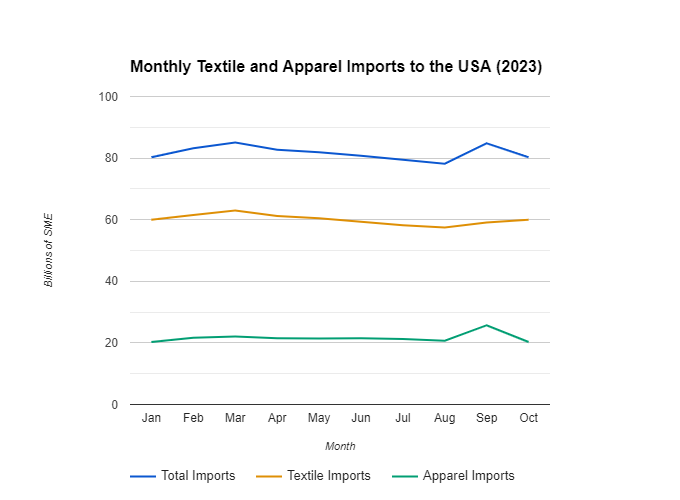
Textile and apparel imports into the United States saw another monthly decline in October, dropping 4.5% compared to September, according to data from the Office of Textiles and Apparel (OTEXA). However, a closer look reveals a more nuanced picture, with annual comparisons showing both gains and losses across different segments and source countries.
Overall Imports:
• While down from September, October imports were 2.8% higher than a year ago, totaling 8.03 billion square meter equivalents (SME).
• This discrepancy is driven by diverging trends within textiles and apparel:
• Textile imports edged up 0.1% for the month and a healthy 7.2% year-over-year, reaching 6.0 billion SME.
• Apparel imports, however, fell sharply, down 14.3% from September and 8.3% from the previous year, at 2.03 billion SME.
Year-to-Date and Ending-Year Trends:
• The year-to-date picture continues to paint a negative landscape, with total imports down 15.0% compared to the same period in 2022, at 78.9 billion SME.
• Similar disparities persist within textiles and apparel:Textile imports are down 11.2%, while apparel imports have taken a steeper 23.8% hit.
• The year ending in October shows an even sharper decline, with total imports down 17.0% to 91.9 million SME. Textiles see a 14.0% drop, while apparel's decline widens to 24.3%.
Source Country Spotlight:
• China remains the top source, though imports dipped 8.0% from September and are still down 19.6% year-over-year.
• India saw a surprising 11.0% monthly increase but remains down 9.7% annually.
• Vietnam and Turkey experienced moderate monthly declines but face larger annual setbacks of 16.5% and 3.1%, respectively.
• Interestingly, both Malaysia and Mexico posted significant monthly gains, with Malaysia imports surging 97.6% and Mexico jumping 32.8%. Egypt also saw a notable monthly spike of 177.7%.
Changing landscape of USA imports
These statistics reveal a complex and evolving textile and apparel import landscape. While the overall monthly decline suggests ongoing market headwinds, the annual and source-country data indicate pockets of resilience and even growth. The continued strength of textile imports compared to apparel suggests a potential shift in consumer preferences or supply chain dynamics. The strong showing of some source countries like Malaysia and Mexico further highlights the diversification of import patterns.
Coats Digital unleashes AI revolution in fashion supply chain
Coats Digital, a leading digital transformation partner for the fashion supply chain, has embraced the era of artificial intelligence (AI) with the launch of an innovative AI Assistant. Developed in just six weeks using Microsoft's Azure AI solutions, the AI Assistant introduces advanced natural language processing capabilities, allowing global customers to access information seamlessly across Coats Digital's solutions. Users can now pose natural language questions related to product documentation and training materials, enhancing the overall customer experience.
John Powell, Senior Director of Software Engineering at Coats Digital, emphasized the collaboration with Microsoft as a crucial step in tailoring AI solutions to the specific needs of the fashion sector. The AI-powered knowledge base, named Docs, has already proven its worth by providing instant, relevant responses to customer queries. Powell highlighted the ongoing AI revolution, foreseeing continuous innovation to benefit shop floor workers globally.
Coats Digital's AI Assistant has notably improved customer onboarding and navigation through the extensive database. Jonathan McCormack, Director of Software Engineering, highlighted its ability to understand user intent, delivering highly relevant results compared to traditional keyword searches. The AI tool has made Coats Digital's knowledge base more accessible and user-friendly, increasing engagement and unlocking previously underutilized resources.
Steve Ede, Director of Customer Support, underlined the AI Assistant's immediate benefits, making Docs the primary resource for customer inquiries. The overwhelmingly positive response has prompted Coats Digital to expand AI capabilities across the business, with plans to enhance internal experiences in production systems and sales channels. Eric Kalin, Chief Data Officer at Microsoft, praised the collaboration as a driver of real digital transformation in the fashion industry, envisioning a future where aligned technology collaborations become indispensable for growth.
Mango's massive global expansion: 500 new stores by 2026
Mango, the Spanish fashion giant, is set to make a formidable mark in global markets with plans to open 500 new stores by 2026, targeting key locations such as the United States, Canada, France, Italy, the United Kingdom, and India.
Aiming for record-breaking sales this year, the company anticipates a minimum 12% increase over 2022, exceeding 3 billion euros. This surge is attributed to the successful entry into the U.S. markets of Texas, Georgia, and California.
In a strategic move, Mango is doubling its presence in the United States, bouncing back after two previous unsuccessful attempts. Having already inaugurated 130 new stores and revamped 80 in 2023, Mango boasts a total of approximately 2,700 outlets across 115 markets.
As part of its expansion plan, the family-owned retailer is diversifying its board of directors by adding four independent members, notably including Marc Puig, chair of Spanish cosmetics group Puig, which owns renowned brands like Carolina Herrera and Paco Rabane. Mango, founded 40 years ago in Barcelona, is not only broadening its retail footprint but also reinforcing corporate governance by expanding its board to nine members.
Furthermore, Mango's Chief Executive, Toni Ruiz, has personally invested in the company, acquiring a 5% stake. This strategic move underscores the company's commitment to sustained growth and global prominence in the highly competitive fashion industry.
Surge in India's pre-owned luxury market defies global trends
In a surprising twist amidst global luxury market contractions, India witnesses a remarkable surge in pre-owned luxury sales, indicating a shift in consumer trends.
Luxepolis, with a burgeoning online user base of 3.5 million, reports an impressive 80% growth this year.
The durability and investment appeal of pre-owned watches, particularly Rolex, Omega, Cartier, IWC, and Panerai, contribute to sustained growth.
This resurgence signifies a paradigm shift, with pre-owned luxury becoming a sought-after trend among India's aspirational youth and expanding into untapped tier-II and tier-III markets.
Sri Lanka apparel export earnings decline by 12.68% in November: JAAF
In November 2023, Sri Lanka’s export earnings from the apparel sector declined by 12.68 per cent Y-o-Y to $371.17 million.
However, Sri Lanka apparel export earnings during the month reported a rise from $333.18 million in September and $330.95 million in October, indicating a potential turnaround, especially with the seasonal demand.
Provisional data by the Joint Apparel Association Forum (JAAF) shows, Sri Lanka’s export earnings from the United Kingdom surged by 19.7 per cent Y-o-Y to $48.34 million during the month.
On the other hand, exports earnings from key markets such as the United States dropped by 15.12 per cent Y-o-Y to $141.09 million, while from the EU, earnings declined by 7.18 per cent Y-o-Y to $126.62 million. Exports earnings from ‘other’ markets contracted by 2.87 per cent Y-o-Y to $55.07 million.
The largest decline in export earnings in the sector was seen from the United States markets, where export earnings declined by 23.81 per cent Y-o-Y to $1.63 billion.
Similarly, the EU and the United Kingdom markets reported a 17.81 percent Y-o-Y and 13.76 per cent Y-o-Y decline in export earnings to $1.26 billion and $572 million, respectively. Sri Lanka’s exports to ‘other’ markets contracted by 18.17 per cent Y-o-Y to $ 642 million.
Sri Lanka’s largest industrial export sector, apparel earned $ 5.95 billion in 2022. The sector employs around 300,000 people, most of whom are women.
Sri Lanka’s export earnings from textile and apparel sectors are expected to decrease by approximately one billion dollars this year, as per JAAF estimates.
Boycott calls from Gaza compel Zara to pull out advertising campaign
Boycott calls by pro-Palestine activists has forced fast fashion retailer Zara to pull out an advertising campaign featuring mannequins with missing limbs and statues wrapped in white, from the front page of its website and app.
Inspired by men’s tailoring from past centuries, the collection was launched by Zara on December 7. Its campaign photos depict a studio with ladders, packing materials, wooden crates and cranes, and assistants wearing overalls.
First featured on Zara's online store home page, the photos have been removed from both the brand’s website and also its app.
The move highlights consumers’ heightened sensitivity to international issues like the Israel-Gaza war.
Comprising six jackets, the collection is one of Zara's most expensive, priced from $229 for a grey wool blazer with chunky knit sleeves, to $799 for a studded leather jacket.
Lectra marks 50 years with industry 4.0 insight
Celebrating its 50th anniversary, tech solutions group Lectra released a white paper titled "Industry 4.0 Growth Increases Manufacturing Efficiency."
The paper, a collaboration with global experts, explores the impact of Industry 4.0 on sectors like fashion and automotive.
Lectra's Observatory, dedicated to tech and industrial innovations, aims to foster discussion and collaboration in the evolving landscape.
Emphasizing the shift towards circularity, agility, and fluidity, Lectra positions itself at the forefront of the fourth industrial revolution, providing insights and solutions for businesses navigating digital transformation.
MAAG faces disappointment as Zara's replacement in Russian retail
In a significant development in the Russian retail scene, MAAG, the Lebanese clothing brand that stepped in to fill the void left by Zara's departure, is facing widespread disappointment, according to a survey by the Union of Shopping Centers (STC). The study, reported by RIA Novosti, designates MAAG, owned by Dubai-based Fashion And More Management DMCC, as the "disappointment of the year" among Russian landlords.
Following the closure of Zara and other Inditex stores in Russia last year, MAAG took over their former locations in May. However, the survey reveals that MAAG stores have reported the poorest sales performance since their inauguration, drawing criticism from landlords. STC Vice President Pavel Lyulin, referring to the survey, highlights factors such as an inadequate product range, minimalist design, and ineffective advertising campaigns as contributors to MAAG's lackluster results.
The disappointment unfolds against the backdrop of changing dynamics in the Russian retail sector, where brands from Turkey, China, India, and other "friendly" nations have expanded their presence, replacing Western firms exiting due to Ukraine-related sanctions. MAAG's struggles underscore the intricacies of successfully replacing well-established international brands, especially in Russia's diverse and competitive market.
As MAAG grapples with the aftermath of the survey, the incident serves as a cautionary tale for businesses eyeing vacated market spaces, underscoring the importance of understanding local consumer preferences, implementing effective marketing strategies, and offering a compelling product range for a seamless transition and sustained success.
Indorama Ventures launches 100% recycled spandex
Indorama Ventures has launched ECOModa100, a 100 per cent recycled spandex to address the industry’s need for sustainable fashion.
Enhancing the environmental profile of garments, ECOModa100 also enables companies to create fully recycled fabric collections. The versatility of this spandex allows fashion brands to seamlessly integrate it into various apparel categories, from activewear to denim to everyday fashion. It allows global fashion brands to transition towards a net zero carbon future by creating a100 per cent recycled fabric collection.
A testament to the Indorama’s dedication to balancing style with environmental
responsibility, ECOModa100 makes the company’s the path to a fully sustainable fashion landscape clearer.











