FW
Value of Vietnam exports up 21%, new markets, products explored
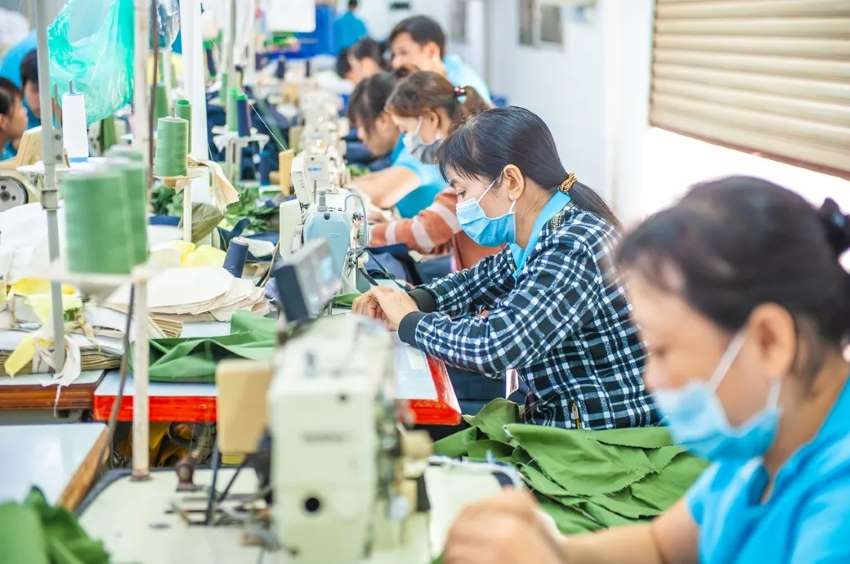
The value of Vietnam's textile and garment exports were up 21 per cent in the first nine months of 2022 over the same period last year.
The Vietnamese enterprises did not depend on the five traditional export markets, including the US, Europe, Japan, the Republic of Korea and China, but also expanded exports to Russia and some other countries.In Europe, they not only focused on a few large export markets such as Germany, France, Spain and the UK, as in the past, but also expanded exports to other countries in the EU.They also promoted the production of knitwear products for export instead of making only traditional products such as jeans, khakis or T-shirts.
Among textile and garment exporting countries in the world, Vietnam had the earliest opening-up policy for normal operation after the Covid pandemic. Therefore, in the first six months of the year, Vietnam's textile and garment industry had a large number of orders and good business results.
The textile and garment industry will be brighter in the first quarter of 2023 because the export tariffs on some of Vietnam’s textile and garment products to the EU market will be reduced thanks to the EU-Vietnam Free Trade Agreement (EVFTA).
US teens opt for Nike: Piper Sandler
Nike is the most popular clothing brand for American teens. So says Piper Sandler. Along with having endorsement deals with famous athletes and an extended contract with the NFL, Nike also sponsors young athletes from local leagues, clubs, and federations.
Nike, based in the US, is a leading maker of athletic footwear, apparel, equipment and accessories for a wide variety of sports and fitness activities. Nike’s strategy is based on its competitive advantages, including the strength of the brand, deep consumer connections and pipeline of innovative product.
Nike’s first quarter results set the foundation for another year of strong growth. The focus continues to be the consumer and action is being taken to navigate near-term dynamics while expanding long-term structural benefits through a Consumer Direct Acceleration strategy. For the first quarter Nike’s revenues were up four percent compared to the prior year. Sales were up eight percent. Gross margin decreased 220 basis points to 44 percent. Selling and administrative expense increased ten percent. Diluted earnings per share for the quarter were down 20 percent. The fall in gross margin was primarily driven by elevated freight and logistics costs, lower margins in Nike’s direct business driven by higher markdowns and unfavorable changes in net foreign currency exchange rates.
Indian textile and leather slip in IIP ranking
India’s textiles and leather industries are among the worst hit sectors as per the Index of Industrial Production (IIP) for August 2022.
The index of manufacture of textiles, wearing apparel and leather and related products recorded a double digit hit in this period. The manufacture of textile index fell to 105.5 in August 2022 from 120.2 in August 2021. The cumulative index also came down from 113.8 to 109.3. The industry has recorded a negative growth of 12.2 per cent in August and four per cent in April 2022 to August 2022.The apparel index slipped by 18.3 per cent to 117.7 in August 2022 from 144.1 in the corresponding period of last year.However, the cumulative index managed to register a growth of 26.6 per cent to reach 136.2 from 107.6 of August 2021.The index of leather and leather products fell by 15 per cent to 90.5 from 106.5 in the same month of last year. The cumulative index grew 1.7 per cent to 98.3 per cent from 96.7 per cent in August 2021.
IIP confirms the sluggish demand and pressure of prices on the textile value chain. Earlier, the Indian textile industry had faced a shortage of cotton and sky-rocketing prices. However, the demand was better than today. Currently, low demand from domestic as well as international markets is a critical challenge for the sector.
India: Raymond exports on the rise
Raymond is experiencing an increase in exports and is adding new overseas customers every month.
One of the country’s leading branded fabric manufacturers and fashion retailers went through a tough period during the pandemic and the resultant restrictions.
But after things opened up, it was able to improve its efficiency, which translated into good sales. Cost control initiatives helped improve overall performance. The company is looking forward to a good season ahead and is continuously focusing on product development. The shirting and suiting ranges are constantly evolving keeping customers in mind.
To attract new customers, new and younger looking products are being launched, especially apparel. The ratio between physical and online stores won’t change much in the coming days. At present, more than 90 per cent of Raymond stores are physical and will continue to be so in the near future.The strategy is to create the best product at the best price at the best locations. The strategy is to deliver customer delight. The company has entered the edtech segment, seeing this as avery good social objective, and has been opening schools. The hope is to have some 40,000 students in these schools by the next financial year.
Fast Retailing profit up 61, sales grow 7 per cent
Fast Retailing’s net profit for the latest year was up 61 per cent. Annual sales rose seven per cent. Fast Retailing owns Uniqlo, Theory and GU. Uniqlo Japan’s revenue was down two per cent and operating profit was up 0.6 per cent. Full-year same-store sales (including e-commerce) fell by three per cent year-on-year, but that was largely due to a weak first half. The second half was much more positive. Uniqlo International’s revenue was up rising 20 per cent and operating profit was up 42 per cent.
The Greater China region reported revenue up one percent but operating profit down 16 per cent. Uniqlo south and south east Asia and Oceania reported large increases in both revenue and profit. North America achieved a large increase in revenue and an operating profit margin just below ten per cent. Europe (excluding Russia) also saw a big revenue rise and a move to profits. But the company’s GU segment’s revenue was down one per cent and operating profit was down 17 per cent. Theory reported significant increases in revenue and profit thanks to a recovery in performance in both the United States and Japan. The label was able to successfully expand its customer base by offering comfortable, highly finished lightweight clothing and strategically expanding products with revised price lines.
UK’s Frasers acquires Australian brand Sneakerboy
Frasers has acquired Australian luxury footwear brand Sneakerboy.
The Sneakerboy concept store was at the cusp of the retail revolution. It was an online store with no stock, no cash, and no product to take home. All that was needed to make a purchase in the store was a smart phone. The rest of the available space was dedicated to the range of shoes, which meant Sneakerboy could boast a larger range of stock on a much smaller footprint.
Frasers will take on employee entitlements but will not take on additional liabilities of Sneakerboy. Sneakerboy has three remaining stores in Australia. From 2018 there were a few warning signs, pay was occasionally a tiny bit late, like a day late.Then over the years it would be one to two weeks late.
This acquisition further strengthens and diversifies the group’s luxury proposition, while securing the future of Sneakerboy and allowing the luxury footwear retailer to benefit from Frasers’ expertise in this sector. Frasers is a UK-based apparel and sportswear firm. Frasers operates businesses including Jack Wills, Flannels, USC and Sports Direct and also recently acquired N Brown, Studio Retail, Missguided and I Saw It First and has amassed stakes in both Hugo Boss and Mulberry.
India: Andhra spinning units on verge of closure
Many spinning mills in Andhra Pradesh may have to close down. Mills in the states were operating with 50 per cent capacity earlier but now they have decided to close them due to soaring operational costs. The main reason for this situation is sluggish demand and a fall in cotton prices. There are 125 textile mills in Andhra Pradesh with a combined capacity of 35 lakh spindles.
Not only Andhra Pradesh-based spinning mills but the entire industry in the country is facing similar challenges. The recent price fall in cotton and polyester fiber could not encourage the downstream industry which is facing a lack of confidence regarding future demand. Spinning mills in other states across India are running at reduced capacity. Mills are facing lower demand even for cheaper polyester yarn.
Garment importers in major markets of the developed world are facing sluggish buying at retail stores. Therefore, they are giving limited orders to exporters. These exporters are also facing problems regarding order cancellations, acceptance of export consignments by importers and payments from buyers. The Russia-Ukraine war has caused an energy crisis which has led to higher inflation across the world. The global economy was already weak due to Covid and is not able to bear the current economic shocks.
For $100 billion garment export, B’desh needs to explore multiple fronts
 2022 hasn’t been a year of cheer for Bangladesh and its apparel export business. The traditional importers of Bangladesh’s garment products have primarily been the US, Germany, the UK, Spain, France, Italy, the Netherlands, Canada, and Belgium. The pandemic and the ongoing economic crises looming across the Western world has affected the volume of Bangladesh’s export to the point the nation faces a foreign exchange reserve crisis.
Moreover, its focus on manufacturing and exporting cotton-fibre based garments may have given it an established market in the West, but now is stagnating due to lack of diversification. Bangladeshi manufacturers of RMG contribute around a fifth of its gross domestic product and 82% of its export earnings. The shrinking of demand from the West has become a grave concern.
Commenting on the current scenario in Bangladesh, Shahidullah Azim, vice president of the Bangladesh Garment Manufacturers and Exporters Association (BGMEA) said, “Most factories are getting orders of less than 30% of their capacity for the next winter season amid record inflation rates across Europe and the US. To cope with the ongoing turbulence on the global economic and political fronts, we have started looking for [nearer] destinations to export to." Bangladesh cannot afford to slack off and has to quickly reclaim lost grounds as it grapples with dangerously low foreign exchange reserves. Sheikh Haseena’s government recently applied for a USD 4.5 billion loan from the IMF to help bring down the risk of the kind of instability that has swamped its neighbors Sri Lanka and Pakistan.
Eastward bound
It was only the logical way forward for Bangladesh to realise it needed market diversification and the East offered less crisis-related issues than the currently beleaguered West. Azim said, "We are going to hold garment expositions in Japan and Korea individually in October this year to attract more retailers and brands from these countries." Bangladesh has been eyeing the tiny but lucrative Singaporean market where its garment exports have been nominal as it does not have the advantage of being an ASEAN member like fellow competitor Vietnam. However, since the end of 2021, Bangladesh and Singapore have been working towards an FTA which might add an advantage to the South Asian nation. However, the best deal so far has been China agreeing to raise duty-free access to 98% of goods imported from Bangladesh.
Diversifying beyond cotton
Product diversification seems the way out of this situation and Bangladesh is eagerly embracing working with man-made fibres to enable them to enter trending niches such as athleisure, sports apparel and technical-textile made garments. Kutubuddin Ahmed, chairman of Envoy Textiles said, “In view of the prevailing situation, we are now focusing more in research and development to produce more low-cost fabric and man-made fabric, as people's buying capacity is going down due to inflation. Such a switch could also help clothing makers deal with soaring input costs. Raw material prices have hiked, so we are thinking how we can make our production cost effective.”
Bangladesh knows the importance of exporting garments which yielded rich results for its economy and made it the poster boy of under-developed nations who are on their way to becoming developing nations. Tipu Munshi, Minister of Commerce explained, “We’re planning an export target of 80 billion US dollars by 2024 and 100 billion US dollars in 2026.”
YKK develops new Natulon zipper
YKK Corporation has developed the AquaGuard Natulon zipper, replacing the conventional water repellent AquaGuard zipper. The environmental-friendly Natulon has a tape made of recycled PET plastic and a fluorine-free water repellent.
The new product also improves the AquaGuard zipper’s opening/closing operability as well as its appearance.By using recycled PET for the tape, the Natulon zipper contributes to resource utilization and reduction of greenhouse gas emissions.
Furthermore, switching the main material used in the water repellent finish (film) to one that is fluorine-free also leads to improvement of the manufacturing process environment. This move also meets the tightening of organic fluorine compound usage regulations in Europe and elsewhere.YKK made improvements to the structure of zipper parts such as the chain and slider, improving the pin insertion and the sliding force when opening and closing the zipper.
Founded in Japan in 1934, YKK has continuously set industry standards for quality, innovation, and sustainability in the production of zippers, plastic hardware, hook and loop fasteners, webbing tapes, and snap and buttons. YKK solves the most complex fastening and attaching challenges and continues to pursue further functionality of its fastening products while promoting the development of products that are friendly to the environment and contribute to the achievement of a sustainable society.
US imports of industrial textiles hit two year high
Imports of industrial textiles by the United States in the second quarter of this year were the highest in more than two years.
The country’s imports of industrial textiles were valued at $2.941 billion in 2021.US imports of industrial textiles increased in the second quarter compared to $720.832 million in the first quarter of the current year. However, the imports witnessed a downtrend in the preceding quarters. They were at $752.101 million in the fourth quarter and $765.800 million in the third quarter of last year. The country imported industrial textiles worth $752.054 million in the second quarter of last year, crossing the $700 million mark for the first time in six quarters.The US had imported industrial textiles worth $2.941 billion in 2021, $2.302 billion in 2020 and $2.616 billion in 2019. Imports reached $1.793 billion in the first seven months of this year and the number stood at $265.270 million in July this year.
Industrial textiles comprises conveyor belts, drive belts, computer printer ribbon, printed circuit board and ropes and some other items made of fiber that are used for special purposes.Increased imports of industrial textiles show improvement in industrial activities in the world’s largest economy.