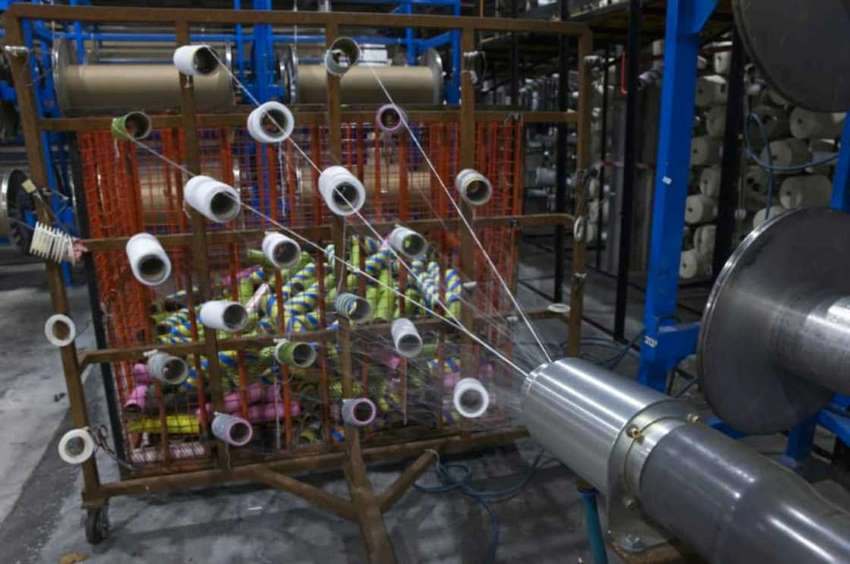
In 2017, of all new circular knitting machines , Asia received the highest share of shipments of 84 per cent, whereas global sales of electronic flat knitting machines soared by 44 per cent.
Global shipments of large circular knitting machines rose slightly by 0.12 percent. With 39 per cent of worldwide deliveries, China was the single largest investor. India and Vietnam rank second and third.
In 2017, worldwide shipments of shuttle-less looms increased by 12 per cent. The main destination of shipments of shuttle-less looms was Asia with 91 per cent of worldwide deliveries, of which 48 per cent were water-jet looms, 31 per cent rapier/projectile looms, and 28 per cent air-jet looms.
In the segment of fabrics continuous, shipments of mercerising-lines, singeing-lines, and stenters increased by 54 per cent, 11 per cent and two per cent. Deliveries in the other sub-segments decreased. In the segment fabrics discontinuous, shipments of air-jet dyeing and overflow dyeing machines increased by 35 per cent and 72 per cent respectively whereas those of jigger dyeing/ beam dyeing machines fell by seven per cent.
Global shipments of single heater draw-texturing spindles decreased by 87 per cent. Shipments of double heater draw-texturing spindles increased by 27 per cent.

- 1
- 2
- 3
- 4
- 5
- 6
- 7
- 8
- 9
- 10
Next-gen digital Indigo systems redefine textile manufacturing economics
The global textile sector is experiencing a structural shift as industrial-scale digital dyeing technologies replace traditional indigo vats in major... Read more
Fashion retail’s physical comeback, stores become experience hubs
Online shopping has permanently altered fashion consumption, making convenience, algorithmic recommendations, endless assortment and doorstep delivery standard expectations. Yet the... Read more
India reworks apparel export strategy as US tariffs squeeze margins
As tariff volatility, shorter retail buying cycles and aggressive price negotiations in the US expose weaknesses in the country’s traditional... Read more
MIT’s recyclable yarn could disrupt spandex’s grip on fashion
Stretch has become essential to modern fashion. Activewear, denim, underwear and athleisure all depend heavily on elastic fibres such as... Read more
Speed, synthetics and trade pacts propel Vietnam past Bangladesh
Vietnam has overtaken Bangladesh to become the world's second-largest exporter of ready-made garments (RMG), marking more than a symbolic change... Read more
The €2,150 Question: Can Europe afford circular fashion at scale?
Europe's push to build a circular textile economy is facing an uncomfortable commercial truth. The technology capable of producing virgin-quality... Read more
From cotton peaks to polyester pressures, textile supply chains face a reset
The assumption that textile supply chains can absorb periodic swings in cotton prices has become untenable. During the first seven... Read more
Global sourcing reset exposes India’s apparel competitiveness gap
The assumption that global apparel sourcing would naturally shift from China to India is proving increasingly misplaced. Fresh trade data... Read more
The new fashion equation, quality, agility and value replace speed and discounts
The traditional order that once separated low-cost fast fashion from premium luxury is steadily breaking down as consumers become more... Read more
AI goes invisible as fashion brands rewire design studios
The fashion industry's digital transformation is entering a new phase. After investing heavily in sophisticated 3D computer-aided design (CAD) platforms... Read more