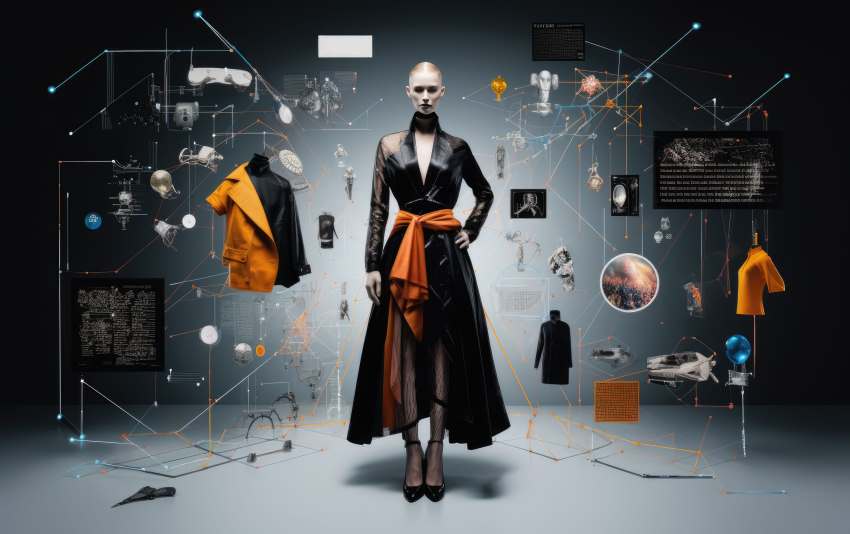
The fashion industry's digital transformation is entering a new phase. After investing heavily in sophisticated 3D computer-aided design (CAD) platforms over the past decade, leading apparel companies are quietly changing course. Instead of expecting designers to master complex software, brands are embedding generative artificial intelligence into product development workflows, allowing technology to operate largely in the background while designers focus on creativity.
The shift is more than a technology upgrade. It reflects an operational rethink in which digital tools are expected to adapt to human creativity rather than the other way around. As brands race to shorten product cycles and respond faster to volatile consumer demand, companies are discovering that removing technical barriers from the design process can generate greater commercial value than adding more software capabilities.
When technology slows innovation
Traditional 3D design platforms transformed fashion product development by reducing physical sampling and enabling digital visualization. However, as these systems became more sophisticated, they also became more demanding. Across several European apparel companies, internal assessments have shown that designers were often simplifying ideas during the creative process because translating complex concepts into detailed 3D models required considerable time and technical effort. Instead of expanding creative possibilities, software limitations were increasingly shaping design decisions.
This realization is prompting retailers to rethink their technology investments. Rather than purchasing advanced tools and training designers to fit predefined workflows, companies are redesigning their digital infrastructure around the creative process itself. Generative AI is increasingly being used to convert sketches, written prompts and rough concepts into detailed visual prototypes, allowing designers to spend less time navigating software interfaces and more time refining products. The result is a subtle but significant change in organizational priorities, from software proficiency to creative output.
AI shortens development cycles
The commercial implications extend well beyond design studios. According to the Business of Fashion-McKinsey State of Fashion report, generative AI could contribute between $150 billion and $275 billion in additional operating profits across the global apparel, fashion and luxury industries. Much of that value is expected to come from faster design iterations, automation and more efficient product development. Brands adopting AI-assisted workflows are now capable of generating thousands of visual design assets every month, dramatically expanding the number of concepts that can be evaluated before committing to production.
Perhaps the biggest operational gain lies in sample reduction. Predictive visualization technologies can accurately simulate how fabrics, textures, drapes and garment constructions will behave before physical prototypes are created. This enables material specialists and product developers to validate designs digitally, reducing dependence on multiple rounds of physical sampling. For retailers facing rising material costs and sustainability pressures, digital sampling can reduce prototype development expenses by as much as 60 per cent while simultaneously shortening product development timelines.
Business users become technology builders
Another notable trend emerging alongside generative AI is the democratization of software development inside fashion companies. Using natural-language programming techniques often referred to as ‘vibe coding’ designers, merchandisers and product developers are now creating their own lightweight digital tools without relying extensively on corporate IT departments. Instead of submitting software requests and waiting weeks for implementation, business teams can rapidly prototype workflow improvements using AI-assisted interfaces.
The operational impact is significant. Software enhancements that previously required around five weeks to develop can now be delivered in roughly two weeks. This allows retailers to update digital workflows continuously as consumer trends evolve, making technology infrastructure considerably more responsive to fast-changing fashion cycles. The approach also reduces dependence on centralized technology teams, giving creative departments greater autonomy over their day-to-day operations.
Measuring value beyond software
The emerging strategy highlights an important shift in how fashion companies evaluate technology investments. For years, competitive advantage was often associated with acquiring the most advanced design software.
However, retailers are finding that commercial success depends less on software sophistication and more on how seamlessly technology integrates into creative workflows. Instead of requiring designers to become technical specialists, AI systems are translating simple sketches and natural-language descriptions into production-ready digital assets. This reduces the steep learning curve traditionally associated with industrial 3D software while accelerating collaboration between designers, product developers and manufacturing teams. The competitive advantage therefore lies not in accumulating more technology, but in making technology virtually invisible.
A fast-growing market
The broader market reflects this shift.
Table: AI in fashion market
|
Aspect |
Market detail |
|
Current Market Value |
$2.47 bn |
|
Projected Market (by 2030) |
$9.45 bn |
|
Expected CAGR |
Nearly 40% |
|
Primary Investment Focus |
Brand-specific generative AI |
|
Business Objectives |
Faster design cycles, lower inventory costs, reduced sampling, and improved market responsiveness |
As investment grows, spending is gradually moving away from traditional CAD licensing toward proprietary AI platforms trained on each brand's own design language, product archives and consumer insights. These systems are expected to help retailers reduce inventory risk, respond more effectively to fluctuating raw material costs and compress concept-to-shelf timelines critical competitive advantages in an industry where speed increasingly determines profitability.
The next competitive edge
The evolution of fashion technology suggests that the industry's next competitive battleground will not be defined by the complexity of its software but by the simplicity of its user experience. Generative AI is shifting digital infrastructure from being a visible tool to becoming an invisible operating layer that enhances rather than interrupts creativity. As retailers continue to balance efficiency, sustainability and speed, the winners are likely to be those that allow designers to concentrate on imagination while intelligent systems quietly handle the technical complexity behind the scenes. In an increasingly AI-driven fashion ecosystem, creativity not software expertise is once again becoming the industry's most valuable asset.