VF Corp explores strategic options for denim business
VF Corp is exploring strategic options for its denim business that could include a sale or spinoff of its Lee and Wrangler jeans. Greensboro, N.C.-based VF, which also makes Vans shoes, generates over $2.5 billion in annual revenue. Its jeans business has been declining since big retailers including Walmart stock more of their own private label brands.
The company recently released its financial results for the first quarter of fiscal 2019. The company’s revenue from continuing operations increased 23 per cent to $2.8 billion; revenue from continuing operations increased 12 per cent excluding the revenue contribution from acquisitions.
Active segment revenue increased 25 per cent including a 35 per cent increase in Vans brand revenue; Outdoor segment revenue increased 6 percent including an 8 percent increase in The North Face brand revenue and a 6-percentage point revenue growth contribution from acquisitions.
Vietnam attracts $2.8 billion FDI in H1 2018
As per Vietnam Textile and Apparel Association (VITAS), Vietnam’s garment-textile lured $2.8 billion worth foreign direct investment (FDI) in the first half of this year, bringing the total FDI in the sector to nearly $17.5 billion. This has been mainly due to FTAs such as the CPTPP and the EU-Vietnam Free Trade Agreement (EVFTA) – although they are yet to come into force, which have created great attraction amongst foreign investors as they bring huge opportunities for Vietnam’s garment-textile sector.
The CPTPP will enable Vietnam to increase shipments to CPTPP member countries that spend up to $40 billion on garment and textile products every year. The EVFTA, expected to take effect at the end of this year, will also offer ample opportunities for Vietnamese textile and garment products to ship to the European market thanks to tariff preferences.
The EU is Vietnam’s second largest export market. Given the current tariffs ranging between 10 and 12 per cent which will be slashed to zero, it will boost Vietnam’s goods to this enormous market.
Indonesia targets Chinese textiles in US market
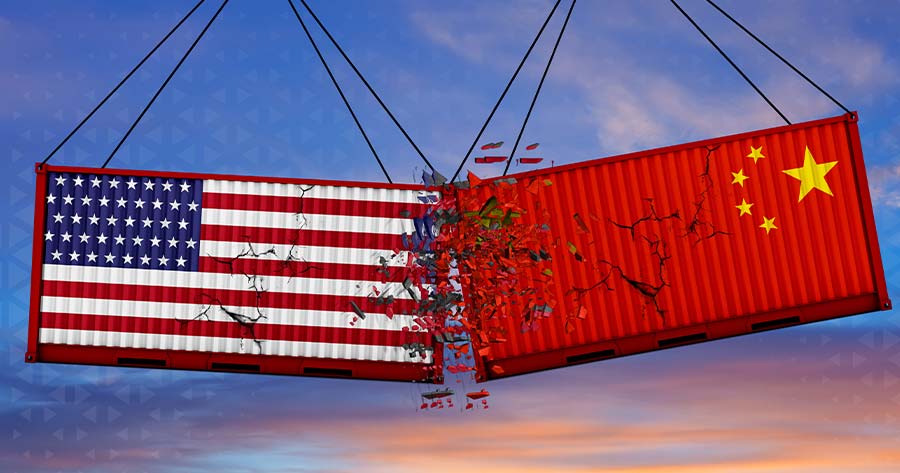
Indonesia is targeting a portion of the share of Chinese textile and textile products in the United States (US) market as the trade war situation escalates between the two countries. To achieve this target, the country plans to increase trade with the United States.
The increase in textile exports would be accompanied by imports of cotton from the US. Indonesia's market share of all textile and garment imports in the US is only around 4.5 per cent. Meanwhile, China which is in a trade war situation with the US has a market share of up to 26 per cent.
In addition to textiles, Indonesia also wants to take advantage of the US and Chinese trade wars to further increase trade in steel and aluminum products. Because, Indonesia's steel market share in the US is very small with a percentage of only 0.23 per cent. Therefore, the country has sought exclusion from increase in tariffs on imports of iron and aluminum products.
US cotton exports on the rise with growing global demand
US cotton exports reached their highest level since 2005-06 and are the second highest on record. China was the second largest destination for US cotton and served as the largest market for US pima. Demand for pima and upland cotton continues to grow as China pursues higher quality inputs and works domestic stocks down further.
US exports to Pakistan saw the largest year over year increase despite its larger domestic crop. The country’s yarn production continues to grow and is expected to expand into 2018-19, a promising sign for US export prospects. Shipments to Mexico and Turkey were down compared to the previous year, due to higher production in those countries.
Compared with last year, US cotton shipments expanded in four of the top five markets. Expanding use in Southeast and South Asia has underpinned significant US shipments. Vietnam continued for the third year as the top US market where shipments surpassed last year’s record, owing to the country’s record yarn production and robust yarn exports.
US exports are forecast down slightly the next year with exportable supplies lower in the United States and higher for the rest of the world excluding China. Nonetheless, 2018-19 US shipments are forecast to be the second-highest since 2005-06.
Sri Lanka emerges a pioneer in ethical fashion
Sri Lanka is South Asia’s pioneer in ethical fashion. For the Lankan apparel industry, sustainability is a much more complex ideology than simply increasing the number of green plants. It is an approach that converges social, environmental, and economic strategies where people, planet, and profit are all equally important.
Over the last decades, the Sri Lankan apparel industry ensured its growth through sustainability; firstly, through better working conditions, then engaging professionalism with business and empowering people at all levels.
Environmental sustainability move kicked off around 12 years ago with the implementation of green building standards and the energy efficiency drive. Today, the Sri Lankan apparel industry seeks to find solutions at the global level to address problems of material circularity and work-life integration. The overall long-term strategy is to drive towards zero impact on all aspects. Buildings and infrastructure do play a big role but they are a part of the bigger strategy.
Female workers have long been celebrated and encouraged by the country’s apparel industry. Most companies believe that strengthening women is as good as strengthening a family unit and therefore the entire society. The country has been working on developing its own sustainability index for factories that overcome the weaknesses of most traditional assessment systems.
Pakistan’s textile exports up nine per cent in first 11 months of this fiscal
Pakistan’s textile exports contributed more than 50 per cent to the country’s total exports during the last fiscal year. The country’s textile exports rose 9.82 per cent in the first eleven months of the current fiscal year. In May, total exports were up a staggering 32.4 per cent year on year but they were marginally up 0.52 per cent month on month. The country’s total exports rose 15.3 per cent in the July-May period.
Cotton yarn exports in May increased 41.3 per cent year on year, knitwear exports rose 39.2 per cent, bed wear exports surged 27.9 per cent, readymade garment exports climbed 23.99 per cent while cotton cloth exports were up 22.08 per cent over the same month a year earlier.
However, Pakistan's competitors have set targets for textile exports while Pakistan remains far behind. The country is only getting spillover orders and that would stop coming once competitors increase their capacity. Restoration of competitiveness of the export-led industry is a must to regain the lost share in the international marketplace.
The currency lost around 14 per cent since December last year following the depreciation against the dollar. Exporters say an enabling environment would aid in a surge of exports.
Pakistan complains of raw deal from China on trade agreement
For all its bonhomie with China, Pakistan has no proper free trade agreement. There is one but Pakistan feels it needs to be revised. Pakistan’s exporters have to struggle to make their presence felt in China because their competitors enjoy zero-rated tax.
Even India in comparison to Pakistan has better trade relations with China. Pakistan exporters lose their competitive edge because of Asean which has a very strong FTA with China. Its products are taxed at a lower rate than Pakistan’s. Therefore, a huge chunk of Pakistan’s textile exporters are forced to export raw material to Asean member countries like Vietnam, which exports finished goods to China. Exports through this channel are less costly and competitive in Chinese markets.
Instead of exporting raw material in the form of cotton and yarn, Pakistan wants to export finished and value-added goods. Pakistan ranks 16 on the list of China’s export partners while it stands at 61 in its import partners. Even countries like Kenya are ahead of Pakistan in the exporters’ list. Pakistan’s imports from China are $18 billion while exports are a meager two billion dollars. This tilts the balance in favor of China by a massive margin.
EU’s apparel and textile exports to the US up 15 per cent
From January to June 2018, the EU’s exports of textile and clothing products grew 15.12 per cent year on year. Of all textile and clothing products, earnings from readymade garments were up 16.26 per cent while earnings from other textile products were up 14 per cent.
Italy was the top exporter from the EU to the US. Italy’s earnings from exports of readymade garments to the US were up 19.18 per cent year on year. The country had a 50 per cent share in total US imports from the EU. Italy clearly got advantage of its luxury fashion products which drew US buyers’ attention all through the period. Italy’s earnings from other textile products in the US market such as yarns, fabrics and fiber were up 16.77 per cent.
Portugal’s earnings from readymade garment exports to the US grew 22.80 per cent on a year on basis. France’s earnings from the US noted a double-digit surge of 14.67 per cent year on year. Earnings for Romania, an underrated export source, from apparel exports to the US registered a 14 per cent yearly growth. If the US and Europe agree on eliminating tariffs between the two regions, imports from the EU would attract no duties, making European apparels cheaper for US buyers.
India: Cotton bales specification to be included under BIS Act, 2016
The Union textiles ministry has approved a proposal to include the Indian Standard Cotton Bales Specification IS 12171:201 3, under Mandatory Conformity Assessment Scheme under Bureau of Indian Standards (BIS) Act, 2016. Accordingly, a draft Cotton Bales (Quality Control) Order, 2018 has been proposed which includes confirmation of cotton bales to IS 12171:2013 and bearing the standard mark under a licence from the Bureau of Indian Standards as per Scheme-II of Schedule II of BIS Conformity Assessment Regulations, 2018.
The Bureau of Indian Standards shall be the certifying and enforcing authority along with an officer who will hold the rank of General Manager, District Industries Center in Department of Industries of the state government, who shall be the enforcing authority. Any person who contravenes the provisions shall be punishable under the provisions of the Bureau of Indian Standards Act, 2016.
CAITME 2018, UzTextile Expo 2018 to be held concurrently in Uzbekistan
Iteca Exhibitions the International Exhibition Company and recently established Uzbekistan Textile and Garment Industries Association had, in April 2018, signed an MoU for joint organisation of 1st International Uzbek Textile and Fashion Industries Exhibition-UzTextile Expo in Tashkent from September 5 to 7, 2018.
The International Central Asian Exhibition CAITME 2018 will also be organised on the same dates with the new project. It will host the German National Pavilion, Spanish National Pavilion, large expositions of Italian, Turkish, Chinese, Indian, Swiss South Korean textile machinery manufacturers, totalling over 400 well-known companies and brands.
The vast business program will also include Tashkent International Textile Conference dedicated to development of the textile industry, the roundtables, B2B and B2G sessions, exhibitors’ presentations, etc. The Uzbekistan Textile and Garment Industries Association will contribute to the joint event through a special governmental decision and state support measures.
The partnership will attract professional buyers of environmentally friendly Made in Uzbekistan textile products, foreign investments, new technologies to Uzbekistan, as well as will bring up trade relations to a new level. The event will demonstrate the latest achievements and innovations of the textile business and fashion industry of Uzbek and world leading manufacturers along the entire production chain - from yarn to ready-made clothing.
More...
Wool supply and prices could be hit by Australian drought
As per experts, the ongoing drought in wool growing regions of Australia is likely to hit supply and prices. Figures from the Bureau of Meteorology indicate the second-driest autumn in Southern Australia with rainfall 57mm (2.24in) below average. In July, less than 10mm of rain was recorded in New South Wales, prime farming territory, and ongoing dry conditions are forecast to continue.
This week, 23 per cent of New South Wales was classed as being in intense drought, while the rest was in drought or drought affected. The state produces around 25 per cent of Australia’s agricultural output. Other parts of Australia also suffered, with over half of Queensland being in drought and some areas of Victoria and South Australia also seeing dry conditions.
Around 50 per cent of Pakistan’s exports generated by APTMA
As per All Pakistan Textile Mills Association (APTMA), it contributes more than 50 per cent to the country's exports, i.e. over $11 billion out total annual exports of $23 billion as on 2017-18. APTMA is the premier textile industry association representing members from corporate sector and manufacturing and export of textile and clothing products
The spokesperson stated the textile industry has a potential of adding another $24 billion to exports on a fast track subject to positive policy initiatives. Various non-textile exports also pass through the hands of APTMA members. He stressed the burgeoning gap of trade deficit can only be met through devising an export-led growth policy. Therefore, those advocating for the support of domestic industry are not well wishers of the country as well as the government, as restoration of competitiveness of export-led industry is a must to regain the lost share in the international marketplace.
Already, the anti-export approach witnessed a decline of country's exports from $35 billion to $20 billion in 2016-17. Unfortunately, certain vested interests have started campaign against exporting industry, generating forex, direct and indirect employment besides backward and forward linkages.
Turkey’s textile machine imports fall in the first six months of 2018
Turkey imported 1,100 circular knitting machines in the first six months of 2018. Compared to last year, volume fell from 1,132 circular knitting machines and the value also dropped. The decline in imports was driven by overvaluation of foreign exchange rates and high interest rates.
China tops the list of the countries that exported circular knitting machines to Turkey (391 machines). The cost of these machines was valued at 11.4 million dollars. Last year, China stood second with 270 circular knitting machines at 8.4 million dollars.
Germany holds the second position with 290 circular knitting machines worth 21.5 million dollars. With 369 machines at 26.2 million dollars in 2017, Germany witnessed drops in both volume and value in the current fiscal.
Countries like Italy, Japan, Taiwan, South Korea saw major decline in machinery exports to Turkey. However, against these, the UK exported 165 circular knitting machines valued at 0.71 million dollars while last year the volume was just eleven machines worth 0.49 million dollars.
Turkey is one of the world's leading manufacturers of knitted fabrics. As Turkey’s textile exports grow, the country’s textile manufacturing companies will have to upgrade their machinery, parts and components, as well as the manufacturing processes.
RIL partners Arvind to make high performance fabrics
Reliance Industries (RIL), as a part of RIL’s Hub Excellence Partners (HEP) Program, has partnered Arvind to manufacture co-branded R|Elan™ high performance fabrics. As a part of this partnership, Arvind will provide a high standard quality fabric and RIL will ensure timely delivery of R|Elan™ high-quality performance technologies to Arvind.
The co-branding effort re-affirms the brand’s vision to offer aesthetically pleasing, technologically advanced and, sustainable products. The R|Elan™ co-branding exercise will bolster RIL’s foothold in Rs 225,000- 250,000 crore Indian apparel industry having almost equal share of menswear and womenswear. RIL is also in the process of adopting a B-2-B-2-C approach under its Hub Excellence Programme (HEP) in which it is set to forge partnerships with textile manufacturers to provide technology for the manufacture of high performance fabrics under RElan.
RIL has partnered 32 textile players that are equipped to produce New Age fabrics using R|Elan™ technologies, it said.