Americans want more plus size options
Customers in the US looking for plus sized clothing are often disappointed. For one not too many brands make clothing above size 16. And even if they do they don’t present the entire wardrobe. Some may make only T-shirts and not pants.
The reality is that there’s money to be made in catering to overweight people especially women. It makes business sense for designers to expand their size offerings since there’s a large market of people who would like to dress themselves in interesting clothes and in new fashions and ethical materials.
Plus size clothing sales represented around 17.5 per cent of all women’s clothing sales in the US in 2016. Plus size fashion is here to stay and has already conquered the hearts and budgets of many in the apparel industry. Spending on this niche is on the rise and so are the opportunities for retailers wanting to tap into the 46 billion dollar opportunity. E-commerce contributes to the growth of plus size fashion primarily because of ease of access, size availability and convenience that it provides. While one size does not fit all, and standard sizes for all is one of the major challenges to the segment, personalization is further leading to the success of many brands.
Alpaca fiber market on a growth curve
The alpaca fiber market is witnessing high growth mainly due to the upsurge in demand for alpaca fiber fleeces and other types of fashion accessories made with alpaca fiber. Alpaca clothing is warm, soft and extremely comfortable. Alpaca fiber is witnessing a greater demand over wool in the textile industry being a natural fiber that provides more warmth minus the scratchy texture of wool.
As the trend of offering highly sustainable and eco-friendly garments and accessories is gaining popularity, alpaca fiber market is growing at a rapid pace with the surging demand for warm and soft alpaca fiber.
While the alpaca fiber market is expanding at an impressive growth rate, market players are aiming at producing alpaca fiber with even better quality to attract more consumers. As high genetic merits can lead to producing large quantities of high-quality alpaca fiber, manufacturers in the alpaca fiber market are putting efforts into providing nutritious feed to alpacas. Nutrition makes a significant impact on the health and reproduction capabilities of alpacas and ultimately helps obtain softer and high-quality alpaca fiber. Leading manufacturers and distributors in the alpaca fiber market are investing heftily in alpaca nutrition in order to be able to offer the finest quality of alpaca fiber and gain a competitive edge in the alpaca fiber market.
Adidas creates new age sneaker
Adidas has made Futurecraft.Loop, a performance running shoe out of thermoplastic polyurethane. It is 100 per cent recyclable. The technology allows the entire shoe to be ground up, melted back into raw material, and used for new products. Like most running sneakers, the shoe is a jumble of textures. It has a knit upper that looks and feels like woven polyester, except in spots where it turns into a more rigid material to provide support. The midsole is fused pellets, resembling styrofoam. A stabilizing torsion bar in the midsole is a hard, molded plastic, while the outsole is tough but flexible. The laces replicate the look of cloth, and the insole has a knit pattern on the top but a material like pressed plastic pellets on the underside.
Today, the average performance running sneaker uses 12 to 15 different materials. That material mix is part of the reason a running shoe can’t be easily recycled. The materials would all have to be separated, or one might contaminate the recycling process of another. It’s not even possible to separate certain fiber blends, and some items, such as cotton, can’t yet be recycled without a substantial loss in quality.
The challenge of making a running shoe from a single polymer is that it needs to replicate the functions and performance of all those other materials replaced. That’s what Adidas has done on the Futurecraft.Loop.
Global textile market expanding at four per cent
The global textile market is expanding at a CAGR of 4.24 per cent. Population growth, rising disposable income levels, and rapid urbanization in developing countries like China, India, and Mexico are likely to boost product demand. Moreover, an increasing number of supermarkets and retail outlets in these countries is expected to drive the demand further.
Development of technical textiles that offer protection against high temperatures, electric arc flash discharge, molten metal impact, and acid environment is estimated to fuel the textile market growth. Therefore, the growing personal protective equipment market is expected to drive demand for textile products.
Middle East and Africa are projected to witness a revenue growth of 4.19 per cent from 2019 to 2025 owing to constant product innovations in the apparels application segment. Asia Pacific is expected to register the highest CAGR during the forecast years. Cotton is the most widely used raw material in the global textile industry owing to its excellent durability and resistance to dust mite and hypoallergenic property. In terms of volume, polyester held a market share of 28.04 per cent in 2018 and will grow further owing to its properties such as high strength and excellent shrink resistance.
Qatar fashion show next week, to feature an Indian pavilion
The Heya Arabian Fashion Exhibition will be held in Qatar from April 26 to 30, 2019. It will feature over 250 brands from 11 countries and include 20 fashion shows. Participating countries will include Oman, Kuwait, Lebanon, Morocco, China, Belgium, and England. The show provides an enriching event for lovers of Arabian fashion, whether designers, shoppers or businesswomen.
The Heya Arabian Fashion Exhibition will feature an Indian pavilion to promote Indian designers. Three Indian designers will take part. Suneet Varma will make his Qatar debut. Varma will also partake in workshops talks throughout the event on fashion, textiles, and sustainability. Pero, 3 Clothing, and SR will showcase their latest collections.
Sales of apparel at many outlets in Qatar, especially those in value retail, remain strong. Apart from citizens, shoppers from Kuwait and Oman buy shirts, blouses, undershirts, shorts, and pants. Ramadan is known as a peak period for clothing retailers. Qatar Summer Festival features a variety of entertainment activities for all ages and attractive promotions and discounts at malls and other shopping destinations. Shop Qatar Design District brings a colorful showcase of local and international pop-up shops, cafes, fashion shows, workshops, master classes as well as engaging design dialogue, all under one roof.
Smart manufacturing is the answer
Any country whose exports comprise mainly manufactured goods would do well to think of smart manufacturing. At the heart of smart manufacturing lies a smart factory which is equipped with a fully connected fluid system that can use artificial intelligence and data from connected operations and production systems to learn and adapt to new information. That results in faster manufacturing operations with less human intervention and more precision.
Automated workflows, synchronization of assets and optimised energy consumption in smart factory can increase yield, uptime and quality while reducing costs and waste. These smart factories will utilise multiple digital and physical technologies including digital twin, digital design, additive manufacturing machines and autonomous robots. It is this kind of technology that will drive production processes in the not so distant future. In fact, companies in wide-ranging industries from apparel to automotive manufacturing are already building smart factories.
Bangladesh and Vietnam have already made it a part of their long term industrial policies and companies are investing heavily for strategic benefits. Vietnamese corporations estimate spending heavily on digitisation and automation with the next five years and these potential investments may be significantly larger than global estimates. The expected benefits of investing in Industry 4.0 by Vietnam’s workforce include improvement in operational efficiency and improved access to customers through integration and digitisation of value chains.
Levi Strauss Q1 revenue up seven per cent
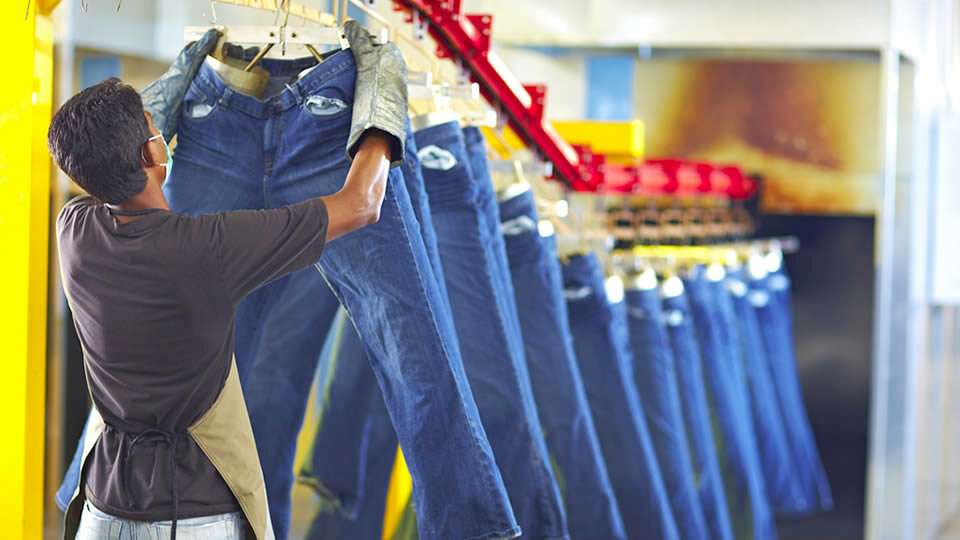
Levi Strauss net revenue for the first quarter globally grew seven per cent. Revenue growth from brick-and-mortar stores was 11 per cent, reflecting positive comp performance of existing stores as well as ongoing expansion of the company’s store network internationally, while e-commerce grew 24 per cent. Direct to consumer grew 14 per cent for the quarter in total, and has now grown double-digits for 12 consecutive quarters. Direct to consumer includes the brick-and-mortar stores and e-commerce sites that Levi Strauss operates.
Levi Strauss is taking the opportunity as a newly publicly traded company to breathe fresh life into its brands and approach to business. The new chapter the company is writing is being driven by changes in retail-consumer relationship and the push to expand its reach to new customers in new ways. A key strategy is to become a leading world-class omnichannel retailer. Another vital strategy is to diversify the business by expanding more into tops and women’s under-penetrated markets. Levi’s women’s business grew 18 per cent in the first quarter.
When the company discovered the main reason shoppers left stores without buying anything was because they couldn’t find their size or color, it implemented an RFID system to help better track inventory and keep its stock up to date.
Global home textile market grows at three per cent
The worldwide market for home textiles is expected to grow at a CAGR of 3.1 per cent over the next five years. Home textile is a flexible woven material consisting of a network of natural or artificial fibers often referred to as thread or yarn. Home textiles include terry towels, bed sheets, curtains, pillows cases, rugs, carpets etc used for home furnishings. Bedding is the largest segment of home textiles with a production value market share of 38 per cent.
Developing economies such as China and India are major home textile exporters while the US and Europe are major importers of home textiles. China is the largest supplier of home textiles, with a production value market share of nearly 29 per cent and sales revenue market share of nearly 23 per cent. North America has a production value market share of 20 per cent and sales revenue market share of 30 per cent. Europe enjoys a 16 per cent production value market share and 28 per cent sales revenue market share.
In the next few years, the home textile industry will be a steady energetic industry. It presents a lot of opportunities and there will more companies entering this industry, especially in developing countries.
ITMA holds denim event
Itema Italy hosted a Denim Day. The day was dedicated to trends and challenges throughout the denim sector, with a special focus on how to meet sustainable perspectives by presenting and introducing new business models and innovations. The event provided an unique opportunity to share ideas, experiences and best practices. It represented an exclusive and rare occasion for the industry to enter into a fertile and sparkling debate involving all actors of the denim supply chain. The event shed light on the most recent green innovations through a market and customer-oriented approach. The whole supply chain was the center of a lively debate which highlighted the connections between ethics and business, the most recent product and process innovations, key technologies, as well as a survey of digitalisation in the value chain for the textile sector.
The event also highlighted the most recent rapier, airjet and projectile weaving innovations designed and developed by Itema exclusively for denim fabrics. Innovations presented by Itema, tailored and customized for denim production, attracted great interest from denim mills delegates attending the event, impressed by the considerable cost-saving, user-friendliness and unparalleled innovative content of the Itema looms.
Itema is a provider of advanced weaving solutions, including weaving machines, spare parts and integrated services.
Finland-based Infinited Fiber makes fiber from textile waste
Infinited Fiber, based in Finland, has produced a strong, sustainable fiber from textile waste. The company is currently running a 50-ton pilot plant and plans to increase the annual capacity of next generation sustainable textile fiber production up to 500 tons in order to meet the growing demand from the market.
Besides cotton rich textile waste, Infinited Fiber manufacturing process can use most material containing cellulose, e.g. recycled paper, cardboard, and agricultural waste such as straw. The reborn fiber will be the same. Properties of the Infinited Fiber include a natural soft look and feel, consistent proven quality, 30 per cent to 40 per cent better color uptake than competing fibers. It’s antibacterial and bio-degradable and has excellent moisture absorption qualities. In addition, it has a total cost competitiveness in the textile production supply chain. The reborn Infinited Fiber is re-usable forever, carbon neutral and applicable like natural cotton without any microplastics harming the environment.
The business model of IFC is to license the Infinited Fiber technology for global fiber producers in textile and non-woven industries. End-use applications include fashion, disposable personal care products (e.g. wipes, diapers, pads) and technical products (e.g. automotive filters, dairy, construction applications). The production process is protected by several patents in key market areas.
More...
China offers Pakistan duty free
Pakistan is about to sign the second phase free trade agreement with China. China has agreed to allow Pakistan to export 313 items duty-free. Pakistan and China will also sign several MoUs and agreements to enhance bilateral cooperation in diverse areas. The China-Pakistan Economic Corridor is one of the largest projects under the Belt and Road Initiative and nearly 50 per cent of the project has been completed since 2014. China is helping Pakistan's spinning mills become more cost efficient and competitive. China also wants to relocate its textile units to Pakistan to benefit from Pakistan’s low paid and well-experienced textile labor.
Pakistan’s major exports to China are cotton yarn, chemical material, crude vegetable material, rice, raw hides and skins, fish and fish preparations. Major imports are machinery and spare parts, manufactured fertilizer, yarn and thread of synthetic fiber, iron and steel, chemical materials and products, vegetable and synthetic textile fiber, road vehicles and their parts, non-ferrous metals, tires and tubes of rubber etc.
Meanwhile, Pakistan’s economy is going through a difficult period, with the country’s foreign exchange reserves falling. Economic growth is expected to slump to 3.9 per cent in fiscal 2019 down from 5.2 per cent in 2018.
Block chain and fashion go together
Apart from consumer education about issues like waste, transparency and toxins in the fashion industry, technology also plays an important role in solving problems related to sustainability.
Block chain has a role in sustainable fashion. When collecting textile waste from consumers, block chain sits right in between because it gives trust and transparency without being owned by any specific brands or organizations. This tech can be used to promote good production processes. Tracing the supply chain through block chain will support traceability and accountability. Ultimately, it will lead to a supply chain that embraces good practices.
Circular economy is a legitimate economic concept. Because this has gained ground, the job of a designer in the fashion world also needs to evolve. The role of the designer is changing. They are no longer just selecting the fabric and making designs but need to know every step of production, including disposal. Smart innovation speaks to the new generation of consumers and enables the circular economy because millennial shoppers are willing to pay more for a sustainable product.
In its current form the fashion industry is a toxic industry. There are toxins in the clothes that we wear. There is a relationship between the increased use of synthetics in fabrics and a rise in serious illnesses such as breast cancer.
Shri Ravinder Kumar Passi elevated as new chairman of EPCH
 Shri Ravinder Kumar Passi, Vice-Chairman-EPCH has been elevated as new Chairman of Export Promotion Council for Handicrafts (EPCH) during 164th meeting of Committee of Administration (COA) held on today informed Shri Rakesh Kumar, Director General – EPCH. Shri Passi has taken charge from Shri O.P. Prahladka. All members of Committee of Administration were present during the meeting.
Shri Kumar further said that Shri Ravinder Kumar Passi, representing M/S R.K. Arts, New Delhi is a leading handicrafts exporter from Northern region since last 26 years. He is associated with Export Promotion Council for Handicrafts (EPCH) since its inception and has served EPCH as its Chairman during 2001 and 2002.
He is very actively involved in various trade bodies. Shri Passi has also been the Co-Chairman of National Centre for Design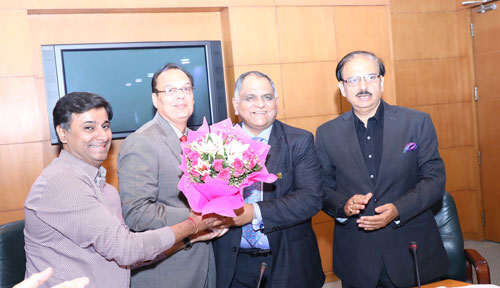 and Product Development [NCDPD] for many years.
Shri Passi expressed his gratitude to members of Committee of Administration of EPCH after taking over as Chairman of Export Promotion Council for Handicrafts, an apex organization for promotion of Exports of Handicrafts from the Country.
The exports of Handicrafts have shown an increase from Rs. 23029.36 crores (2017-18) to Rs. 26590.25 crores during the year 2018-19 [prov.] Showing an increase of 15.46% % over previous year. Shri Passi further said that in order to sustain this growth, the international marketing initiatives, cluster development projects, design and product development, new policy initiatives are needed to be pursued more vigorously.
Spring edition of IHGF-DELHI fair be held in April 2020
 Shri Rakesh Kumar, Director General – EPCH informed that the dates of Spring edition of IHGF-Delhi Fair have been shifted from February to 15 – 19 April, 2020.
Shri Kumar stated the reasons behind shifting of dates of Spring edition of IHGF-Delhi Fair by elaborating that after conclusion of IHGF-Delhi Fair Spring 2019, the Council carried out a survey amongst exhibitors and buyers so as to take their feedback to consider shifting the show dates from February to April i.e. before China and Hong Kong fairs and found that 90% of the participants of this edition of the show expressed that dates should be shifted to April. Another reason for shifting dates cited was to give proper time to manufactures to prepare and develop new products lines to encourage buyers to visit the show in April enroute their way to the shows in China and Hong Kong. Shri Kumar informed that EPCH availed the opportunity of availability of buyers from more than 50 countries who are in India to source their requirement from Home Expo India being held at India Expo Centre & Mart and exhibitors as well to share and popularize the new dates of IHGF-Delhi Fair Spring to be held from 15 – 19 April, 2020.
As EPCH is an apex organisation of handicrafts exporters, the feedback received from the members was to be welcomed so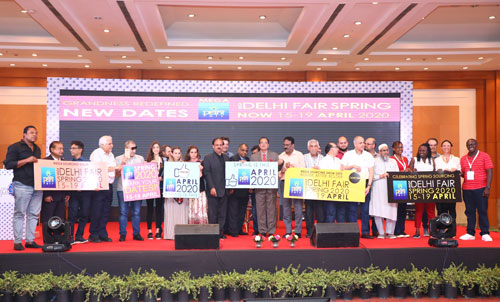 accordingly Members of the Committee of Administration have took the decision to shift the dates of Spring edition of IHGF-Delhi Fair from February to 15 – 19 April, 2020.
Shri Kumar elaborated that EPCH had been organising Spring edition of Indian Handicrafts & Gifts Fair 1994. The first edition of this fair was held in January, 1994 at Pragati Maidan, New Delhi with 313 exhibitors in an area of 5500 sq. mtrs. at Pragati Maidan with visit of 515 buyers. From 2006 onwards the fair is being held at state-of-the art exhibition centre i.e. India Expo Cenre & Mart, Greater Noida. The Indian Handicrafts & Gifts Fair was revamped and renamed as IHGF-Delhi fair with bigger, bolder and for five days during in 2014.
Spring edition of the show have registered fast growth in terms of exhibitors, display area, visit of buyers and generation of business enquiries. The fair which was started with display area of 5500 sq. mtrs. in 1994 has acquired 1,90,000 sq. mtrs in February, 2019 with 3189 exhibitors with visit of 6737 buyers and business enquiries of Rs. 2900 crores.
Shri Kumar hoped that with new dates of the show from 15 – 19 April, 2020 more buyers would be able to visit the show before going to attend fairs in China and Hong thereby enhancing business enquiries and earning of foreign exchange for the Country.